

https://commons.wikimedia.org/wiki/File:Incendios_de_2022_%28Our%C3%A9m%29.jpg
Human-induced climate change made the extreme fire weather that fuelled the recent destructive wildfires at least twice as likely in France and at least 20 times more likely in Spain, according to a new World Weather Attribution (WWA) study.
The severe wildfires which have burned across France and Spain, and which now are affecting Greece, have destroyed thousands of homes and have forced more than 300,000 to flee before the flames. Major tourist areas and cities such as Madrid and Bordeaux were threatened with the destruction, though they were not themselves evacuated. The report noted, ‘In France, the fires originated near the Atlantic coast on 22 and 23 July but have since spread inland, becoming particularly destructive in the Gironde department around Bordeaux. The Gironde fire has so far burned approximately 40,000 ha, the second largest area of land devastated by a single wildfire in France since the Second World War
At least 240 homes have been destroyed, with many more damaged, while around 220,000 residents and tourists were evacuated as the fires continue to threaten forests, highly touristic and iconic areas, as well as sensitive economic activities and surrounding communities.’
High temperatures are forecasted for the next few days in both countries, potentially worsening fire conditions and these fires have been described as some of the worst ever in their countries, with 140,000 hectares burned in Spain in July and 115,000 in France since the beginning of the year.
The researchers from the WWA did not use climate models for this recent study, instead they analysed historical weather observations to see how fire-prone weather conditions have changed over time and used the Daily Severity Rating (DSR) to examine the difficulties in suppressing the fires once they had started. To understand the changes in the risk of extreme wildfires, scientists compared this year’s fire weather conditions to the maximum fire weather conditions recorded in previous summers (June-August), within a comparable 7-day window. They then analysed trends in observed data, and compared today’s climate with simulations of a pre-industrial climate.
Dr. Clair Barnes, Research Associate in Extreme Weather and Climate Change at the Centre for Environmental Policy, Imperial College London said: “What we’re seeing in France and Spain isn’t just bad luck, it is a clear sign of the escalating impacts of anthropogenic warming. A wet winter, followed by this intensely dry summer and a succession of heatwaves, has left forests loaded with dry fuel, and relentless heat – fuelled by human-caused climate change – has created the conditions for sparks to take hold and become massive, dangerous wildfires.
She continued, “We’ve seen repeatedly how climate change increases hot, dry, flammable conditions that are extremely conducive to wildfires. What’s unique about this case is that it’s still early in the season – and with another heatwave looming, these findings are extremely scary.
These aren’t fires burning in remote areas, they are happening in close proximity to where people live. Every fraction of a degree of warming pushes us into unknown territory, and these fires show exactly what that risk looks like.”
Climate is shifting faster than governments are acting
Dr. Friederike Otto, Professor of Climate Science at the Centre for Environmental Policy, Imperial College London added: “Our studies time and again show how Europe’s climate is shifting faster than governments are adapting. Last year we documented the Iberian fires; more recently, our research showed how climate change is worsening drought across the continent. Now we’re seeing yet another disaster fueled by the same driver: the burning of fossil fuels.
“Science doesn’t care whether this year follows record fires, whether governments are prepared, if winter rain was adequate, or if this is coming at the back of several heatwaves that exhausted resources and the population. Climate change means that the right combination of weather conditions that create a tinderbox and turn it into a disaster happens much more often.”
Compounding climate risks
As well as risk to life, property and infrastructure- wildfires also carry with them the threat of impacting air quality, presenting an additional health risk.
Wildfire smoke contains high levels of particulate matter, as well as carbon monoxide, carbon dioxide, nitrogen oxides, ozone, volatile organic compounds (such as formaldehyde and benzene), lead, and other toxic and irritating substances, creating significant respiratory and cardiovascular health risks.
In Spain, nearly 100,000 people were confined to their homes because of the air quality. On the other hand, France released FFP2 masks for the first time to pharmacies for vulnerable populations during the ambient air pollution episode.
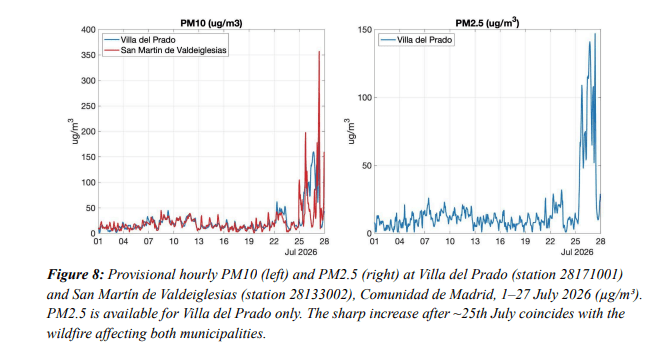
Augustin Colette, Head of Unit at the French National Institute for Industrial Environment and Risks said: “The extreme fire events occurring at the wildland-urban interface sparked devastation and released massive amounts of air pollutants in the atmosphere. The smoke from the fire plumes increased particulate matter peak levels up to 20 times above what is considered “fair air quality” for PM2.5 in Europe, and extremely poor air quality was felt up to 400 km away from the fires.
“These extensive wildfires and subsequent air pollution outbursts will bear upon a population already hard hit by several weeks of heat waves. This summer 2026 sequence of compounding climate risks should be an eye opener for the upcoming adaptation challenges and motivate ambitious climate action.”
‘Dante’s Inferno’
The report made clear that severe fire weather is here to stay and with conditions increasing, more needs to be done to reduce risk exposure.
‘Severe fire weather is no longer rare under today’s climate. As the likelihood of these compound fire weather conditions continues to increase, reducing wildfire risk will require not only effective fire suppression and cross-border coordination, but also greater emphasis on prevention through risk-sensitive landscape planning and management (e.g., increasing species diversity) and reducing exposure.’
This point was repeated by the European Commissioner for Equality, Preparedness and Crisis Management, speaking to Channel 4 on the 30th July. She said the wildfires ravaging Europe were now being described as “Dante’s Inferno”, warning that climate change was reshaping the continent’s disaster landscape. ‘We need really to have the lessons learned because climate change is really reshaping our landscape and we need to adapt and anticipate what is becoming the new norm.
The solutions are clear
Simon Stiell, UN Climate Change Executive Secretary, added: “These mega-fires show how fast climate-driven extreme heat and dry landscapes can turn wildfires into devastating national disasters – forcing mass evacuations, destroying homes, businesses and vital infrastructure, driving huge additional carbon emissions, and harming human health, as dangerous smoke spreads far beyond the firelines.
Humanity continuing to burn colossal amounts of coal, oil and gas is baking our planet, making these conditions more dangerous, and these megafires more deadly and destructive.
But the solutions are equally clear: all countries must move faster from fossil fuels to renewables and protect people from worsening climate impacts, from wildfires, to megastorms and floods, to droughts hitting food production.”
.


