-
Review of ‘The Problem With Plastic: How We Can Save Ourselves and Our Planet Before It’s Too Late’ by Judith Enck and Adam Mahoney
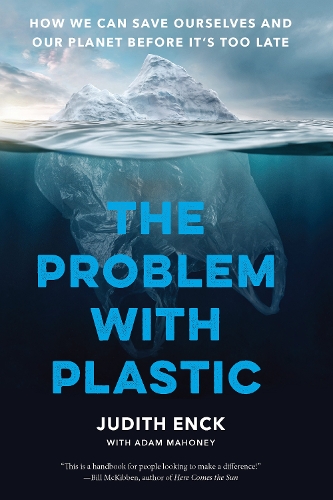
Plastic pollution and contamination sadly seems to be so ingrained into our environment that yet another book on the issue appears to be superfluous. That being said, Enck and Mahoney peel back the veneer of company ‘plastic-washing’ and false promises to challenge the dominant and overwhelming narrative from the plastics industry (read fossil-fuel industry) that if individuals were just better at recycling, then the problem would be solved.
They make the early point that despite plastics being a relatively new invention, they have colonised the world, making us overly-dependent and addicted to their use. ‘What began as a marvel of modern science has been woven so tightly into the fabric of our lives that imagining a world without it seems impossible.’
Humans once lived in a world without plastic and this seems hard to fathom now. ‘In just seventy- five years, plastic has cradled our planet in a synthetic embrace.’ Enck and Mahoney address the systemic issues at the core of the plastic crisis and explore the links to environmental injustices, using repeated examples of neighbourhoods and communities blighted by plastic pollution, with attendant increased health risks. They call out big business as being a knowing actor in the ‘plastic racism’ and argue that short-term profits are more of a priority to these companies than real solutions to reduce the production of plastic. ‘Despite the mounting evidence against the plastics industry, those in charge continue to double down on false solutions, successfully misleading the public and hindering real progress.’
No place untouched by plastic
Enck and Mahoney remind the reader that, ‘Today, there isn’t a place on Earth untouched by plastic.’ From plastic bags deep in the Mariana Trench to plastic pollution on the slopes of Mount Everest, to inside the human body with microplastics and nanoplastics, the contamination is everywhere, with the tap of production not even close to being shut off. For an industry that is not older than the oldest person alive today, this shocking impact on our world is the worst of achievements. ‘Half of all the plastic ever created has been around only since 2007’
The authors make the point that massive production of plastic will thwart and dwarf the best efforts of recycling, or even ‘chemical recycling’, which continues to stand at less than 10% globally. The same fossil-fuel playbook of hoping for a technological ‘magic bullet’ solution, which will allow production to continue and profits to prosper, has been successfully used by the plastic industry and it is this that the authors want us to be alerted about. This should be no surprise as the vast majority of plastics are made from fossil fuels and it is the same industry pushing both products.‘Plastics are made from fossil fuels and chemicals. The world’s biggest oil and gas companies are also the biggest plastic producers.’ … ‘In less than a century, plastic has changed the world. In 1950, the world produced just 2 million tons of plastic. It now produces over 450 million tons per year.’
‘With microplastics seemingly everywhere—in the air, water, and food we consume—it’s easy to feel overwhelmed.’
Against this industrial plastic behemoth, it can feel that our efforts and voices are insignificant and that it is easier to not challenge their narrative, however Enck and Mahoney argue that this is far from the case, and that the plastic edifice is beginning to crumble. They highlight communities where local protests have successfully repelled fracking industries, incinerators and landfill operators. ‘Most people experience plastic in passing as a brief relationship with a throwaway item. The bulk of the consequences, though, are saddled upon the local communities where plastic is fracked, cracked, dumped, and burned: from the Indigenous, to the free towns, to the poor working class. In short, plastic kills. Yet organized resistance to plastic is spreading across the globe.’ It appears that it is the communities which are threatened the most which are standing up the most against the polluters, but they need the help of powerful, unafraid governments, which are not content with solutions that ‘skim the surface’, but which apply rigorous regulation to industry. ‘As with traditional landfills, incinerators and toxic ash landfills are overwhelmingly located in low-income and minority communities where residents bear the brunt of the health and environmental impacts from plastic pollution.’
The authors call for meaningful and significant change to phase out this plastic pollution.
‘Meaningful changes that significantly reduce plastic production and waste must occur on a vast scale, one that matches the current volume of plastic produced and consumed…Achieving such large-scale change requires the introduction of new laws that compel industries to take actions they have otherwise failed to initiate on their own.’
The authors make the repeated point in ‘The Problem with Plastic’ that,
‘If the science is clear and the damage so severe, why hasn’t the crisis been meaningfully addressed?’
A cleaner, healthier future is in our hands
In order to achieve this cleaner and healthier future, Enck and Mahoney powerfully argue for a two-pronged attack- one which is government led and one which is consumer led. They urge that meaningful choices for customers away from plastics cannot happen magically on its own and need the helping hand of a necessary Big Government. The current unrealistic self-policing practices of the plastics (fossil-fuel) industry must come to an end.
‘Governments must implement strict regulations to curb plastic production, enforce transparency in corporate sustainability claims, and eliminate subsidies for plastic production under the guise of recycling innovation. And we, as consumers, must be empowered with better choices, clearer labeling, and access to plastic-free alternatives that are genuinely sustainable. The petrochemical industry will continue pushing misleading solutions unless there is strong pushback from communities, policymakers, and environmental advocates.’
The authors close by reminding us that profound transformation is possible and that inventions, although they can’t be ‘un-invented’, can be refined (!), improved upon and in many cases, left behind, as more sustainable, efficient and safe options become widely accessible.
‘Yet this is no natural catastrophe; it is human-made, and that means it can be unmade. Plastic pollution, climate change, and environmental injustices are not inevitable; they are the results of choices made by businesses, governments, and, to a lesser extent, you and me.’
The path forward to save ourselves and our planet from this plastic juggernaut will likely not be an easy one. It is reliant on individuals moving away from convenience to choice, from being fettered to plastics to freedom, and from apathy to action. When held against the healthy vision of the world, just over the horizon, this surely is a price worth paying.
‘The way forward is daunting but not impossible. It requires courage, persistence, and a shared vision of what the world can be.’
-
Review of ‘The Nature of Pandemics: Why Protecting Biodiversity is Key to Human Survival’ by Jake M. Robinson

Robinson’s latest book, The Nature of Pandemics could not have come at a more timely moment, as hospital admissions of flu patients in the UK rose by 55% in one week owing to a winter ‘super flu’.
Robinson explores what lessons have been learned from the Covid-19 global pandemic and warns that a proactive approach to the next Disease X is far more sensible than a reaction which might come too late.
This book repeatedly urges for action and awareness when it comes to emerging diseases and strongly warns about the dangers of the deadly duo of apathy and ignorance. As Robinson notes, ‘Complacency is the breeding ground for disease. Where vigilance falters, contagions thrive.’
The Nature of Pandemics begins by looking to the past for clues and lessons, noting the incredible bravery of the villagers of Eyam, Derbyshire in 1665, who, through their actions, taught the future about containment. ‘Exploring the annals of past pandemics can help illuminate the path ahead, casting light on future outbreaks.’ Robinson begins the book by ensuring that his readers are clear on the various terms of pandemics, outbreaks and epidemics, especially in the modern world, where they are often used interchangeably by the general public.
Throughout the text, he convincingly argues for a ‘One Heath’ approach and mindset- an approach which ‘acknowledges that the health of humans, non-human animals and our environment are inseparably linked.’ He cautions that finger-pointing and blame do not by themselves offer solutions and can oftentimes hide the solutions, if the closeness between humans, non-humans and the environment is not well understood. ‘Yet pointing the finger at wildlife for pandemics is off track. It’s a misguided heuristic that overlooks the complexity of diseases, ecosystems and human antics. It’s also a way to keep solutions buried in a grave of misconception.’
When we push nature to its limits, nature pushes back.
Dilution, diversity and amplification effects are all explored in the text, with human behaviour placed under the microscope. Robinson argues that global movement of people can create a convenient mode of transport for pathogens. ‘Millions of people cross oceans and borders each year. As we do, we provide a comfy vehicle for pathogens.’ The change in land-use, from practices such as deforestation, and also a lack of awareness on the importance of soil, can allow for the evolution, emergence and mutation of diseases.
‘Over 30% of new diseases reported since 1960 can be attributed to deforestation and land-use changes. Closeness is an issue. By changing the land, we increase human-wildlife contact.’ Throughout the book then, Robinson argues that spillover events can not be described as ‘accidents’, but are a predictable outcome from the closeness between species and the pressure of conditions that this can bring. ‘Spillovers don’t just happen. They’re a consequence of fractured ecosystems and close interactions between humans and other organisms. ‘When we push nature to its limits, nature pushes back.’
Disease X- It’s Coming
‘The Nature of Pandemics’ should not be read as an ‘alarmist’ or ‘doomist’ text- instead it rationally outlines the likelihood of global pandemics and the emergence of ‘new’ or ‘old’ diseases that are flourishing in our world, sometimes through political inaction, or through the dangers of antimicrobial resistance. ‘Disease X symbolises the perpetual race against new and evolving pathogens. It’s an ongoing struggle to keep pace with microbial evolution- a relentless drive for survival.’ Disease X itself is simply a term used to represent the next unknown pathogen that could cause a severe pathogen that could cause a severe pandemic, so to some extent, we are both preparing for a ‘known unknown’ as well as an ‘unknown unknown.’ At present, the statistics warn that another event like COVID-19 is coming.
‘The current likelihood of experiencing another COVID-19-like event in one’s lifetime is 38%, a figure that may double in the coming decades due to increasing rates of disease emergence.’
What was particularly refreshing about Robinson’s arguments was that he did not shy away from highlighting that pandemics, such as bird flu, within non-human species are already happening at an alarming rate. Treating the ‘non-human animal kingdom’, in a medical sense as well through vaccinations, to ensure positive health could help bring stability to linked species and food webs.
A critical crossroads
In order to ‘stay ahead of the curve’ then, Robinson suggests that re-building the connection to the natural world could be seen as a public health intervention. He argues that, ‘It’s clear that our relationship with the natural world is at a critical crossroads.’ He highlights examples of nature regeneration, green prescriptions, community level work that together sow the necessary seeds of change that can help address the looming and current threats. ‘In a world facing a double burden of disease, from contagious outbreaks to chronic illnesses, reconnecting with the natural world may offer a powerful form of relief.’
As per his other books, Robinson challenges us to shift our mindsets and arrogance about our place in the ‘animal kingdom’ and begins to suggest that our relationship with nature should be heading towards a symbiotic relationship where all parties mutually benefit. He writes, ‘We must recognise that the health of our planet and its inhabitants is inextricably linked to our actions.’
Pandemics happen. They exist. They have existed and they will exist. They are a part of our world. We need to learn how to stop them from being our world. The Nature of Pandemics by Robinson, charts this course for us.
-
Review of ‘Life on a Little- Known Planet’ by Elizabeth Kolbert

Kolbert, the Pulitzer Prize winning author, has gathered for her readers 17 celebratory articles from the last 20 years of her writing career, to highlight and inspire others working for a better climate today and tomorrow.
With devastating climate events happening daily around the world, articles on issues from ten years or over, may seem out-dated to some readers. The lesson here, however, is to acknowledge the journey towards climate action, that sometimes has happened slowly and other times has been revolutionary in nature. Many of the essays draw our focus towards solutions and how the impact of an individual’s work on conserving, communicating, rewilding and protecting our precious world and ecosystems, can motivate and inspire local communities to work together.
Kolbert reminds her readers that, ‘We live in an extraordinary time’ and that the alarming pace of climate decline we witness in the modern world, is a rare occurrence in the planet’s history and one which we are in danger of pushing past a point of no return. ‘But over the last four billion years, only very rarely has change rushed along at the pace it is moving today.’ Rising global carbon emissions and the resulting need for decarbonisation can become political footballs, which can delay helpful technologies which may play a part such as carbon dioxide removal initiatives. Kolbert is quick to note the challenges that need to be surmounted before any of these programmes could be feasible at large scale and suggests instead that these efforts may simply be a distraction from the need to turn the curve of global emissions back down to the steady and stable levels of the past.
Kolbert notes, ‘The amount of CO₂ in the air now is probably greater than it’s been at any time since the mid- Pliocene, three and a half million years ago, when there was a lot less ice at the poles and sea levels were sixty feet higher.’
‘Life on a Little- Known Planet’ is not by any means, a ‘doomist’ text. Instead, it profiles dedicatedindividuals, including more famous names like James Hansen and Christiana Figueres, one of the architects of the Paris Agreement, along with their experiences and expert views.
It also focuses on the efforts of individuals around the world, who have a strong sense of place and connection with their environments. The moral and legal question of whether the natural world should have rights, is evaluated by Kolbert and is found to exist throughout human history. ‘From a certain point of view, granting nature a say isn’t radical or new at all. For most of history, people saw themselves as dependent on their surroundings, and “rivers, trees and land” enjoyed the last word.’
Witnessing how both our local and global environments are changing, transforming and collapsing, reminds us of what we are in danger of losing. Writers like Kolbert have been sounding the climate alarm for over 20 years now and this is brought into sharp relief when we read her prescient articles dating back to 2005.
When languages die out; when ecosystems die out; when insect colonies die out; we are not just in danger of losing connections, species and interconnected worlds- which we are still touching the surface of- no, instead, we are in danger of losing ourselves and our relationship with our world. How we respond to the climate crisis as the defining challenge of our times, means that we have to move beyond words, treaties and pledges. We need a response which is rooted in gratitude.
The Earth is not a capitalist commodity.
It is our home.
-
Review of ‘Clearing the Air’ by Hannah Ritchie

‘Climate change- and the energy, materials and food systems that drive it- is a massive but solvable problem.’
It is not often that we find a climate book that is openly honest, factual and optimistic about where we are in ‘one of the biggest challenges that humanity faces’. Ritchie structures this book into a question- answer format which makes the writing accessible, while at the same time, objective and factual. Her 50 questions are divided into 10 sections covering issues ranging from food, carbon removal, heating, electric cars, renewable energy and more. Every section has clear action points which are necessary to bring about the change that is needed. Her objective, data based clarity approach makes her writing compelling and her arguments convincing. She argues that ‘We are not only capable of solving climate change but also poised to create a better future for ourselves in the process. To do that, we first need to understand that it’s possible.’
Ritchie repeats that aiming for ‘perfect solutionism’ is a pathway doomed to failure. She argues, like many others, that we should not ‘let perfect be the enemy of good. ‘Another problem is that we seem to be stuck in something I call ‘perfect solutionism’. People seem to expect solutions to climate change that have no downsides…Unfortunately, perfect climate solutions don’t exist.’ She challenges what this search for a ‘perfect solution’ actually means: ‘We also need to recognise where a search for perfection will leave us: in a much hotter world, still hooked on fossil fuels, with millions still dying from air pollution.’
‘It won’t be straightforward, but it will be worth it.’
Ritchie begins by tackling some of the oft-repeated questions that seek to delay climate action. Some of these will now be summarised here, owing to the quantity of times we have seen these arguments. ‘Isn’t it too late? Aren’t we headed for a 5 or 6℃ warmer world?’
Ritchie tackles this question head on and deals with it by highlighting how much progress we have made from the early scenarios that suggested these higher global temperatures. She urges honesty in these discussions, in order that the public do not lose trust in the messages from climate scientists. Her succinct answer is that, ‘Every tenth of a degree matters. There’s no point at which it’s too late to limit warming and reduce damage from climate change.’
Attention is then turned to the issues of polarisation, or apparent political divides and support for climate action. Ritchie argues that the data indicates that ‘more people care about climate change than you think’ and that views on this are skewed by the preferred media that is consumed. She points to survey findings which indicate that the public welcome climate policy action. ‘A survey of 59,000 people across 63 countries found that 86% thought that humans were causing climate change and that it was a serious threat to humanity.’ Ritchie urges that talking to real people about climate issues and actions, such as installing solar panels or choosing to drive an electric car, can really make a local difference. When communities work together and people talk to each other, solutions can be found which then drive further innovation. ‘Systemic change is driven by culture and public sentiment, and how we all think and talk about climate solutions shapes that culture.’
Why should my country act when others are not acting?
Ritchie also explores the ‘1%’ argument when she poses the question, ‘My country only emits 1% of the world’s emissions; surely it’s too small to make a difference?’ She highlights two factors here when this is used as an excuse not to act; one, that ‘the world’s ‘small emitters’ make up more than one-third of the world’s emissions, enough to significantly turn the dial’ and secondly the moral argument of understanding the importance of historical emissions and not just emissions now. ‘There is also a strong moral argument for why countries like the UK should care, even if their emissions today are not a big piece of the pie. The UK emits just 0.9% of emissions, but if we add up all its historical emissions, it accounts for 4.5%.’ Countries like the USA historically have emitted around 24%, but the spotlight is rarely focused on them, but rather the climate scapegoat of China.
Ritchie does focus on China and answers the question, ‘Aren’t our efforts pointless if China’s emissions keep growing?’
She acknowledges China’s position now, but also highlights its climate leadership position, when she argues that the data demonstrates that, ‘China is the world’s largest emitter but it’s rolling out renewables and electric vehicles at breakneck speed.
China is rolling out solar and wind at a staggering rate. In a single year, it builds enough solar and wind to power the entire UK. In 2023, it installed more solar power than the US had in its entire history.’
She makes the point that, ‘[r]elying on others is a geopolitical liability’, one which was demonstrated only too well in the UK, when the impact of Russia’s invasion of Ukraine was felt in electricity prices. Her point is that solar and wind energy are free in every country, although some countries may make decisions on their energy needs depending on their geography and local conditions.
The future is there, waiting for us to take it. Or, rather, build it.
‘Clearing the Air’ continues in this analytical approach, outlining the facts around electric cars, the energy needs from the food industry, heating and cooling and nuclear power- the ‘big topics’ of climate discussions and policy. Throughout, Ritchie stresses what the data indicates, which heightens the optimistic possibility of what can be achieved.
‘Getting our emissions to zero- while providing a good life for billions of people- is one of the biggest challenges that humanity faces. It’s possible to do it, and there are very few technical constraints in our way, but that doesn’t mean it’ll be easy.’
Ritchie finally urges us to understand and appreciate that a mindset shift will help enormously. We accept that society has changed in the past- oftentimes very quickly, but oddly, we find it difficult to project this understanding into future events.
‘We accept that changes have happened in the past but are sceptical that tomorrow, next year or the next decade will be much different.’
It can be difficult, when living in a transitional moment, to recognise that change is happening and that attitudes are shifting. But looking back to how much progress we have made to reduce emissions and to negate high emission pathways, demonstrates that significant progress has been made.
The journey has already started.
Where it ends, is up to us.
-
Review of ‘Here Comes The Sun’ by Bill McKibben
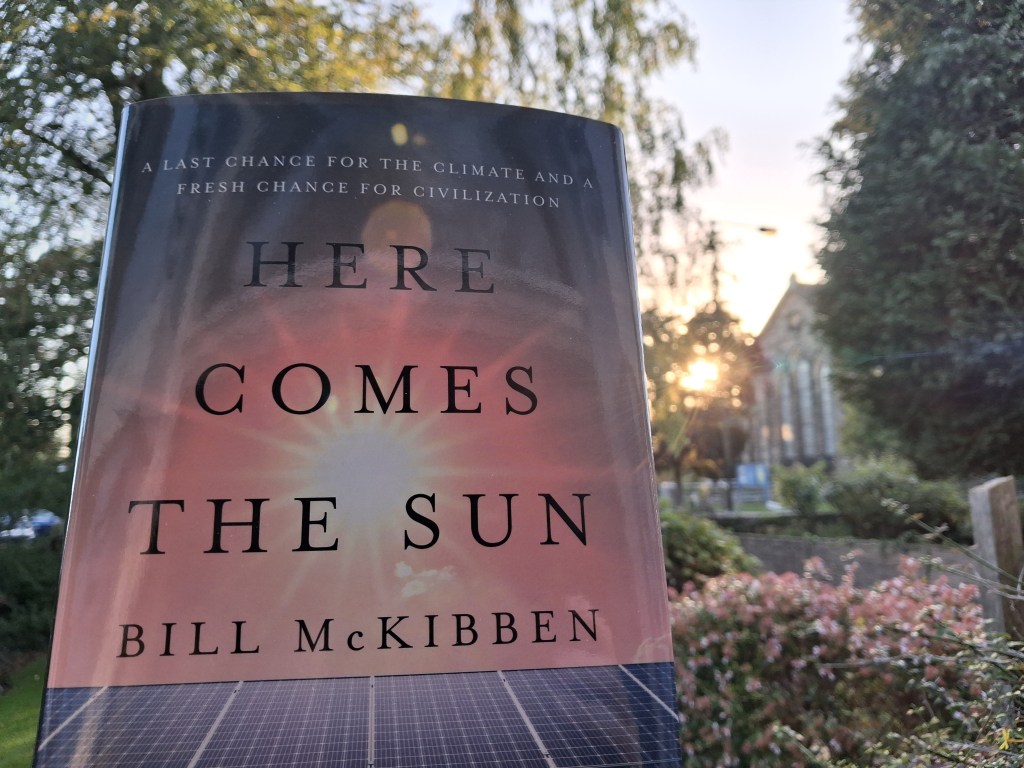
Bill McKibben’s ‘Here Comes The Sun: A Last Chance for the Climate and a Fresh Chance for Civilization’ is a book which throughout highlights the transformative revolution of solar power and which revels in the ability for countries around the world to see past the short-term interests of the fossil fuel industry- desperately clinging on to its profits- to see and build a new world. ‘ And yet, right now, really for the first time, I can see a path forward. A path lit by the sun.’
McKibben admits that the task between now and 2030- a scant 5 years away- is difficult, but also reminds us that there are no longer technical or financial obstacles in the way. ‘…[W]e must cut greenhouse gas emissions in half before the decade is out. That target is on the bleeding edge of the technically possible, and this book is an effort to shove us toward that deadline.’
This is a book which hopes to re-ignite our connection with our sun. McKibben reminds us that, ‘We were all sun worshippers once.’, with the hope that metaphorically, we can be again. He argues passionately that we have an opportunity, a chance in this moment, which is not to be missed- which cannot be missed. ‘Our species, at what feels like a very dark moment, can take a giant leap into the light. Of the sun.’
The revolutionary idea of this book is that it is past time when we should break the habit of burning things. In more poetic terms, the Fires of Isengard have already spread…’and all that was once green and good this world will be gone.’ McKibben notes that changing and converting the economy is as important as changing our power supply. He also highlights that Big Oil will be a difficult hydra to slay. ‘Big Oil will do almost anything to stay in the burning business, because their reserves of oil and gas are currency worth tens of trillions of dollars.’ He hammers this point home effectively arguing that ‘… fossil fuel is going all out to make sure it doesn’t happen. In fact, the entire point of the industry by this point in its history is to make sure we keep burning something. It’s desperate, as we shall see, to slow down this switch by any means necessary.’
As a result of their rapacious extractive measures, McKibben describes the state of humans on the planet through the medical metaphor of being in the ER. ‘We’re very much in the ER- that’s what all those statistics about the jet stream and the bleaching of the Great Barrier Reef mean.’ He highlights the ecological systems around the world which are becoming critically threatened- ‘There are only so many really huge and vital systems on the planet, and now all of them seem to be in some sort of violent flux.’ Global records continue to be shattered by the world that has been forged and created by Big Oil, but McKibben outlines that even though they have tried hard to steer us off course- and despite their best efforts- solar power has undergone one of the most revolutionary successful transformations ever seen.
McKibben effectively reminds us of the many many solar technologies and projects taking off around the world- from Spain and Germany, to Ecuador, to China and to Australia and Pakistan. He points out that many of these revolutions tend not to gain the global attention which they deserve, because they are simply not in the West, calling us out accurately on our ideologies. ‘One reason we’ve missed some of that revolution is because so much of it is taking place in China, and we’re used to thinking that anything important must happen in the West.’
As a result of these extraordinary breakthroughs, McKibben is energised (terrible accidental word- pun) and encouraged to power through our dependency on the fossil fuel industry. ‘Before our decade is out, we have to break the back of the fossil fuel system. We have to land the sun on the earth.’ He ends Section 1 of the book with the alarming comment, ‘It would be unthinkable not to figure this out.’
As the book progresses, McKibben frankly ridicules the arguments trotted out by stooges for the fossil fuel industry- arguments solely designed to slow down the transition away from their product. He first ridicules the ‘Can we afford it?’ argument. ‘Of course we can afford it- the sheer fact that we’re merrily building out terrawatt after terrawatt of solar and wind power is more or less proof that it’s becoming affordable.’
He urges us to consider what the cost implications and ramifications would be if we continued on the fossil fuel path- citing that the insurance industry is already acting to protect its interests by not offering climate cover. ‘First, though, let’s reflect for a moment on what it would cost us to do nothing- that is, to continue lurching slowly through a haphazard transition off fossil fuels that happens too slowly to really arrest climate change.’ McKibben notes that the supply and demand pathway is one which works against capitalism- ‘because energy from the sun and wind is so plentiful and cheap, it can’t make as much profit for investors as oil and gas, which are scarce and dear.’
Throughout, he advises that ‘Emergencies demand urgency’ and that ‘[W]e need to do this now; we can’t afford another miss.’ He asks the very simple questions of what are the obstacles to this solar and wind transformation; who are the players acting against this revolution; and why are they behaving like this. It’s not a land coverage issue, it’s not a battery storage issue, it’s not a recycling of parts issue, it’s an enslavement to the fossil fuel industry issue and we have the power to break those bonds. Dependency on fossil fuel is dead. There’s no reason not to embrace the solar revolution.
McKibben asks us all to turn our faces to the sun once more in wonder and build a world ‘where we no longer set things on fire, but rely instead on the great fire out there in space. A world where we can turn to our star.’
He ends the book exhilarated about the possibilities lying ahead of us and exhorts us all to seize fire from the Gods once more.
‘We’ve been given one last chance…a chance to restart that civilization on saner ground, once we’ve extinguished the fires that now both power and threaten it.’
-
Review of ‘Human Nature: Nine Ways to Feel About Our Changing Planet’ by Kate Marvel

Dr Marvel’s ‘Human Nature: Nine Ways to Feel About Our Changing Planet’ is a wonderfully balanced book. It offers clear and detailed scientific information, which logically ties all the climate clues together, while at the same being unashamedly and unapologetically a personal account of the range of feelings that the climate crisis brings.
Marvel’s writing is peppered with a sharp dry wit and crackles with a passion for climate action. She draws on the wonderful power of storytelling and compares the hubris of modern humans in their fossil fuel lives, with the classical figures of mythology to suggest that the lessons still haven’t been learned. The chapters of the book are entitled with major emotions, such as ‘Wonder’/ ‘Anger’/ ‘Fear’/ ‘Pride’ which read like mythological characters progressing on a quest. Marvel makes the powerful point that the humanity of climate scientists does not cloud their judgment, but rather enhances it with a love of what can be saved. “I’m sad, desperately so, when I think about all the things we’ll lose. I’m afraid of the disasters I know are coming. I’m proud and surprised and hopeful and utterly in love with our beautiful world, I feel so much.”
As a scientist well versed in using climate models to better understand the impact of climate scenarios, Marvel focuses our attention on our living model- one that is our home. “Scientists have used climate models for decades to see possible futures. Now these long-predicted changes are coming to pass…It’s not a toy planet burning; it’s our beloved Earth.” She compares climate scientists to modern day Cassandra- like figures: “We see the tragedy that awaits; we try to warn of it.”
“Yes, it’s real. Yes, it’s us. Yes, it’s bad. Yes, we’re sure.”
Repeatedly in the book, Marvel hammers home the point that the scientific information of climate change has been known for many decades and that we appear to be more interested in ‘watching Rome burn’, than in taking the action which will make us the heroes of our own story. “The evidence is overwhelming, the science unequivocal: The world is warming because of greenhouse gases.” She rails at the ignorance- oftentimes deliberate ignorance- of those who fail to understand scientific uncertainty and attempt to use it to delay further climate action. “I am angry at the cynicism, the lies, and the greed. I feel burning rage when I hear the same tired talking points, the falsehoods repeated credulously by people who should (and do) know better. And I’m absolutely furious when I see the uncertainty inherent in the scientific method twisted into something evil.”
Marvel’s writing style lifts the words off the page. Her command of the cadence and rhythm of language leads to arguments being well balanced and emphasised.
“We are more sure that greenhouse gases are warming the planet than we are that smoking causes cancer…To stop the planet warming, we simply have to stop emitting them.”
Marvel argues powerfully that we are the agents of change and the future that we hand to our children must contain the acknowledgement and apology that humans have been poor guardians of the planet so far. “When we accept our own responsibility, we gain a powerful truth: How bad it gets is up to us. The future is still in human hands.”
The future matters for Marvel and she argues that we have an immense and unprecedented challenge ahead of us, as the planet changes. “The future remains uncertain. But I’m sending my children there, and they are never coming back.” The political choices that humans make now to act cooperatively, will create this future world- whether it is a world of conflict, limited resources and fear, or whether it will be a peaceful world remains in our control. “We can’t predict what future climate disruption will do to geopolitics, conflict, or the risk of war. But it would be unwise to think it will make the world a more peaceful place.” Marvel continues this argument, that our future world depends on our choices now by saying, “It’s true we don’t know what future climate change will look like. And this is mostly because we don’t know what choices humans will make.” Unprecedented human action to fight against this all too real climate monster is a choice that we need to make so that compound climate events do not continue to imperil us.
The world is not supposed to warm this quickly
Marvel negates the arguments from climate deniers and delayers that ‘climate change has always happened’ by adroitly pointing out that, “The planet’s temperature goes up and down irregularly, like many unsynchronised hearts beating together. What it does not do is rise consistently for more than a century.” This pace that we have caused and then witnessed rightfully causes concern. “The pace of recent climate change is stunningly, bewilderingly fast…The world is not supposed to warm this quickly, to change this suddenly. It never has, or at least not since humans (or anything like humans) have existed. It feels wrong. It is wrong.”
Marvel urges that in this climate emergency, we should be ‘throwing everything at the problem’, but cautions against the ‘silver bullets’ of geoengineering, which continue to hold unknown dangers. She acknowledges that, “Miracles are possible. But it’s a terrible strategy to bet the planet on one.”
We are urged not to be the ‘mad scientists’ of shock horror B movies, creating the golems of climate technological saviours, as we have no idea what climate chimeras we might unleash.
Marvel asks instead that we act out of love and compassion- compassion for our world and for ourselves, so that future generations may look on us with pride and gratitude for a job well done. She quotes the great Carl Sagan, “For small creatures such as we, the vastness is bearable only through love.” We are the writers of this new climate story- one which will be passed down generations, as the myths of the classical past have been gifted to us. Marvel describes this simple and powerful act- a journey that no one has gone on before, but a path which we all must chart.
“At bedtime we read stories about heroes and monsters, quests fulfilled against impossible odds. I tell him that to stop climate change, we will have to do something that no one has done before. But that, he knows, is what happens in any story worth telling.”
Leibniz’s words, popularised by Voltaire, bring Marvel’s ‘Human Nature’ to a close. ‘All is for the best in the best of all possible worlds.’ We are reminded again by Marvel that the planet that we have damaged, and continue to damage, is our only home- our once and future home.
“We can only live here, together. Here in the world that we have changed so much. Here, shining out into cold space where there is no darkness, only light we cannot see.”
-
Review of ‘Positive Tipping Points: How to Fix the Climate Crisis’ by Tim Lenton
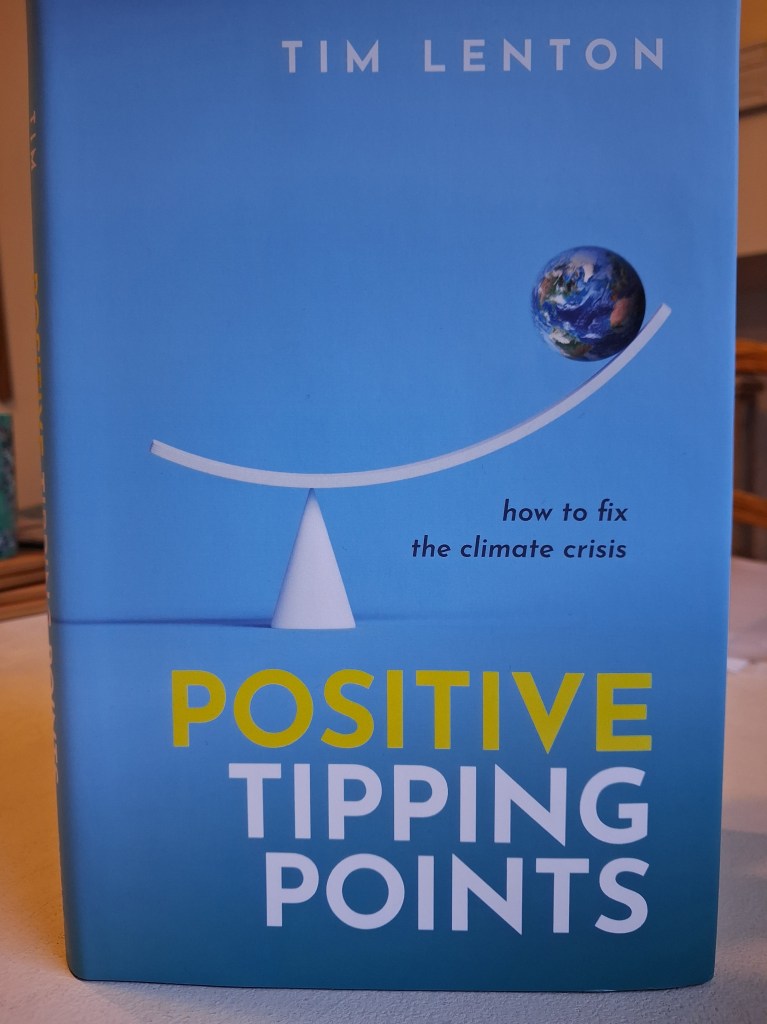
Tim Lenton’s ‘Positive Tipping Points’ does well to remind us all that we have agency to create meaningful change- that as cogs in the societal machine, we have the power to enhance and act transformatively, or to disrupt the current system. As he notes, “To get out of the incumbent, unsustainable state we need a fundamentally social tipping point, because it is people and their actions that either maintain the status quo or oppose it.”
Lenton makes the early point that, “We are in a climate and ecological crisis of our own making.” His focus is on finding the lever which will accelerate positive societal change. “We need to find and trigger positive tipping points that accelerate change in our societies and technology towards sustainability and social justice.”
‘Positive Tipping Points’ highlights well known examples of small actions which had large and significant consequences. He uses the example of the ‘Ever Given’ ship which blocked the Suez Canal to emphasise how the actions and decisions of just a few people ‘can sometimes escalate into global consequences.’ He makes the point that the world is far from the ordered, stable, place that we imagine it to be and that small changes can create large- scale self-propelling social change which could create the positive tipping points of actions and behaviours that are required. “We have been brought up to think that the world is an orderly, predictable place, where if we act in a proportionate manner we’ll get things back under control. But today’s world is not behaving like that.”
Lenton correctly clarifies what he means by a ‘tipping point’, arguing that overuse in the media has led to a confusion in the term. Additionally, he highlights the inherent danger in overstating the inevitability of such tipping states.
“There is also quite a bit of popular confusion over what is and is not a tipping point. This matters because if we overstate the existence of bad tipping points, knowing that they are self-propelling and hard to stop or reverse, we may feel disempowered and fatalistic.”
He gives clear and thorough examples of past ‘tipping points’ which moved societies through stable states to unstable alternatives. He explores nomadic lifestyles and how these were replaced with sedentary cultures; how foraging food made way for farming; how the Industrial Revolution in the UK changed the world; how cars replaced horses; and how previous complex societies collapsed owing to a range of external and internal factors impacting them simultaneously. Creating a ‘new world’ through innovative techniques can never be viewed as truly successful before the change has occurred. Lenton outlines that, “There are two faces to tipping points- they are sometimes creators and sometimes destroyers of worlds.” His argument is that once collapse gets underway, reinforcing and amplifying feedbacks can propel it at a much faster pace.
We are on thin ice
The immediacy of the positive tipping point for climate action is well documented in the text. “Now we are at around 1.5℃ of global warming and our list of potential climate tipping points has grown to sixteen.” Lenton explores how these tipping points might increase the abrupt risk of further points being broken irreversibly, owing to the complex interconnected Earth systems. “Our journey around the tipping elements has begun to reveal how tipping one thing affects the likelihood of tipping another. Hopefully this is intuitive. The Earth is a complex interconnected system where if something breaks it has repercussions elsewhere.”
Changing course
However, this is not a ‘doomist’ text- listing tipping point after tipping point. Instead, Lenton argues that disaster can be averted. He argues that by learning from moments of drastic change in the past, we should have learned to spot the warning signs. “To believe we can change fundamentally, and fast, we need to appreciate that we have done so in the past.” As climate tipping points are a “universal negative to avoid”, Lenton points to successful social movements of the past which brought the necessary change. The abolition of slavery and the Suffragette movement are both explored as movements which reached a ‘critical mass’ where change became inevitable and self-propelling. “Social movements, like the suffragettes or the climate protestors, are a particularly important way of tipping change. Many, if not all, the great social changes in the past had social movements behind them.” Attitudes towards change are driven by core groups, labelled by Lenton as “Innovators, early adopters, early majority, late majority, laggards”. Changing the social norm can be done in short timescales when intention and a better vision are part of the messaging. Society has changed its attitude towards smoking in a relatively short timeframe. Solar power, EV cars, vegetarianism and other changes in diet, have also broken through quickly as group dynamics ‘nudge’ others into taking action. The rise in technology in the past 20 years, and the acceptance and reliance on this technological innovation, also indicates how significantly society can change its attitude.
Government policy can play an impactful role when rapid change is required. This was ably demonstrated when the ozone layer was threatened with CFCs. Government and industry worked quickly together to reduce the harm and risk. “We urgently need such a tipping point of international coordination to tackle climate change”
Lenton pulls no punches in addressing this need for government policy, nor the bad actors at play, delaying climate action or promoting untested geoengineering proposals. “Policy is particularly important, because the transformation we need now is a rapid and intentional one.”
‘Revolution is impossible until it is inevitable.’
Lenton closes by quoting Trotsky’s famous line that ‘Revolution is impossible until it is impossible’. He urges that waiting until we have reached the point of an impending climate tipping point before acting would be risky and foolhardy. “Common sense says it would be a very risky strategy to wait until we are near certain about impending catastrophe before we act together.”
The stress on resources of climate migration could be well founded as humans move beyond their ‘climate- niche’ of stable survival. Hundreds of millions of people could be displaced in the coming decades and could become climate migrants, leading to an impact on welcoming countries and unwelcoming countries alike.
“The take home message from all this is that if we carry on knowingly towards 3℃ of global warming many people will have an existential risk to deal with, and in the worst case, we could be heading for a tipping point of societal collapse.”
Acting proactively rather than reactively may make all the difference to creating the necessary, critical mass social change. We can see the very real danger ahead- the alarm is sounding- our course needs to be altered.
“For all these reasons we need to act fast, well in advance of the point of impact, if we are to avoid it.”
Margaret Mead’s words may become prophetic once again,as we each consider what part we want to play in the positive tipping points to come.
“Never doubt that a small group of thoughtful, committed citizens can change the world. Indeed, it is the only thing that ever has.”
-
Review of ‘Science Under Siege: How to Fight the Five Most Powerful Forces that Threaten Our World’ by Michael Mann and Peter Hotez

When two world-class science heavyweights take the time to warn us about scientific endeavour being under attack by bad actors, it is incumbent upon us to listen. Doctors Michael Mann and Peter Hotez have spent much of their professional life being targeted by the political and ideological opposition to science at enormous personal cost and this book serves as a both a warning and a call to arms to recognise and fight against the orchestrated disinformation efforts of those who would focus on short- term profits over the threats to human life. In this very timely book, the authors identify the five forces that fuel this antiscience narrative. “In Science Under Siege we seek to provide a succinct yet detailed delineation of the five forces behind the modern-day antiscience movement (the five p’s, we’ll call them- the plutocrats, the petrostates, the pros, the propagandists, and our press).”
The authors stress that it is vital that these forces are recognised for what they are and that we do not allow them to fan the flames of division, especially at a time when our way of life is threatened by the twin crises of global pandemics and the climate crisis.
“The future of humankind and the health of our planet now depend on surmounting the dark forces of antiscience.” The disinformation tactics of attempting to isolate an individual scientist to discredit them can be seen as an attempt to quell the pursuit of science among younger generations, who then see science as a career where you are derided and reviled, rather than the industry of respect that it was in the latter part of the 20th century. Indeed, the authors go further here, and note the silence from the scientific community when one of them comes under repeated and targeted attack. The silence of friends- fearful of their own career reputation, or personal attack, can be a useful tool to isolate and ‘gag’ scientists.
“In the end, we will remember not the words of our enemies, but the silence of our friends.” So far, the silence has- in some instances, been deafening.”
Mann and Hotez argue that, “Mistrust in science is now escalating in certain demographics because of a targeted campaign against us- antiscience predation for someone else’s financial or political gain.” Instead of being seen as a significant social wedge issue, the attack on science to seed and sow state-sponsored disinformation, becomes a means of destabilising democratic societies around the world.
Mann and Hotez remind their readers that the fossil-fuel industry has been well aware of the dangers of the climate threat for almost 50 years and highlight that the delaying obstacles and challenges to government action are not physical or technological- but rather that they are entirely political. The ideological motivated efforts to deny the threat of the COVID-19 pandemic more recently follow this same pattern of political division and delay- sadly with human lives hanging in the balance.
“Meanwhile, the world’s largest fossil-fuel companies already understood the climate threat. In an internal report from 1982 that was eventually leaked into the public domain, ExxonMobil’s own scientists accurately predicted the increase in CO₂ concentrations and warming that would occur today in the absence of efforts to curtail fossil-fuel burning.”
Mann and Hotez make the repeated argument that we do not have to be passive receivers of this well-funded campaign of antiscience, but that by ‘knowing our enemy’, we can become armed into neutralising this threat and that metaphorically, sunlight can be the best disinfectant to this highly organised dangerous ideology.
“While there is urgency- unlike any we’ve ever known- there is still agency. We can still avert disaster if we can understand the nature of the mounting antiscience threat and formulate a strategy to counter it.”
A Candle in the Dark
“Happiness can be found, even in the darkest of times, if one only remembers to turn on the light.”- Albus Dumbledore.
The authors then begin to turn the spotlight onto each of the 5 ‘ps’ in turn, those oftentimes defenders of the powerful special interests and political agendas which actively promote anti-science as their repeated mantra for their own culture wars. They begin with the plutocrats, where power is held and controlled by a small minority of high-net-worth individuals and name them as malevolent players. Names which are familiar to us, such as the Koch family, Rupert Murdoch, Zuckerberg, Musk and Bill Gates. The point is made that “Today’s malevolent plutocrats frequently operate through a complicated web of entities as they wage war against science and scientists” and note that this ‘dark money’ can be difficult to follow and its users are protected by a lack of accountability. The impact of the Koch family casts a long shadow. “Koch Industries is the world’s largest privately held fossil-fuel company, with an obvious financial interest in fossil fuels.” The importance of funding for the disinformation campaign has led to bad actors appearing ‘untouchable’ and appearing to have a disproportionate amount of power.
“Elon Musk, the world’s richest man, the tech bro of tech bros and cryptobro of cryptobros, has become a leading spreader of disinformation writ large.” As a result of the distractions and delay caused by these plutocrats, the necessary government action has effectively been nullified. When Musk bought Twitter, he then “converted Twitter into a forum for far-right extremism…which in turn, led to “[t]he evaporation of science from platforms like Twitter launched an exodus of science from the public conversation.” When there is a vacuum of communication, with scientists forced out by trolls and bot armies, only one narrative remains powerful, which sets humanity back decades. Very recently, we have seen the return of some climate scientists to this platform- scientists unwilling to yield large amounts of online space to bad actors for free. This might be the start of a reclamation of the space by the science community, which would be welcome, as it has left those remaining active voices very marginalised.
Who is standing up for science?
In the fight to discredit accurate and robust science communication, plutocrats can merge with another ‘p group’- that of the petrostate. “Petrostates are often run by dictators, plutocrats, and oligarchs who acquire political or economic power (often without accountability) through the wealth they derive from extractive industries.” Some petrostates are more well known than others, but there are commonalities- one of which is to choose not to lead on any concerted global action on climate, but to remain firmly in delaying action for as long as possible. Mann and Hotez understandably focus on events in the United States and ‘the American petrostate’ and are persuasive in their arguments that politics is not only divisive- it is deadly. There has been a long game strategy played by the fossil-fuel industry, to slowly move their policy makers into position, even if this takes years and decades- but now they are in place. “During the 1990s the fossil-fuel industry began to invest heavily in conservative policy groups, think tanks, and front groups advocating policies friendly to the fossil-fuel industry. Meanwhile, they funded conservative climate-denying politicians, most of who were from oil states.”
With President Trump’s second term as President, the attack on science has become more vitriolic and dangerous on a global scale. The National Oceanic and Atmospheric Administration (NOAA) has faced significant cuts, seen by many to be a malicious attack on climate science and climate partnership with other leading organisations. More recently, the Department of Energy published a report claiming scientific concern about the climate crisis is overblown and exaggerated. A hand-picked team of science contrarians were selected for this report, which was viewed as an attempt to replace legitimate science with pseudoscience and has been fact checked for misinformation. The respectable Carbon Brief organisation, counted more than 100 false or misleading scientific claims contained within this report. In the authors’ minds then, it is clear that this is just the latest in the concerted attack on science.“There is unquestionably, a coordinated, concerted attack on science by today’s Republican Party- the American petrostate, if you will- with climate and biomedicine as focal points of the assault.”
The authors powerfully argue that the end result is to halt science progress in the United States and then by extension, hold back meaningful global action on climate- at the least, disrupt any action. This chapter ends, and indeed this argument ends, by ‘calling out’ the political attack on science.
“The fact that antiscience has been embraced so fully by one of the two major parties in the United States is grave cause for concern.”
Pros and propagandists
Mann and Hotez next focus on the twins of ‘pros’ and ‘propagandists’- figures with huge social media presence who regularly appear as ‘experts’ on media platforms touting for the fossil-fuel industry. “Pros include individuals with scientific credentials who have been financially lured by polluters and plutocrats and weaponized into a force to attack mainstream science and scientists. There are also the paid propagandists with no scientific credentials but plenty of media savvy and access to wide platforms.” These players are linked to the science-denial machine and appear to be free from the same funding scrutiny that is applied by them to the science community and to science communicators. Dissemination of misinformation now reaches tens of millions of people, through the power of social media, with platforms taking little to no responsibility for the toxic content of propagandists. “The propagandists now benefit from the extraordinary amplifying power of social media, including a Musk-weaponized Twitter, disinformation podcasts with huge reaches, and now most recently, AI. Slowing or stopping them is a complicated endeavor that requires disrupting their weapon of choice, antisocial media and other high-visibility disinformation-promoting vehicles.”
However, Mann and Hotez highlight that the playbook of antiscience has shifted now that the impact of climate change has become too obvious to deny outright. “Climate denial is untenable today with the vast majority of our population because they are witnessing profound impacts already playing out…They have instead largely turned to other tactics- delay, deflection, division, and so forth.” The resurgent weapon of choice is now the use of conspiracy theories. Conspiracy theories run rampant and there is an overlapping Venn diagram of anti-vaccine posters and anti-climate science posts online, which are amplified disproportionately to create the impression that they are the majority. This would come to no surprise to the average online user- even sheltered in their own echo chambers. Online trolls and misinformation impacts all of us and with algorithms constantly pushing targeted material onto us all, it can be difficult to take the time to sift through the overwhelming quantity of media information.
The partisan press?
There has been a manufactured campaign against the media, with partisan media groups gaining access and those promoting science being sidelined, especially by US politicians, with President Trump famously demonising news outlets as being ‘fake news’. We are all aware that press outlets will cater to their target audience and that how the public consumes their news is very different from a world of even 20 years ago. Capturing attention and holding the attention of the public has become the sensationalised strategy, rather than a ‘golden age’ quest for truth. The press undoubtedly have a part to play in good science communication, though as an industry, they appear to be excoriated by Mann and Hotez. “The press, as we have already seen, has engaged in widespread attacks on both science and scientists. Beyond the usual suspects- Fox News, the rest of the Murdoch media empire and other conservative media- even mainstream outlets like the New York Times have in recent years miscommunicated the science behind climate change and COVID.” They argue that creating the false equivalence between robust science and conspiracy theories and allowing “bothsideism” has built the illusion of equal weight to competing arguments. They are clear that there are some networks which act deliberately to attack science, while others can sometimes act unwittingly to create ‘doomist narratives’ that misrepresent the science, whether this is regarding the climate or global pandemics. The concern of the authors is that the framing of science stories can lead to the support and promotion of untested technological ‘silver bullets’, most of which allow for ‘business as usual’ for the fossil- fuel industry. “How doomist framing has led to support for potentially dangerous geoengineering schemes as desperation measures.”
“Fellowship of the Planet”
Mann and Hotez then lay out their ‘battle plan’ to push back against the tide of antiscience, arguing, “We need to restore the rightful role of science in our political and societal discourse if we are to maintain the capacity to address the major challenges we face, including the climate crisis and worsening pandemics.”
They acknowledge that ‘the hour is late’ for a new found faith in science, but argue that as we can see the actions of the ‘antiscience industry’ in delaying meaningful action, are we just going to allow them to destroy our way of life without putting up a fight? “We wish that humanity had followed a more enlightened path decades ago when the climate crisis had clearly emerged, or back in 2020 when we were given a golden opportunity to implement pandemic policies- guided by the best available science- to ensure the health of both our species and our planet.”
Mann and Hotez urge that by: communicating constructively; defeating disinformation; and supporting scientists, we can be led in our actions, not by partisan politics, but by the best scientific understanding at this given point.
Mann and Hotez close their book by referring to the powerful story and imagery of “The Lord of the Rings”. They connect with the repeated analogy of the industrial fossil-fuel furnace rooms of Sauron and Saruman, and offer the stark warning that if we don’t act, then we risk losing ‘The Shire’. [I]f humanity fails to combat the great global crises we face today, there won’t be an Earth- at least not the one we’d recognize. Yes, there will still be a large spherical planet rotating around the sun. There will be life, but we will lose the welcoming planetary home we know today, with its rich forests and oceans and ecosystems teeming with diverse, interconnected life forms.”
Science disinformation is a plague which threatens to destabilise us all. We must make a stand, to push forwards. To say that we will take the first step against the forces of disinformation, even if we ‘do not know the way’, and even if we do not know how that story finishes. We know the ending of the story if the fossil-fuel industry and anti-pandemic responses continue their stranglehold on science education, policy and action. We don’t know the ending if we fight for a pro- science tipping point, but we do know that if the fossil- fuel industry and agents of geoengineering miracles come for us, then we must be doing something right.
“We fight for a livable planet, for us, our children, and future generations. Because it’s worth fighting for.”
-
Review of ‘They Poisoned The World: Life and Death in the Age of Forever Chemicals’ by Mariah Blake

Blake’s book is a detailed, comprehensive, chronological investigation into how synthetic PFAS chemicals polluted and contaminated town after town in America. It focuses on the dogged and determined individuals, who fought against chemical companies which delayed, obfuscated and denied the extent of their PFAS pollution.
Most of the narratives come from individuals concerned about the impact on their family and looking for ways to limit and reduce exposure to harmful chemicals.
‘How can they protect their families and communities from an insidious group of chemicals that permeates the bodies of all living beings from the moment of conception until death?’
‘They Poisoned The World’ charts the struggles, especially of the Hickey family, and repeatedly makes the point that responsibility and accountability for truth, information and protection should come from the chemical industry, and should not rely on individuals researching information to better protect themselves from dangerous forever chemicals which have been ‘grandfathered’ into legislation.
Blake notes that, ‘We live in a synthetic world. Our homes and workplaces are brimming with man-made materials. Our bodies are saturated with their chemical residue.’ PFAS chemicals have now been found to pollute on a global scale- from the oceans to the Arctic to Mount Everest. ‘They also pollute the bodies of virtually every person on the planet. Once inside us, they stay there like a ticking time bomb of disease.’
3M, Chemours, DuPont, and more, all come under the spotlight in this vital exposé- one which details the long history of the development and profits of these chemical companies, from the early 20th century, through the arms development of World War 2, through to the domestic sphere of the 1950s and 1960s which followed. ‘The push by companies like 3M to turn wartime innovations into peacetime profits would transform American life.’ All too often, the chemical giants became the main employer in US towns, causing whistleblowers and local impacted people to come under incredible pressure to tow the line and not to cause waves. Thankfully, in recent decades, these companies have now become infamous and synonymous with corporate malpractice and betrayal. More attention and more truth-telling has appeared through the efforts of campaigners and litigators. Public awareness has exploded with the likes of films like ‘Dark Waters’, ‘Erin Brockovich’, and others which highlight real life cases of pollution by chemical companies, as well as their efforts to hide the truth.
This isn’t a text then just about the struggles of towns and families in the US to force litigation to bring these companies in check. Blake’s book is the roadmap for countries which are behind on chemical regulation to understand the delaying tactics used by chemical companies when finally it is their turn to be ‘exposed’. Blake argues that companies rely on the delayed action from the public, as the public find it challenging and difficult to accept that a stalwart of a community could equally be responsible for polluting a town.
‘All too often, we respond to grave environmental threats with a kind of collective paralysis.’ Her argument is that speaking out and building local communities to safeguard and protect families becomes a duty for us all, even if it takes years and decades.
‘It is up to us to protect ourselves and make a safer future for our grandchildren and great-grandchildren, who will reap the consequences of the choices we make now.’ Now that we know that those who were charged with providing safe products and a safe environment, actively betrayed that trust, while making huge profits, means that that trust has been broken forever.
Blake outlines the many ‘household names’ like Teflon, Gore-Tex, ScotchGard and Tefal, which brought their chemicals into our homes. As an aside,it is interesting to note that on Tefal’s website in 2025, it states directly, ‘Tefal was one of the first manufacturers to eliminate PFOA from its non-stick coatings over a decade ago.’ It does not have the same transparency over its actions and behaviours over its 60 years history. ‘The synthetics revolution also brought thousands of new chemicals into American homes.’ Blake notes how profits became the focus over consumer safety by DuPont. ‘Teflon…would become revolutionary both for DuPont, which parlayed it into a billion-dollar-a-year business.’
Just like Big Tobacco, the chemical industry knew of the dangers of their products, but did little to safeguard and protect the public. ‘Up until this point, [1958] DuPont had avoided marketing Teflon for use in home kitchen products because of toxicity concerns.’
Parkersburg, West Virginia
Perhaps the most well-known toxicity story that emerges focuses on the Tennant family and their litigation against DuPont in the late 1990s, through the lawyer Rob Bilott. Following a court order, DuPont turned thousands of documents over to Bilott, who painstakingly went through them all.
‘Gradually, the entire horrifying story came into focus: DuPont and 3M had been studying the chemical [PFOA] for decades. They knew that it was toxic and that it was polluting drinking water and human blood thousands of miles away from its factories, but they had concealed most of these findings. The papers also showed that DuPont had used the landfill near the Tennants’ farm as part of an increasingly elaborate cover-up.’
‘They Poisoned The World’ also details how the chemical industry began to respond to the emerging litigation by their own PR machine, by holding ‘information sessions’, and by lobbying hard in congressional races and political action committees to limit chemical regulation and to attempt to obtain gag orders against Bilott. At the same time, they began to court public opinion by admitting that PFOA was present but that the levels were ‘safe’. ‘In late October 2000, a letter written largely by DuPont officials went out on Lubeck Public Service District letterhead. It informed residents that there was a chemical called C8, or PFOA, in the water, but claimed the levels were safe to drink.’
Flint, Michigan
The other famous case of the contamination crisis in Flint, Michigan is also addressed in Blake’s book. It is noted that President Obama in 2015 declared a state of emergency, but Obama also famously lost the trust of the public by failing to drink water supplied to him from Flint at a public meeting. Once public trust is lost, it never comes back. ‘All their lives, they had trusted that there were systems in place to protect them, and now that trust had been shattered.’
In 2016, the EPA finally unveiled new “lifetime health advisories” for PFOA and PFOS combined. ‘Suddenly, more than five million Americans in nineteen states and several U.S. territories were informed that their drinking water contained unsafe levels of these chemicals.’ In order to be better informed of the possible health impacts, many Americans began voluntary blood tests in order to find out the levels in their blood. Blood levels then began to appear on protest signs as public anger began to mount against the chemical companies.
The dangers of GenX
What campaigners constantly fight against is the seeming inability to regulate forever chemicals. By the time litigation reaches court, the chemical company has already stopped using that specific chemical and replaced it with shorter chain chemicals, like GenX, which means that the whole process of linking health impacts to exposure to the new chemical needs to start again.
‘In early June 2017, a North Carolina paper broke the news that more than two hundred thousand people downstream of the Chemours plant were drinking water heavily polluted with GenX.’
Campaigners need to have stamina and be aware that legal action against chemical companies can take years, by which time, those suffering health impacts often will have passed away and will never have their ‘day in court’. For the Hickey family, which is the thread in Blake’s book, their story began in 2010 and ‘finished’ in 2021- four years before the publication of this book. The impact on campaigners can be huge- from social ostracisation to personal and family pressures, to economic concerns. These all play into the hands of the chemical companies.
The first step to limit the level of chemical pollution and contamination is to ‘turn off the tap’, and ban the production and sale of PFAS products. Following that, extensive remediation is necessary, while the dangers of simple disposal are well known.
‘In 2023, the European Commission introduced a wholesale ban on the production and sale of PFAS and products containing them, the most sweeping chemical regulation in the bloc’s history….
Moreover, the methods used to clean up PFAS pollution often end up returning the chemicals to the environment instead. The landfills where we bury forever-chemical waste, for instance, simply belch them back into the air.’
We are discovering more and more previously unknown PFAS, and lesser studied ones are now ‘breaking through’ into public awareness. The extent of TFA pollution is incredibly shocking, continues today, and ‘may only be the tip of the iceberg.’
‘They Poisoned The World’ is then a breathtaking account, sadly both literally and figuratively. It offers hope though, that the long battle against those companies and bodies which pollute us, can be won. Now we know the industry’s playbook, we can be better informed when these strategies are used, as more PFAS pollution hotspots appear in communities around the globe.
“It shows just how much individual people and communities standing up and speaking out can do and the dramatic change they can put in motion,” he said. “It took us way too long to get here, but it’s happening.”
-Rob Bilott
-
Review of ‘Love, Anger & Betrayal’ by Jonathon Porritt

Just Stop Oil.
Now pause and consider the emotional response you just had to those words.
Was it pride? Frustration? Anger? Apathy? From where did those emotions arise? How did you form that opinion, and has a dominant narrative shaped your response to this group of activists? Jonathon Porritt gathers together testimonies, contributions and profiles from 26 young climate activists and co-authors, to present an alternative reading of much needed climate activism.
Porritt notes, ‘The principal purpose in writing this book is to allow readers to find out a whole lot more about who these campaigners are, their hopes and fears and why they have chosen to live in ‘civil disobedience’. And why all of this is so directly relevant to all of us.’ He urges a wider view of climate protest, one which allows for climate messaging to be heard, instead of being shut down as recent UK judges have tried to do. Silencing the motivation behind non-violent, or peaceful direct action potentially leads to a worrying precedent, one, which to date, UK juries have not been led by. ‘As well as providing a more balanced view of what Just Stop Oil was, and particularly its young activists are, trying to achieve.’
He argues that their impact and profile have been hugely significant and follows the actions of powerful resistance groups of the past. ‘Few, if any, campaigning organisations have achieved such a high profile in such a short period of time.’ From 2022 until 2025, their many high profile actions of civil resistance have caused mainstream environmentalists, as well as the media and the general public, to focus more on their actions, rather than their motivations. ‘Just Stop Oil ‘burst on the scene in a blaze of orange’ back in March 2022. Three years on, it announced that it would be bringing to a close all its campaigning activities within the month. During that time, 3,500 Just Stop Oil Supporters were arrested with around 180 instances of people sentenced or held on remand.’
Their actions are meant to be disruptive. They are meant to polarise.
‘[Just Stop Oil] organises disruptive actions specifically designed to polarise opinion, and to encourage the ‘still undecided’ to decide which side they are on.’
It is noticeable that the media have highlighted and made more prominent actions by Just Stop Oil over their 3 year campaign- focusing on those which are the most disruptive, as well as those which are symbolic. It may be that Just Stop Oil is just the last incarnation of climate protestors from Extinction Rebellion to Insulate Britain, to Just Stop Oil. As the job remains unfinished, there is still a space for a radical movement to challenge those in power. “As the climate movement’s Radical Flank, Just Stop Oil was not there to be liked either. And its activists asked the same questions of the mainstream environment movement: What has your sympathy for the cause achieved in practice?”
It remains true that how a group or an individual presents their direct action impacts how the message is ‘heard’. Far too often we have heard, ‘I agree with them, but I don’t agree with what they are doing.’ Leading to the interesting question, of what action would the public prefer to see which matches the urgency of the climate crisis. A stereotypically British response of a stern letter? Furthermore, for some reason, the public chose who to accept and listen to, even though science methods and findings are the same. David Attenborough, yes. Greta Thunberg, no. Climate Scientists, no. 20 year old activists, no. Though there is no difference between where Attenborough has gathered his information and where other climate scientists and environmentalists have gathered theirs. In acknowledging this, Porritt continues to ask, ‘Why are most politicians still so indifferent to scientists’ warnings about the climate crisis?
There is also a real contradiction in the narrative and perception of the need for climate justice and needed climate action. From polls and surveys, Just Stop Oil is viewed negatively, though at the same time, the public, across countries, are worried about climate change and its effects and the lack of climate action from governments. The last YouGov survey on Just Stop Oil in 2023, noted that 66% of respondents had an unfavourable view of the group. Towards the end of 2024, a YouGov survey across European countries found that well over 60% of respondents were worried about climate change and its effects. At the same time, over 70% of respondents accepted that the world’s climate is changing as a result of human activity.
Radical resistance has a long history
Repeated links and comparisons are drawn throughout the text between the activists of Just Stop Oil and the powerful voices of the past who fought for change, from the Suffragettes, the Freedom Riders, the Civil Rights Movement, Gandhi’s protests against the British. Porritt is careful to limit the comparisons though, acknowledging the awful violence committed by the state to those who dared to challenge the status quo and raise their voices. From the horrific violence of Birmingham, Alabama, and too many towns and cities in America, to the sexual and physical violence against the Suffragettes, the ‘Radical Flank’ of resistance movements has always faced persecution.
What is happening to the right to protest in the UK?
Porritt details and explores the ‘manifestly excessive’ prison sentences meted out to Just Stop Oil activists, using the example of Roger Hallam’s 5 year sentence for planning a direct action, suggesting that they too are a persecuted movement. ‘Lady Justice Carr described the five-year sentence for Roger Hallam as ‘manifestly excessive’, reducing it to four years.’
‘The right to peaceful protest remains a basic human right, but you sure as hell wouldn’t know that here in the UK any longer.’
What will happen to those who have been arrested for holding ‘Palestine Action’ signs and for those showing support for the state of Palestine, once the UK acknowledges the genocide committed there and acknowledges the state of Palestine? Will their arrests be erased? What will happen to climate activists when the reasons for their actions become manifestly obvious?
Porritt argues that the UK state is using its given power to oppress any challenge to its lack of climate action. He quotes John Locke’s famous saying from 1689: ‘wherever law ends, tyranny begins’. But what if the laws by which you as a citizen are bound are themselves tyrannous? In other words, using power or authority in a cruel and oppressive way. That is exactly what is happening here in the UK today.’ Porritt uses the example of a police raid on a Quaker House to highlight the direction of police action and asks in whose interest this is in. In the past week alone, 4 Just Stop Oil supporters were given conditional discharges for marching in the road- or for ‘interfering with key national infrastructure’- a law solely created to target Just Stop Oil activists. Take a moment there. The UK Government took legal action in order to ensure that peaceful direct action would be criminalised. Of course, a simple internet search would reveal many other protests which have marched on ‘national infrastructure’ without any lengthy prison sentences following- so what is it about Just Stop Oil which the UK Government objects to?
Porritt eviscerates the UK Government by pouring scorn on plans that we can come back from a climate ‘overshoot’ through direct air capture schemes, or recarbonising the soil. He is scathing of the current UK Prime Minister’s climate credentials. ‘Keir Starmer himself does not have a climate-friendly bone in his body. He’s been forthright about his contempt for Just Stop Oil. He quotes Starmer’s speech in 2024, where he said, ‘I will not sacrifice Great British industry to the drum-banging, finger-wagging Net Zero extremists.’ He continues in a blunt manner, ‘The harsh truth is that politicians are making a catastrophically bad job of addressing this challenge.’ He concludes that there will be a time of climate reckoning, as the scientific methods make this clearer and that those who delay the necessary climate action need to be accountable.
“I cannot find it in my heart to rationalise the vast majority of politicians’ indifference and inertia, let alone to forgive it.”
Porritt then quotes George Monbiot who asks why there is a fervent drive to silence and imprison climate activists for speaking out, while ignoring the real guilty parties. “‘Why do the mass killers of the fossil fuel industry walk free while the heroes trying to stop them are imprisoned?…Why, when we know so much, do we permit a handful of billionaires to propel us towards predictable catastrophe?’” To support this argument, Porritt draws attention to the direct support for fossil fuels which is still ongoing around the world. “The US Federal Government in 2022 stumped up an extraordinary $757 billion in direct and indirect support for fossil fuels. How can one interpret this as anything other than a conspiracy against the American people by their own Government?”
There is a moral reckoning, as well as a legal and political reckoning to the climate crisis. Porritt returns to the tradition of peaceful resistance from the past to make the point that simply waiting to be given justice has never been successful, as those with power will cling tenaciously and desperately to any vestige of control. It does make one think more of post-apartheid South Africa with this reasoning, that a political present is not always ‘just’.
“When Martin Luther King said that the ‘arc of the moral universe is long, but it bends towards justice’, he sure as hell didn’t mean that justice will simply arrive, so sit back and wait for the happy outcome! Such justice is never freely given by those who have power; it is only ever won.”
Porritt rings out the clear warning that narrowing the right to protest and the right of freedom of expression will inevitably lead to more protestors heading to prison for ‘crimes’ which are questionable. “As the climate crisis worsens, repressions of resistance will increase, and the bar for going to prison will get lower and lower as the government continues to try and deter us from taking further effective non-violent action.” It is curious to note that the far right in UK politics argue that the freedom of expression of the far right is being restricted, but these are also the ones most opposed to Just Stop Oil. There is never any challenge to Just Stop Oil’s freedom of expression being infringed by the state from these groups and indeed the right wing media in the UK- clearly climate action and climate protest is so beyond the pale, despite millions demonstrating around the world in 2019 in the biggest climate protests in history.
Who are the real ‘dangerous radicals’?
“We are on the brink of an irreversible climate disaster. This is a global emergency beyond any doubt. Much of the very fabric of life on Earth is imperilled.”
Porritt concludes by successfully arguing that climate change is not an environmental issue, nor that it should be labelled ‘an issue’ at all.
“Climate change is not, and has never has been, ‘an environmental issue’. It is not, and never has been, ‘an issue’ of any kind. It is an unfolding physical and geopolitical reality that is already affecting the lives of the vast majority of human beings, and will, in the not too distant future, become the single most significant influence determining the future of our entire species.”
António Guterres, the Secretary-General of the UN, makes it clear where he sees dangerous radicalism. ‘Climate activists are sometimes depicted as dangerous radicals. But the truly dangerous radicals are the countries that are increasing the production of fossil fuels. Investing in new fossil fuel infrastructure is moral and economic madness.’
Guterres is always stark in his analysis and never shies away from telling climate truths. It is this point where Porritt chooses to conclude this intergenerational, challenging read. An argument which draws together all the threads of the 26 climate activists, focusing on the starkness of the climate action that is drastically required.
‘We have a choice. Collective action or collective suicide. It is in our hands.’
-António Guterres
-
Subscribe
Subscribed
Already have a WordPress.com account? Log in now.
 Climate Thoughts with Brian