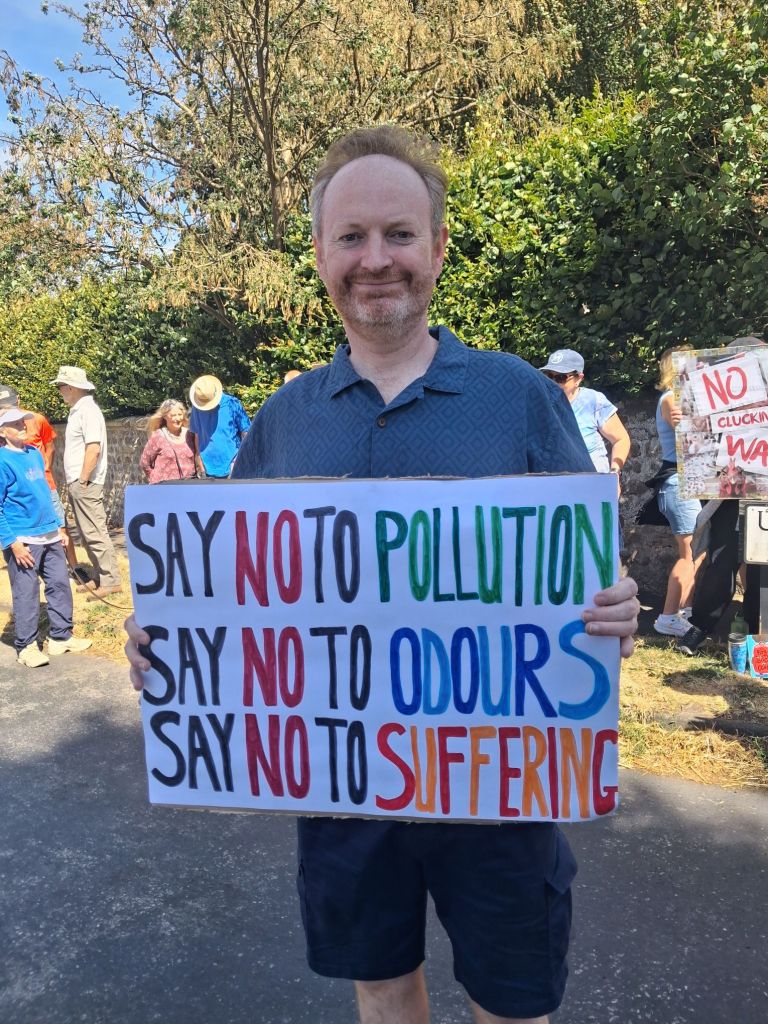
Almost 30 people gathered this morning in the quiet, rural village of Melmerby, Ripon, to protest against the planned development of an intensive chicken factory, which will house 2.7 million chickens annually.
This time, instead of reporting on a protest or a campaign, I found myself leading and organising the protest. Amid amusing chicken-related puns on placards, there were serious environmental and planning issues being focused on by campaigners.
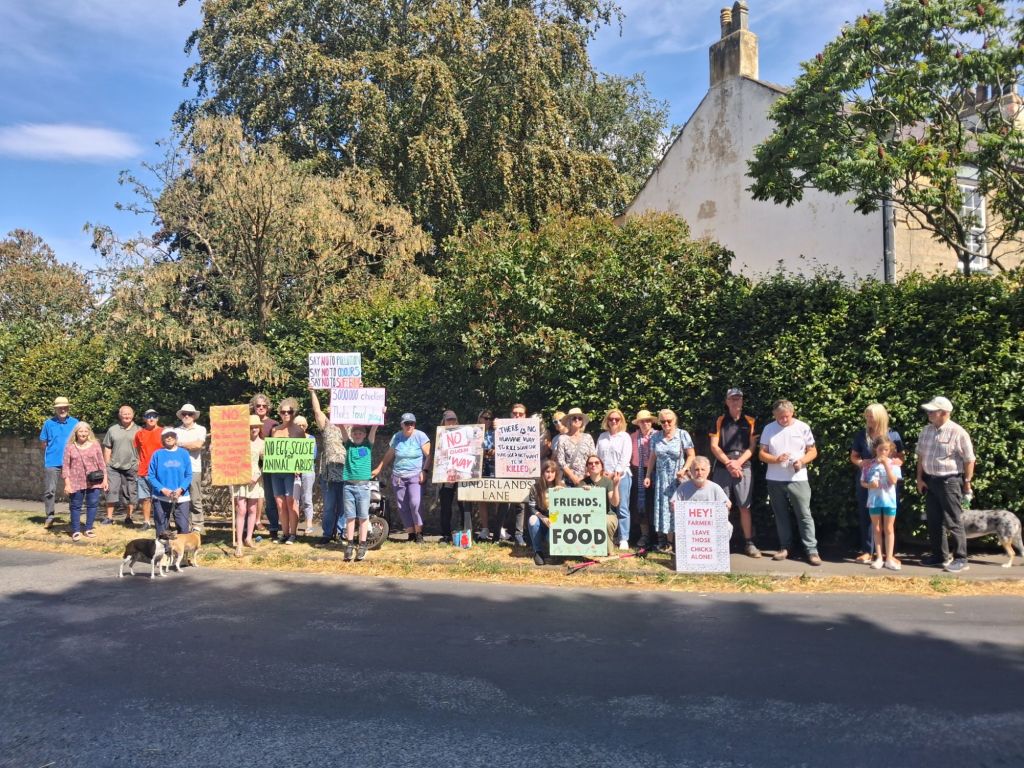
For those who have organised and led protests themselves, you will know that there are always many factors to consider and juggle. From informing the police as a sensible precaution to help with public safety and awareness; from deciding on a convenient date, time and location for the public; from coordinating with the press to grow media attention and awareness for the issue which you are protesting about; and then finally, putting yourself into the crosshairs, by informing the local community about the campaign and noting the extensive and inevitable backlash from anonymous posters, trolls and bots, which although tiresome, helpfully promote any post on some social media platforms. On the day, you hope that everything will go smoothly, that the weather will be kind, and that there will be a decent turnout, so you won’t be embarrassed.
So why bother? Staying quiet is easier, right?
Wrong.
The power of individuals to make their voice heard comes from individuals coming together as a group. Groups of people can change things, if the famous words of Margaret Mead are to be believed. At the protest today, we saw a group of people from different backgrounds who came together to try and make a change.


Of course, protesting an issue doesn’t always mean that you are going to be successful. It may be that this chicken factory will go ahead in some form. Sometimes, there are times where you know you are going to lose before you begin, but you give it your best efforts anyway, knowing that this might make it easier for the next group to come along. Some issues need to be spoken out against, otherwise it can quietly become a very dangerous world, where the powerful feel that they can do what they want and the little people will be quiet.
So why bother? Because if this intensive chicken factory is approved and I did nothing, then I would struggle to be proud when I looked at myself in the mirror- knowing that I could have done more, that I could have brought people together, that I could have spoken out, but that I chose not to because it wasn’t convenient for me? That I couldn’t be bothered? Now, my inner self-indulgent Don Quixote is not being channelled here, nor is my Edmund Burke, but it is a moral imperative to speak your truth clearly and do all the good you can, by all the means you can, in all the ways you can, in all the places you can, at all the times you can, to all the people you can, as long as ever you can.
What are the factory plans that need to be refused?
Forest Poultry Ltd have put forward a proposal to house 6 sheds, each containing approximately 60,000 chickens, so that at any one time, there would be 360,000 chickens on site. With 7 and a half cycles a year, this would mean that approx 2.7 million chickens would be reared for roughly 30-35 days, before being transported from the site to a slaughterhouse.

The UK animal welfare charity, PETA says that 18,000 people have signed an online petition against the factory proposal. Over 430 people have objected on the North Yorkshire Council Planning Portal, with only 1 supporting comment for the proposal and that is from the National Farmers’ Union. Despite all the sound and fury on local social media groups about the desire for ‘cheap British chicken’, it appears that the public will take the time to post furiously on social media, but not actually register their view officially.
Language matters from both sides of this campaign and indeed any campaign. Describing the proposal as a ‘farm’ creates the positive connotations of a child’s toy, with fences and a few animals and a big red farmhouse- small scale and with a sense of freedom for the animals. Describing the proposal as a ‘factory’ creates the sense of an intensive, mechanical, industrial scale venture, churning a product out simply to make a profit. We need to be careful of the poultry industry and other industries such as ‘salmon farming’ which aim to create the narrative of a place with lots of space for a few animals to grow up, being looked after lovingly by a ‘farmer’- when, in reality, this is far from the case.
Comments that were passed on to local and regional media outlets included the following:
‘It is worrying that at this late stage of the process, the people of Melmerby are still being ignored by the applicant and key information is missing. It really feels like this is being pushed through, regardless of what the locals think.
It really is fantastic to see the turnout today- from people who want to have their voices heard on the environmental issues, animal welfare issues and planning issues which surround this plan.
Background ammonia concentrations already exceed critical levels and this is accepted by the applicant. The intrusive smell of 2.7 million chickens is a real concern and hasn’t been fully addressed in the planning documents.
People here also have concerns about the pollution of groundwater- which we have seen is a real concern in places where we have these industrial units- for example the River Wye.
There is a strong narrative being pushed that we need ‘cheap chicken’ with high welfare standards rather than rely on imported chickens, but what appears to be missed is that the claims of a national need for chickens is an industry narrative and is not a government initiative at all.
What is missed in the documents is that to feed almost 3 million chickens, we will need to import huge amounts of chicken feed–so it is not a strong argument to say that this facility is needed to reduce imports, when it is totally reliant on imported feed- this is the development’s largest single emission source- over 53%- therefore, the food security argument is weak.
Then there are the animal welfare issues- there is no assessment in the documents of an avian influenza (bird flu) risk despite recent outbreaks in Bedale, North Yorkshire.
Then we have the living conditions themselves- the 30-35 day life span of the birds and 360,000 crowded together at any one time.
Some people are concerned that the chicken manure will be sprayed on fields, however the planning documents suggest that it will go to a processing plant in Norfolk. The problem is that the processing plant in Norfolk for the almost 4,000 tonnes of chicken manure annually, does not have a licence beyond 2027 and is likely to close. There is no assessed alternative given in the application.’
The Skipton and Ripon Planning Committee need to be asking serious questions about why we have so many unsubstantiated and inconsistent claims in this application.’
All eyes will be on the Planning Committee to see whether they will reject this application and reject this narrative from an industry solely focused on profits.


