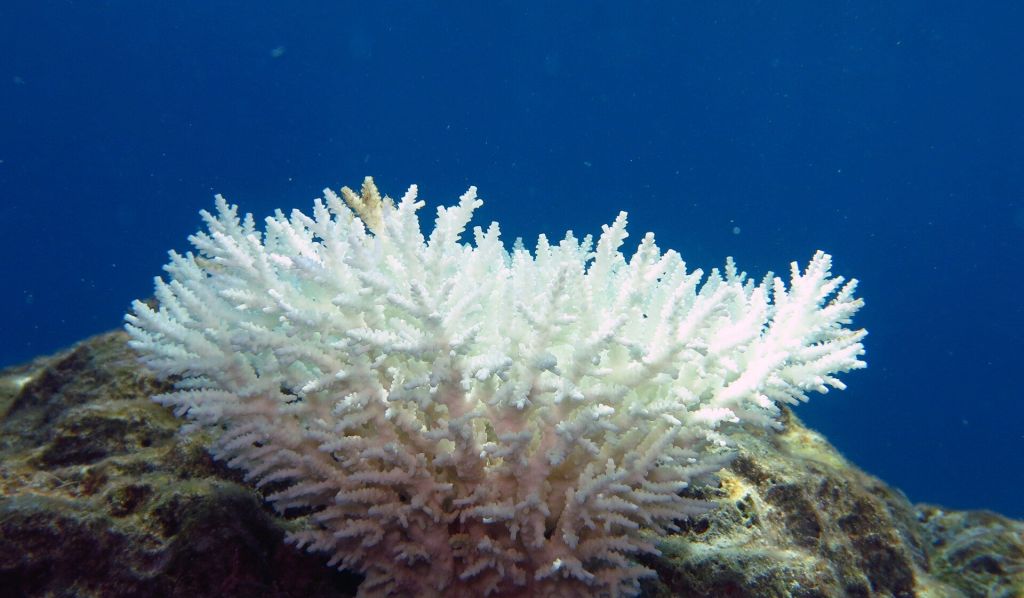
Human-caused climate change, not El Niño, is the driving force behind all global coral bleaching events, argues new research published today in Oceanography.
Over the past 40 years, the Climate Central- led paper found that human-caused climate change has been the main driver of coral bleaching risk.
The paper argued, ‘Four global mass coral bleaching events have now been recorded…
All these events also coincided with El Niños for at least part of the period. While El Niño is an important factor, each event has also
occurred during a period of rising global temperatures. Here, we use attribution of daily sea surface temperatures to show that the most recent global coral bleaching event is entirely due to human-caused warming.’
It further suggested that all global mass coral bleaching events of 1998, 2010,2015-2017, and 2018-2025 also had strong fingerprints of anthropogenic climate change.
‘Our analysis shows that global warming is the main driver of bleaching and that global coral bleaching simply would not occur without human-caused climate.’
Information released from Climate Central today was clear on the climate change influence on coral bleaching risk. ‘[F]ossil fuel-driven ocean heat is the fundamental force behind bleaching and coral mortality.’
Although coral reefs were praised in the report for their variety in different regions around the world, this simply emphasised the linked impacts of the destruction of the ecosystem.
‘Coral reefs are the most diverse marine ecosystems, housing approximately 32% of all named marine species.’
Threats to communities increase
Dr. Andrew Pershing, the paper’s lead author, spoke about the human impacts of coral loss, including threats to food security, economic losses tied to tourism, and the loss of a natural barrier that helps protect coastal communities from flooding and storm surge, when he commented,
“Our study shows that without climate change, coral bleaching would be a rare and isolated event, and global mass coral bleaching simply would not occur. Millions of people and entire countries rely on healthy coral reefs for livelihoods and food security. But our emissions of carbon pollution are causing increasingly widespread damage and death to these vital and vibrant ecosystems. Without immediate emissions reduction, coral reefs as we know them will disappear.”
Species and ecosystem loss
The analysis in the report was based on 100 ecoregions from the Marine Ecoregions of the world database but also bluntly warned of species loss and transformed ecosystems. ‘The International Union for Conservation of Nature (IUCN) has documented that 1,008 species have gone extinct since 1600, most due to human activities (IUCN, 2025). Continued emissions and additional warming raise the potential that human actions may soon eliminate coral reef ecosystems as we know them from the planet.’
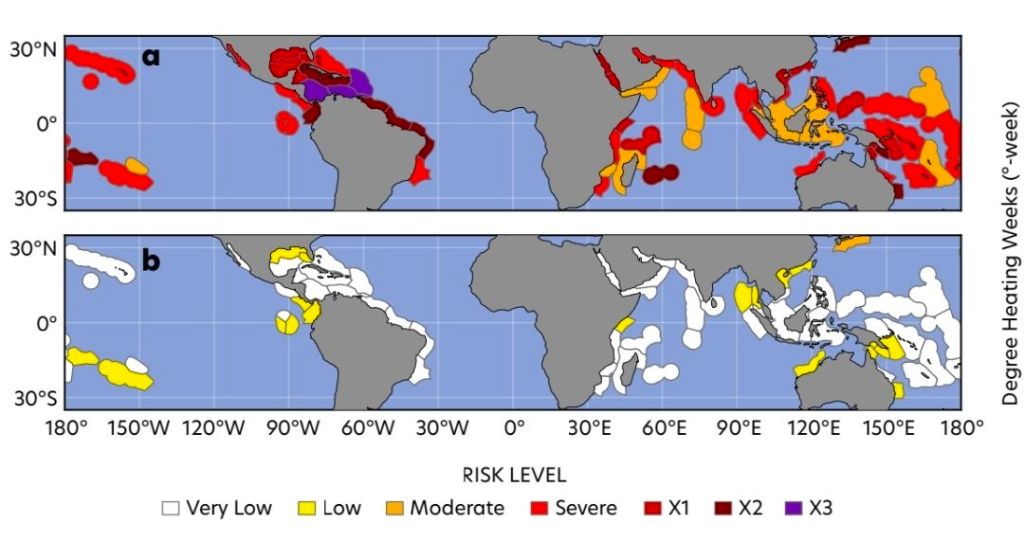
Extremes not averages
The warming ocean temperatures are raising concerns about the health of The Great Barrier Reef. In the publication ‘Oceangraphic’, on 21st July, warnings were given about the ‘very high risk of extreme and widespread bleaching and “ecosystem collapse’ to The Great Barrier Reef.
Localised temperatures rather than global averages were focused on as being crucial by UNSW Professor Alex Sen Gupta, an expert in marine heatwaves. He warned, ‘While the high global average gives us a very broad picture, a coral really only cares about the temperature at its own reef.’ He raised concerns about the perception between coral cover and the health of the coral community, saying, ‘The headline figure can be high coral cover, while the underlying coral community itself has degraded substantially.’
70-90% coral extinction by 2050?
Scientists have already warned that 70% to 90% of coral reefs could be functionally extinct by 2050.
The Intergovernmental Panel on Climate Change (IPCC) projects that even a 1.5° C increase will lead to a 70% to 90% decline, while a 2.0° C rise would result in a 99% decline in global reef systems.
With the current global average temperature at 1.3-1.4°C above pre-industrial levels, we could be entering a world where global mass bleaching of corals will happen and humans will be responsible.


