
Climate change unequivocally to blame for record-shattering European heatwave
The extreme June heat currently breaking records across Western Europe would have been impossible just a few decades ago according to a rapid attribution analysis by World Weather Attribution (WWA).
WWA scientists used both observed and forecast temperature data to analyse the hottest three-day period across a large area of Europe sitting under this ‘heat dome’. They found unequivocally that climate change is the driving force behind the severity of the dangerous heat.
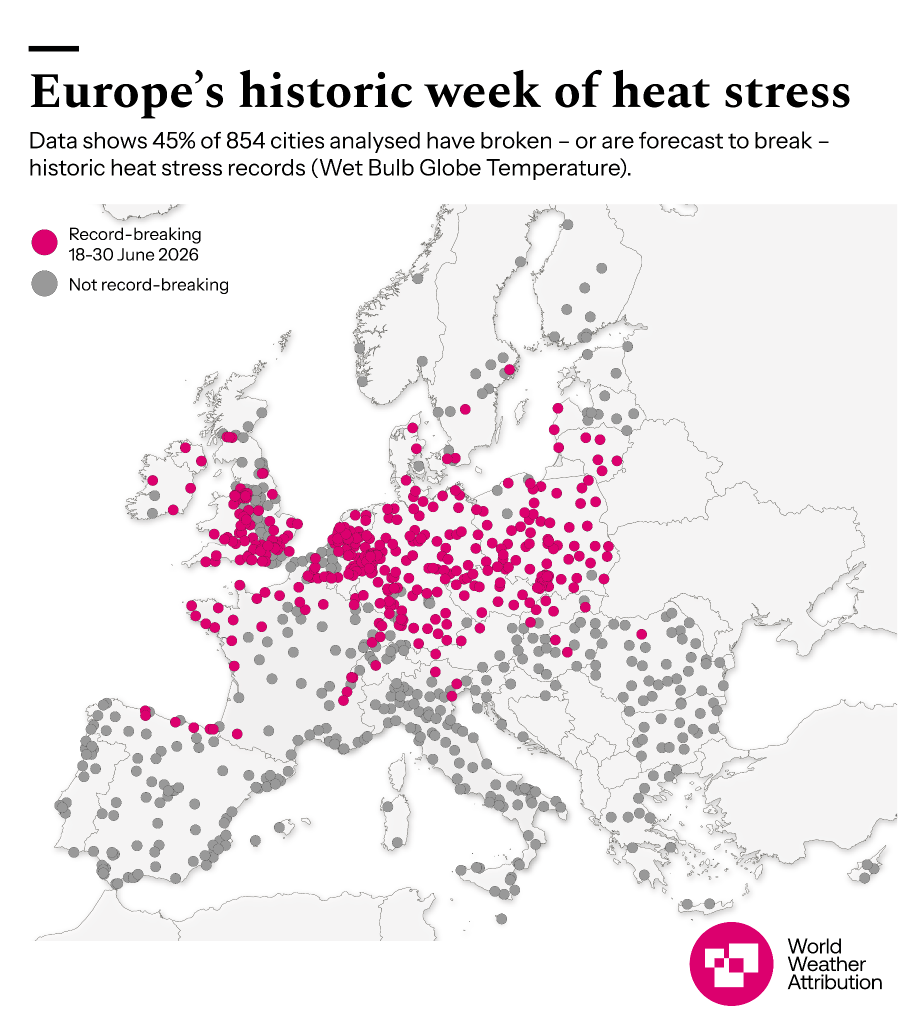
A staggering 45% of cities analysed across 30 European countries have already, or are predicted to, break their highest ever heat stress levels.
The study found that the sweltering overnight temperatures keeping many people awake this week are about 100x more likely today than they were just 23 years ago during the infamous 2003 European heatwave. The daytime peaks are about 10x more likely.
What kind of future do we want?
Professor Friederike Otto, Professor of Climate Science, Imperial College London said: “Scientists like me are beginning to sound like a broken record. We put out similar quotes year after year reacting to heat extremes that climb ever higher. Yes this is climate change, yes it’s us, no it’s not El Nino, yes we have the solutions, no we’re not implementing them fast enough. “It’s really now a question of what kind of future we want for ourselves, and whether we’re willing to do what it takes to secure it.”
One of the study’s authors, Dr. Theodore Keeping, Extreme Weather and Wildfire Researcher, Imperial College London added: “The science of how climate change is worsening heatwaves is settled. Continued fossil-fuel emissions are directly responsible for the disruption people are experiencing this week in their homes, schools and workplaces. “The speed of change is startling. Every few years we are seeing heat records shattered in Europe. This year it has been in consecutive months. In the UK, we are used to ‘snow days’ shutting down schools, but this generation is now growing up with ‘heat days’ as well.”
Impossible now possible
Both the daytime highs and overnight temperatures seen during this heatwave would have been virtually impossible to occur at this time of year as recently as 1976 – just 50 years ago. The report focused on 2003 and 1976, as other years with major heatwave events, and noted that heatwaves led to excess deaths, despite the rose-tinted, romanticised, childhood memories of so many online posters.
‘The 1976 heatwave primarily affected northern Europe (especially the UK) and led to an increase in excess deaths in e.g. Birmingham, England of approximately 20%.’
The 2003 heatwave was described as the first major “wake up call” for Europe on the impacts of climate change, it killed over 72,000 people – with the biggest impacts in Italy and France.
The heatwave is affecting large areas of the continent. In France, red heat alerts have been issued across more than half of the country’s departments, impacting an estimated 39 million people. Authorities report at least 18 heat-related deaths since the weekend, including two children who were left in a hot car. More than 1,350 schools have been closed.
Rare red warnings have been issued across parts of the UK as extreme temperatures threaten to break longstanding June records amid the intense European heatwave. Multiple schools in the UK have closed early, or have not opened at all, in order to help minimise health risks.
Impacts to UK infrastructure
The report reminds us of the serious threat to human health that heatwaves pose and that they have profound impacts on ecosystems, infrastructure systems and daily life.
Network Rail has given advice for rail passengers to only travel if it is absolutely necessary, as the warning extends onto Friday of this week. They warned that, ‘Trains will operate at reduced speeds and to amended timetables, meaning journeys will take longer and there is a heightened risk of delays, cancellations and last-minute alterations. There will be no rail replacement bus services during this period.
We do everything it can to prepare the network throughout the year so that we can keep the railway running in hot weather – using a combination of proactive monitoring and investment in smart technologies, like remote sensors and innovative cooling solutions, to protect critical infrastructure.
But when extreme heat hits – as is true across many areas of the world – the likelihood of disruption increases as the rising temperatures can adversely affect the tracks, power and signalling systems, and ground conditions, leading to rails expanding, overhead lines sagging, and infrastructure potentially failing.’
Jake Kelly, deputy CEO of Network Rail, said: “We know how important it is for people to get where they need to be, but this spell of very hot weather will make journeys more challenging across the network. Very high temperatures – like we are seeing in Great Britain and across parts of Europe – put significant strain on the railway, so our priority is to keep passengers safe while keeping services running.”
He continued, “We’re asking passengers to think carefully about their plans and only travel if it’s absolutely necessary in the areas most affected by the extremely high temperatures that are being recorded.”
Transport for London have also warned passengers about disruption to services as well as the impact of rising rail temperatures. Claire Mann, Transport for London’s Chief Operating Officer, said: “Given the red extreme heat warning issued by the met office for parts of the country including London, we have been working closely with other agencies, including Network Rail, the Greater London Authority and others to confirm our hot weather plans.
“Customers should be aware that, given the very high temperatures that are forecast, we are likely to see some disruption to rail and Tube services – with rail temperatures likely to lead to temporary speed restrictions and therefore reduced services in some cases. This will vary by line, with some services that share parts of the over ground rail network – like the Overground and the Elizabeth line – likely to be more affected.
“We encourage customers to think about their comfort and to consider whether their journey is necessary.
‘Government measures are completely inadequate’
Temperatures in the recent heatwave surpassed the previous June record of 35.6°C set in 1976.
During the summer of 2022, more than 60,000 people across Europe died as a result of extreme heat. Even in the following summer, which was significantly cooler, over 47,000 heat-related deaths were recorded. The report noted that a similar heatwave in June would have been about 3.5°C cooler during the day in 1976 and about 2°C cooler in 2003, with a clear warning that due to global warming, these very high temperatures are now expected regularly during the summer months in many capitals in Europe. High humidity and unusually warm overnight conditions are now also limiting the opportunities for relief and increasing health risks for vulnerable groups.
Bill McGuire, Professor Emeritus of Geophysical & Climate Hazards, UCL, who warned about these extreme climate conditions in his most recent book ‘The Fate of the World: A History and Future of the Climate Crisis’ said,
“The fact that the roasting conditions across the UK and Europe would not have been possible just 50 years ago, in the absence of global heating, attests to just how rapidly our planet is becoming a blistering hell hole. The reality is that such extreme June temperatures don’t even represent a new normal, but just one small step on the road to summer heat that will make normal life during the months of June, July and August, all but impossible.
Government measures in the UK and across Europe, to mitigate the impact of future heat, are completely inadequate, flagged by the fact that more than 90 percent of UK homes, alongside schools, hospitals and workplaces, are slated to become uninhabitable heat-traps at 40C and above.
There isn’t even a maximum working temperature limit in the UK, putting the health of many thousands of farmers, builders and other outside workers at risk. Preparing for life on an inevitably much hotter world, requires nothing less than placing the country on a war footing, and even then everyday life during the summer months, in the decades ahead, will still be grim.”
Phasing out fossil fuels is critical
The report highlights that at 1.4°C of global warming, extreme heat is already reaching the limits of our societies’ ability to cope. Their analysis indicated that intense heat is increasing rapidly even in living memory, with such events tens to hundreds of times more likely since only 2003 and virtually impossible just 50 years ago. A rapid phase-out of fossil fuels is critical if we are to avoid even higher temperatures and their consequences in the future.
Simon Stiell, UN Climate Change Executive Secretary reinforced this point, when he said: “Extreme heat is shattering records across Europe, and the science is very clear about why: climate change is running rampant, caused by the world’s addiction to burning coal, oil and gas. “But the solutions are equally clear: a faster shift to clean energy – which is now much cheaper than fossil fuels – as well as protecting forests and building climate resilience. No nation cannot afford more business-as-usual. We must step up the pace, together.”

