-
Review of ‘The Darkness Manifesto’ by Johan Eklöf

It would be difficult to write a review of ‘The Darkness Manifesto’ while trying to avoid the lyric of ‘Hello darkness, my old friend’, so let me get this out of the way at the start. Thankfully, Eklöf also acknowledges this familiar relationship, when he writes, ‘The night is quite simply our friend- we rest in darkness, in its stillness and subtle beauty. There’s still life in the darkness of night, so let us take back the night, let us seize it. Carpe noctem’
‘The Darkness Manifesto’ is a thorough examination of the dangerous impact that light pollution is having on eco-systems and biodiversity around the world and is a call to arms, or ‘a stirring manifesto for natural darkness.’ Eklöf defines light pollution as ‘a collective term used for light that can be regarded as superfluous but still has a great impact on our lives and ecosystems.’ And argues that humans have blurred the boundary between night and day with their spreading glow of artificial light to such an extent that nature is being confounded and disorientated.
Eklöf argues that darkness should not be regarded simply as an absence of light, but that ‘it is my absolute view that darkness has an independent worth.’ That there is a balanced interplay between these two states, ‘Because without light, no darkness, and without darkness, no light.’
At the same time, however, he acknowledges the emotional attachments that we have to darkness and comments that, ‘To be afraid of the dark lies in our genetic, as well as our cultural heritage.’ He argues that light has always represented safety to humans, as we navigate a darkness that is not our natural world, but rather one in which we are simply visitors.
‘All the light we cannot see’
With the ever-spreading ‘skyglow’ from cities, humans are creating a world where artificial light blocks out the natural wonder of the stars. Eklöf explores the Bortle scale- a scale which assesses how much a night sky is affected by light pollution. He states that, ‘In the very best of night skies, rated as a stage one or two on the Bortle scale, up to six thousand stars or other objects can be seen with the naked eye.’ Despite this majesty, he also identifies that we see but a fraction of the night sky. ‘Only one out of five people in Europe can see the Milky Way on a daily basis, and in North America and Europe, nearly everyone, 99 per cent, lives under a sky affected by artificial light. Few people know real darkness or what a starry sky looks like.’ It is therefore not an accident that astro-tourism is increasing as a hobby and people are actively seeking out the darkness to connect to areas where artificial light does not block out the sky. ‘Dark Sky’ parks and remote areas, far from the urban sprawl are more popular and are increasing in their number. Could it be that we have recognised- on some level at least- that we have lost our connection to our place in the skies and are aiming to restore this marvel, wonder and awe? ‘Out of all the stars we humans ought to be able to see with the naked eye, for most of us only a fragment, half a per cent, remains. The rest have been absorbed by artificial light, disappeared behind a smokescreen of human activity. They are there, but not for us to see.’
Impact on the natural world
The spread of light pollution has not only inhibited our view of the stars, but has had a catastrophic impact on biodiversity and marine life. In recent years, we have had repeated messages of the massive decline of insect life and Eklöf does not shy away from blaming humans. ‘Today, about 40 per cent of all insect species are threatened with extinction …shows that we’re moving towards the earth’s sixth mass extinction. And humanity is the cause.’ He does accept though that there could be a multitude of reasons for the huge decline in biodiversity, but aims to raise awareness of the impact of artificial, or human created, light. ‘The number of insects is decreasing. The reasons for insect death are many, from urbanisation and global warming to insecticides, large-scale farming, monoculture and disappearing forests. Probably all these factors play a role. But to everyone who’s ever seen an insect react to light, it is obvious that light pollution is a major cause.’ With half of the insects on the planet being nocturnal, Eklöf urges that there needs to be a re-balancing of priorities between species and that human wishes should not be paramount. ‘The more attention on the impact of light in ecological systems and our own well-being, the closer we’ll get to reconciling society’s need for light with nature’s need for darkness.’ As animals and insects feel safe in the darkness and seek its protection, it seems that humans are attempting to drown it out entirely in light, as we feel safe in the light instead. Eklöf draws attention to our religious mythology that light triumphed over darkness where chaos and uncertainty reigned and uses the Christian origin story in Genesis as an example of the historical and cultural acceptance and need that darkness must be conquered. ‘Human beings have extended their day, and at the same time have forced out the night’s inhabitants.’ We have done this to such an extent that we have changed our planet’s appearance from space- an understanding that we only recognised in the late 20th century. ‘Humanity’s desire to illuminate the world makes the earth, viewed from space, glow in the night.’
Artificial light as a disruptor
The impact of human created light sources on marine and terrestrial life is one which is thankfully the area of more academic study. Recent studies by the University of Plymouth have focused on the impact of artificial light sources and how they are a danger for marine ecosystems. The journal Science Direct, has been blunter in their assessment and concluded that ‘Light pollution is a global threat to biodiversity.’ Eklöf recounts in his book the dangers encountered by turtles which were confused and disorientated by man-made light and instead of heading directly to the ocean, began to make their way towards human habitation instead, as they ‘trusted their instinct to follow the light.’ As a result, their natural instinct was destroyed by the light from humans, ‘It can displace 200 million years of instinct in an instant.’ Eklöf also highlights the plight of wallabies being born up to a month later owing to artificial light from a naval base and commented that ‘Nature was again disrupted by man-made light.’
Eklöf argues in ‘The Darkness Manifesto’ that we are far from understanding marine life and that the darkness of the oceans is an alien world for humans. ‘Ocean life is several hundred million years older than terrestrial life and still not fully explored.’ He celebrates the darkness of the ocean, ‘The dark and unknown deep ocean is a world completely different from our own, and there, darkness is the norm and light only comes for short visits.’ He also highlights marine animals that use echo-location, such as sperm whales, ‘whose clicking sounds are sent through the oceans at an incredible 230 decibels’- levels which are life threatening for humans. (A rocket launch has been measured at 180 decibels) He outlines that military forces such as the US navy are keen to understand more about bio-luminescence and how potentially this natural bio-light could be used to track unknown vessels in the ocean. There is much to learn from the ocean, but if we continue to pollute it through artificial light, this learning could be lost. Eklöf concludes this section of the book by commenting, ‘We are a long way from thoroughly understanding the chemistry created by darkness in the creatures of the natural world.’
Away from the water, we have all seen examples of nature flowering at ‘the wrong time’ and Eklöf suggests that artificial light plays an important role in causing this. He also warns of the domino impact on the food chain when late flowerings or no flowerings occur. ‘At the start of spring, artificial light can accelerate the awakening of the trees, making the buds open prematurely.’
‘Normally they [bird’s foot trefoil] attract large numbers of aphids, but a late flowering or the absence of flowering can decimate entire populations of aphids, which in turn affects green lacewings, damselflies, ladybirds, hoverflies…the domino effect begins, and the ecosystem is disrupted.’
‘The easiest environmental problem to solve’
With humans increasingly suffering from sleeping issues as their circadian rhythms move to an unnatural alignment, Eklöf concludes that there is much that we could do to solve the impact of human sources of light pollution. ‘Light pollution is really the easiest of all the environmental problems to solve, at least technically.’ He acknowledges that the public may find it difficult at first to accept increased darkness, but welcomes moves by councils such as in Germany, where landmarks are no longer lit in darkness. ‘Light and illuminated environments mean safety for many people, so it may be difficult to accept the increased presence of darkness.’
With the growing popularity of the annual ‘Earth Hour’, where individuals, communities and businesses are encouraged to turn off non-essential lights for one hour, Eklöf hopes that our attitudes towards the darkness may turn to one of welcome and for health benefits. ‘Perception of time changes in the dark; the clock seems to slow down and disappear. There’s long been talk of light therapy for us northerners in the winter. But the fact is that even dark therapy is starting to become a concept.’
Eklöf concludes his book, both with a warning that time is running out, but also with a list of easy steps to begin to change our cultural relationship with darkness. ‘The question is how much time we have to act. Many of the animals that live under the protection of darkness are on the verge of extinction and with them their invaluable services: pollinating insects, pest-hunting bats. Meanwhile, we humans have ever-worsening sleep and plants are ageing prematurely.’
‘The lights don’t always have to be on; there is more to be found in the dark than we think.’
-
Review of ‘An Irish Atlantic Rainforest’ by Eoghan Daltun
‘Our species is fully responsible for what is now befalling all non-human life on Earth.’
As scientists presently decide which place will formally mark the start of the Anthropocene, Daltun’s ‘An Irish Atlantic Rainforest’ reminds us that, as humans, we have incredible potential to transform the world for the good or the ill.
Unusually for my reviews, this one begins at the end of Daltun’s journey and the end of the text, where he concluded with his key argument, ‘Quite simply, it is profoundly immoral for us to think and act as if the entire planet were ours alone, and that we don’t have to leave enough wild spaces for the millions of other species that have just as much right to exist as we do.’ The realisation and humble acceptance that our species is just one of the millions which are lucky enough to exist on the planet and not the most essential one, is a central message of the book.
My journey to this book was via ‘Losing Eden’ by Lucy Jones, ‘The Insect Crisis’ by Oliver Milman and ‘Silent Earth’ by Dave Goulson, so it was comforting and reassuring to read similar messages breaking through to a wider audience. On one hand, ‘An Irish Atlantic Rainforest’ is not a ‘climate’ book- and yet, it is. For me, it was about the change in perspective that is needed to live as a part of nature and to respect nature as a living entity.
Nature existed for millions of years, both before and without humans, and will undoubtedly do so again. Despite our existence on the planet, being in geological terms the blink of an eye, our destructive influence on the world has been marked and noticed. Daltun makes the point, early in the text that a connection with this geological timeframe is a vital one. ‘I was beginning to perceive the landscape around me and under me in ecological and geological terms and time frames, rather than just those structured around the narrow window of time that is a human life.’ Through the tactile touching of the soil and strata comes a realisation of our true place in the world and the understanding that by changing our nature of stamping artificiality on the world, we could give nature a chance. ‘Our task is mainly just to stand back and let that happen: no small thing for a species whose success thus far has been so firmly predicated on the control and manipulation of environments.’
Daltun argues that by stepping back and letting go of trying to ‘tame the wilderness’, we can be blessed with blooming ecological diversity and life. ‘We need to learn to be able to let go- and then enjoy nature come flooding back in and do its thing.’
Discovering awe
In truth, the ‘narrative’ aspect of this book, could be seen as potentially clichéd. A family moves from the city to the country and they have their eyes open to the beauty of nature and they aim to protect an area of land and ensure that an ‘Atlantic rainforest’ can breathe again. This would be a very trite reading of the book and one that attempts to minimise the deep, almost genetic memory and connection that we have when we encounter nature.
Daltun connects with a growing zeitgeist– that of experiencing awe when faced with nature and the environment. He states ‘I was in complete awe of the place.’ and describes an encounter with a sparrowhawk, which ‘left me literally ‘enraptored’, and close to tears. It felt like a very personal welcome from another world, and in a sense perhaps it was.’ There are moments in our lives when we do experience awe and wonder and are transformed by it, as we realise that our eyes and minds cannot process what we are experiencing. If you have seen the Grand Canyon, this may be the closest example that I can think of here. You may be able to intellectually cope with its formation over millions of years, but on an emotional front, it is much harder to embrace and fathom. Without these transcendental moments in our lives, we miss out on a connection. For Daltun, it is the proximity to forests which is the focus of the book, ‘In the forest, ecological time, which is only truly measured in scales stretching far beyond our own lives, potentially comes into view, if not quite within full grasp of the mind.’ He acknowledges the healing properties of nature- and notes that forest bathing is medically prescribed. Whenever I felt as if I was carrying the weight of the whole world on my shoulders, within a few steps into the woods I would feel that start to lift, often in the most indescribably powerful way.’ He continues to explore the transformative power of the connection of nature almost as a rebirth, ‘After spending time in the woods, I leave as a different person, recharged to my very core.’
Nature must be permitted to come back
This book is filled with words that try and capture the elusiveness of his journey. Daltun writes about ‘rewilding’ and ‘reverting’ and ‘renewing’ and ‘returning’ and ‘rejuvenation’, as the limits of language make it difficult to describe what the preservation of the temperate rainforest becomes. Preservation itself isn’t the right word- as it suggests interference. What Daltun describes, is almost a preservation through inaction.
He repeatedly acknowledges that he is not promoting a return to some Golden Age, but rather to create opportunities for ‘land sparing’- ‘The real objective is not to back to the past, but forward: to complex, vibrant ecosystems that actually work by themselves and are therefore more resilient in the face of climate breakdown and other shocks coming down the line. As has been said before, the aim of rewilding isn’t to turn the ecological clock back in time, but to allow it to actually start ticking again.’
We are all ecologists now
Daltun intersperses his book with images of human interaction with nature and in this, there is a similarity to the photographer Jonk’s work in ‘Naturalia’, where he visits abandoned human sites around the world, where nature has reclaimed the land and buildings. There is a humbling, haunting beauty in both the images of Jonk and the natural world described by Daltun. ‘How nature can return- and does best- when left alone.’
The practice of humans not leaving nature alone, but instead introducing non-native species creates significant issues for Daltun, as it threatens self-regulating eco-systems. He argues, ‘It may surprise many people to learn that invasive exotic (non-native) species are recognised by ecologists as the second biggest driver of global species extinction.’ He also points out that introducing non-native plants, or larger mammals can have unintended consequences for other elements of the food chain. ‘There is strong evidence that the increasing prevalence of non-native plant species is a major factor driving the current sharp decline of insect populations across the world.’
Good intentions aren’t enough
Daltun explores in depth the complex issues that are created when humans try to interfere, sometimes with good intentions, with what they view as deficits in nature. Perhaps not understanding that if something is not there in the eco- system, then nature has probably not put it there for a reason. He bemoans the introduction of goats and sika deer, ‘Often described by ecologists as ‘desert makers’, they are responsible for helping to push native species across the planet into extinction, with fragile island ecosystems especially vulnerable.’ He supports this point by emphasising that when human activity has impacted the eco-system already, any more interference can prove costly, ‘The most crucial thing to understand about invasive species is that they tend to make most headway in ecosystems which are already heavily compromised by human activities.’
Daltun takes time to unpick the dialogue between farmers, governments and environmentalists, and explores the challenges and cooperation that is possible between these groups. His target appears to be the Government more, which tries to impose and limit nature, while at the same time allowing invasive species to damage what and threaten what remains. ‘That such a situation has been allowed to persist for so long- both sike deer and rhododendron were already recognised as serious problems by the mid-1970s- is a monumental national disgrace.’
The dangers of monoculture plantations are analysed fully in the text- ‘However, despite all the arguments in favour of treating the land gently, there is a rapid and relentless homogenisation taking place throughout the length and breadth of the Irish countryside, with flat monocultural banality the ideal always strived for.’
There is also a warning that easy political soundbite solutions should always be viewed with caution, especially the ideology that if we just plant enough trees, all will be well. ‘Tree-planting is not synonymous with conservation; it is an admission that conservation has failed.’- Oliver Rackham
Daltun suggests instead that a flourishing, diverse, self-reliant ecosystem is thebetter solution- not just for a political term, but for the generations to come. ‘Nature must be permitted to come back. Society needs it; our rapidly disappearing wildlife desperately needs it.’
Our relationship with nature is a broken one, but it can be repaired.
It is important to note that Daltun does not finish his journey with an arrogant flourish of ‘Look what I achieved and you can too, if you work hard enough.’ In truth, there is no end point to the natural rainforest journey- just perhaps a different steward and guardian at some point. The connections and awareness of time that nature allows is more vital, as is a deep gratitude. Of his own experience, Daltun writes, ‘Restoring a wild natural ecosystem- or, more accurately, removing some of the man-made impediments that were preventing it from restoring itself- has brought deep joy, fulfilment and meaning.’
For more people to experience this deep joy and meaning, he argues that a dramatic cultural shift is required- to one of awe and to one of wonder. ‘Since culture is such a key driver of human behaviour, a profound transformation in our cultural relationship with forests and other natural ecosystems, to one of respect, and indeed reverence, is vital.’
If we continue on the path of treating nature as expendable and as a resource for us to enjoy, then we will continue to be the ‘planetary killers’ as E.O. Wilson describes us. Daltun concludes by arguing that our priorities need to dramatically altered. ‘The human economy is always placed first in our order of priorities…while the natural world is actually treated as expendable…it should be the diametric opposite.’
Without this cultural shift, we could be jeopardising our own future. ‘It is not an exaggeration to say that our own very survival as a species will ultimately largely hinge on whether we can do so- or not.’
‘The essence of nature is wholeness’- Douglas Chadwick
In reading this text, I thought about the journey of the author from Italy, to South Africa to Ireland. I thought about his work as a sculptor and wondered if Michelangelo’s quotation of ‘I saw the Angel in the marble and carved until I set him free.’ could be applied to Daltun’s transformation. I felt there was a spiritual part to this book, which wasn’t based on a religion, but on a discovery- that the work of preserving and setting nature free, changed Daltun more than it changed nature. When he writes, ‘I was privileged to be witness to the most stunning, magical transformation of the land inside,’ it seemed as if nature had transformed the writer as well.
What happens to us when we lose the magic of connecting with nature and choose to not allow ourselves to be transformed?
Will our rooms refuse to transform into forests as in ‘Where the Wild Things Are’ by Maurice Sendak?
And will we always be missing a part of the wholeness that could enrich our lives?
-
Review of ‘Losing Eden’ by Lucy Jones
With a title like ‘Losing Eden’, one might be forgiven that this book was going to be filled with religious allusions, where capitalism acts as the serpent deceiving mankind, until we lose that which was most precious to us. Jones goes beyond this simple interpretation and instead offers a cautious, scientific evaluation of our changing relationship with the natural world and the impact of lost knowledge.
She bookends the text cleverly with an imagined conversation across the generations regarding nature, with the warning coming from the older generation that, ‘Why did nature end? We didn’t love it enough and we forgot it could give us peace.’ Jones makes the repeated point that there is a wealth of knowledge retained in older generations about the names of plants, trees and wildlife that is being lost in the modern world with the focus and attention on ‘indoors’. ‘As fewer children connect with nature, it will follow, he argues, that if they become parents, their children will in turn have a more tenuous connection with the natural world.’ This is an early point for readers to engage with, as they may well recognised their inability to answer a child’s question about the type of plant in a park, or flower in a garden, or type of beetle.
Using apps on smartphones to identify species may be useful, but there is a huge gulf between information and knowledge and Jones points to several examples where children are being better equipped to experience the natural world. This is counter-pointed by the statistics on the loss of the natural world in a short time frame, ‘In Britain, half of our ancient woodland has disappeared in the last eighty years…Over just the last fifty years the populations of mammals, birds, reptiles and fish have fallen by 60 per cent worldwide.’
These numbers may be difficult for us to imagine and connect with and process. What follows as our response is also touched on by Jones- do we shrug apathetically, or do we begin anew to protect what remains- whether this is through protest action to protect trees from being felled, or simply by taking a long walk in nature, to refresh and renew. ‘Perhaps we are noticing this all the more now, as we are in danger of losing the living world as we have known it, and with it, potentially part of ourselves.’
Increased urbanisation
Jones begins by exploring the increased urbanisation of humanity and the dangers to self and identity that come with this. ‘What does it mean, then, to live in a city, as the vast majority of us do? By 2050, 68 per cent of the world’s population will live in urban areas.’ The distance that this creates and disconnect that is increased by this, Jones suggests, endangers our identity as natural beings, no higher or greater than other species, but as an inter-connected part. ‘If we lose our relationship with the natural world, we may, in some way, be losing a part of ourselves and a profound psychic experience that we all need.’ Jones makes this point more simply by saying ‘Without contact with the natural world, we become impoverished’ and warnsthat humanity may not notice this loss of nature, as artificiality takes over our lives. ‘Could we be sleepwalking into a time when the natural world is reduced to its bare minimum?’
Simulating nature does not give the same connection to humans and can indeed add to the contamination of the planet. ‘Will plastic trees and simulated virtual reality gardens be enough for future humans? Are we so desensitized that we are losing the thirst for a relationship with the natural world? And is the absence of this connection causing us harm, whether consciously or not?’
What impresses me most about this book, is that Jones openly asks questions and then takes the time to point to academic studies that explore the topic and reveal conclusions- in essence, Jones was prepared to be wrong, but looked at the facts and scientific evaluation and was led by this.
A wonderful moment in this text, is when Jones reminds us of moments that are special to us- when we experience the smell of petrichor- and asks why humans have this level of sensitivity- how it would be useful for us in our modern lives.
Nature is not a luxury
Jones then begins to support her arguments more fully by highlighting that ‘Nature is not a luxury: its presence or absence creates and causes different health outcomes for different groups of people. There is a direct benefit from being near nature on our mental health.’ She notes the 2013 RSPB report which ‘concluded that four out of five children did not have an adequate connection with the natural world.’ The comparison with the time spent outdoors with prison inmates, was particularly shocking for readers, ‘Three-quarters of children (aged five to twelve) in the UK now spend less time outdoors than prison inmates, who require, according to UN guidelines, at least one hour of exercise in the open air every day.’ It is worth expanding this out more that the UN offers the guidance that prisoners should have at least one hour in the open air every day, yet the majority of children in the UK spend less time outdoors than prisoners.
Jones takes the time to explore and evaluate the benefits on ecotherapy projects around the world, perhaps most famously the practice of forest bathing, though she warns that increased biodiversity loss can reduce this opportunity even further. ’Ecotherapy projects are currently on the rise in the West, from wildness therapy and pilgrimage walks to woodland therapy sessions and gardening groups.’
A walk in the woods has never hurt us, but we have so much to gain from it- yet our mythology is filled with horrors lurking in the woods- fear usually comes from a position of ignorance.
‘Biodiversity loss will deplete the natural environments where some humans go to seek restoration and thus the extent and quality of that restorative effect will shrink.’
Time to feel awe
Jones highlights that a means of experiencing awe in our world and indeed our recognition that we are experiencing awe, comes from our connections with nature. ‘Many experiences of awe in the modern world still come from an encounter with nature, despite our disconnection.’ This has a particular resonance with me from a teaching perspective. There is a poem that is taught at GCSE level called ‘Extract from The Prelude’ by Wordsworth that students have to learn and engage with. Every year, this is the hardest poem to teach and learn, as students cannot understand how an individual can experience awe in the face of the power of nature. For me, this is the reason why this poem must be retained, so that this lesson is taught, and not removed owing to its difficulty. It is also encouraging that a new GCSE of Natural History will start to be taught in schools in the next few years. Teaching the knowledge that might otherwise be lost is a huge step in the right direction.
Jones also argues and emphasises that building connections with nature can enhance our connections with other humans. ‘Awe, then, can shift us away from pure self- interest to be interested in others. It can help us bond and relate to each other. It can turn off the self, the day-to-day concerns, to propel us into focusing on something bigger and hard to comprehend.’
Again, Jones warns that in our modern urban environments, we are intentionally reducing our opportunities to allow nature to thrive and as a result, endangering our heath. ‘We choose to bask in screens instead of mirror-calm lakes, burbling streams and above, starlings, swallows and buzzards.’
With light pollution hiding the stars, and artificial light affecting our sleep, the increased popularity of Dark Skies visits and experiences has grown. It does appear that humans are beginning to recognise on an unconscious level perhaps that there is something missing in our lives and that that gap needs to be filled. ‘We are losing the benefit of natural sounds, then, and natural smells and also natural light, which has serious consequences for psychological health.’
Access to nature
Jones then explores the imbalance between access to nature and open spaces. She asks who owns the land who it is used for. She analyses who has access to private gardens and green areas and whether economic deprivation causes health impacts. ‘Children who live in deprived areas are nine times less likely to have access to nature, through green space and places to play, than children in affluent areas, who may also have access to private gardens.’
Jones argues that a connection with the natural world should not be an accident of birth, or a by-product of wealth, but that nature should be recognised as a vital human right. ‘And it makes the case that, no matter the circumstances of birth, a connection with the natural world, the opportunity to walk barefoot on grass, to plant seeds in the soil, to hear birdong or touch the bark of an ancient oak, should be a fundamental human right.’ With more natural elements such as rivers gaining legal protection around the world, it is hoped that the recognition of nature as an individual rather than as an object to be used as a resource, will continue to expand.
The wild places
Jones begins to close the text by passionately arguing that gratitude for the ‘wild places’ will help us connect with our spiritual selves and that spirituality through nature has always helped us cope with life itself. ‘Faith, religion, spirituality have all helped people cope with death. If a connection with nature can offer transcendence, can it also help us at the end of our lives?’
She connects life and death well and points out that we have lost sight of the natural element of these elements of life. ‘It appears that through our disconnection from the natural world, we are also more separated from death and disease, and therefore less able to cope with them.’
She recognises that in the birth of her child that this was the beginning of a journey that would also end in a death and that this understanding enhances the transitory moments in a life. ‘I had given birth to a life, to my great love, but also a death at some point.’ With the Christmas season just finishing and the natural element of the ‘death’ of the dark days and the return of the light, I am reminded of the T.S. Eliot poem ‘The Journey of the Magi’,
‘Were we led all that way for
Birth or Death? There was a birth, certainly,
We had evidence and no doubt. I had seen birth and death,
But had thought they were different; this Birth was
Hard and bitter agony for us, like Death, our death.’
A new story
Jones finishes by correctly asking how we can change our current behaviour and renew the lost relationship with nature in our daily lives. ‘How can we collectively fall in love again with nature? How can we think about the relationship differently? By knowing and noticing the other beings who live around us for a start.’ I would argue that a return and a reset are needed more than something ‘new’ and this is perhaps my only disagreement with the book. ‘So it is time for a new story, a new myth, a change of mindset, attitude and behaviour. If we feel it, we must be galvanized by our ecological grief.’
Jones closes her arguments by returning to the narrative between the generations, but this time the knowledge has been passed on and lessons have been learned. The disconnect has been bridged and rebuilt and human lives have been enriched. We all have something to learn.
‘If we are disconnected from the natural world, we are missing out on nourishment for our minds.’
To notice the small world and to choose to create the time in the natural world, will help us see the big picture of the world that is not ours, but which we are living in, along with other species. A reflective moment to recognise that we can lose ourselves in time will help us all.
‘To see a World in a Grain of Sand
And a Heaven in a Wild Flower,
Hold Infinity in the palm of your hand
And Eternity in an hour.’
-Wordsworth
-
Review of ‘On Time and Water’ by Andri Snӕr Magnason
‘Ok is the first Icelandic glacier to lose its status as a glacier. In the next 200 years, all our glaciers are expected to follow the same path. This monument acknowledges that we know what is happening and what needs to be done.
Only you know if we did it.’-
Magnason 2019
In 2019, a solemn warning to the future was unveiled, via a memorial plaque on the Okjökull glacier, as the first glacier worldwide was lost to climate change,
The memorial on the lost glacier can surely be compared to Armstrong’s ‘One small step for man, one giant leap for mankind’ in 1969. Armstrong’s words will be etched in history as a time of expansion for the human race. In much the same way, these words on this memorial to the first of the glaciers to have been lost will be etched in history, as a time when humanity’s expansion threatened the existence of humanity- all within the short span of 50 years.
‘You can tell stories. You must tell stories.’
‘This book is about time and water. Over the next hundred years, there will be foundational changes in the nature of water on our Earth. Glaciers will melt away. Ocean level’s will rise…All this will happen during the lifetime of a child who is born today and lives to be my grandmother’s age, ninety-five.’
Magnason defines clearly the purpose of his book quite early on and identifies one of the biggest issues facing climate change- that of communication and action. ‘For most people the phrase ‘climate change’ is just white noise.’ He asks the question about how we connect people to a global crisis in a way that moves them- what language will they understand? ‘Should we draw words for discussing the Earth from science, emotion, statistics or religion? How personal and sentimental can we get?’
He acknowledges the difficulty of trying to fully grasp the issue of the climate crisis for an individual and what that means as a priority for them. ‘It affects everyone we know, everyone we love. We are confronted by changes that are more complex that most of what our minds typically deal with.’ At the same time, he reinforces that we do have the tools to better engage a public, who can be afflicted with mass apathy regarding a global problem that they see as being too big for them to be a part of the solution. ‘The only way to write about the subject is to go past it, to the side, below it, into the past and the future, to be personal and also scientific and to use mythological language.’
It’s not often in a book review where I can squeeze in a quotation from Tolkien- but it seems fitting considering his connections with Iceland. The character of Pippin says to his friend that maybe they are too small to make a difference. ‘Pippin: Maybe Treebeard’s right. We don’t belong here, Merry. It’s too big for us. What can we do in the end? We’ve got the Shire. Maybe we should go home.’ To which, Tolkien has the character Merry respond, ‘The fires of Isengard will spread. And the woods of Tuckborough and Buckland will burn. And all that was once green and good in this world will be gone.’
Magnason rightly suggests that what connects us all is mythology and that language is bound up in identity. ‘Words affect our emotions, our feelings. Words enable us to get a handhold on the state of being.’
How do we tell stories that are bigger than ourselves? How do we build the foundations of culture and connection?
It is not an accident that we have been telling the story of a family travelling on a donkey from Nazareth to Bethlehem for almost 2,000 years.
We have been telling the story of a cataclysmic flood, across multiple cultures, for thousands of years.
We’ve told stories of Norse Gods and Greek heroes in a way to understand our world and our place in it.
We have always been storytellers.
We are a bridge over time
The personal and intimate cadence of Magnason’s story fills the spaces of this book and echoes the refrain throughout. The book starts with personal familial connections, to know who we are and where we are from- in a bid to honour our ancestors and descendants. Magnason’s message repeated throughout is that ‘this world is heavily interdependent. We are all interdependent. That’s the reality.’ The language used in the media of the phrase ‘by the end of the century’, Magnason argues is one which is blinding us to the reality of the crisis. He argues that humans are bad at understanding the geological age of the Earth and that using phrases like ‘by 2100’ can make us miss that connection with our responsibilities to the future.
Magnason repeats his argument that, ‘Two hundred and sixty-two years. That’s the length of time you connect across. You’ll know the people who span this time. Your time is the time of the people you know and love, the time that moulds you. And your time is also the time of the people you will know and love.’ He does this through memories and conversations of family members, who calculate how many years will pass between generations. This part of the book and this message really connected with me, as it will with many people who have young families.
My son is 5 and he is lucky enough to have great-grandparents who are 95. This means that they were born in 1927. If my son also lives to be 95, then he will see the year 2112. 12 years past the ‘end of the century’. Continuing this idea, if my son, also becomes a great-grandparent when he is 90, and that child lives to be 95, then that child will see the year 2202.
Over 270 years of connections and history within one family, with one child being the bridge across generations. What will the Earth be like by 2112, with current emissions and global temperature rise?
What will the Earth be like by 2202?
Magnason makes the point that, ‘For the Earth, one hundred years is like a moment.’ He continues more intently that there is an obligation to the future, as well as a recognition of the past. If my life is in danger, if my earth and my descendants are in danger, aren’t I obligated to understand what’s at stake? What words manage to define the world?
Unfortunately, Magnason laments the banality of our lives and our attention spans. He states that ‘The same week in October 2018, the United Nations IPCC issued a kind of ‘final warning’, the internet was consumed by an array of variously trivial things.’ A phenomenon that we have seen repeated as COP15 closed. A critical, once-in-a-decade biodiversity crisis disappeared in a torrent of social media activity over what the owner of Twitter would do next. There’s always a celebrity who generates much angst and anger over their comments online- more anger than is ever generated by the plight of the planet. Indeed, these climate and biodiversity summits are sometimes ridiculed as achieving little, ‘The Earth has abandoned geological speed; it is changing at human speed. And yet our response happens at a glacial pace. We hold a conference to determine the location for the next conference.’
The risks to humans
Although Magnason repeats the scientific evidence of the risk to humans, this does not feel like his primary message. The repetition of warnings about the climate crisis have not yet been heeded. Either we are not listening properly, or the story needs to change.
Magnason, perhaps rightly then, gives the headline statements, in case his reader is new to this topic. In a carefully neutral voice, he intones:
- ‘Glacial melting can have the most drastic consequences; millions, even billions of people are at risk.’
- Earth’s most densely populated regions lie around the Himalayas. Three nuclear powers surround them; Pakistan, India and China.
- Scientists have pointed out that we are experiencing the sixth mass extinction period for animal species in the Earth’s history.
- According to a 2019 UN assessment, just under a million animal species are in danger of extinction.
This is the point. If you are ‘climate literate’, you will be aware of this information- though what you are doing with this knowledge in terms of climate action is debatable. If this is the first time that you have seen and read this information, then how do you respond and on what level? Magnason identifies that perhaps we do not understand the immediacy of the crisis and that we view it still as a problem ‘tomorrow’. What people really mean here is that they will be dead and gone and so they won’t be impacted and so they feel it has nothing to do with them.
This degree of a lack of connection with the future lies at the heart of this text. Rhetorically, if you were told- ‘Your behaviour and actions right now could significantly alter the quality of life that your child has for the worst’- would you quit that behaviour? The concept of sticking to boundaries may be the inherent fault in humanity’s stars. Magnason suggests that, ‘The problem is, humans don’t seem to know any boundaries. They do not know when they are satisfied, nor when they’ve gone too far.’
We are standing at a crossroads
With humanity’s goal of lowering carbon emissions and reducing the ever-increasing global average temperature, we really are at a crossroads.
By 2050, we may have wide ranging government action across countries, as we did when the ozone layer was threatened. We acted quickly and collectively.
Knowing where we are and our point in time is crucial. As Magnason states, we must notice the present. ‘In the last ten years, we’ve seen the eight hottest years since temperature record-keeping began in the mid-nineteenth century. Since the turn of the century, the Icelandic glaciers have retreated more than they retreated in the entire previous hundred years. There’s a reason to take notice of the present. The time of greatest change is upon us.’
Will we seize this as an opportunity to agree at a global level, that we need to change. That what we have done to this point cannot serve our futures. What we owe to the future, from parent to child, has always been the opportunity that their life will be better that ours. That our children do not need to face the same struggles that we have faced. That we have sacrificed, so that they can benefit.
Why has this responsibility been lost?
Magnason notes that ‘Nothing we have done will be considered remarkable if achieving it has meant closing our eyes to science and throwing away the life and happiness of future generations.’
As a species, we have lost our compass as well as our path.
It is fitting to return to metaphorical language of directions, bearings and journeys, as this book is littered with journeys. From the physical journeys on glaciers from Magnason’s family, to the emotional and spiritual journey of Magnason himself, to that of the journey of the glaciers themselves. Stories about journeys that are connected. We all journey.
Magnason closes the text by driving home the responsibility that is owed to future generations not to rob and deprive them of so much of this Earth that is of value. For us to begin to tell the stories of why we value what we value, so it can be protected before it is lost.
‘And now we need to think and behave differently than we did before. We have the tools, all the devices and all the knowledge to do it.
And, if we do not, we fail both our ancestors and our descendants.’
-
Review of ‘The Insect Crisis’ by Oliver Milman

Global wildlife populations have plummeted by 69% on average since 1970.
Flying insects numbers have plunged 64% since 2004.
‘A landmark United Nations finding in 2019 outlined how 1 million species across the animal kingdom are facing extinction in the coming decades. Half of these lost species will be insects.’
Our apathy to these headline figures lies at the heart of ‘The Insect Crisis’ by Guardian journalist Oliver Milman. And although the book came out in early 2022 and was shocking then, more information on global species decline continues as 2022 comes to an end. With COP15- the biodiversity conference being held in Montreal- finishing with no real progress from targets set almost a decade ago, Milman’s message deserves to be repeated.
‘The next few days couldn’t be more significant in laying the foundations to avoid what is potentially a mass extinction event.’ Was the warning from the Chair of Natural England, Tony Juniper, who emphasised the critical nature of the once in a decade opportunity to set global ambitious targets at COP15 to protect and potentially reverse the catastrophic and relentless attack on nature.
Milman makes the point early in ‘The Insect Crisis’ that, ‘The public’s awakening to the insect crisis has come in waves and is far from complete’ and acknowledges that ‘The alarm over insect declines has rung intermittently for some time, if not quite so loudly as now.’ The interconnected web between human survival and insect life thriving on Earth is repeatedly made by Milman, with the argument made that insect loss, although drastic, would not wipe out insects, but instead be more of a human emergency. Humans are not innocent bystanders- we are the guilty parties in our own demise. ‘Through the destruction of insects’ habitats, the spraying of toxic chemicals, and increasingly, the heating up of the planet, we have unwittingly crafted a sort of hellscape for many insects, emperiling all we rely upon them for.’
Milman also highlights the global inequalities of the biodiversity crisis that are similar to the global inequalities of the climate crisis and points out that hundreds of millions of people who are already malnourished before the crisis and which are already being felt. ‘But for the majority of humanity, the loss of insects would be an agonizing ordeal eclipsing any war and even rivalling the looming ravages of climate breakdown.’ He continues, ‘The question of how long human civilization would withstand the loss of insects is both hideous and unfathomable.’
Milman closes a hard-hitting first chapter by highlighting the level of inaction and indifference regarding the biodiversity crisis and quotes Brad Lister. ‘We are looking at a global collapse of insects and we have yet to sense the urgency of what that means for us.’
‘A sense of disquiet’
Milman continues in Chapter 2 to emphasis the consequences of a world without insects by quoting several scientific experts. “The consequences are clear; if insect declines are not halted, terrestrial and freshwater ecosystems will collapse, with profound consequences for human wellbeing”- Dave Goulson. “I can’t imagine how a world without many insects would look like but I don’t want to see it”- Sebastian Seibold.
He uses academic papers to demonstrate that ‘Insects that pollinate crops are vital to our food security, yet “substantial concern exists over their current and future conservation status”’. Though there do exist issues with the scientific approach, as Milman chronicles the dangers of scientific rectitude, where messaging and a narrative compared with actual events can make the public feel that the issue is less important. ‘If we are primed to brace ourselves for a certain adverse impact, a lesser blow can feel like an acceptable rate.’ He warns that the shifting baseline syndrome, with its gradual shift of accepted norms, can make comparisons between decades and years difficult. Despite this, the public unconsciously realise that all is not as it was, through anecdotal evidence of insects on windshields. ‘There are still sparks of understanding, a sense of disquiet that windshields are clearer now, that outdoor lights aren’t swarmed as often, that those skimmed headlines about bees probably don’t bode well.’
This sense of disquiet is matched with the research indicating that, ‘British butterfly numbers have nearly halved in the past fifty years.’ And that in other locations such as the US, ‘the abundance of four species of bumblebee has plummeted by as much as 96 percent in recent decades, with the bees’ geographic ranges shrinking by nearly 80 percent.’
The Windshield test- “Zero Insect Days”
We know there is a problem with insect decline, but we didn’t have the visual imagery to connect with biodiversity loss until the evidence completed by Anders Pape Møller, revealing that the number of insects on windshields, represented ‘dramatic declines.’ ‘The lack of bugs on cars windshields is becoming the accessible emblem of insect decline, much the way dejected polar bears are now a sort of shorthand for the climate crisis.’ 2022 was the year when repeated news stories on fewer dead insects on windshield began to cut through with the public, as anecdotally, they could observe this for themselves. Milman also points out that eco-systems are fragile inter-connected systems, where food chains are more precariously balanced than humans choose to acknowledge. ‘In other words, as the insects vanished, so did the birds, probably due to a lack of food. The local eco-system had been hollowed out, from its base upward.’
The cause of the crisis
In a word- humans. But oddly, humans can also be the saviours of the situation and their own endangerment. Milman reveals that, ‘Insects have been devasted by the way we’ve altered the world around us, physically but also chemically. The battery of pesticides now routinely applied to our landscapes has created a toxic miasma for insects that scientists have only recently begun to quantify.’ Big agriculture and the chemical industry come under scrutiny from Milman, as he delves into the ‘peak of the pesticide’ and the narrative that has been created that insects are pests and are there simply to be eliminated, with neonicotinoids being especially harmful. ‘Over the past century, however it has been the chemical industry that has shaped a whole new arsenal of deadly weapons against invaders that nibble away or choke crops.’ He draws on Brazil where, ‘around 500 million bees died in just a few months, the piles of dead bodies riddled with fipronil, an insecticide banned by the European Union’.
He further notes that habitat spaces have been destroyed, leaving insects with ‘nowhere to go’, where ‘half of all hedgerows, key habitats for pollinators and insect predators of crop pests, have disappeared in just a few generations.’
‘More than a billion animals perished in the fires’
MIlman then draws the biodiversity crisis and the climate crisis together, explaining that rising temperatures impact the delicate eco-systems where insects thrive. as ‘Rising temperatures are pummeling monarchs everywhere.’ The climate crisis then acts as a threat multiplier for insects.
He acknowledges with sadness the horrific loss of animal life in the recent Australian fires- fires which have been largely forgotten by western Europe. The scale of insect life means that it can be difficult for humans to grasp the numbers involved as Milman explains, ‘Insects’ huge numbers make them appear both inconspicuous yet omnipresent.’ He also draws out the significant global impact of the loss of insect life and makes the comparison that although the loss of one endangered species, like the rhinoceros may be tragic, this is dwarfed by the growing silence from the insect world. ‘In terms of impact, the insect crisis drowns out any other alarm bells in the domain of animals.’
Despite all of this, Milman is at pains to offer hope and practical solutions. He argues, in tandem with the experts, that allowing nature a chance, as observed during the global pandemic, can create the gaps, for biodiversity to bounce back. ‘Butterflies, like other insects, are being assailed by a barrage of threats. But if we give them just a few gasps of breathing space, even those most delicate, fragile-seeming species can find a way to make it.’
Bees and Butterflies
Milman then heads into his conclusion with a detailed and forensic analysis of the loss of two of the most recognisable symbols of biodiversity loss- bees and butterflies. He quotes Henri Clement, “If we lose the bees, we lose fruits, vegetables, even grains. And without those, we begin to lose birds, mammals and so on. Bees are a cornerstone of diversity.” And highlights the colony losses, especially in the US in the season 2018-2019 where ‘around 50 billion bees were wiped out in just a few chilly months.’ The point is made that multiple simultaneous threats are narrowing the chances for insects to recover. ‘There are so many intertwined threats facing insects that there is no simple escape for them.’
A human emergency
How to finish a detailed book on the demise of many insect species and biodiversity was always going to be a difficult task, especially with new reports emerging regularly noting the loss of yet more species and a future world filled not with the hum of bees and the noise of insects, but with an empty silence. Milman makes final pleas to his readers that attention must be brought to this topic and urgent action taken- ‘We need them far more than they need us. The insect crisis is, from our self-interested point of view, a human emergency.’ He urges that we can take actions to mitigate and potentially rebuild insect colonies and the natural world, while warning that this is a problem of our own making- that we have been the actors in our threatened environment. ‘By flattening and poisoning our landscapes, altering the chemical composition of our atmosphere, and creating biological deserts in the pursuit of progress and aestheticism, we are conducting a high-stakes experiment with hideous risks.’
Although, this book is almost a year old now, the media silence surrounding the recent COP15 is thunderous. Without information about biodiversity loss being a dominant news story, the public cannot be fully informed about the size of the issue, nor about what actions they can take to make their lives more connected with nature. At the same time, the information is available for people who search for it. To quote the legal sector, ‘Ignorance is not a defence.’ As we witness the lacklustre response to the clear and present danger of the climate crisis, I for one, am not convinced, yet, that the public have recognised the urgency or pressing nature of the crisis.
If we wait until the skies become silent, it will be too late.
“We are at the beginning of a major extinction level event. Things are just going to get worse if humanity chooses to do nothing differently.”
-Floyd Shockley
-
Review of ‘The Climate Book’ by Greta Thunberg

Waiting for some other person, or some other time, is no longer an option.
‘The Climate Book’ really is the one-stop shop for all climate issues. There are contributions from over 100 global experts in their fields, some of which are summaries of their own books, but which address the latest position on the climate crisis and what needs to be done to avert the worst of the climate disasters. My fear in listing some of these climate leaders is that the list needs to include everyone. Reducing the list, or offering a preference for some articles over others would only indicate my own European and Northern hemisphere bias. Thunberg sets out her aim for the book- that the knowledge from the range of experts will help each reader on their own journey of climate education, ‘The idea behind this book, is that, taken together, their knowledge in their respective areas of expertise will lead you to a point where you can start to connect the dots yourself.’
There may not be a representative voice for every reader in this collection, but that is precisely Thunberg’s point- that we can all be our own representation.
Waiting for some other person, or some other time, is no longer an option.
How it is structured
The book is helpfully colour coded throughout, with Thunberg’s own words contained as introductions to the main chapter headings, before she gives way to the scientists and experts.
Thunberg breaks down the climate issues into a holistic chronological approach, outlining for a general audience the basics of how climate works, before moving on to how our planet is changing. Thunberg then focuses on how the changing planet affects us, outlines what we as a species have done about this impact, and then concludes with a strong message on what needs to be done now. The climate stripes, pioneered by Ed Hawkins, are used at the start of each chapter, as a visual representation of our progress and an alignment of what stage we are at now.
‘The climate and ecological crisis is the greatest threat that humanity has ever faced.’
The opening chapters to ‘The Climate Book’ are deliberately stark and blunt, as Thunberg is famous for ‘telling it as it is’- indeed, this is the charge that gives to her readers. She states, ‘When it comes to the climate and ecological crisis, we have solid unequivocal scientific evidence of the need for change…That ship has sailed. The science is as solid as it gets.’ She then suggests that what is needed is for scientists to speak a different language, ‘What largely remain is tactics. How to package, frame and convey the information. How disruptive do scientists dare to be?’
Thunberg’s comments in this book are stylistically unique. She lays out the facts and then offers simple choices. She dismisses despair and ‘doomerism’ and instead focuses on the positives of action. ‘And there is no time for despair; it is never too late to start saving as much as we can possibly save.’ She reminds us that the debt we owe to the past is also owed to the future, but that we should be grateful that we are alive now, so that we can be part of the greatest movement for change in humanity’s history. ‘We have the unfathomably great opportunity to be alive at the most decisive time in the history of humanity. The time has come for us to tell this story, and perhaps even change the ending. Together, we can still avoid the worst consequences.’
What about COP27?
There will be some who will claim that the timing of the book release by Thunberg is no accident though. That, with COP27 starting barely a week after the publication date, that she is trying to switch the spotlight onto her views. More cynical observers may categorise this as simply good marketing. As Thunberg resolutely and regularly advocates the listening to climate scientists and has done since she started her climate protests in 2018, it would seem churlish to argue genuinely that the timing of the book release is just self-serving for Thunberg. She makes the relevant case that ‘the EU will not update its climate targets in time for COP27’ and points out that when the media focus during COP fades, then urgency is lost and that ‘this is exactly how you create a catastrophe.’
On the other hand, do we really need another book telling us that time to act on the climate is running out and that time for climate action must now happen. Some readers may feel that there are few new messages in this book and that climate books by themselves will not be the tipping point for climate action. Thunberg acknowledges this claim head on, ‘There is nothing new about this…All the words that we say have been spoken by others. All our speeches, books and articles follow in the footsteps of those who pioneered the climate and environmental movement.’
In recent times though, we have seen an upsurge in non-violent political protest, which has been both applauded and criticised for not winning over any new followers, as some are ‘put off’ by the more direct action from protesters. Thunberg demonstrates in the book that, ‘Social norms can easily be changed’, which is a hopeful outlook on the necessary speed that is needed from an active society. Thunberg argues that ‘We need a whole new way of thinking’ as a main priority to wake people up from a deeply flawed system.
Yet, the climate clock is only getting louder and louder, as the sands of time disappear and the window narrows for options, leaving only the truly desperate measures left available. ‘All geoengineering schemes are attempts to manipulate the Earth with the same domineering mindset that got us into the climate crisis in the first place.’ Niclas Hällström, Jennie C Stephens and Isak Stoddard
Thunberg argues that this collision course of time and action must be met bravely and advocates for systemic change, ‘Our safety as a species is on a collision course with our current system.’
An unprecedented time
Perhaps this book comes at the perfect time then, to remind us that not everyone needs to be convinced of the need for climate action, nor perhaps that everyone could be convinced of the need. Instead of wasting time trying to win over the remaining ‘dismissives’ and ‘delayers’, perhaps an awakening and activation of social behaviour is what we need. Thunberg herself comments that ‘We as individuals should use our voices, and whatever platforms we have, to become activists and communicate the urgency of the situation to those around us. We should all become active citizens and hold the people in power accountable for their actions and inactions.’ Thunberg also reminds us of the stark warning from the IPCC that ‘limiting global warming to 1.5°C will require rapid, far reaching and unprecedented changes in all aspects of society.’
The idea of better climate communication, especially in the face of an unwilling media and fossil fuel interests, is a solution that is returned to many times in the ‘The Climate Book’. There is perhaps quite a shocking statement from George Monbiot that, ‘If you were to ask me which industry is most responsible for the destruction of life on Earth, I would say the media.’ Thunberg is typically blunter, ‘We have been lied to.’ Although this is more in reference to the fossil fuel industry which knew about the impact of their actions, but which choose short-term capitalistic growth, over planetary interests.
‘This is not the ‘new normal’- this is only the very beginning of a changing climate’
‘The Climate Book’ focuses heavily on the science. There are over 80 articles from leading scientists, experts and community leaders, with most articles being a manageable 3 or 4 pages only. Almost every page and article has a quotable message that sums up a narrative that has been allowed to continue for too long.
Thunberg herself comments, ‘We are all in the same storm, but we are definitely not in the same boat.’ She continues, ‘But the climate is not just changing. It is destabilizing. It is breaking down.’
This is supported by the argument from Dr Friederike Otto, who has a similar blunt style to that of Thunberg. ‘Today, those of us who are not completely delusional have realized that climate change is not something happening somewhere else, at some point in the future, but a phenomenon that is killing people here and now.’
As you would expect, there are repeated messages in the book: humanity’s reliance and dependence on fossil fuels has to stop, holistic solutions are best, and the evidence that humanity can change quickly in the face of global emergencies.
‘We need to take immediate action. First and foremost, we must immediately and drastically reduce greenhouse gas emissions.’ Jennifer L. Soong
‘We must immediately stop extracting fossil fuel from reserves in the Arctic’ Örjan Gustafsson
‘The climate crisis is upon us, powered by our addiction to fossil fuels.’ Tedros Adhanom Ghebreyesus
‘And still, instead of taking steps to overcome our fossil fuel dependency, we are deepening it,’ Thunberg
The other repeated message in the book, is that holistic solutions are needed to face a multi-faceted problem of the climate crisis- that there is no one silver bullet that can be used quickly to solve and perhaps absolve governments and companies from years of inaction. Margaret Atwood argues that, ‘The climate crisis is multidimensional; any solution to it will have to be multidimensional as well.’ On the other hand, Naomi Klein believes that this transformational approach has yet to be attempted, ‘Holistic transformations, on the other hand, have never been tried in the face of the climate crisis.’
The equality of climate justice and the acceptance that ‘loss and damages’ is a requirement and not just a political phrase is argued strongly. As Saleemul Huq says ‘Loss and damages’ is also a diplomatically negotiated euphemism for something we’re not allowed to talk about: ’liability and compensation.’ Finally, the principle that the polluter must pay echoes throughout the text and is given space and time by Thunberg.
What we can learn from recent global emergencies such as COVID, is that humanity has demonstrably acted in self-preservation before, be that during world wars, managing the hole in the ozone, or in the face of global pandemics. As Seth Klein argues convincingly in the book, better communication can lead to better outcomes. ‘In frequency and tone, in words and in action, emergencies need to look and sound and feel like emergencies. The Second World War leaders we remember best were outstanding communicators who were forthright with the public about the gravity of the crisis yet still managed to impart hope.’
‘Winning slowly is the same thing as losing.’- Alex Steffen
Thunberg concludes ‘The Climate Book’ by heading straight into the imagery and language of ‘The Day The Earth Stood Still’, both the original and the remake. The iconic 1951 film concludes with the words, ‘this Earth of yours will be reduced to a burned-out cinder. Your choice is simple: join us and live in peace, or pursue your present course and face obliteration. We shall be waiting for your answer. The decision rests with you.’ The remake in 2008, uses similar language about the human species reaching their adaption point. ‘You say we’re on the brink of destruction and you’re right. But it’s only on the brink that people find the will to change. Only at the precipice do we evolve. This is our moment.’
Thunberg finishes using a similar metaphor to that of film fiction, ‘There is still time to undo our mistakes, to step back from the edge of the cliff and choose a new path, a sustainable path, a just path. A path which leads to a future for everyone. And no matter how dark things may become, giving up will never be an option. Because every fraction of a degree and every tonne of carbon dioxide will always matter. It will never be too late for us to save as much as we can possibly save.’
Correctly, the final word should not go to Thunberg, indeed she advocates against that herself.
George Monbiot calls up the cultural imagery and reference to the public awareness, boosted by Rachel Carson when he states,‘We can replace our silent spring with a raucous summer.’
Perhaps what is required, expected and demanded of each individual now, is that they renew their view of the relationship with nature and realise that there is no planet B and that our environment is worth fighting for.
‘Do not gentle into that good night.
Rage, rage against the dying of the light.’ -Dylan Thomas
-
‘The Intersectional Environmentalist’, by Leah Thomas

Greta Thunberg (weißes T-Shirt und Megaphon mitte-rechts) und Luisa Neubauer (daneben in Grün) im Demonstrationszug von Fridays For Future, Berlin, 24.09.21 Review of ‘The Intersectional Environmentalist: How to Dismantle Systems of Oppression to Protect People + Planet’ by Leah Thomas
‘Climate justice is only justice if it includes all of us.’ Vanessa Nakate
An environment book that made a soft landing in September was ‘The Intersectional Environmentalist’ by Leah Thomas. In recent weeks, this book has made a larger impact, as audiences have noted its authenticity and values of caring.
‘The Intersectional Environmentalist’ is rooted in identity, advocacy and people.
Thomas lays out in depth how climate injustice has impacted communities such as Black Americans, Latinx Americans, Indigenous communities, and Asian American and Native Hawaiians/ Pacific Islanders. For each group, she identifies the challenges of air quality, extreme heat, food security and water access that each group historically had had to face, as well as outlining the continuing issues faced by each group. Although Leah Thomas is an intersectional environmental educator, writer, and creative based in Southern California, she’s also passionate about advocating for and exploring the relationship between social justice and environmentalism globally and feels that every voice needs to be amplified.
Thomas builds on the work of Professor Kimberlé Williams Crenshaw, who is a Black feminist legal theorist, who in the late 1980s, focused heavily on the intersecting identities of discrimination that were identifiable then in the legal courts. “Intersectionality was a prism to bring to light dynamics within discrimination law that weren’t being appreciated by the courts”. For Thomas then, intersectionality is the ‘complex, cumulative way in which the effects of multiple forms of discrimination (such as racism, sexism and classism) combine, overlap , or intersect, especially in the experience of marginalized individuals or groups.’ She aims to focus on the ‘sometimes double or triple marginalization that people with several oppressed identities faced.’
Unheard voices
As Thomas states in her introduction, ‘We can’t save the planet without uplifting the voices of its people, especially those most often unheard. As a society, we often forget that humans are a part of our global ecosystem and that we don’t exist separately from nature; we coexist with it each and every day.’
Thomas acknowledges that, in 2020, she felt ‘alone and unheard, without much acknowledgement from the wider environmental community.’ She comments that ‘Our identities flow through our politics, our advocacy, what we care about- whether we realize it or not.’ When her intersectional environment graphic went viral, Thomas realised that there was a global audience wanting to hear this message and that her identity and her voice, were part of the narrative. Thomas’s aim in this book is to inform and acknowledge that ‘social justice and environmentalism are deeply intertwined and that addressing this interconnection is crucial for attaining justice for both people and planet.’ Her drive for an audience to seek out stories of marginalised groups and address the relevant social injustices echoes strongly throughout her message. Indeed, she comments that ‘It is an immense privilege to create space for and hold a piece of their magic and legacies every time the word ‘intersectionality’ is said or written down.’
Thomas divides her book into clear focus areas- Intersectional theory, Feminism and Intersectional Environmentalism, Environmental Justice, Unpacking Privilege, Who’s Affected: the Reality for BIPOC Communities and then effectively concludes with People and Planet.
Thomas argues that ‘Intersectional Environmentalism (IE) is an inclusive approach to environmentalism that advocates for the protection of both people and the planet. IE argues that social and environmental justice are intertwined and that environmental advocacy that disregards this connection is harmful and incomplete.’ She continues that ‘Intersectional environmentalism argues that the same systems of oppression that oppress people also oppress and degrade the planet.’ As Diandra Marizet puts it: ‘Intersectional environmentalism is the lens. Environmental justice is the goal.’
Understanding privilege
As a white male, in the Northern hemisphere, I questioned whether I was being challenged with this book to feel uncomfortable. I felt that it was not Thomas’s goal to finger point and blame, but rather to acknowledge the past and understand that our present is rooted in the past. As Thomas says, ‘The more we talk about our identities and the ways they influence how we experience the world, the better we can understand how they’re connected to both the privileges and prejudices we might experience. The truth is, ignoring our differences doesn’t stop discrimination or lead to systemic change.’ Am I being asked to listen and to understand? Yes. Is this a negative? No.
It is important to note that repeated point in the book, that social injustices didn’t magically stop at some point in the 1970s or 1980s. Thomas points to the many examples of recurring prejudice towards minority communities, whether in Flint, Michigan, or post hurricane disasters. She cites Paul Mohai, an environmental justice expert and professor who found that ‘even when socioeconomic factors are similar across white and non-white communities, the community of color is still more likely to be near environmental hazards.’ ‘Startingly, as of 2019, race is still the number one indicator of where waste facilities are located in the U.S.’
What can I do?
Thomas asks of us all that we abide by the IE tenet: ‘I will amplify the messages of Black, Indigenous and POC activists and environmental leaders. I will not remain silent during pivotal political and cultural moments that impact Black, Indigenous, and POC communities and all marginalized identities.’
She argues that ‘This tenet of the pledge is one of the most important. It’s twofold: it encourages you to 1) amplify the messages of diverse climate leaders and activists and 2) not remain silent.
Silence is what allows the status quo to continue. Together all of our voices are so powerful—much more powerful than we might think.’
Thomas concludes her inclusive approach by saying, ‘One day I hope that when people think of an environmentalist, they’ll automatically envision a person who cares very deeply about both people and planet.
The future can and will be intersectional.’
-
Review of ‘Nomad Century- How to survive the Climate Upheaval’
by Gaia Vince
‘Nomad Century’ by Gaia Vince ‘A great upheaval is coming. It will change us, and our planet.’
Vince tackles the elephant in the room with regards to the climate emergency with a refreshing frankness. Climate migration and the protective regulations surrounding migrants need to be front and centre, as tens of millions continue their migration.
Vince makes the early point, that, as a species, we have always been migrants. ‘Migration will save us, because it is migration that made us who we are.’ She argues that ‘a radical rethink’ is required and that ‘Migration is not the problem; it is the solution.’
This is not a simplistic nor naïve proposal by Vince, suggesting that millions of migrants would simply converge on countries that are least impacted by the climate crisis, but rather an admission that as a species, we have always moved and adapted to our environment. ‘Migration is our way out of this crisis. Migration made us. This might be hard to see in the context of today’s geopolitical identities and constraints, where it can feel like an aberration, but, viewed historically, it is our national identities and borders that are the anomaly.’
With numbers of migrants estimated to be in the hundreds of millions, the attitudes and ideology that we have been taught about migrants is tackled well in this book. Vince urges us to look beyond the narratives of country borders and to recognise that we are a global species, with global responsibilities. Although fully aware of the narrowing window for action, she delivers the clear positive argument that we can be bystanders, or that we can be active participants in the solutions. She states, ‘Human movement on a scale never before seen will dominate this century and remake our world….
Have no doubt, we are facing a species emergency – but we can manage it. We can survive, but to do so will require a planned and deliberate migration of a kind humanity has never before undertaken.’
The Four Horsemen of the Anthropocene
Vince takes the time to describe the situation that humanity has placed itself in and with a wonderfully titled chapter (above), outlines the risks, challenges and impacts of the Four Horsemen of fire, heat, drought and flood. She outlines that, ‘Fire, heat, drought and flood will transform our world this century.’ With news stories almost on a daily basis on these four amplified risks, it is hard to disagree with her analysis- especially now, with tens of millions of people displaced owing to floods in Pakistan. She persuasively argues that ‘We are leaving the sanctuary of an unusually stable climatic era in Earth’s history- one which enabled crops to be grown and the flourishing of human civilizations.’ Into a world which has already reached 420 parts per million, the highest that it has been for at least the past 3 million years and one which will likely hit 450ppm by 2032. She castigates countries and companies who are ‘not making anywhere near enough progress to meet the pledged emissions standards.’ Climate attribution studies are already concluding that extreme weather events are many times more likely as a result of human caused climate change and are on the increase. Vince argues convincingly that, ‘A liveable planet is not a lost cause. It is still within our agency to turn this around and we must try. Every degree of temperature rise we avoid, the safer we will be; every tenth of a degree matters.’
Global and social cooperation is a must
As Vince states that migration will be essential to human survival, collaboration and social cooperation need to embedded within ideologies and beliefs. She highlights the recent judgment in 2020 where ‘the UN Human Rights Committee ruled that climate refugees cannot be sent home, meaning that a state would be in breach of its human rights obligations if it returns someone to a country where – due to the climate crisis – their life is in danger.’ Our shared humanity and shared reminder that we only have this one Earth, need to be paramount. Legal protections for climate migrants, whether moving from repeated drought or flood zones, need to be enshrined. Accepting and accommodating migrants enriches societies and countries Vince points out, as she details GDP increases that occur and increased rights that are developed by policies that are accommodating. ‘Decades of anti-migration rhetoric and misinformation means there is massive misconception in rich nations about the basic facts of migration.’ Decoupling the political and arbitrary lines on maps that ‘define’ identity and recognising that the world faces a crisis which can only be solved through cooperation and a shared sense of humanity is the necessary step.
Diverging on geoengineering
I finally found myself disagreeing with Vince on her views on geoengineering, though I accepted the moral position from where she was coming. She accepts the dangerous uncertainty of geoengineering when she says ‘If we turned down the temperature of the planet, fewer people would be forced to migrate, and those who have been displaced could return. However, the methods for doing so, known as geoengineering, are mostly untried and controversial.’ Her reasons for at least keeping an open mind on geoengineering are certainly laudable and centred in the needs of migrants.
‘For me, the morally right thing is to do whatever we can so that our fellow humans can live in a safe climate where they have enough to eat. This will mean helping those living in danger and hardship to migrate to safety; and reducing global temperatures so that climate stability is restored.’ To continue to quote her fully ‘It means all efforts for cooling must be considered, with the more feasible all propelled forward.’
Vince begins to close her arguments by exploring the food and water crises; accepts that these will lead to conflicts and explores options that could be considered. Her final points are that colossal migration is inevitable, but how we respond to it is not. ‘The question is whether we will manage the transition through calm preparation or wait until hunger and conflict erupt – an unconscionable outcome that would endanger us all.’
The absurdity of migration
This is not a text about reducing emissions, nor about corporate blame. This is a text that simply acknowledges where we are and looks for future management of an inevitable problem. Vince makes the repeated point that simply being passive bystanders, responding to the latest climate disaster with a wringing of the hands, is no longer an acceptable or palatable choice. ‘But today we lack a coherent plan; we are simply experiencing our world heating up, and reacting to each new shock – each drought, each typhoon, each blazing forest, each heaving boat of migrants – with a new patch-up.’
Her final point is that it is absurd that we have reached this point, but that it would be even more absurd if we continued to ignore the mass migration of people.
‘It is absurd that we are considering the mass migration of billions of people. It’s absurd that we are continuing to heat the planet, knowing the consequences.
Migration is inevitable, often necessary, and should be facilitated. But a situation in which billions of people are forced to leave their homes because parts of the world have been made unliveable is a tragedy. To a degree, this situation is not yet inevitable.’
‘Whereof what’s past is prologue; what to come, in yours and my discharge’
-
Review of ‘Saving the Planet Without The Bullshit: What They Don’t Tell You About The Climate Crisis’, by Assaad Razzouk
‘We must resist oil, gas and coal companies trying to shift the burden for solving the climate crisis to individuals. Instead, we must compel them to assume their immensely larger responsibility.’
Razzouk’s frank and frustrated rancour against the duplicity and mendacity of Big Oil, is well argued and justified throughout this entirely readable journey through the unwieldy narratives we have about the climate crisis and the systematic change that is desperately required.
As a clean-energy entrepreneur and high-profile climate communicator, his extensive knowledge and experience, as well as sardonic tone, are brought to bear in this message about demystifying and simplifying the multitude of climate messages and reducing the main focus to simple, clear aims.
In the opening five chapters, he adroitly sets the scene and concisely describes the state of the environmental world in which we live. He ends this section with a topical and provocative examination of the systematic change that is required and argues that capitalism does not have to be the villain. In each chapter, he carefully explains the problem, before outlining simple solutions, which are not naïve, but which are heavily delayed by oil, gas and coal companies who see the end of their profits in these markets. Razzouk then leads us to where our focus should be and the positive steps that we can take, before circling back to his central, repeated message that for too long, oil, gas and coal companies have been expert at abnegating their responsibility and have controlled the ‘consumer responsibility’ narrative to shine the focus away from their actions.
Tragically, Razzouk begins with his personal experiences of climate change-fuelled destruction and lists Pakistan as being heavily impacted. ‘I witnessed the incredible vulnerability of Thailand, the Philippines, Indonesia, China, India and Pakistan to floods.’ With over a thousand dead and over 30 million people being affected over the last few weeks in the most recent flooding in Pakistan, it serves as a sad reminder that history repeats the cycle until it is broken. ‘Today it’s Pakistan. Tomorrow, it could be your country.’ were the words of the UN Secretary General, António Guterres, to remind the world that climate change needs our attention.
Razzouk makes it clear in his introduction that, ‘It’s time to change the conversation.’ He does not shy away from pointing the finger firmly at polluting companies and decries the ongoing strategies of Big Oil companies, arguing that they haven’t learned from past behaviour. ‘The fact that Shell, still has the gall to try and mislead the public shows that the road ahead continues to be paved with the bad intentions of wealthy and destructive corporations.’ Throughout this book, the author attempts to offset the pressure on individuals to change their behaviour and does focus more on corporations and companies. He does not criticise individuals for their changes in lifestyle, but urges that these, by and of themselves, will not bring down the rising emissions swiftly enough to reduce the climate impact as soon as we can. ‘Individual action, while good and important from a moral standpoint, makes little actual difference and may even be counter-productive in some cases. We are in critical need of major systemic changes.’
Razzouk challenges the need for a plastic pervasive society and argues that this has been created to benefit gas and oil companies. He comments that, ‘We eat, drink and breathe plastic because it’s a waste product of the oil and gas industry and because of the obscene money that has been made available to petrochemical companies to manufacture a lot more of it, insanely cheaply.’ Their need for money has become the hazard to our environment. He examines in depth the hazards of plastic pollution, fast fashion, mass industrial fishing, the exporting of recycling to developing countries, with an ‘out of sight and out of mind’ mentality, the damage caused by air pollution, the environmental impact of fracking and all the time highlights the only beneficiaries of such a system. ‘It really is an extraordinary gig: unleash poisonous pollutants everywhere, free of charge, and make lots of money doing it.’
Boycotting doesn’t work
As the book develops, Razzouk highlights one of the main difficulties with customer led action- that boycotting products doesn’t work. In the case of plastics, or palm oil, the reach of these products as ingredients is so great, that customers could not have the knowledge to avoid them all sufficiently enough to put pressure on companies to change. Legislation and regulation need to be strong and powerful. Razzouk advocates for accountability, transparency and responsibility from directors of oil and gas companies, which does not seem unreasonable. ‘If the directors were held legally responsible for the environmental harm caused by their supply chains and as a result insurance companies stopped covering environmental destruction in their policies, everything would change overnight.’ He argues that the default positions for companies, corporations and countries should be sustainability, or cutting carbon emissions- that these, should not be ‘targets’, but that prevention is better than the cure and that this should be the starting position for any decision-making process.
Fresh air is a myth
Thankfully, awareness and information about air pollution has been growing, so Razzouk’s chapter on it comes as no real surprise. Air pollution is a global killer. He states that, ‘The fundamental driver of air pollution is the burning of fossil fuels over the past 150 years, using the air as a free garbage can.’ He once again zeroes in on the fossil fuel companies who have given no thought to the consequences of their product and instead have focused on short- term company gain, at the expense of everyone else. This is a repeated message, that oil and gas companies have been given free rein to pollute and abuse eco-systems and now that attention is focused on them, they attempt to switch responsibility onto the individual consumer, with their ‘carbon-footprints’.
Overthrowing Capitalism Is A Waste of Time
Up to this point in the text, Razzouk sets the scene and lays out solutions clearly and carefully. We then come to one of the two chapters which I found personally challenging and provocative. Chapter 6, ‘We Don’t Have Time to Overthrow Capitalism’, came as a shock, as Razzouk had been suggesting radical system change in earlier chapters. Indeed, he begins this chapter by stating, ‘Only capitalism is likely to provide the answers to the climate emergency.’ What he does in this chapter is highlight that any ideologies or narratives that take us away from the central goal of reducing emissions, should be discarded as a waste of time and energy. He sets out the challenge that those who call for degrowth and system change are not perhaps being as practical as they could be. He suggests that no alternatives are suggested to replace capitalism and changing the system for multiple countries around the world would be counter-productive. ‘Instead of naively calling for the abolition of capitalism, we should focus on holding companies to their commitments and pushing more towards sustainability, whether in the production of goods or the supply…Capitalism is perfectly suited to regulate the system from within.’ Razzouk cautions about falling into narrative and ideological traps which distract from the main goal of reducing emissions. He states that the broad church of the climate movement is too broad and that it is ‘unwieldy and unfocused.’ He notes that as long as this is the case, polluting companies will continue to prosper. He highlights in this chapter that abolishing fossil fuel subsidies would be a powerful method of dismantling the fossil fuel juggernaut. ‘Yet according to the International Monetary Fund (IMF), we continue to this day to subsidize the production and burning of coal, oil and gas to the extent of $5.9 trillion, or 6.8 per cent of global gross domestic product. That’s $11 million every minute of every day paid to Big Oil to make the climate emergency more acute.’
Solutions
Razzouk is clear on solutions. ‘We need to build circular economies.’ He explores the benefits of ‘green’ hydrogen, compared to ‘black’ and ‘blue’ hydrogen, though admits that ‘we’re not there yet.’ He is clear that change can happen very quickly and cites as an example of this, the global response to the dangers of CFCs. He makes the persuasive point that nuclear power ‘is so over’ and that there hasn’t really been growth in this industry over the last 30 years. Storage of waste, subsidies for the industry, the significant use of water and the cost implications of nuclear power are all examined fully. Again, Razzouk cuts through the noise and simplifies the issue. ‘But we know what we have to do to fight climate change. We have to stop using fossil fuels-oil, gas and coal- by 2050. We know how to do that: we need to decarbonize our economies and lifestyles using clean and green energy.’
He advocates for more climate litigation, though later warns that law firms may risk their ‘green’ reputations if they continue to have fossil fuel companies as clients. Razzouk outlines the dangers of ‘greenwashing’ done by companies in their efforts to ‘look good’ and states that carbon offsets and tree-planting have been used repeatedly in bad faith by companies. ‘Hundreds of thousands of companies think that they can continue doing what they do while generating carbon emissions and looking great doing it.’
The inexorable rise of emissions has continued with the obfuscation of fossil fuel companies over the last four decades. Razzouk’s point is that ‘The last time the atmosphere contained this much CO2 was more than three million years ago, at a time when global sea levels were several metres higher than they are today…We are now fast moving towards 450 PPM…We add approximately 3 PPM each year, so to reach 450 will take just 10 more years.’
By 2032 then, we could be living in a world of 450 PPM, if the rise continues at the same rate.
How do we avoid this?
Razzouk uses history to set out a successful strategy to avoid this potential future.
- Crystallise and zoom in on Big Oil
- Have a single compelling message (ideally positive)
- Have a coherent movement that has clear goals
- Convince the public that the cost of effecting change is low
- Create stable institutions that can give the message permanence.
Razzouk believes that having this clear focus on the ‘Nasty Ninety’ companies responsible for two thirds of the harmful emissions generated since the industrial age began, can help campaigners coalesce around narrower objectives. He chooses not to be distracted by other messages such as flight shaming, or the choice of having children, or the choice of veganism, or even global population. His view appears to be that these individual actions are morally laudable, but that they don’t effect the necessary change for emissions to be reduced by the fossil fuel companies. ‘Don’t lose focus on the fight that really matters: phasing out our existing oil, gas and coal use as soon as possible and stopping deforestation. Both are driven by big corporations with no moral compass that desperately need to be more regulated to be responsible.’
As a climate communicator, Razzouk finishes on the interesting point about how information about climate news is presented by the media and how it is received by the public. He compares the coverage of the failure of biodiversity, with more ‘positive’ news stories of royal babies or celebrity lives. He closes with two powerful images: one, if health warnings appeared of diesel-powered buses and cars, plastic products, gas stations, ships and planes. When Big Tobacco was forced to label their products with ‘Smoking Kills’, the propaganda spell was broken. This could be the same for the oil, gas and coal companies. ‘Fossil Fuels Kill.’ Secondly, he again uses the tobacco industry as an example and imagines oil executives from ExxonMobil testifying in court that they had knowing misled the public, with the possible bankruptcy this could bring to mutiple companies.
With the rise in climate litigation around the world, surely this day may not be too far away.
Don’t be distracted- be prepared to cut through the noise and focus on narrow objectives. Make those responsible for the continued rise in carbon emissions actually responsible.
Instead, of a conflicted unwieldy climate community, sometimes at odds with itself, Razzouk reminds us that we have a common enemy, as well as a common aim.
At present, what are we doing in terms of reducing emissions?
Razzouk’s answer: ‘It’s not enough’.
-
‘Sustainable biomass’ doesn’t make any sense
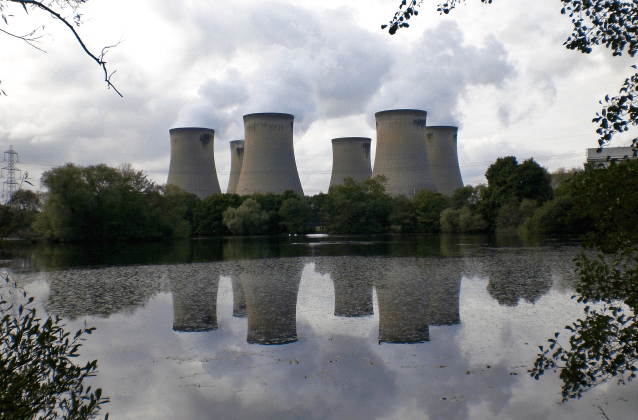
Drax Power Station There have been some mixed messages regarding the Drax bio-mass plant in Yorkshire. The Guardian recently reported the business and energy secretary, Kwasi Kwarteng commenting that ‘importing wood to burn in Drax power station was not sustainable and doesn’t make any sense.
’More publicly, Kwarteng is actively promoting ‘sustainable biomass’, when he recently tweeted, ‘Sustainable biomass powers 4m homes – a critical part of our energy mix. Today’s plans will kick-start a new industry in the UK: bioenergy with carbon capture and storage (BECCS). Clean, affordable energy – and thousands of jobs.’
In 2021, Drax’s own annual report revealed that they had earned £893 million in government subsidies, or tax-payer money, for burning biomass. Over the last decade, the UK Government has given Drax £5.6 billion in subsidies.
In the July document ‘York and North Yorkshire Routemap to Carbon Negative’, the council revealed that they would continue to invest significantly in Drax
‘As one of the few areas within the UK which has the potential to go beyond net zero, York and North Yorkshire can sit at the heart of the UK’s decarbonisation plans and create significant economic opportunities. We can build on the region’s existing industry strengths, including: · Drax – significant investment in Bioenergy with Carbon Capture and Storage (BECCS) and associated supply chain opportunities.’
It appears simply that funding is delayed for projects that reduce carbon emissions such as electric vehicle infrastructure, while investments continue in power plants which are ‘not sustainable’.
-
Subscribe
Subscribed
Already have a WordPress.com account? Log in now.
 Climate Thoughts with Brian