-
Review of ‘Humanity’s Moment: A Climate Scientist’s Case for Hope’ by Joëlle Gergis

‘Humanity’s Moment’ is a masterclass in climate communication, with Dr Gergis detailing the climate impacts already being felt and aligning these with real emotional and psychological responses. Dr Gergis served as a lead author for the IPCC Sixth Assessment Report and is an authority on the climate science underpinning the report. This is not a dry science textbook however, Gergis draws on the recent work by Rebecca Solnit and Caroline Hickman to explore the climate anxiety felt by many around the world. She argues that ‘Until we are prepared to be moved by the profoundly tragic ways we treat the planet-and each other- our behaviour will never change.’
Her aim in ‘Humanity’s Moment’ is to help people recognise that we are here, at this time, despite our wishes to be alive at any other time, or to quote Tolkien, as Gergis does, ‘”I wish it need not have happened in my time,” said Frodo.”’ And that we have the capacity for great change, as we have done so many times in the past to come together as a species to recognise our humanity. ‘This book is an invitation to reclaim our shared humanity at this transformative time in history, wherever you are in the world. You want to be a part of the group of people who cared enough to try…How bad we let things get is still up to us- the apocalypse is not a done deal.’
Gergis convincingly outlines thatwe must feel the impacts of climate change- we must connect with the impacts- we must respond to the impacts. She draws attention to the need to remove ourselves from a driving, relentless media which aims to enthral our attention with sensation without substance. She praises the uncertainty of science language, but acknowledges that this approach is now widely understood or necessarily appreciated. ‘Its measured pace is in direct conflict with the relentless speed of the news cycle. This means that the loudest voices- which are not necessarily the most informed, or even sane, often dominate public commentary…Hence our use of carefully crafted uncertainty language, which is at odds with the fast and loose approach others are willing to take. Sensational clickbait always seems to win.’
Gergis outlines her argument early in the text- that an understanding and acceptance of the warnings from climate science, have to be met head on with an understanding and acceptance of climate change on every level- physically, emotionally, and spiritually.
To quote Shakespeare’s ‘Macbeth’: ‘Dispute it like a man. Macduff: I shall do so, / But I must also feel it as a man.’
‘Climate change is real and it is here, and it’s not going away. We need your help.’
Gergis expertly draws out the conclusions from IPCC reports and breaks this into straightforward, easily understood language, which makes the necessary action explicitly clear. ‘Right now, current policies in place today, will lead to 1.9-3.7°C of warming by the end of the century, with a best estimate of 2.6°C…the best-case scenario could see global warming stabilize between 1.4 and 2.8°C by 2100, with 2°C considered most likely. To have a chance of limiting warming to 1.5°C by 2100, global emissions need to halve by 2030.’
She draws out that the rate of climate change is almost entirely without precedent in the history of the planet and that the last 200 years and the rise of approx. 1.2°C since industrialization, which is around seven times faster than the average rate of warming since the last ice age, where the planet took around 5000 years to warm around 5°C. In short, instead of 0.1°C per century, the planet is now warming at approx. 0.1°C per decade. ‘The current speed of climate change is effectively without precedent in the entire geological record spanning 4.6 billion years. The only exception is the instantaneous meteorite strike that caused the extinction of the dinosaurs 66 million years ago.’
‘I face them because I must.’
The heatwaves and other climate events of July 2023 have forced the eyes of the public open to an issue, which for many, was ‘psychologically distant’ (to quote Prof Hayhoe). All of a sudden, what seemed a problem for children and grandchildren, was here and now. ‘We know that the planet is warming, but just how quickly and dramatically things are changing is stunning the scientific community.’ It is therefore no accident that Gergis quotes from the World Weather Attribution team- a team which has concluded that the recent heatwaves in Southern Europe were ‘virtually impossible without climate change.’ She additionally makes the case that the IPCC report also can now speak in more absolutes than they have before: ‘Perhaps our most significant conclusion is that it is now an established fact that human activities have altered all aspects of the climate system…In other words, humans are responsible for virtually all observed global warming.’
An aspect that appealed to me about this book was that once Gergis had summarised the scientific conclusions, she then explored what this might mean for individuals and indeed the impact on her herself as a scientist, being deeply immersed in the data. ‘I’m sure you’ll agree that thinking about climate change can be overwhelming. Thinking about it day in day out as a scientist can sometimes feel so crushing…I face these things not because I find it easy or comforting. I face them because I must.’
‘Averting planetary disaster is up to us.’
The first half of ‘Humanity’s Moment’ then, is Dr Gergis succinctly summarising the science that has led us to this point in a rational and reasonably detached manner. Although the book is structured into 3 distinct parts of ‘The Head’, ‘The Heart’ and ‘The Whole’, it felt to me that there was a sense of ‘How we got to this point’, followed by ‘What we do next.’ To truly understand what is at stake, we need to move out of the realm of the head, and into the wisdom of the heart.
The only flaw in Gergis’ approach was perhaps assuming that the scientific information and the rational approach would move people from their entrenched position of denying the impact and extent of climate change.
Gergis could not make it clearer when she writes, ‘It’s a very blunt warning that unless we drastically change course and cut emissions in half by 2030, and reach net-zero emissions no later than 2050, we are on track for catastrophic levels of warning that will profoundly alter all life on Earth.’ The sad point is that this statement still isn’t enough to mobilise the necessary climate action in time, leading Gergis to ask- can we muster the best of humanity in time?
‘The Lost World’
Gergis devotes time in her book to appreciating the beauty of nature and biodiversity and to signpost to others the importance of what can be saved, stating ‘We must re-establish our connection with the natural world, restore our care for the Earth and with it our humanity.’
It is relevant that Gergis also spends time exploring in detail the growing impacts of heatwaves and water crises that are crippling communities around the world, especially as multiple countries around the world are burning with heatwaves and wildfires.
But to appreciate the worlds that might be lost- which are being lost- individuals need to connect with nature spots around them. Gergis highlights several sites that offer her a connection to something larger than herself- whether this be the ocean and therefore ocean communities already suffering the impacts of climate change and forced to become ‘climate migrants’- the first of the projected hundreds of millions, depending on the pathway we choose.
‘The Culture of Uncare’
Gergis then moves into a fascinating space- that of the mental health impacts of the growing climate crisis. She purposefully quotes from Caroline Hickman and the University of Bath’s study, as well as Sally Weintrobe’s ‘Culture of Uncare’. Are governments doing enough to address the crisis? Are governments pretending to do enough? As Gergis states: ‘We know exactly what we need to do, but we still aren’t prepared to do it.’
What impact does this have on the young who will be left with a world that has been created for them by the actions of their elders, who appeared too selfish to care about them? Will we all be like Cain, Abel and Seth, bemoaning our exile from the Garden of Eden, based on the selfish actions of Adam and Eve?
‘The IPCC report clearly states that we know we need to reduce greenhouse gas emissions by at least 50 percent between now and 2030 to keep this goal within reach.’
A new day is dawning
Gergis then completes her book by outlining multiple methods where people can take action and can usefully focus their energies to ensure that the message that people do care is a strong one. She argues, ‘We are witnessing the biggest social movement of our time…When we align our values with our actions, we are unstoppable.’
She defends the efforts of climate scientists who have been informing the public for decades and who in recent years have become climate activists in their own right- demonstrating that ‘activism’ should not be regarded as a pejorative, or a lazy slur used on social media.
‘I want you to know that there are scientists who really care about the future we are leaving our kids and their kids a thousand generations from now. We did all we could to warn the world. We tried to minimise the intergenerational damage. What happens next is up to all of us: who you vote for, what you buy, how you spend your brief time on this planet matter more than ever.’
Gergis concludes by arguing that the coming social revolution is inevitable and that positive urgent climate action, which does not rely on desperate technology that cannot be scaled up, is here, if we know where to look with open eyes. ‘This is humanity’s moment to right the wrongs of the past, to heal our relationship with each other and all life on Earth. We just need the moral compass of our shared humanity to guide us home.’
‘Another world is not only possible, she is on her way. On a quiet day, I can hear her breathing.’- Arundhati Roy
-
Review of Jeff Goodell’s ‘The Heat Will Kill You First: Life and Death on a Scorched Planet.’
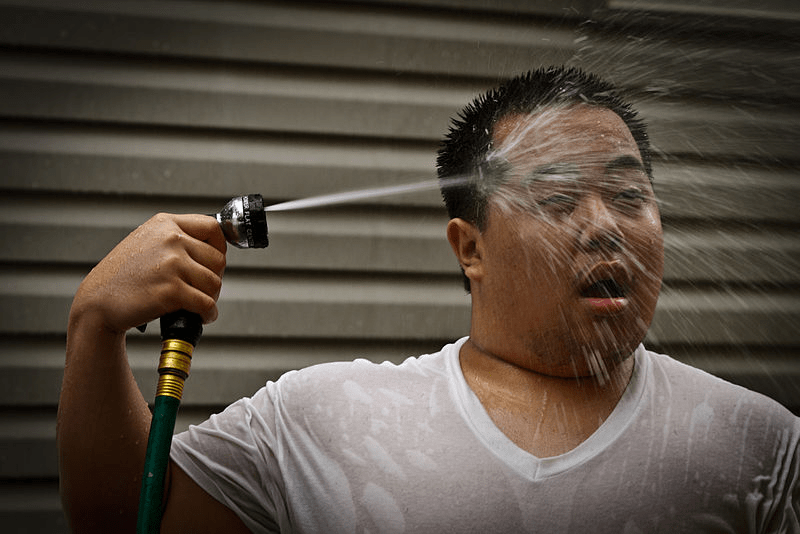
2023 has been the year where we have recently seen global temperature records being broken repeatedly, sea surface temperature anomalies in the North Atlantic making the international news, and Antarctica sea ice extent hitting new record lows.
In a world that has seen the UN describe climate change as being ‘out of control’, Jeff Goodell’s latest book, ‘The Heat Will Kill You First: Life and Death on a Scorched Planet’ will be required reading for many and will easily act as the only roadmap we have to navigate the extreme temperatures that are impacting our present world.
Goodell achieves the seemingly impossible- he condenses the multiple issues relating to extreme heat within an engaging and detailed structure, which always focuses on the impact on people and connects us with our humanity. ‘Wherever we may be headed, we are all on this journey together.’ He outlines his aim early in the text, ‘In this book, my goal is to convince you to think about heat in a different way. The kind of heat I’m talking about here is not an incremental bump on the thermometer or the slow slide of spring into summer. It is heat as an active force, one that can bend railroad tracks and kill you before you even understand that your life is at risk.’ This book is full of the author’s experiences and direct encounters with the impact of extreme heat. It is not however, a ‘doomist’ mission statement- rather, he clearly states the impacts being felt now in our warming world, highlighting where countries and cities could make the changes necessary to save lives.
Extreme heat will be the defining feature of the next decade,as it drives climate migration, exposes social injustices, threatens lives, endangers crops and increases the risks of zoonotic diseases- all issues dealt with expertly by Goodell. ‘As the temperature rises, it will drive a great migration— of humans, of animals, of plants, of jobs, of wealth, of diseases.’ This is also a topic addressed by Gaia Vince in ‘Nomad Century’, where the challenge of climate migration is detailed in full and where rising temperatures force people to move out of stable, safe zones.
Goodell outlines at the start that the ‘Goldilocks’ zones that have helped keep the planet stable are now in danger of being pushed to their limits. ‘Extreme heat is remaking our planet into one in which large swaths may become inhospitable to human life. One recent study projected that over the next fifty years, one to three billion people will be left outside the climate conditions that gave rise to civilization over the last six thousand years.’ In recent weeks, we have witnessed residents in China seeking safety underground in air-raid shelters, from the extreme heat, as temperatures remain at record-high levels, with drought compounding the country’s ability to manage and adapt.
‘Things fall apart; the centre cannot hold’
Goodell offers a warning from his opening chapters, where he describes the cautionary tale of a family being overcome and dying owing to extreme heat and hyperthermia while on a hike. The typical structure of most of his chapters is to focus on a specific event where people have been impacted now by extreme heat, in a world that has not yet reached the 1.5°C ‘limit’ agreed in the Paris Agreements. These negotiations had the goal of legally binding countries to hold the increase of global average temperature to well below 2°C. In June 2023, the global average was 1.3°C above the pre-industrial levels.
‘We simply have not come to terms with it, especially in the way I am describing. It is not how anyone expects to die. In part, it’s because we live in a technologically advanced world where it’s all too easy to believe that the rough forces of nature have been tamed. But it’s also because our world is changing so fast that we can’t grasp the scale and urgency of the dangers we face.’
Goodell outlines the historical and evolutionary steps which allowed humans to adapt and become one of, if not the most dominant, life-form on the planet. He describes how walking upright kept us away from the dangers of heat from the ground and how sweat glands allowed us to regulate the temperature of our bodies. ‘But to take the next step in human evolution, to really allow our ancestors to range widely in the newly warmed world, they still needed one more key evolutionary innovation. They needed to learn how to sweat.’ The discovery of ‘Lucy’ in Ethiopia in 1974, a female human ancestor who lived about 3.2 million years ago, brought more clues about how humans operated, managed and developed the expansion of the species.’Heat management is a survival tool for all life on Earth.’
A Brave New World
Humans eventually found themselves building modern cities, though the skills of the past in terms of building to be in conjunction and harmony with nature, seems to be lost now, as more and more ‘concrete jungles’ appear. Goodell explains that, ‘By 2050, 70 percent of the world’s population will live in cities.’ He continues that ‘Modern cities are empires of asphalt and concrete and steel, materials that absorb and amplify heat during the day, then radiate it out at night.’ He carefully outlines the lived experience in cities like Chennai, India, where urbanisation and urban demand has created a melting pot (literally) of extreme issues. ‘“The ancient south Indian port has become a case study in what can go wrong when industrialization, urbanization and extreme weather converge and a booming metropolis paves over its floodplain to satisfy demand for new homes, factories and offices.”’
Goodell additionally explores in detail the issues when culture and extreme heat come into conflict by thoughtfully evaluating the heatwave in France of 2003, where the historical importance of zinc roofs became traps for intense heat. Underlining the fact that when cities were built, they were built for different temperature extremes and range. ‘The last time the Earth was hotter than it is today was at least 125,000 years ago, long before anything that resembled human civilization appeared. Since 1970, the Earth’s temperature has spiked faster than in any comparable forty-year period in recorded history. The eight years between 2015 and 2022 were the hottest on record.’ There are difficulties of trying to retrofit a city to adapt to extreme heat, especially where there is no history of climate culture. ‘There had been hot days in Paris, but nothing like this. For nine days in August, the daytime temperature was above 95 degrees, sometimes spiking up to 104 degrees. It didn’t cool off much at night either…In less than two weeks in 2003, fifteen thousand people in France died as a direct result of the heat wave.’
Moving to hot zones
Life is moving away from inhospitable zones, as people move to these stressed cities, increasing the pressure and demand on dwindling resources. ‘The UN estimates that four out of five African countries don’t have sustainably managed water resources and that seven hundred million people will be on the move by 2030.’ Goodell summarises that ‘Climate change compounds risks for cities: heat, floods, failing infrastructure, displaced people.’
Animals are also on the move, meaning more contact between species than before, increasing the risk of zoonotic spillovers- a risk that is being studied carefully by scientists in order to be as prepared as possible. ‘In the past decade, scientists who study the movement of animals have found that of the four thousand species that they’d tracked, between 40 and 70 percent had altered their distribution. On average, terrestrial creatures are moving nearly twenty kilometers every decade.’
Goodell devotes a whole chapter to the emerging and present threat of spillover diseases, while also detailing the spreading impact of mosquitoes and the threat of the dengue virus. ‘But the biggest impact on human health and well-being may be the emergence of new pathogens from animals…By 2080, five billion people, or 60 percent of the world’s population, may be at risk for dengue.’ Furthermore, he highlights the potential dangers currently hiding in the Arctic permafrost, which may yet see the light of day in a warming world. ‘Thawing permafrost in the Arctic is releasing pathogens that haven’t seen daylight for tens of thousands of years.’
‘You owe us, and you need to pay.’
Who is responsible for putting the people of Earth in this situation and what solutions are they offering should be the simplest question to ask. Planetary changes are now underway that will impact most life on the planet- our fingerprint on our planet has been given the name of the Anthropocene, so how has this happened?
The inclusion in Goodell’s book of attribution science and the impact of Dr Friederike Otto and others’ work, is a vital one in identifying whether climate events could have happened without climate change- and identification of responsibility is just the first step on the way to climate justice.
‘“To me, science is— or can be— a tool for justice,” she [Otto] told me. “Extreme event attribution is the first science ever developed with the court in mind.”’
For example, to directly attribute climate change as the cause of an event could eventually lead to the largest fossil fuel companies being taken to court for damages. This is a highly charged financial battlefield, which may resemble the battle to hold Big Tobacco to account for the consequences of their product.
‘ExxonMobil, which, by some measures, is responsible for about 3 percent of historic global CO2 emissions, could be sued for 3 percent of the deaths or property destruction and economic losses from every climate-driven flood and heat wave— past, present, and future. To say that there are hundreds of billions of dollars at stake doesn’t begin to describe it.
No more ‘Earth is getting greener’
Atmospheric carbon dioxide is now at levels not seen in modern human history and have risen by approximately 50% in the past 200 years, or from the Industrial Revolution. Goodell successfully and thoroughly rebuts the ‘Earth is getting greener’ argument trotted out by those who wish to deny human-caused climate change, whether this will be the final word to this argument though is perhaps wishful thinking on my part. He points out that simplistic soundbites do not scratch the surface of a complicated interconnected issue.
‘And it’s true that as CO2 levels in the atmosphere increase, the Earth is getting greener. But it’s more complicated than that. Like humans, plants also acclimatize, so the effect diminishes with time. CO2 also means more heat, and the effects of heat quickly overwhelm the benefits of higher CO2 . It also makes some plants less nutritious. Rice grown in high-CO2 conditions has lower amounts of protein, iron, zinc, and B vitamins.’
When we have a staple crop like rice being threatened by extreme heat, this becomes an issue that needs to be addressed, which Goodell does convincingly. How we feed the world over the next century is not a straightforward problem. ‘In the coming years, the challenge of feeding the world will only get more complex. For one thing, the world population is projected to grow from 8 billion today to nearly 10 billion by 2050. To meet the expected demand for food by midcentury alone, global agricultural output will have to rise by more than 50 percent.’ Threatening food production and agriculture is becoming a military weapon, as demonstrated when Russia invaded Ukraine- whether this could be a future war crime could make an interesting legal argument.
‘Unprecedented conditions’
Goodell does not content himself with dealing with issues on the land either. He details the impact on marine life of rising temperatures. ‘It’s also compelling evidence of how tightly all life on Earth is linked to the ocean. Because we live on land, we often think of heat as a terrestrial event. But as temperatures rise, it’s what happens in the ocean that may have the biggest impact on our future.’ He quotes from the stark 2019 IPCC Special Report on the Ocean and Cryosphere in a Changing Climate, which summarised the impact of the unpredictability of the coming decades, ‘Over the twenty-first century, the ocean is projected to transition to unprecedented conditions.’
It is particularly noticeable that food security featured significantly in this report which had the ocean and cryosphere as its focus. As Goodell notes however, ‘The ocean is the main driver of our climate system.’
Making an invisible killer visible
Goodell begins to conclude his book by exploring the difficulty of visual communication surrounding extreme heat. ‘But there are no iconic images of extreme heat.’ He outlines that the poignant images of polar bears or dwindling ice, do create an emotional response, but that all too soon, people forget and go about their daily lives, until the next heatwave. ‘The memory of the heat wave faded, as memories of heat waves always do, until they become like the fleeting images of a nightmare you’re not quite sure you had. Or a future you don’t want to imagine.’ He argues that ‘The way we communicate about extreme heat is often distorted by nostalgia for a climate that no longer exists.’ and that, ‘We are constantly bombarded by images that suggest that if paradise does exist, it is warm and sunny.’ To break this cultural ideology that ‘hot is cool’, will require better language, images and communication, but at present, people simply do not understand the risks of extreme heat with sufficient clarity to perceive it as ‘an extinction force.’ ‘Moreover, people die because they don’t understand the warning signs of heat exhaustion and heatstroke or don’t take precautions and ask for help when those warning signs appear. There is so much ignorance and confusion about what to do in extreme heat situations.’
The undiscovered country
Goodell concludes, not with defeatism, but with a sense of challenge and a connected experience with the rest of the world and in that, there is hope. ‘There are no maps for this journey we are taking, no virtual reality tours of the road ahead.’
Extreme heat will affect us all eventually. We can’t simply wait for it to arrive, because for some, it is already a daily threat and we cannot look down from our place of safety and not act. ‘In many places in the world today, heat is rising faster than our ability to adapt to it.’
This book should be branded in the minds of every person on the planet. This is not just the inherited world we will pass on, but the world of today. A world which has been damaged by our indifference to the impact of our actions. ‘We have not only continued burning fossil fuels, we have continued burning them with reckless abandon.’
For me then, it is powerful that Goodell frames this as an opportunity, a challenge and a story- and stories have a long lasting cultural memory.
‘This is the great story of our time, one that I feel privileged to tell. And yes, it gets dark sometimes. But it is also endlessly inspiring because I meet so many people who are fighting for the future and reimagining everything about how we live on this planet.’
‘Wherever we may be headed, we are all on this journey together’
-
Review of ‘The Three Ages of Water’ by Peter Gleick
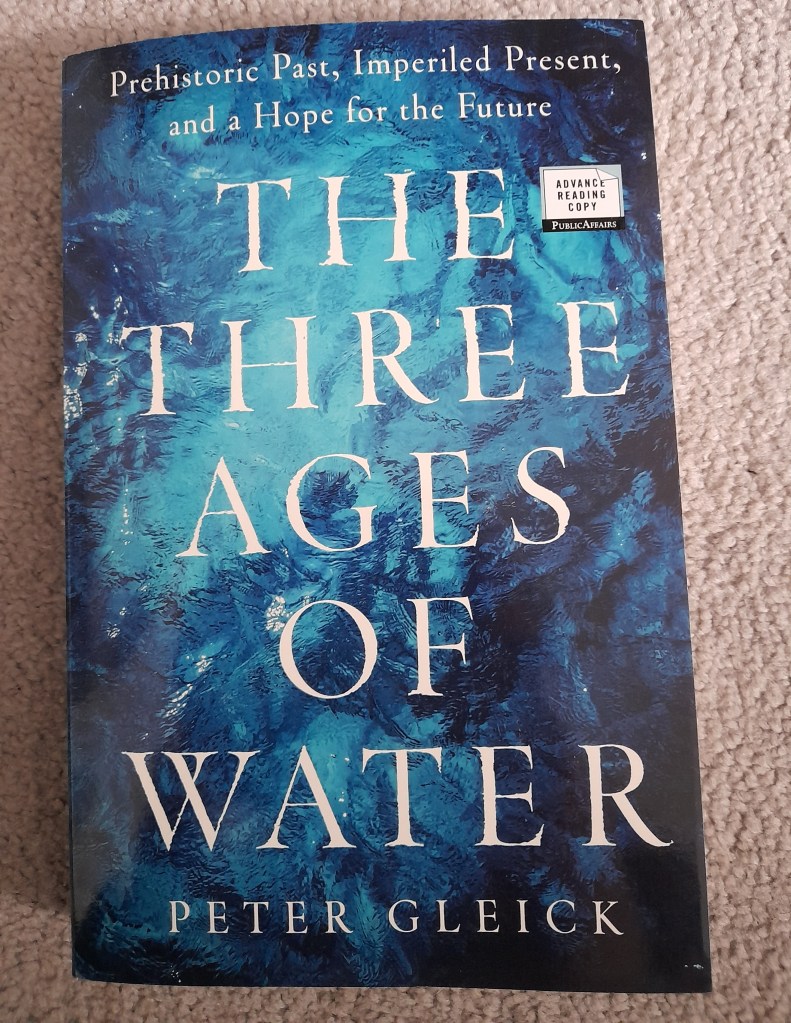
Gleick’s book is an engaging, detailed and yet wide-ranging, authoritative exploration of the relationship between humans and water and how a positive sustainable world is within our reach.
He describes that we have already had the first two Ages of Water, with the Third Age being the positive, equitable vision that realises the benefits of water for everyone. ‘In the First Age of Water, the earliest human relationship to water was both central and unplanned…The Second Age flourished in the seventeenth and eighteenth centuries when cities around the world were reaching critical size… The Second Age of Water has also brought the first global threats.’
Gleick expertly opens with the story of water from the beginning of time and explores the impact of the presence of water at the start of the creation of the Earth. He then details the existence and possibilities for water elsewhere in the solar system and argues that ‘The creation of life on Earth is bound together with the story of water in both science and culture.’ He closely examines the creation myths across cultures, which all use waters, to either create or destroy. ‘In 4,000-year-old Sumerian creation myths, heaven and earth were formed from a watery chaos by the goddess Nammu.’… ‘The three main Western religions, Judaism, Christianity, and Islam, all borrowed themes from Mesopotamian cultures and a describe a god creating the heavens and the earth including the first waters and bringing order and light from chaos.’ It is perhaps no accident that it is four rivers which flow from the Biblical Garden of Eden.
His discussion of water in belief and mythology inevitably brings him to the repeated Great Flood stories that are shared between cultures. ‘Every child of the Western religions of Judaism, Christianity, and Islam hears the story of the Great Flood sent by God.’ He does not limit this evaluation to ‘Western’ religion, but also explores Hindu texts, as well as Sumerian, Akkadian and Babylonian texts such as ‘The Epic of Gilgamesh’ to search for geo-physical clues to support a cultural mythology.
The Second Age of Water- Our Age
Human attempts to harness, channel and manage water then become Gleick’s focus, as he outlines the impact of water for the beginnings of agriculture. Aqueducts, wells and dams are all highlighted as innovations to control water through engineering. ‘The era of large-scale water engineering, with succeeding empires learning from and advancing the practice of moving, storing, and manipulating the hydrologic cycle.’ It should be noted that Gleick also emphasises water as part of the story of human migration and dispersal.
He also warns of the unintended consequences of the mastery of water. That the relationship between humans and water has been, up to now, a relationship of power, with humans using water and access to water, for geopolitical ends. ‘The Nile River in Egypt is the only major source of water for the country of 100 million people. Yet ten other countries share the watershed, all of them upstream of Egypt with their own growing populations and demands for water.’
Flowering opportunity unfortunately became opportunities for conflict to dominate others. It sadly remains true that whoever controls the water, controls the power.
‘Ultimately, the need to understand and control nature, and especially fresh water, helped drive the melding of art and science, engineering and technology, and law and economics that defined the advances of the Second Age of Water… And with these advances came the unintended consequences of pollution, ecological disruption, water poverty, social and political conflict, and global climate change.’
Gleick examines some of these unintended consequences, as he turns his attention to water-related diseases in a detailed and comprehensive manner, as he recounts the successes of medical advancement in linking diseases such as cholera with illness and death. He focuses on the scientific and methodical work of John Snow, who demonstrated that cholera was waterborne and therefore managed to save numerous lives. Gleick argues that a lack of access to safe water is still a present threat to people around the world today and that this sadly has not been a problem that has already been eradicated. ‘Deaths from diseases associated with the lack of safe water and adequate sanitation kill on the order of 2 million people a year… Water poverty in a global crisis with victims in every country… In 2020, the United Nations estimated that 2 billion people lacked access to safely managed drinking water free from contamination.’
He closes this section on the consequences of the Second Age of Water, by stating that we are now in a transformational phase. ‘The Second Age of Water is coming to an end, and not a moment too soon. The world as a whole must make a transition away from its current unsustainable path and forge a new future.’
The Third Age
In his concluding chapters, Gleick acknowledges that, ‘We live on a planet of hydrological extremes.’ And that, ‘This isn’t a book about climate change; it’s a book about water. But you can’t talk about one without talking about the other.’ He once again warns that transformative attitudes must come before transformative actions.Before Gleick turns his attention to the myth of the ‘golden bullet’ of desalination plants to provide technological solutions- ‘The greatest challenge to the widespread use of desalination is the high economic cost of building and operating the plants and providing the energy to strip salt out of water’, he bemoans our negligent ignorance of the precious commodity of water. He stresses the importance of recycling and reusing that is done aboard the ISS and argues that every drop should be viewed as important. ‘When we recognise the true value of water, a whole new way of thinking- and doing- emerges, and water and ecosystems become resources to protect, conserve and even restore, rather than pollute, consume and destroy.’
He repeats his core message of the book that, ‘By learning from the past, humanity can better understand the present and then imagine and build a better future.’
Gleick suggests that our future hopes for a sustainable world for both water and the planet must begin with the vision of a positive, equitable world. ‘Two divergent paths lies before us: one to that dystopian future, the other to a positive, sustainable world. Just as we can imagine a disastrous future, we can imagine a positive one, with a balance between humans and nature.’
In saying this though, his concluding remarks are a stark reminder that we are accountable and responsible for our own future world- that this positive vision cannot simply be wished into being, but rather that it shall not find us afraid to build a new world.
‘If we fail to achieve the positive future for water, it won’t be because we can’t. It will be because we didn’t.’
-
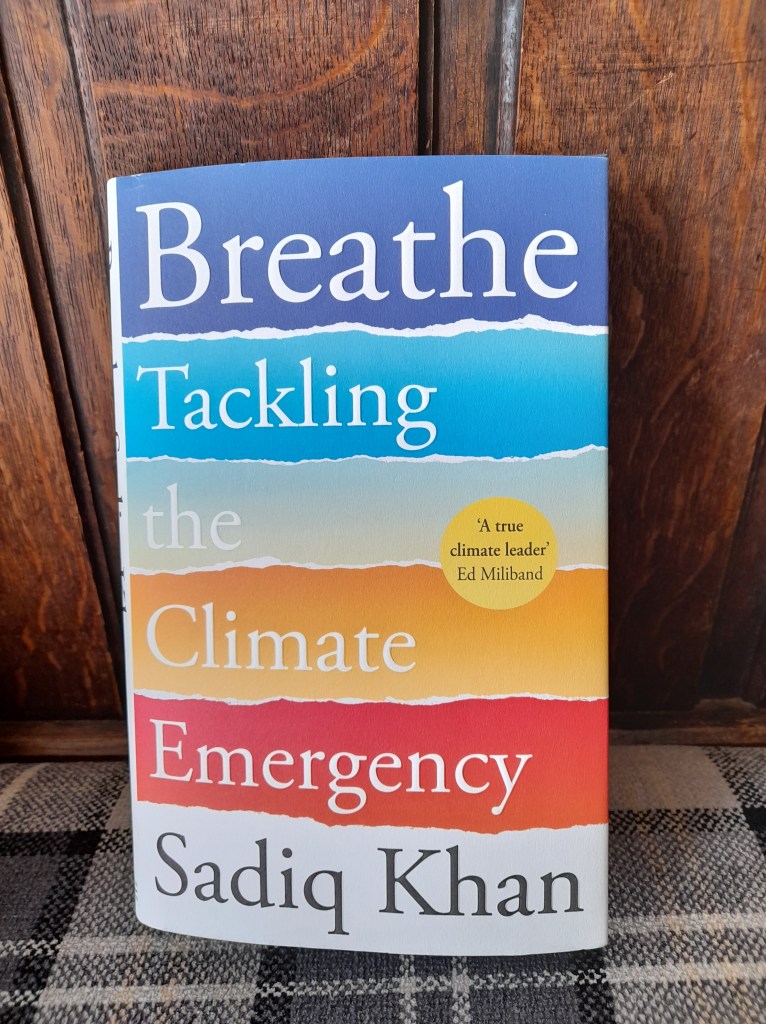
Review of ‘Breathe: Tackling the Climate Emergency’ by Sadiq Khan
‘Breathe, said the wind
How can I breathe at a time like this,
when the air is full of the smoke
of burning tires, burning lives?’-Lynn Ungar
Despite the frankly ridiculous tearing up of Sadiq Khan’s book ‘Breathe’ by Talk TV presenters on live television a few days ago, no stunt by them can get away from the central point in the book.
Air pollution is killing people in London, and around the world, and it doesn’t have to be like this.
Khan cleverly organises the book into the attitudes-or obstacles- to issues like air pollution that are viewed and displayed- from Fatalism and Apathy, through Deprioritisation and Hostility and Cost and bookends the text with the story of Ella Kissi-Debrah, who is the first person in the UK to have air pollution listed as a cause of death. Khan’s book argues how we can avoid any more deaths like this.
Make air cleaner to save lives
Khan makes the early point that the impact of air pollution is linked to social disparities. ‘But while we breathe, we don’t all breathe the same air.’ Although this book is obviously London based, the same impact is felt in other cities. ‘If you’re living in a more deprived area, you’re much more likely to experience the negative effects of air pollution.’ Owing to an accident of geography then, your life span may not be equal to someone else in another area of the same city, simply owing to air pollution levels alone- and the impact of this is worse for the young with their developing lungs. ‘It revealed that hundreds of the capital’s primary schools were in areas where pollution breached the EU’s legal limits. Of these, 83 per cent were considered ‘deprived’ schools where more than 40 per cent of the pupils were entitled to free school meals.’
The World Health Organisation recently described air pollution as being ‘one of the greatest environmental risks to health.’ Khan picks up this point in his book and notes that, ‘The nine million early deaths it causes each year makes air pollution a bigger killer than tobacco smoking. These deaths are disproportionately concentrated among the most disadvantaged people in society.’
Making the invisible visible
Khan openly admits that at times he had viewed climate change, as not the priority issue that he now views it. ‘Climate change had always seemed very far way- both geographically and temporally. It was a ‘tomorrow’ issue rather than a ‘today’ issue.’ He states that through education, as well as personal asthma concerns, he realised the extent of the problem. In essence, this is the crux of the book- identify an issue and then work with interested parties to eradicate that problem in order to help as many people as possible. ‘The climate crisis was an issue right here in London.’ Khan outlines the measures and campaigns that were issued to grow the understanding of Londoners to this issue of air pollution- from graphic campaigns depicting soot, stating, ‘If you could see London’s air, you’d want to clean it too.’ Interactive air-quality maps showing the levels of air pollution in London were also used in attempts to alter the perception issue that climate change is only a problem for ‘them’, ‘over there’, but rather it is a problem for us, here.
The world today is not the world of ten years ago.
Khan takes the time to outline that the climate crisis is not the divisive issue that populist figures would have us believe. Nor is it a ‘political issue.’ Those who have the power to act, to mitigate and to plan, may be the mayors, politicians and councils, but that in itself does not ‘politicise’ the scientific evidence, despite attempts by the current US Republican nominee, Ron DeSantis to ‘politicise the weather.’ As a public, we have to be grown up to spot and ignore these attempts to delay action that can save lives and Khan suggests that the evidence suggest that we are growing up as a society. ‘Voters care about climate more than they ever have before.’ ‘In 2021, 82 per cent of Londoners were concerned about climate change, with more than two-thirds saying their level of concern had risen in the last year. Yet when you read the news or turned on the TV, you could be forgiven for thinking that climate change was a divisive issue.’
Learning the lessons
Khan details in his book the impact of the global pandemic and the impact of coronavirus especially for people in London. He also looks at what lessons could be learned from a global mobilisation to a problem and how to lead people during this time. He makes the point that when faced with a global emergency, working out the priority is key. ‘Rightly, the focus becomes saving lives first, and saving the economy second.’ This does not sound like the worst motto for action to mitigate the climate emergency. Khan notes the actions that have been put in place in London to reduce air pollution- such as ULEZ, building the infrastructure for 15-minute cities and focusing on sustainable transport. He always assesses the impact of his climate policies and records that, ‘The proportion of bicycle and walking journeys had increased from 29 per cent pre-pandemic to an estimated 46 per cent post lockdown.’
Changing the language?
Khan acknowledges that a change of language could be a useful approach- he notes that ‘the solutions to air pollution and climate change are often the same.’ The impression that this creates, is that he does not appear to be too invested in what we call the problem, as long as we enact solutions to the issue. This echoes the recent words of actor and ex-Governor, Arnold Schwarzenegger, who, in an interview said, ‘So my thing is, let’s go and rephrase this and communicate differently about is and really tell people we’re talking about pollution. Pollution creates climate change and pollution kills.’
Khan rightly concludes that ‘There is so much more that we have to do.’ It’s beyond time to question why what has been successful in London cannot be rolled out across other major cities, so that we can be the generation who ensures that no more children die from air pollution in our country, because we have been too apathetic to solve the problem.
-
Review of ‘The Future of Geography’ by Tim Marshall

When did a spacecraft from Earth first land on the Moon?
Who owns the Moon?
How many people have walked on the Moon?
How many flags are there on the Moon?
What legal frameworks regulate space activity and who enforces these frameworks?
Tim Marshall returns in ‘The Future of Geography’, a prophetic vision of what the geopolitics of space could look like over the next 50 years, as countries and private companies compete to control power and access to humanity’s shared future. Marshall’s comprehensive style will be familiar to readers of his previous works, such as ‘Prisoners of Geography’ and ‘The Power of Geography’ and his insights and commentary on the dangers of astropolitics, could help us chart the new frontier of space.
Marshall structures the book highly effectively, paying homage to the scientists and thinking that has helped humanity get to this point in space exploration- then evaluating how each of the three main superpowers of the USA, Russia and China have progressed in their plans and what their ambitions might be- then finally exploring what tomorrow’s world might look like, as private companies and entrepreneurs race to put their stamp on the history books.
He acknowledges that ‘Space has shaped human life from our very beginning.’ He charts the human fascination with the stars from hunter-gatherer tribes to the Babylonians and Sumerians to the Greeks, Romans and the Golden Age of Islam. He tracks the development of scientific exploration through the familiar names of Copernicus, Giordano Bruno, Galileo Galilei, Newton and Einstein and emphasises that the knowledge of the past has been surprisingly accurate in its measurements of the Earth and its place in the stars. He focuses on Eratosthenes of Cyrene, who over 2000 years ago concluded, without the equipment available to use today, ‘that the Earth’s circumference was between 40,250 and 45,900 kilometres. The actual circumference is now usually accepted as 40,096 kilometres.’
Marshall describes how ‘‘Much of human endeavour has been driven by our desire to reach for the stars’ and that the last few decades have pushed humanity to the edgeof tantalising further discovery. ‘And the desire to find out, to know more- and even to go there ourselves- has proved irresistible.’ He also warns that we need to ensure that we do not take our current insular political conflicts with us- that we cannot repeat the mistakes of the past and that advancing into space is for all humanity and should not be controlled by a single entity or a loose, unstable partnership of organisations. ‘If we cannot find a way to move forward as one unified planet, there is an inevitable outcome; competition and possibly conflict played out in the new arena of space.’
‘Earth is the cradle of humanity.’
Marshall quotes the Russian scientist Tsiolkovsky, who said ‘Earth is the cradle of humanity, but one cannot stay in the cradle forever.’ Marshall explores in detail the decades following World War 2, when humanity took its first faltering steps into the cosmos. ‘We first crossed the border with space less than a century ago. But it was conflict on Earth that finally got us there. The technology that took us to the heavens came from the arms race of the Cold War.’ He notes the number of historical ‘firsts’ that the Russians had in their space progression, much to the Americans’ chagrin, and reminds his audience that Russia reached the moon first, albeit through a ‘hard-landing’, ‘Then in 1959 the Soviets had a hit, literally, when Luna 2 became the first spacecraft to reach the surface of the Moon.’ The Space Race that excited the 1960s, appeared to diminish soon after the successful landing, and notably, flag planting, of Apollo 11.Marshall comments that it was a historic global effort that helped Armstrong take that first step. ‘Armstrong is a colossal figure, but he knew he stood on the shoulders of giants such as Gagarin and Tsiolkovsky, Goddard, Oberth, Korolev, von Braun and, before them, the great scientists down the ages.’
There is almost a nostalgic tone from Marshall in this chapter, as if he feels that the late 1960s could have been the moment that fuelled space exploration in a momentous and significant way for the entirety of the Earth. He acknowledges the reasons for the Space Race coming to an end when it did, as budgets and political pressures became important, but also recognises that the Moon still has a hold on us all. ‘It’s estimated that about 110 billion humans have walked on the surface on Earth. Almost all of them will have gazed at the Moon in wonder. But only 12 have walked there.’
It is now over 50 years since humans have walked on the Moon, encouraging Marshall to explore the question- is it now time to go back?
‘Apollo 17 was the last, leaving on 14 December 1972, and since then no one has been back.’
Location, location, location
In a fascinating manner, Marshall outlines the reasons for countries and ‘space superpowers’ to go back to the Moon and indeed continue with space activity. He compares space geography to Earth geography and notes that if an interested party controls access, then they can control the power.
‘If a space superpower could dominate the exit points from Earth and the routes out from the atmosphere, it could prevent other nations from engaging in space travel. And if it dominates low Earth orbit, it could command the satellite belt and use it to control the world.’
Low Earth Orbit, from 160km- 2000km, is one of these key locations, owing to satellite engagement there. ‘Strategically, low Earth orbit is a potential ‘choke point’. ‘Low Earth orbit is an attractive piece of real estate because that’s where most satellites operate.’ He also identifies the 5 Lagrange points of our system as being another key tactical area. ‘The Lagrange points of the Earth-Sun system are advantageous positions to place satellites.’ Marshall indicates that space expansion has led to a crowded low Earth orbit zone. ‘It’s getting busy above Terra, and is destined to become more so. More than eighty countries have crossed the border and placed satellites in space.’
In terms of a return to the Moon, polar exploration may be the focus of future visits with mining of resources, particularly helium-3, being the motivation behind space investment. ‘Many countries have the incentive to go after them [metal oxides], especially those that don’t want to rely on China, which currently holds a third of the world’s known reserves.’
The point being made clearly in Marshall’s book is that an understanding of geopolitics and ‘astropolitics’ is required in space, as our expansion continues. ‘Many of us still think of space as ‘out there’ and ‘in the future.’ But it’s here and now- the border into the great beyond is well within our reach.’ More worryingly, Marshall highlights a key gap in enforcement of space activities– that the ‘laws’ we have, belong to, and were written for, a different time. ‘The ‘laws’ we currently have for activity in space are little better than guidelines. Technology and changing geopolitical realities have overtaken them. With an increasing number of space-based platforms for military and civilian uses- space is becoming a congested twenty-first century environment requiring twenty-first-century laws and agreements.
It is worth noting, however, that it is not a pessimistic picture that Marshall paints. He repeatedly makes the call for global cooperation as the method and vehicle through which, space exploration can continue in a positive manner. ‘The ISS is a symbol of what can achieved in space through cooperation.’ Without global cooperation, his fear is that ‘we may end up fighting over the geography of space, just as we have done over the geography of Earth.’
‘It is space and it needs space laws.’
Marshall continues the point that our current ‘space laws’ belong to another age. He identifies the Outer Space Treaty (1967), The Moon Agreement (1979) and The Artemis Accords (2020) and concludes that, ‘Existing space laws are horribly out of date and too vague for current conditions.’ The legal frameworks and agreements that we do have rely on countries signing up to them and some of the definitions are too loose and hazy to be effective. Perhaps they didn’t imagine a time when non-countries, in the form of private enterprise would be competing for ‘space rights’. Who could be in position to regulate the space activity of Musk’s SpaceX? Perhaps that should even now read ‘Who is regulating Musk’s space activity? To whom could parties appeal and protest? What would be effective sanctions for breaking agreements? ‘Laws and agreements are difficult enough on Earth, where there are clear boundaries and borders, and established precedents. What’s more, in space, it’s not in the interests of the big powers to give up their advantage.’
To emphasise this point, Marshall, explores hypotheticals that need addressing before they happen, not as a belated response after they happen. ‘The presence of corporate and private enterprise in space also raises all sorts of questions unrelated to military activity. Which of Earth’s laws would apply to their ventures- and how would they be enforced?’ Marshall underlines this serious and significant point by arguing that, ‘Technology has outpaced law. Without laws, geopolitics- and now astropolitics- is a jungle.’
There are also pressing issues which need international cooperation, such as the risks from solar flares, asteroids and space debris. ‘There are other, more immediately pressing issues that also require international collaboration. A big one is space debris.’ As Sangeetha Abdu Jyothi, from the University of California notes, ‘To the best of my knowledge, there are no global agreements or plans to deal with a large-scale solar storm.’ The recent DART- Double Asteroid Redirection Test- development, which spent $325 million to change the orbit of another planetary object was regarded as hugely momentous in its success- as well as being an undoubted bargain for the 8 billion inhabitants of planet Earth.
The Big Three
Marshall then dedicates a whole chapter to each of the Big 3 space superpowers of China, the USA and Russia and highlights their respective notable achievements and ambitions for space activity. ‘In 2019, the uncrewed Chang’e 4 became the first spacecraft to land on the far side of the moon.’ In perhaps, a now expected symbolic tradition, ‘…it planted the Chinese flag on the surface and began digging for rocks in a region it is considering using as a base.’ The USA, on the other hand, ‘plan to construct a Lunar Gateway Space Station near the Moon.’ Russia is developing a new system known as ‘Kalina’, which could focus laser beams to dazzle or ‘blind’ other orbiting satellites, in actions that might normally be seen in a James Bond movie.
There is a growing number of countries and companies, which are trying to elbow their way into the ‘New World’ of space exploration. ‘While China, the USA and Russia are the three main players in space, many others are looking to increase their presence.’ Jeff Bezos has founded ‘Blue Origin’, Richard Branson has Virgin Galactic and Elon Musk has Space X. In addition, there are a host of countries from France, Germany, Japan, Australia, India, the UK, Israel, Iran, India and the UAE, who are all vying for projects, partnerships and prestige in a crowded marketplace. And sadly, this is how space is now being viewed- not as a frontier of hope and expansion for the species, but as an opportunity to exploit and abuse resources. It appears that the lessons of the past have not been learned.
‘Nothing new under the sun’
‘Each time humanity has ventured into a new domain it has brought war with it. Space is no different and the potential battlefield is beginning to take shape.’ Marshall concludes in an even handed manner, by firstly acknowledging our history of conflict and war, ‘Given all recorded human history, it is unlikely that we will recognize our common humanity and work together in space to harvest its riches and then distribute them equally.’ At the same time, he accepts the inevitability of our next steps into space. ‘Humanity has not gone so far only to stand still now.’
By the mid 2030s- only a short 15 years away from now- we may see the first human landing on the planet Mars and it is worth a moment of imagination.
How many people across the world will watch this globally unifying event?
In 1969, we left a message on the Moon that ‘We came in peace for all mankind.’ What will our new message in the stars be? What language will it be in? Will it acknowledge and reflect our shared humanity and shared vision? Or will it reflect our conflicting natures?
‘We are now writing what will be history in space. We already have magnificent pioneers and amazing achievements. Where they went, and what they did, was incredibly hard.’
For their sakes, we have to follow.
-
Review of ‘Reconnection- Fixing Our Broken Relationship with Nature’, by Miles Richardson

In ‘Reconnection- Fixing Our Broken Relationship with Nature’, Miles Richardson charts the causes of nature decline in the UK and convincingly argues that a re-evaluation and a reset of this relationship will help give nature a chance.
Miles Richardson is Professor of Human Factors and Nature Connectedness at the University of Derby and has gained recognition for creating the ‘biodiversity stripes’- a visual which highlights and emphasises the dramatic decline of biodiversity that has been witnessed in recent decades.
Richardson begins this book with the logical position of querying that if the relationship with nature now is patently broken, then at what stage did that occur. He starts with familiar ground for many, who spent their childhoods outside. ‘We spent plenty of time outdoors, but did we have a close relationship with nature? Looking back, I don’t think so. Nature was the setting.’ He argues that there is an intrinsic element to modern day life that has widened the gulf between humans and that a reconnection is vital for both parties in the relationship. ‘There’s something about our modern lives that keeps us apart from nature. There is a real need for reconnection.’
Richardson then moves into a snapshot of the present picture of nature, especially in the UK, with a range of statistics that are meant to be paused over, but sadly fail to connect with the public. ‘69% of animals have been lost since 1970 and that humanity has overseen the loss of 83% of mammals.’ ‘Over two-thirds of the animal population has been wiped away in fifty years.’ These facts and knowledge do not seem to be helping with any break through, wide spread alarm over the human-nature relationship and Richardson argues that this is, in part, owing to the lack of an emotional attachment to nature. He states that, ‘The stark reality is that the UK has one of the worst records for biodiversity in the world.’ And follows that up with the engaging rhetorical starting point of, ‘Why is there a seemingly deep desire for nature yet little care for it?’ Richardson then closes his opening by suggesting that the relationship with nature was lost, when the perception of humanity as the dominant species became prevalent. When nature was viewed as a commodity by humans, this led to the unequal balance. ‘The global destruction of habitats and wildlife, together with the climate emergency, show that the human-nature relationship is broken. Nature is used and controlled by humans.’
Humans became the overlords of nature.
Richardson artfully charts the philosophical and linguistic narratives that have forged this disconnect from nature, especially in Western Europe, where nature is now viewed as the ‘other’- something not to be valued as having intrinsic value for its own sake, but to be stripped of resources and plundered for the benefit of the human species. He traces the rise of dominant ‘self’ philosophies and individualism, from Descartes and Bacon, suggesting that their viewpoint of human dominance over nature was pivotal in promoting scientific investigation of nature, which placed a bias in the favour of the observer over the observed. ‘Descartes wrote of science allowing humans to be masters and possessors of nature. Francis Bacon set a similar tone for scientific investigation, asserting that humans have power, command, dominion and rights over nature by divine request.’
Richardson’s focus is that this growing unequal balance in the relationship, exacerbated by the spread of empire and conquest, created the divergence of understanding of humanity’s place in the world. ‘The reality is that humanity exists embedded within nature.’ He supports this viewpoint by emphasising that nature is not a static object to be dissected and resourced, but rather life that needs to be recognised as equal. Nature itself is not defined in this book and I found this to be helpful, as the subjective identification and answer to ‘What is nature?’ can change dramatically depending on the audience of the question. Richardson contends that the relationship with whatever we understand nature to be is of more value than a narrow definition. ‘Relationships matter. Nature is embedded, interdependent and dynamic.’
These inherent questions of what is nature; how do we know when we are in nature; how do we value nature, and what do we value it for, resonate throughout the book. Richardson argues that as soon as nature is seen as separate and as the background setting to be used only when beneficial for humans, then our actions will continue to negatively impact nature. ‘If everyday speech and metaphors suggest that nature is an other, separate from humans, a resource to be controlled and exploited, this will inform our viewpoint and actions.’
It is a strong argument that when, ‘Humans celebrated their greatness and became addicted to individualism. Nature was diminished.’ Although nature was celebrated by artists and writers, the rise of the Industrial Revolution and the driving forces of capitalism and consumption, overwhelmed and dominated the language and narrative. ‘Wordsworth saw how the emerging modern age disconnected people from nature, people who then became egocentric. We celebrate the poets that resisted this vision of industrialisation, but their defeat is a story not often told.’
Time in nature
Despite this rise in technology and the growing distance with nature, including on a linguistic level- with words for nature dropping out of modern-day dictionaries, particularly ones for children, our cultural understanding of nature is one that can be regained. Richardson notes the cultural ‘othering’ and fear of nature that has its echoes in fairy tales and monsters. He balances this with the present modern fears of natural disasters and wildlife to suggest that ‘The power of negative cultural associations can also impact the positive emotions brought by interactions with the natural world.’
In saying this however, he contrasts this view by examining the medical evidence to support the beneficial impacts of nature for humans. ‘Although many may feel disconnected from nature or not even think about it, research shows that humans are deeply embedded and interconnected with the rest of the natural world.’ Richardson cautiously welcomes the rise of prescriptions for connections with nature and supports this with the Edinburgh prescription pilot for nature. ‘In the pilot, five GP practices prescribed nature to 350 patients, and the results revealed that 91% of prescribers would continue to prescribe it, and 87% of patients would continue to use nature for wellbeing.’ He is at pains though to acknowledge that ‘using’ nature simply for wellbeing is another form of exploitation. He states bluntly that, ‘If we do need a dose of nature, we need it like we need a dose of air.’ A connection to nature should therefore happen when humans also feel healthy, as well as when under prescription. ‘Nature’s story is one of relationships. Nature should not have a ‘part-time role’ in our wellbeing.’
Nature wellbeing is about moments, not minutes
Richardson is also at pains to clarify that although time in nature can be a useful starting point, it is not the quantity of time that is the key component on building relationships, but on how that time is spent. ‘Yet time in nature may not involve active engagement with it. What matters is how that time is spent.’ Repeatedly, Richardson draws the comparisons with human relationships and connections and argues that relationships are difficult, but that the real world is all about building relationships. He draws on scientific research about neighbourhoods and communities with access to nature and those lacking access and concluded that ‘Presence of green space did not equate to use of green space’. This part of the book was interesting, as potentially this was ‘the quick-fix’ to build the human-nature relationship back up again. To make the human comparison again, simply having access to someone else may not mean that the relationship is a strong one, where both parties are understood and valued. Richardson argues that, ‘Bluntly, improving access isn’t fundamental to addressing climate warming and biodiversity loss; it can form a part of a new relationship with nature, but does not get to the root of the issue.’
The element of understanding nature, rather than simply using nature as the setting and backdrop for a different activity, was one carefully drawn out by Richardson. ‘Where science is about understanding nature, connection is nature better understood. This subtle distinction is important.’ He challenges his readers into stopping and pausing within nature, not ‘to do’, but ‘to be’. To notice the details and to listen. He promotes the view that‘Nature always has a story to tell’ and concludes that for the relationship to work, humans need to listen better.
How to create nature positive societies
Richardson poses the challenging question in the book, ‘Can humans ever truly live in harmony with the rest of nature?’ and acknowledges that, ‘Transformational societal change for a close relationship with nature is a challenge of the highest order.’ He answers both of these issues in the same way- that we simply have to try- as what we have been doing up to this point has only driven the wedge deeper at great cost. He states that ‘The climate and biodiversity crises cannot be solved without addressing the causal issue: how people relate to the wider natural world.’ He concludes by highlighting the problem of the shifting baseline syndrome, that creates the perception that the decline of nature is not really as severe as the objective stance demonstrates. He laments that, ‘A vibrant natural world has been lost…A lost right most don’t know they should have, which is why they settle for less.’ Richardson highlights that this has not been an accidental loss of nature, but rather one that has been done by design for human gratification. ‘Loss is normal, but this is not loss; they are not missing or misplaced. They have been decimated and taken from us, by us.’
To transform this horrific decline in nature and biodiversity, Richardson argues that several steps should be taken and that these could be amplified by powerful feedback cycles. ‘Realising we are part of nature and living that reality through seeking a closer relationship with it would lead to change.’ He argues that when ‘people take actions to create visible biodiversity, it boosts noticing nature which brings people closer to nature, which motivates actions for biodiversity.’ I enjoyed his cautious approach in describing this future relationship, as the intention and motive of those wishing to change the relationship needed to be part of the discussion. ‘When presented with a vision for the future, it is perhaps wise to ask whose worldview we are looking at and what intentions lie behind it.’
As humans, we once told stories about our place in the world. We can become better story-tellers, by changing our language to one of nature connectedness, which emphasis the reality of our place within nature, rather than human dominance. As Richardson clearly argues, ‘Reconnection is simply about being a human within the rest of nature.’
It is time to celebrate the meaning and joy of nature once again and to build a lifelong connection with nature, before we lose a central understanding of what is to be a human after all.
-
Review of ‘Not Too Late’ edited by Rebecca Solnit and Thelma Young Lutunatabua

‘Not Too Late’ is a collection of climate hope messages from climate scientists, organisers and activists, who challenge us to recognise that the future is yet to be decided and that our actions do matter. Solnit opens the collection in a powerful manner, stating the current state of affairs. ‘It is late. We are deep in an emergency. But it is not too late, because the emergency is not over. The outcome is not decided. We are deciding it now.’ She rightfully addresses climate despair versus climate hope in the opening chapter and acknowledges the importance of being aware of our emotions. ‘To hope is to accept despair as an emotion but not as an analysis. To recognize that what is unlikely is possible, just as what is likely is not inevitable.’ She quotes the playwright, Vaclav Havel, who commented: “Hope is not the conviction that something will turn out well but the certainty that something is worth doing no matter how it turns out.”
Solnit concludes the opening chapter by reminding us that not all successes are visible and so therein lies the danger when we look for evidence for climate hope- the evidence may be invisible, but that does not mean that it does not exist. ‘Sometimes victory leaves nothing to see, the trees that weren’t cut down, or the drilling permits that weren’t issued.’
We are challenged to remember that we are simply the last in a line of courageous humans who have come before us to overcome incredible odds that seemed insurmountable- whether those be in the guise of slavery, pandemics, or migration.
‘We need to remember our own heroic nature, our capacity for courage, compassion and action, to remember those who came before us who took action against the odds and sometimes won.’
‘Change happens gradually, then suddenly’
This point of humans successfully overcoming the odds is reinforced by the climate scientist, Dr Joëlle Gergis, in her chapter on hope, where she comments, ‘What gives me hope is that human history is full of examples of people across the ages who have risen to face the great challenges of their time and have succeeded. Victory is not the arrival in some promised land; it is the series of imperfect victories along the way that edge us closer to building the critical mass that eventually shifts the status quo.’ She indicates that the ‘status quo’ of reliance on fossil fuels is at an end and welcomes everyone to the global movement to save as much as we can. ‘Change happens gradually, then suddenly. It’s never too late to be part of the social movement that will help heal our world.’ For Dr Gergis then, the alternative of doing nothing is not an acceptable one. ‘Are we really going to sit back, watch, and declare it all too late, that there is nothing worth saving? Is this really the best we can do?’
The scientific argument is also supported by one of the 2022 lead IPCC authors, Edward R. Carr, who insists that, ‘A climate-resilient future is still possible.’ He cautions though a drastic shift in mindset is now required. ‘This is a message of catastrophe, but it does demand we think transformationally.’
‘Nothing is inevitable’
Thelma Young Lutunatabua addresses the other major issues after climate despair- that of the conflict between individual action and responsibility and collective responsibility. Waiting to act only after other people act will delay any response and mitigation we are going to have to the climate crisis. Lutunatabua states: ‘The question shouldn’t be Will my actions be enough? But Will our actions be enough? This is a communal quest in which everyone can bring their talents, visions, desires, access- and if one person struggles, we can help each other up.’ The collective approach as a core theme is picked up by Mary Annaïse Heglar, who argues that, ‘What if your power in this fight lies not in what you can do as an individual but in your ability to be part of a collective?’ Heglar applauds and welcomes that climate is no longer a niche topic to be discussed in isolated groups, but is now globally mainstream, despite efforts from Big Oil to delay and confuse. ‘Climate is no longer niche. It’s mainstream. It’s about time.’
‘We Have The Solutions Now’
Dr Leah Cardamore Stokes outlines the continued efforts from the fossil fuel industry in continuing to thwart action that will alleviate the climate crisis, especially when the issue of alternative power sources is discussed. She points out that there has been a shift in strategy from the industry and that that this shift has been a self-serving one. ‘When denial became indefensible, the fossil fuel industry started singing a new song: the crisis can’t be solved. Delay paid them in cash. When we hear stories about the harms posed by clean energy technologies, we should take a beat and ask: who profits from telling this story? Too often, the fossil fuel industry is seeding propaganda to make us feel hopeless and defeated. If we delay, they profit.’
There are, of course, real issues and concerns that need to be addressed through climate hope and climate action, instead of listening to the fossil fuel industry playbook. Actions that can help give hope to those who are already suffering the ‘first and worst’ impacts of a warming world. Professor Farhana Sultana notes that climate reparations and loss and damage are still a contentious issue and that the financial support which could offer hope to struggling people on the ground, has not been there in sufficient amounts. ‘Colonialism haunts the past, present, and future through climate.
The debates around climate reparations remain contentious, as loss and damage acknowledgement has not been followed through with sufficient financial support.’ She urges that the global collective should focus on reparative climate equity.
‘Looking back From the Future’
‘Not Too Late’ then begins to shift its focus into powerful imaginative messages, which look back to how much progress we have made, as well as imagining what a climate resilient future might look like with global cooperation rather than discord.
As climate is all a form of time travel, these chapters and visions were illuminating in demonstrating that humans have an opportunity to take advantage of their ‘span’ on the planet to change it for good, rather than stamp their activity into the geological record through the Anthropocene.
As Dr Jacquelyn Gill questions: ‘What could we accomplish if we stood together and faced the danger? What if the future was better than the past? What if it was beautiful?’
Change can happen quickly and the span of fifty years outlined in the book illustrate this point wonderfully. Attitudes, innovation and behaviour can all transform, as what was once held up as ‘normal’, turns demonstrably unhealthy. Perhaps we can imagine a world where we state, as Mary Anne Hitt imagines:
‘It takes my breath away to write these words, but we did it.’
‘People often talk about the future as if it already exists’
We get to choose our future. We are the ones in control. We are the future creators. The future is not decided yet.
Finally, the words of Arundhati Roy are quoted perfectly in this book, “There is beauty yet in this brutal, damaged world of ours. Hidden, fierce, immense. We have to seek it out, nurture it, love it.’ Or if you prefer your messages to be more prosaic, but no less heartfelt, the words of Tolkien come to mind. ‘That there’s some good in this world Mr Frodo. And it’s worth fighting for.’
Solnit notes that ‘People often talk about the future as if it already exists.’ But highlights that this is far from the case and that the actions of an individual, a community, a city, can send ripple effects into the world in a positive manner, creating more hope and helping people realise that it is ‘Not Too Late’ in the fight against the climate emergency. To despair and say that it is too late, is to give up on all that we value and hold dear, without a fight.
Mary Annaïse Heglar declared in 2022, “If you are worried that it’s too late to do anything about climate change and that we should all just give up, I have great news for you: that day is not coming in your lifetime. As long as you have breath in your body, you will have work to do.’
-
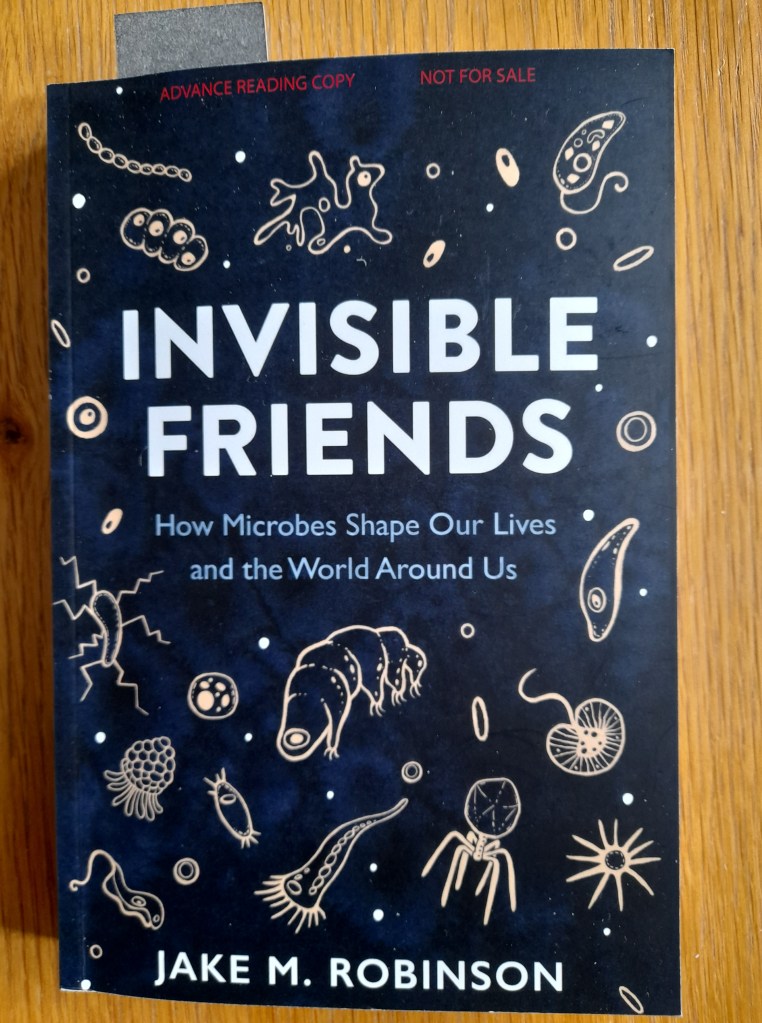
Review of ‘Invisible Friends- How Microbes Shape Our Lives and the World Around Us’ by Jake M. Robinson
‘There are more things in heaven and earth, Horatio,
Than are dreamt of in your philosophy.’Robinson opens his text by challenging his reader to be aware of the invisible world and to understand its long connection and relationship with humans. Microorganisms have existed on planet Earth for billions of years and will likely continue to do so long after humanity has been and gone. Many fascinating phenomena in our world often go unnoticed. The incredible diversity of the microscopic realm around us holds many secrets. He urges us to appreciate and wonder at an invisible world of microbes- a world where humans are not the dominant life form, but instead the short terms guests. With each human having a microbiome with an estimated 39 trillion microbial cells, we could, as Robinson suggests, describe ourselves as ‘walking ecosystems.’ He repeats that Microbes are essential features of our ecosystems, health, social structures, behaviour, food systems and cultures. And quotes Louis Pasteur when he echoes, ‘The role of the infinitely small in nature is infinitely great.’
This book is a fascinating exploration of the possibility of the microscopic world: from outlining the last microbiota-gut-brain axis research; to exploring forensic microbiology in potentially replacing if not complementing DNA in the legal and policing worlds; to describing microbiome-inspired green infrastructure; and finally turning attention to the level of connectedness that we need with nature.
We are all in this together. We are all connected through our invisible friends.
A loss of immunity?
Unfortunately, when we don’t have the collectivism mindset and instead forge ahead with an individualist mindset, we run the risk of not seeing what we have lost until it is too late. Robinson explores the hypothesis of microbes as ‘old friends’, without which, we run the risk of putting ourselves in danger. ‘It is the removal of natural biodiversity from our lives and the lack of interaction between ourselves and the microbes we co-evolved with that causes immune-system issues and inflammatory diseases like allergies.’ He acknowledges and warns against the dangers of misuse of antibiotics in treatment when immune systems are weakened and cautions that this could herald the rise of resistant strains. ‘Nowadays, many people’s immune systems seem to be weakening, and we turn to antibiotics for help.’ Robinson explores the environment factor and uses the ‘Glasgow Effect’ as supporting evidence of the social inequity in exposure to microbes. Researchers found a disparity of 18 years in life expectancy between two neighbouring regions of the city and considered a range of explanations. ‘Scientists have put together various hypotheses forward to explain this disparity, including land contamination by toxins, higher derelict land levels and poor housing quality and social support. All these phenomena could potentially drive inequities in exposure to microbes.’ With ‘nature prescriptions’ on the rise in the UK, an equal exposure and access to green space and ‘forest-bathing’, may be an under-researched and under-used strategy to advance health. ‘The opportunity to ‘bathe’ in friendly microbes and plant chemicals should be available to all.’
Sadly, in the UK, what most of do ‘bathe’ in, when we go to the coasts, is untreated sewage. Clear information is now in the public domain about the water industry and the lack of action from Government bodies to remedy the amount of sewage that is polluting the waterways around the UK. As Robinson identifies, ‘Another important source of antibiotic-resistance genes in our landscapes is sewage.’ He urges us to picture- worryingly not ‘imagine’- the current state of superbugs and the dangers thereof. ‘Just imagine the indomitable armada of antibiotic-resistant bacteria sailing in their fleets in unfathomable numbers through the pipes and into the rivers and seas when raw human sewage is discharged. This is the reality of the situation in the UK.’
‘We’re living in a microbial world.’
Robinson explores in a detailed manner how the psychobiotic revolution has happened and suggests that more research into microbe interactions may impact and alleviate suffering from diseases such as MS. He outlines the numerous pathways linking gut microbes to the brain and suggests that ‘the chemicals produced by microbes are critical players in gut-brain communication.’ A better understanding of this communication may have an impact on human behaviour and learning, as well as implications for treatment. ‘It has been shown that people with MS are more likely to have dysbiotic gut microbiomes, including a reduced number of microbial species, than control groups…
Continuing to study gut microbe interactions provides the hope of understanding more about how MS works- and, dare I say, with crossed fingers and toes, how it could potentially be alleviated.’
On a more philosophical note, Robinson also questions whether microbes could play a part in the debate surrounding human will. Could our microbes affect our perceptions, action and intuition by regulating our impulses? Should we consider this when debating the notions of free will and determinism? It is also worth considering that as humans we have approximately 30 trillion human cells balanced against approximately 39 trillion microbial cells- therefore, what does this relationship mean for an understanding of what it means to be human itself?
A world without microbes
Although Robinson doesn’t like the terms ‘good’ and ‘bad’ as he accepts that even pathogens are part of a normal functioning ecosystem, he takes the time to warn that biodiversity loss, especially that of tree-felling, could have dramatic impacts on our environment. Indeed, the ongoing degradation of ecosystems means that we are living in good times for ‘bad’ microbes, and bad times for ‘good’ microbes. Robinson outlines the vital importance and role that microbes have in our ecosystems. Microbes are the glue that holds our ecosystems together. He imagines a powerful vision of the loss of microbes, with the rapid domino effect that this would have. If microbes were wiped out, plants would no longer draw in vital nutrients and convert them into useful chemicals. They would rapidly lose all capacity to produce energy via photosynthesis, and would swiftly die. All other organisms that depend on plants to survive would soon be cursed with the same fate.
A cultural transformation.
Robinson urges that a cultural transformation is needed in how humans view, understand and relate to the microbial world. He suggests that the possibilities to learn from and work with this world would be hugely advantageous. He enthusiastically describes bioreceptive wall panels, green infrastructure and algae-powered buildings, as in Hamburg, Germany, as only the starting point of what a positive symbiotic relationship could mean. With air pollution becoming a rising concern in most countries and cities, Robinson suggests that a template mitigation method may already exist, ‘to reduce the impacts of city air pollution, the algae powered breathing pavilions produce breathable oxygen whilst purifying the local air.’ Robinson argues thatecological policies and behaviours could be better adapted, once we acknowledge that we live in an interrelated world. But once we acknowledge that we are essentially walking communities exchanging invisible life-forms with our environments, we can use ecological principles to help guide our social policy and behaviour.
He urges ‘that all forms of life-both the seen and the unseen-are in some way connected, ecologically, socially and evolutionarily.’ With this profound shift in mindset from humans, powerful methods of optimising restoration and regeneration policies can be implemented, which would have beneficial impact on humans. From a microbiome perspective, we need to understand how to optimise restoration strategies so that nature can do its thing and heal us. He quotes the doyenne of nature relationships, Robin Wall Kimmerer, to support his argument of a healthy positive relationship with nature. ‘We restore the land, and the land restores us.’
Shifts in architecture, restoration and lower levels of air pollution are only the start. Robinson also conjectures about a future where forensic microbiology may help a criminal justice system in identification of criminal behaviour. He reminds us of Locard’s exchange principle when he writes ‘We leave swathes of microbes behind on objects and surfaces’ and suggests that a better understanding of microbes may eventually replace DNA evidence. Each of us humanoids may be uniquely identified based on the microbial communities living in and on our bodies- our microbial ‘fingerprints’.
We live in an interrelated world
This is not a book written to shock the reader, or to make the reader aghast at the number of microbes on their eyelashes, or in every breath they take. Rather, it is a book to prompt the restoration of the symbiotic relationship between the visible and invisible worlds, as well as the awareness and appreciation of what is contained within our microbiomes. ‘Simply taking a mindful moment to think about this web of interconnectivity can be humbling, and acknowledging its existence and power can be transformative. Ultimately, all the nature you can see intimately depends on all the nature you can’t see.’
Understanding our connectedness with the invisible world can remind us to tread gently and change our behaviour, so that the smallest creatures on the planet can continue to thrive. We are visitors in their world. As Robinson concludes, we cannot do without them.
‘Microbes influence every corner of the world and every second of our lives.’
-
Review of ‘The Big Myth- How American Business Taught Us To Loathe Government And Love The Free Market’ by Naomi Oreskes and Erik M. Conway

What are your views of ‘Government’ and where do these come from?
How much should any government regulate industry, if at all?
With the fossil fuel giant Shell reporting their highest profits in 115 years of almost $40 billion this year, calls have intensified in the UK at least, for a bigger windfall tax on energy companies from the government.
When we observe how big businesses, and individual business owners behave today, wielding their power autocratically- surely it’s time to ask if this is really how we want business to behave. How can we hold them to account as they create mega-media conglomerates and monopolies?
Oreskes and Conway return in ‘The Big Myth- How American Business Taught Us To Loathe Government And Love The Free Market’ to reveal how the narrative and belief system of a ‘free market’ has dominated the American ideology- oftentimes in the face of evidence that leads to the opposition view. The meticulous, detailed, patient and thorough research that was the hallmark of ‘Merchants of Doubt’ is once again on display, as the authors evaluate ‘the history of a construction of a myth.’ The forensic unravelling of the dominant pro-business ideology is potentially more aimed at an American audience, with cultural and historical references throughout. The underlying moral however, has lessons for all countries, as the 21st century faces multiplying threats and the narrative continues as to where the solutions will come from. ‘Many people think climate change will be best addressed by technological innovation in the marketplace’
This book therefore, is not one which simply looks back to how a myth was constructed in one country throughout the 20th century, but rather a studious deconstruction of why we have thought of ‘government’ and ‘business’ in particular ways and who has benefitted from this conditioning.
The authors are keen to highlight that the presented false dichotomies of ‘Big Business’ or ‘Big Government’ are not the absolute choices that they appear to be. ‘Our choices are not confined to oppressive communism or heartless capitalism. To suggest that they are is a dangerous failure of vision.’
Understanding the insidious messaging and omnipresent integration propaganda that has existed, whether for the tobacco industry, the fossil fuel industry, or business interests can help with ‘pre-bunking’ the ‘The Big Myth’ that only one viewpoint can hold sway.
As Oreskes and Conway conclude, ‘The big myth’s expiration date is long past due. Our futures depend on rejecting it.’
How did so many Americans come to have so much faith in markets and so little faith in government?
Oreskes and Conway open the book by identifying the starting place for ‘market fundamentalism’ in the late 19th century, as a burgeoning USA was beginning to assert its identity. ‘Market fundamentalism is a quasi-religious belief that the best way to address our needs- whether economic or otherwise- is to let markets do their thing, and not rely on government.’
‘The market’ became this entity, almost in its own right, that existed nebulously outside of regulation, where ‘economic freedom’ could rule and any regulation of the marketplace ‘would be the first step on a slippery slope to socialism, communism or worse.’ However, the authors suggest that, ‘”The Market” doesn’t exist outside of society, but is part of society and like society’s other parts, must be subject to law and regulation.’
In Chapter 1 then, the authors explore that expressing any type of freedom is always a balance of competing rights. They scrutinise the impact of Amendments to the Constitution and how this balance of protection of citizens could be balanced with capitalist growth. They are also at pains to emphasise the importance of the opening of the Constitution, ‘We the People of the United States’, to highlight the omission of the capitalist focus, therefore opening the question to, where, when and why, did this narrative take hold.
As Oreskes and Conway find, ‘Americans in the early twentieth century were largely suspicious of “Big Business” and saw the government as their ally. By the later decades of the century, this had flipped.’ It is true to note as well that Governments tend not to spend their financial budgets on advertising and promoting their own narratives and ideology, whereas companies and businesses ringfence large amounts of their budgets for the promotion of a free market economy. It is also true to stress the importance of the ‘Tripod of Freedom’, which emerged as a claim that free enterprise was an inseparable part of American identity. ‘The myth of the Tripod of Freedom, the claim that America was founded on three basic, interdependent principles: representative democracy, political freedom and free enterprise. Free enterprise appears in neither the Declaration of Independence nor the constitution.’
Experts for hire
Oreskes and Conway begin by exploring how this narrative started to change in the opening decades of the 20th century and how the electrical industry, and more particularly the National Association of Manufacturers (NAM), which ‘insisted that the federal government should stay out of its way and not regulate the workplace.’ The power of industry and financial backing of industry for advertising campaigns and favourable editorials alongside industry backed ‘studies’ that demonstrated whatever the industry wanted them to demonstrate began to reach hundreds of thousands of consumers. Almost 100 years on, we can see the same playbook being used by fossil fuel companies and advocates to delay the full emergence of the renewable energy industry. Language began to be artfully used to create opposites. That ‘liberal’ now meant ‘anti-American’, or ‘anti-whatever convenient label’ that could be used, including the dreaded label of being a ‘socialist’, forgetting perhaps the Constitution words, ‘to promote the general welfare.’. These campaigns from the National Electric Light Association as well, ‘foreshadowed later efforts by the tobacco industry to fight the facts about their products and influence scientific researchers and educators to promote their point of view.’ And ‘helped to construct a key plank in the platform of American market fundamentalism and a key factor in the big myth of the Free Market.
This messaging came to a crashing halt on October 29, 1929, when the New York Stock Exchange collapsed and the scale of market failure could be clearly evidenced.
Business regroups
Despite the New Deal offering security, business interests regrouped and spent the decade following creating ‘the proposition that any compromise to economic freedom would inevitably lead to despotism- and that political and economic freedom were therefore inseparable- would become one of the fundamental tenets of market fundamentalism’s big myths… Freedom would be defined above all as economic freedom.
This created the necessary cultural semantic echo between ‘inseparable’ and ‘indivisible’- which, in turn, meant that business could now attack any government activity into the marketplace as a ‘threat to freedom, a threat to the American way of life.’ With radio being hugely important as a means of communication and reaching over 80% of American families by the end of the 1930s, a new platform for propaganda could be used continuously and invisibly. ‘Capitalism was about freedom, NAM would insist, and the survival of American democracy was at stake.’
Modes of communication
Oreskes and Conway analyse in depth popular media of the following decades- evaluating the impact the binary rhetoric that was promoted by religious Christian Libertarians of Government or God- or ‘You are either with us, or against us,’ had in promoting absolutes. Absolutes which led to the American people finding it difficult to have constructive conversations about identity, or how they had been led astray.
Influential film directors and writers, from Frank Capra’s ‘It’s a Wonderful Life, to Wilder’s ‘Little House’ books began to counter and promote the interests of business respectively. ‘During the 1940s and ‘50s, libertarian moviemakers and their allies in business deployed censorship, intimidation, and overt propaganda to change the tone of America’s screens and disseminate the myth of the free market.’
‘The era of Big government is over.’
As the final decades of the 20th century arrived, the messaging of the Big Myth of the ‘magic of the marketplace’ was completed by Ronald Reagan. ‘In the 1920s, Americans had hated “Big Business”; Reagan would persuade us to hate “Big Government.” Reagan’s repeated insistence of ‘the magic of the marketplace’- in reality, an empty clichéd phrase- became his catch phrase. A repeated message repeated daily and with the backing of industry can prove very effective at convincing people not to look beyond the words and look for the evidence instead- even when the public are being negatively impacted directly. This was a strategy that Donald Trump would later employ with deadly consequences during both his presidential campaign and during the Covid pandemic.
“Government is not the solution to our problem; government is the problem.”- Ronald Reagan.
In 1996, when Bill Clinton declared “the era of Big Government is over”, business must have rejoiced. What is often forgotten though is that ‘Clinton governed from the center-left, defending Social Security and Medicare.’
Oreskes and Conway begin to conclude ‘The Big Myth’ by drawing attention to the continued market failures to regulate itself, by highlighting the Enron implosion and by exploring the lack of business support for climate action, which hinders business progress.
‘The fossil fuel industry’s economic interests in preventing climate action have always been obvious; less understood is how it camouflaged those interests. No one ever said “I am denying climate change to protect corporate profits.” They said that they were protecting jobs, protecting the economy, and protecting free markets from government “encroachment”. They said they were fighting for capitalism and freedom.’
The response to the Covid pandemic is also highlighted as a market failure, as the authors comment that, ‘The Covid-19 pandemic has shown us how expensive overreliance on the “free” market can be.’ They also conclude that ‘the Covid-19 crisis has made crystal clear why some problems demand substantive governmental solutions, and why many of them can’t just be temporary.’
The era of ‘Big Business’ is over?
The authors caution that a century of programming and conditioning that loving the free market and loathing of Government ‘is not easily undone.’ They warn that‘The Big Myth has a tenacious hold. Polls show that in many domains. Americans trust the private sector more that they trust “The Government.” This continued hostility and lack of trust allows for the rhetoric that any Government can’t be trusted, even in the face of existential threats like climate change. The true costs of the ‘free’ market may be becoming more visible, despite business interests to the contrary.
‘Five hundred thousand dead from opioids, over a million dead from Covid-19, massive inequality, rampant anxiety and unhappiness, and the well-being of us all threatened by climate change: these are the true costs of the “free” market.’
As Oreskes and Conway conclude,
‘Government is not the solution to all our problems, but it is the solution to many of our biggest ones.’
-
Review of ‘The Lost Rainforests of Britain’ by Guy Shrubsole

‘The Lost Rainforests of Britain’ by Guy Shrubsole charts the author’s awakening to the ‘lost worlds’ of Britain and reflects the dedicated and personal journey that he made to appreciate and love the temperate rainforests that once dominated Britain.
Although Shrubsole notes early in his text that ‘Few people realise that Britain harbours fragments of a globally rare habitat: temperate rainforest’, my feeling is that this awareness is expanding and growing- more so in recent months, with more and more of these texts breaking into the public awareness. Education, appreciation and love of the rainforests and the natural world are all core concepts explored in the book.
‘So much has been lost; so little remains.’
The, at best, indifferent attitude to the protection of temperate rainforests in Britain over the centuries has led to a devasting decline in their existence. The transactional relationship and exploitation of nature for our own resources has reinforced the dangerous belief that humanity stands proudly above the other species of this planet and that this planet is in some way ‘ours’, to do with as we please.
Shrubsole notes that although Britain lies in a ‘bioclimatic zone’, which lends itself to the promotion of temperate rainforests, of about 11 million acres of Britain or a ‘staggering 20 per cent of the country’, the existence of rainforests remains solely in isolated pockets- mainly on the western coastal areas. ‘Over the millenia, we’ve destroyed our rainforests, so that now only tiny fragments and relics remain. We’re so unfamiliar with these enchanting places, we’ve forgotten they exist.’ Shrubsole is not afraid to pin the blame on humanity’s actions, ‘But we didn’t just lose our rainforests through some tragic accident. We actively destroyed them.’ It is important to appreciate the intentional nature of the actions which led to this reduction of temperate rainforest. The two culprits examined in depth in this book are the overgrazing done by sheep and deer, as well as the unchecked proliferation of rhododendron. He comments that, ‘Out of the 74,000 acres of temperate rainforest left in Scotland, around 40 per cent is estimated to be infested with rhododendron.’
‘Britain was once a rainforest nation. But we lost most of our rainforests.’
Although the physical evidence of rainforests is now reduced, Shrubsole champions movements and pressure groups whose focus is the rewilding of the country, to recover what has been lost. ‘A habitat that once flourished over perhaps a fifth of Britain has been reduced to scattered fragments covering less than 1 per cent of the country.’ He convincingly argues that the cultural memory of a landscape covered with rainforests is still there, if we know the clues to conduct an effective search, but for the majority, this is something that has been forgotten. ‘This loss of cultural memory, this great forgetting that we once had rainforests, is almost as heartbreaking as the loss of the forests themselves.’
In order to find these clues, he fully analyses a number of place names, through linguistic archaeology, from Celtic and Viking origins, to demonstrate that names on maps can hold the key to the past. This was a really exciting part of the text for me, one which I thoroughly enjoyed- that the memory of what our landscape was once like, can still be found in plain sight through place names, is a fascinating area to explore. Although Shrubsole acknowledges clearly that, ‘The awful truth is that we destroyed them,’ he alsosimultaneously argues that can also be the agents of restoration. ‘If we are to stand any chance of restoring our lost rainforests, we first need to remember we once had them.’
Britain is a land full of myths surrounding trees and nature. Through the works of Tolkien, modern generations have been introduced to living trees, who have underestimated power. We are also privileged enough to have the Welsh text of ‘The Mabinogion’ to be our guide. We forget that we are also a land which has been a fusion of cultures for centuries. The Norse influence- also to be found in place names- continues to be present in modern life in the UK, with days of the week named after Norse Gods, as well as their central belief of the Yggdrasil- the tree of life. In Christian mythology, trees also figure significantly- with many homes and churches decorated with wooden crosses, symbols of the possibility of a new life. Alongside this iconography, we also see the image of the Green Man, once more hidden in plain sight. Shrubsole celebrates that this connection still exists and when discussing mythologies, argues that the power of an old story told anew may well be essential in our present world, beset with various crises. ‘It’s that these stories contain a deep love of place, infusing the real world with sacred meaning. In a time of ecological crisis, that’s a story we badly need to relearn.’
‘I am the Lorax. I speak for the trees. I speak for the trees, for the trees have no tongues.’
One story which we could well to ‘relearn’ might be that of Dr Seuss’s ‘The Lorax’. For various generations, the loss of nature through the actions of capitalist industrialists, has been a memorable story. We are moved by the empty countryside and far-reaching ecological damage. We are left with the hopeful message that, ‘“Unless someone like you cares a whole awful lot, Nothing is going to get better. It’s not.”’
It is clear that Shrubsole ‘cares a whole awful lot’. From the dedication in mapping the possible rainforest zones, to the simple delight that a sighting of a lichen can bring, it is clear that a connection with nature is enriching. Shrubsole comments, ‘Temperate rainforests are full of gifts for those who visit them.’ He contends that visits to rainforests can be affirming, ‘You’ll return from a visit to a British rainforest soaked from head to toe, but feeling all the more alive for it.’
However, Shrubsole also highlights that access to the countryside and to Britain’s temperate rainforests can be problematic at best. ‘But if you want to see much of the English countryside, you need to trespass. We still only have a Right to Roam over 8 per cent of England; over the other 92 per cent, the law of trespass still reigns supreme.’ In January 2023 in England, access to the countryside was further limited when a ban on wild camping on Dartmoor was imposed. This now means that there is no place in England and Wales to legally wild camp. There is an irony that humans are now being excluded from nature, when before exclusion fences limited wildlife from damaging saplings and allowed the regrowth of nature.
When access is granted- or circumvented- Shrubsole describes a temperate rainforest world that is ‘both familiar and strangely alien.’ His enjoyment comes from the observation of the tiny details of these rainforest ecosystems- details which are lost when the re-introduction of large animals make for better publicity. ‘It feels to me that we need to become much more interested in the minutia of the natural world around us. The little things are just as important as the charismatic megafauna.’
Our Once and Future Home
‘The Lost Rainforests of Britain’ then is a book which both reflects on the past and looks hopefully forwards. Shrubsole argues passionately that ‘We have a moral obligation to try and repair the damage caused by our ancestors.’ Perhaps we could extend this further into a moral obligation to our descendants to restore temperate rainforests, even if it takes centuries. Shrubsole is cautious about the ingrained, simple narrative of tree plantations, arguing that a dynamic ecosystem is one that can be self-regulating and self-renewing, full of species to appreciate and marvel at. ‘Our temperate rainforests support an abundance of life. They teem with hundreds of species of lichen, many of which are deemed by ecologists to be of international importance.’
He closes the book optimistically, highlighting that given a small chance, nature can renew itself, as it has done through time. ‘[I]t demonstrates how quickly woodland can naturally regenerate when it’s given half a chance.’ Granting nature a chance is a common refrain in ecological books and Shrubsole argues that it can be easy to forget that ‘life finds a way.’ ‘We can also overlook the gradual resurgence of nature, and forget its powers of renewal.’
He does not advocate that humans should just step back entirely and let nature take its course, but instead advocates for community engagement and a new form of ‘social commons’, which allows rainforests and humans to work together, perhaps in the most symbiotic manner that has ever been attempted. ‘But to have any hope of success, rainforest restoration has to be done with people at its heart. If we’re to bring back our lost rainforests, it’ll prove impossible to do so without the active engagement of the communities who live in and around them.’
‘A society grows great when old men plant trees in whose shade they shall never sit.’
-
Subscribe
Subscribed
Already have a WordPress.com account? Log in now.
 Climate Thoughts with Brian