-
Is the UK prepared for the climate emergency?

An EV charging point UK Water companies waste 3 billion litres of water every day
With heatwaves, droughts and hosepipe bans part of Yorkshire summers, how effective is our response?
With Yorkshire Water today calling for a hosepipe ban to start in two weeks’ time, we can now add water restrictions to the growing list of heatwaves, droughts, wildfires and rivers drying up that are now part of the UK summer.
Neil Dewis, Yorkshire Water’s director of water, said: ‘“Parts of Yorkshire have seen the lowest rainfall since our records began more than 130 years ago. The hot, dry, weather means that Yorkshire’s rivers are running low and our reservoirs are around 20% lower than we would expect for this time of year.”’
Could this drought have been prevented?
Jim McMahon, the shadow secretary of state for environment, food and rural affairs, commented on social media that, ‘This crisis in our system was entirely predictable. The government and water companies should have anticipated and planned for it. In a country with plenty of rain outside of mid-summer, we should not need to rely on hosepipe bans to get us through the dry months.’
Climate scientist, Ed Hawkins, of University of Reading echoed the predictability of this drought, stating that this was not a ‘one-off’ event.
‘It’s not just the summer – this is the 4th consecutive season of low or very low rainfall. And warmer temperatures cause more evaporation and soils to dry out faster, making the drought worse’
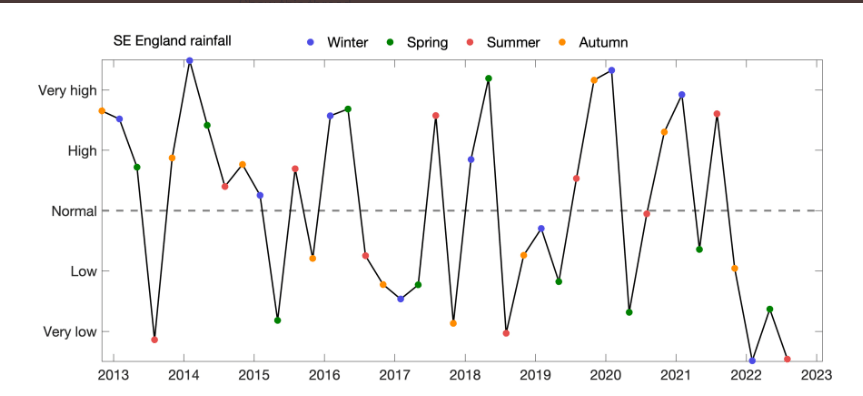
Rainfall over the last decade The Independent reports Kathryn Brown, the director of climate change and evidence at The Wildlife Trusts as saying, “Government doesn’t have a plan at all for dealing with the effects on the natural environment from these drought conditions.”
What were the warnings?
As well as having the data from the last 4 years in order to create a plan, there seems to have been more political posturing than climate action. Only last month, the Climate Change Committee highlighted the urgent and immediate need to plan to mitigate ‘risks to soil health from increased flooding and drought.’
Yorkshire Water, like many water companies had produced a drought plan, where they asserted that ‘we also develop scenarios to represent events worse than those we have experienced previously to ensure we are as resilient as possible to future, more extreme events.’ They have clear measures that they adopt, with customer communication, to reduce the demand on the service. This is the first hosepipe ban that Yorkshire Water have called in 27 years.
Although Yorkshire Water claim that ‘Our level of service has improved since 2001 through leakage reduction, grid extension and additional abstraction licences. Customers place a high value on the reliability of water supply, and we have the same level of service for all of our customers’, the leakage reported per property per day through 2021-2021, was 130 litres of water. With over 5 million customers, that would amount to approximately 650 million litres lost through leakage a day.
The BBC reported today that water companies lose approximately 3 billion litres of water a day through leakage.
Proactive planning needed to mitigate losses
North Yorkshire Council, although declaring a climate emergency in July of this year, has been criticised for its plan lacking in concrete detail. North Yorkshire Councillor Andy Brown told me that, ‘Like so many other councils, North Yorkshire are very good at grand announcements. When the Green group asked to see an actual costed plan with timescales and for a scrutiny committee to be set up, the ruling group blocked any discussion of the plan in full council.’ More locally, Harrogate Borough Council never declared a climate emergency at all, despite two motions, instead passing a motion for a much softer ‘this Council supports measures to address the climate emergency.’
Local strategies to reduce carbon emissions
Harrogate Borough Council have 8 Strategic Themes as part of their Carbon Reduction Strategy and it is through this strategy plan that measures emerge to reduce emissions. Their themes range from Domestic Energy demand, which includes retrofit housing, to Land Use, which includes tree planting. Other themes include council buildings and the Harrogate Convention Centre, as well as reducing emissions through operations and staff transport. One of their core strategic themes is sustainable transport, which focuses on improving the district’s electric vehicle infrastructure.
Harrogate Borough Council are keen to promote their roll-out of electric vehicle charging points, with 34 spaces being created on council owned property across Harrogate, Ripon, Pateley Bridge, Masham and Knaresborough. A council spokesperson told me that they were waiting for a funding bid to be approved, but that this has been delayed from the Office for Zero Emission Vehicles. ‘We always intended to get more than this through using the approved funding at match for central government funding. We have just had word that the NYCC bid we supported was meant to let us know ‘early August’.
Cllr Keane Duncan, executive member for highways and transport, also commented on the funding bid, saying: “We are currently developing plans to deliver charging points across the county so that more residents and visitors are able to choose electric vehicles and charge up conveniently. “In the meantime, we continue to pursue funding opportunities through central government. We have recently submitted a bid to the Government’s Local Electrical Vehicle Infrastructure (LEVI) Fund, which will enable us to deliver around 70 chargers in deeply rural areas that would otherwise be left behind due to a lack of private investment.”
With Harrogate Borough Council being abolished in 2023, it is hoped that NYCC’s Ultra-Low Emission Vehicle Strategy will continue to maintain the contract with Connected Kerb. The council will receive the money from residents charging cars, with any revenue raised being used to expand the network further, but this is all still uncertain at this point as the transition between councils takes place.
Environmental impact of electric vehicles?
As of July 2022, there were approximately 520,000 battery electric vehicles in the UK, out of a global total of 16 million electric vehicles and a UK total of 32.9 million cars. The rise of popularity of electric vehicles prompts those critical of EVs to complain about the environmental impact of lithium mining- lithium being one of the components in electric vehicles.
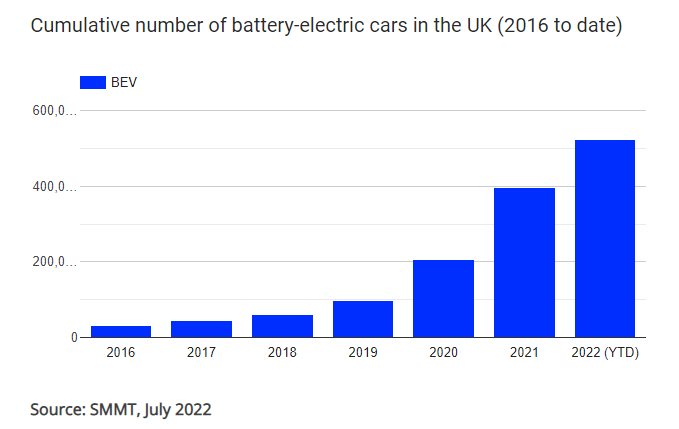
EVs on the rise Lithium is also a component in the 6 billion smartphones in the world, the 16 million laptops and other household electronics. Yet there only appears to be criticism of the lithium needed for electric vehicle batteries, rather than for all goods.
For example, between 1955 and 1980, 125,000 tonnes of lithium were mined globally, without the level of concern about the environmental impact of lithium mining, leaving me to conclude that these criticisms are not about the impact of mining, but as the last bastion of the fossil fuel car industry holding on.
We have opportunities at a local council level to reduce the impact of the climate emergency, if we choose to implement them.
We have opportunities at a national level to reduce the impact of the climate emergency, if we chose to implement them.
-
Review of ‘Hothouse Earth’ by Prof Bill McGuire

‘To have even the tiniest chance of keeping the global average temperature rise below 1.5°C, we need to see emissions down 45% by 2030.’
Over the last few days, Prof Bill McGuire’s latest book ‘Hothouse Earth’ came out. The Guardian newspaper gave a review/summary here, which gave the impression that Prof McGuire was saying that it was too late to do anything about the climate crisis. The article and headline claimed that ‘total climate meltdown cannot be stopped according to a leading UK scientist.’
I raised this with Prof McGuire, who responded ‘My message is NOT that it’s too late. We need to act now to stop dangerous climate breakdown becoming cataclysmic.’
In a separate tweet, he then made it even more abundantly clear and distanced himself from the headline in the article: ‘Just wanted to say, the ‘total climate meltdown’ is the headline writer, not me. I don’t say this, nor does the article. And I still believe we can avoid #climate cataclysm is we act now.’
With this context, I wanted to see for myself what the message in his text was and what I found is below.
‘HotHouse Earth’
McGuire structures this book very coherently, opening with his vision and charting the difference between how generations have experienced life on the planet. The aim is simple: ‘To have even the tiniest chance of keeping the global average temperature rise below 1.5°C, we need to see emissions down 45% by 2030. In theory, this might be possible, but in the real world- barring some unforeseen miracle- it isn’t going to happen.’
If it doesn’t happen then we will have made a commitment to the generations that follow, as well as betraying those who have come before- ‘…this is the hothouse planet we are committed to living on; one that would be utterly alien to our grandparents.’
McGuire does not shy away from the charge that he is raising an alarm, when he states: ‘Raising the alarm, in our current circumstances, is a good thing. It fits with the precautionary principle and also with the idea that we need to really know our enemy…’ He sets out that this text should be seem as the one of the most pressing call to arms that we have had and in this call makes it clear that he still believes there is time.
‘The fact that the future looks dismal is not an excuse to do nothing, to imagine it’s all too late. On the contrary, it is a call to arms.’
He does acknowledge the ‘waste of breath the years behind’ at the end of the text where he makes the point that we are running out of time and have few straws left, owing to interference from bad actors intent on delay tactics. ‘In the decades since the first Un COP Climate Change Conference in 1995, we have used up an entire bale in prevarication and inertia, so all we are left to clutch is the last straw. We cannot fail to grasp it.’
‘We have repeatedly refused to listen and chosen not to act.’
McGuire charts the number of times that the IPCC has sounded the alarm since its inception and, like a tanker, we have been very slow to change direction. ‘We have been put on notice time and time again about the potentially catastrophic impact of rising greenhouse gas levels in the atmosphere, but we have repeatedly refused to listen and chosen not to act.’
With over 30 years of positive, assertive action, the world could be in a much better position that that in which it now finds itself. Instead we find ourselves in a situation where hardly any countries are on target with their emission reductions and where total greenhouse gases have risen by 43% in roughly the last 30 years. Carbon dioxide in the atmosphere has risen from 354ppm to 420ppm, an increase of 19%. We cannot wait for a ‘tipping point’ to occur before acting- by this time it will be far too late. Prevention is always better than impact management.
‘From Narnia to Eden’
In a stroke of mythological genius, McGuire takes the time to explore the transition of our species from Narnia to Eden, or from Ice Age to present. The impact of humans on the environment ‘is written across every corner of the natural world; a time when our pollution, be it carbon dioxide, radioactive isotopes, or microplastics, infiltrates and contaminates everything, down to pristine Antarctica ice and the placentas of pregnant women.’
He also makes the crucial point that more desperate measures may be considered the ‘longer we maintain the human greenhouse’ and we have seen these already being discussed in geoengineering terms.
As this text was written in 2021, McGuire has missed out on many of the temperature records that have tumbled this year. With the UK temperature record of 38.7°C significantly broken at 40.3°C- a country that is not prepared or suited to temperatures of this high, but one which needs to prepare dramatically, as more will follow. Most days will feature climate stories, whether these are wildfires, heatwaves, or flooding, causing untold financial damage and cost to human life. Climate breakdown is happening today and we can all be witnesses to this. Climate breakdown is ‘not something that belongs to the distant future’, as McGuire phrases it. An issue that used to be thought of impacting grandchildren and future generations has sped up and we care now impacted by it today- at only 1.2°C higher than pre-industrial times.
Not everywhere is heating at the same rate and McGuire concisely focuses on the Arctic and the impact of rapid heating there. The different scenarios from the IPCC are also outlined clearly for new readers, but McGuire does not do this flippantly. He emphasises the point that ‘every degree of temperature rise, even every tenth of a degree, chips away that little bit more of our previously benign climate’ and therefore every tenth of a degree is worth fighting for, so that we can save ‘All We Can Save.’
The end of the century and 2100 seem so far away from 2022. But with fewer than 80 years to go, this can easily be in the lifetime of children born today. With heatwaves increasing in frequency and extremity, many different parts of the world may be uninhabitable well before this ‘target’ date of 2100.
The danger of switching off
As images of wildfires and climate disasters such as droughts and floods continue to feature more regularly on our screens, will this be enough to prompt action? In short, how bad does it have to become and for whom, before countries act with purpose with global collective action? It seems that already the Australian fires of recent years have disappeared from our memories- floods seem to happen to ‘other people’.
How long can our attention be focused on climate action and what part does the media and politicians have in sustaining this attention?
Will there be enough fresh water in case of water shortages and emergency response management? Will there be enough food as harvests fail and famines occur?
How high will sea level rise be under different scenarios? Why is the rate of rise increasing? Who is being impacted by this just now and who is likely to be impacted by this in the future? How will sea level rise impact coastal infrastructure?
These are some of the questions that McGuire takes time to explore in this book and these are questions that need to be addressed and solutions thought of now, now only in response to events. Prevention and mitigation are both key.
What I like about this text is that McGuire explains clearly about some of the big topics relating to the climate: soil, oceans, Greenland, Antarctica, methane, AMOC, etc and after explaining each, evaluates how likely each could be and how they are being impacted by the continuing ‘business as usual.’
Climate migrants, refugees
The Sahel, Yemen, Syria are places which are outlined as being in need of humanitarian response, but on whom does this responsibility lie: financially? Legally? or morally? Which countries are prepared to take in hundreds of millions of possible climate migrants and will conflict over water and fertile land produce more future climate flashpoints. McGuire warns that ‘There is no easy way to say it, but the world of our children and their children will be a far more perilous one. As resources and habitable land diminishes will turn against in an effort to maintain or gain what they feel is their share and their right.’ As this has been the history of our civilisation and tribal people, there is no reason to assume that mankind will suddenly stop this behaviour.
Serious questions need honesty
There are serious questions raised in this book, which McGuire does not shy away from. He addresses them honestly and calmly. He acknowledges the difficulty and uncertainty of the future and this approach is a welcome one. Consequences are not absolute, nor does the climate crisis necessitate binary, drastic solutions. McGuire offers pathways to action that are available to all of us to make us empowered rather than being crippled by eco-anxiety and eco-grief. ‘Fossil fuel companies, responsible for leaking around half of all methane emitted by human activities, need to be made-by law- to clean up their act immediately.’ McGuire calls for punitive measures for fossil fuel companies and argues that there can be no fossil future, when he describes the continuation of new exploration licences as ‘bordering in the insane.’
McGuire has been criticised for the seeming rushed ending to this book, where ‘solutions’ are listed, almost in a list. In truth though, we know what the solutions are, as equally we know who is causing much of the problems. With a renewed focus on the impact of decision makers on the climate and with everyone asking the same question, is this decision good or not for the climate, McGuire argues that ‘the coming decade is very likely the most critical in human history’. A point of view that is not new to the climate crisis narrative.
Who is failing whom?
McGuire concludes by offering the moral argument that the mark of great societies is one where all the citizens are looked after, regardless of status and that stewardship of the planet should be a priority. To act otherwise, makes us no better than the smoking companies and fossil fuels companies, who know their products were dangerous, but did nothing, so lonely as the profits came in.
‘The measure of the maturity of any society must be how well it looks after the needs of every one of its people, and how it cares for the planet and all life thereon, by which metric we are little more than toddlers flailing about aimlessly in the dark.’
Those resident in the UK, and indeed in other countries, may watch helplessly on the side-lines, as we see politicians focus on any topic other than the climate crisis, as a means to foster short term support.
But we are not helpless. We are not voiceless. And we can be powerful.
-
Fossil Future- Why Global Human Flourishing Requires More Oil, Coal, and Natural Gas- Not Less’
Alex Epstein
No need to read this book- his supporters haven’t. Despite the author handing out copious free copies.
This is a somewhat over-hyped ridiculous book, which endlessly quotes the author himself.
Epstein makes ‘straw men’ arguments throughout- where he creates extreme scenarios and then attacks those, despite these never been said or written. For example, he bases an early foundation premise on the lack of electricity in a hospital ‘Africa’ on an unverified blog and bases his argument on that. The hospital is not named nor is there a date for when this is supposed to happen.
The countries of Africa get barely a mention in the book, despite huge programmes in renewables and solar energy being implemented ‘there’.
The author, in Chapter 9 makes a big point about levels of carbon dioxide being good for ‘life’. He is very careful not to say ‘human life’- plant life may well benefit from carbon dioxide. Omissions are important.
This leads me to the biggest gaps in the argument.
Epstein not once addresses how his ‘mastery methods’- which of course are not outlined in specific detail, just waved at- will lower the rising global temperature or lower the rising carbon dioxide level.
This is a central point, for the future use of fossil fuels, which he ignores.
He also does not address the impact of rising CO2 or temperature on countries, infrastructure and people, meaning there can be no justification for continued fossil fuel use.
The author is a philosophy graduate, in no way qualified or experienced to write on energy matters.
And it shows.
Far too many general vague points- for example, he spends 3 pages outlining why fossil fuel machines will help people have ‘thinking time’ (for real, this isn’t a joke) and how that will be a benefit. Avoiding of course the impact on the labour market. Another 3 pages are spent describing what a ‘tool’ is. (Feel free to make your own jokes here)
Epstein avoids information that counters his argument and delays arguments in his book, constantly repeating ‘I’ll deal with that later’, which of course, he doesn’t do.
He claims that his ‘motivation’ ‘for writing this book is to prevent the U.S. and other free nations from embracing unilateral disempowerment’. The saviour of the U.S. A heroic role needed for Epstein. Of course, he doesn’t really explore who these ‘other free nations’ are and frankly this is code for ‘China is bad. We need to be more powerful than China.’ He overlooks China’s expansion in solar and wind which dwarf other countries. He overlooks China dropping their emissions. He overlooks that it is the U.S. that historically has the highest emissions.
This is a book that can easily be dismissed by simply looking out your window and seeing the impact of the climate crisis. Yet supporters are lapping this book up, despite not having read it themselves, which is peculiar.
Chapter analysis
The introduction
The fear of China is explicit in this quote from the introduction ‘this with unfree China, which has an explicit goal of being the world’s leading superpower by 2049 and is using an 85 percent fossil- fueled economy to get there— including by using fossil fuels to produce unreliable solar panels and wind turbines’. Of course the solar panels aren’t ‘unreliable’ at all and Epstein’s only claim is that these somehow contribute to ‘higher prices and lower reliability of the U.S. electrical system’, as if having a competitive market isn’t a positive aspect for industry.
Epstein makes the underlying claim that ‘fossil fuels will contribute to further warming going forward. But I will argue that the negative climate impacts of fossil fuels will be far, far outweighed by the unique benefits of fossil fuels.’ What are these ‘unique benefits’ that no other energy source can possibly aspire to? That they are cheap and reliable. Ignore then that the use of fossil fuels will contribute to further warming, it will not cost us as much to heat the planet. Result.
Be that as it may, Epstein believes that the climate impact will ‘continue to be ‘masterable’ by fossil fuel machines’. ‘Continue’ is an interesting verb to use in this context, because we are not mastering the climate impact, not with 1.5°C being approached. For him, it doesn’t matter how hot the global average temperature becomes, climate mastery will be achievable- of course, at no point in the text, does he prove how these mastery methods will help reduce the global temperature. Nor does he explain how they have failed to do so yet.
Despite this pretty big gap in his argument, Epstein states that, ‘expanding fossil fuel use as essential to global human flourishing, I regard “net- zero” proposals as apocalyptically as others regard fossil- fueled climate change. Net- zero policy, if actually implemented, would certainly be the most significant act of mass murder since the killings of one hundred million people by communist regimes in the 20th century’. Nowhere in the rest of the book does he explore how this would happen, this is simply one of his statements that the rest of the book will rely on, with ‘communist regimes’- read China- being presented as the villain.
Chapter 1
Now that his foundation is set, Epstein makes his first claim in Chapter 1 that the benefits of fossil fuels have been ‘ignored’. This chapter is full of the filler phrase ‘I’m going to try and persuade you’, so we know that we are not going to have a balanced argument, as this is not the point of persuasion. This chapter becomes highly repetitive with Epstein stating that a person is ‘50 times less likely to die from a climate- related disaster than they were in the 1 ° C colder world of one hundred years ago’. Of course, he doesn’t say where in the world that might be and how this is calculated. He uses EMDAT information for this claim. This is a favourite ploy of Lomborg as well to use this data and unfortunately for them both, there are gaps in this information. EMDAT information calculates deaths from the drought in the 1930s America as being 3,000 people and Lomborg himself suggests that this number is a low estimate. If the EMDAT data isn’t accurate, then why do so many of these people use it to craft the narrative.
Epstein never explores what factors may explain why these deaths have come down, but simply states that fossil fuels have helped. He also doesn’t explain why this is a bad thing. High numbers of climate deaths cannot be what he is hoping for surely? This is a great example and one of many in the book, where he assigns causation without evidence. The phrase ad hoc ergo propter hoc could well be revisited.
This chapter is where Epstein makes the claim that because ‘experts’ have been wrong in the past, then ‘experts’ can be wrong today and therefore we shouldn’t listen to them- perhaps instead we should listen to him. Although this, on the face of it, looks reasonable, the opposite is also true. If experts have been right in the past, then experts can be right today.
We then have one of the oddest tales in this text, once which he distances himself from as much as he can. He claims that he is a ‘sharing a story’ that was ‘told by a visitor to The Gambia’ about the lack of electricity at a hospital being directly responsible for the deaths of babies. Oh if only those African people could be able to use as much fossil fuels as America all would be okay and babies’ lives would be saved. There are a few issues with this story apart from the distancing. The first is that it is completely unverified. Following the reference, we see it leads to a blog where the hospital is not identified and the author is not identified. This perpetuates the myth that ‘many African countries desperately need energy.’ The Gambia was one of the few countries until recently which was actually on track to meet its 1.5°C pledges, but it fits the racist narrative of ‘Africa’ all being the same. Another issue with this ‘story’ is that he then assumes it is true and reflects on ‘the tragedy of babies dying for lack of the energy needed.’ Well, this hasn’t been proved, as his own reference doesn’t lead to verified data and factual evidence.
Is he resting on scientific information that the rest of us do not have? Sadly not. In his own words, he says that his expertise is ‘As a philosopher who has studied the history of ideas extensively’. He makes the repeated claim that we have ‘no direct access to experts’, which is patently false by the ability to use email and social media to contact experts who enjoy reaching out with their knowledge, but instead that we are relying on the ‘systems’ that give us this information. He uses the example of the nefarious IPCC keeping the decline in ‘climate related deaths’ (a term not actually defined by Epstein) away from the public ‘Whatever the IPCC’s motives for omitting the fact of plummeting climate-related disaster deaths.’ This is a narrative and spin that he is busy weaving- that the experts are hiding things from you, but I will bring the truth- there is a huge conspiracy but I have cracked it and I am telling you, not to sell my book and make money, oh no, no, no, but it is my duty. He then proceeds to quote Michael Crichton of ‘Jurassic Park’ fame.
Epstein also cherry picks in this chapter and if this is what he is doing in Chapter 1, you can rest assured that this is typical of his approach. Look, he quotes an IPCC report- remember they are hiding things from you and you have no direct access to experts…no, hang on, that can’t be right…- that states ‘There is low confidence that human influence has affected trends in meteorological droughts in most regions…’ Howzat! Checkmate.
He knows that you are not going to check the AR6 Report, because if you agree with him, you will take it as read. He also knows that the ordinary public don’t know how the IPCC makes judgements on high, medium and low confidence and that it doesn’t mean the same in ordinary speech. He also knows that if the IPCC does not have historical data, then they will not assign medium or high confidence to any event, as they only support their comments with evidence. Epstein knows this, but he is banking on you not knowing.
In Chapter 11 of the AR6 report, it actually read,’ There is low confidence that human influence has affected trends in meteorological droughts in most regions, but medium confidence that they have contributed to the severity of some single events. There is medium confidence that human-induced climate change has contributed to increasing trends in the probability or intensity of recent agricultural and ecological droughts, leading to an increase of the affected land area. Human induced climate change has contributed to global-scale change in low flow, but human water management and land-use changes are also important drivers (medium confidence).’
His use of ellipsis to hide the rest of the statement was carefully chosen. Remember, this was the person who said you had to rely on the ‘system’, instead of the experts. What a system he has turned out to be in Chapter 1, not even giving you the same information that the experts did.
This chapter was all about the public failing to understand the benefits of fossil fuels, which he has stated already will continue to drive temperature up. The question that he has not answered is a simple one.
What are the benefits of a 4/5°C world?
Advance warning- he never answers this.
Instead, he rounds off this chapter by quoting from BP and the Heartland Institute and splits the world into ‘empowered’ and ‘barely empowered’.
Chapter 2
I think this has to be my favourite chapter in this book for its complete irrelevance to the point he is making. Epstein makes the point in this chapter that ‘how do we identify whether and how much our knowledge system is distorting fossil fuels’ climate side-effects?’. He hasn’t actually proved that ‘the knowledge system’ is distorting climate side effects in chapter 1, but on her rolls regardless. His first point is that there is an inherent problem because, ‘This is difficult to do given that most of our knowledge system’s claims about climate involve predictions.’ This is blatantly not correct. Some climate models are used of course, but most of our knowledge comes from data, gathered from satellites and proxy information- so why is Epstein suggesting otherwise?He is doing this, so he can set up this chapter’s attack, that if climate predictions were wrong in the past, then climate predictions made today will be wrong about the future. This is the general thrust of this chapter.
He makes huge efforts again to distance himself by saying that the views of individuals do not represent the mainstream views, ‘While Ehrlich’s, Holdren’s, and Schneider’s views in no way represented what most climate researchers thought,’, so if he knows this, then why is he going down this line of argument? This entire chapter is to placate a certain demographic who make the wrong assumption that if some climate models and/or predictions were wrong in the 1960s, then that must mean that some models and/or predictions will be wrong in the 2022s. This is a false equivalence.
He then basically introduces the ‘zombie list’ of ‘Environmentalists’ predictions from 1970s that didn’t come true!!’ A list, in case you are unaware, of unknown provenance, but which has about 50 statements or ‘predictions’ on it, all supposedly said by environmentalists. Of course, once you start to explore the list, you see that many of them are newspaper editorial comment, rather than direct quotes. It’s not often that people refer to the ‘Redlands Daily Facts’ or the ‘Noblesville Ledger’ to prove their point, but there we are. Despite fact checkers being used to debunk many of them on a regular basis, supporters of this list like Epstein assume that if they throw enough suspect claims then at least one will stick. But then, let’s see how the argument goes- Person X predicted this in 1965 and it didn’t come true! Ha!
Okay, why didn’t it come true?
Oh, I don’t know, but they were wrong and we know that now.
Could it be that policies were put in place to avoid it happening and that’s why it didn’t come true?
No! How come these experts were wrong eh?!
So what is Epstein doing in this chapter?
He is trying to get your attention away from his mastery methods (remember?) on how to neutralise the rising temperature of 3/4°C, but he now has you on a wild goose chase.
The other thing that he slips in during this chapter, is the ‘Nuclear is good’ argument.
What he doesn’t mention is any country which has over 50% dependency on nuclear power.
Whether nuclear can be described as a renewable energy supply in the first place is definitely contentious.
Either way, he has your attention well away from the negatives of continual use of fossil fuels. Look he claims, U.S. air pollution goes down despite increasing fossil fuel use. What about other countries? No, that’s less important, because they are not ‘empowered’.
Back to nuclear- Epstein claims ‘Nuclear energy, as I mentioned in the last chapter, has historically been the most promising competitor to fossil fuels.’ And it emits no air pollution or CO2.’ We all know that omissions are important. Epstein makes no comment on the pollution or CO2 during plant build, or the long-term waste storage pollution- he just says quite neatly ‘there are no emissions’.
But look, he says, compared to the emissions of CHINA, nuclear energy is amazing. ‘Remember we’re talking about a world before China, India, and others used enormous amounts of fossil fuels to industrialize and lift literally billions out of poverty.’
Not a word about the historic emissions leader that is the U.S.
Chapter 3
To summarise Chapter 3, as I think you get the point now, that a simple study of the gaps between what he is saying and what Epstein is not saying is getting larger- remember his aim was to persuade you- not present you with the arguments and let you make your own mind up- even though that’s what he claims his ‘knowledge system’ is.
Summary of Chapter 3
If you are anti fossil fuels, then you are anti-human and want us to die.
References to the Nazis.
References to the Lion King.
‘Advancing human flourishing is a long- term and wide- ranging goal. It doesn’t just mean thinking about the next year; it means thinking generations ahead.’
When by continual use of fossil fuels, the global average temperature will be what?
Ah, he didn’t say.
But how does Epstein know all this? After all, he is a Philosophy graduate- where is his experience? Where are his qualifications?
What does he say? ‘I decided to become a general expert on fossil fuels myself, drawing on the best sources and specialists.’ Does he say who these are? Or who calls him an expert? No and no. ‘This book is my synthesis of everything that I’ve learned.’ Ah, so it’s a knowledge system- the very thing he decried in Chapter 1. A synthesis also logically means that not everything is included. So what checks did he have on his ideas to ensure that his selection of arguments and ideas was robust and scientifically accurate? No checks? Ah.
So ends Part 1.
Chapter 4
This is a fairly embarrassing chapter for Epstein, in which he suddenly remembers that he was supposed to say something new in the text. He was supposed to build the case that fossil fuels are great and should be continued. He even begins ‘What are the full, current benefits of the world’s massive use of fossil fuels? As we have seen, our knowledge system is constantly ignoring these benefits.’ And rather embarrassingly ‘Those benefits are far, far greater than I have been able to explain so far’.
Why are fossil fuels alone so great? Why should we continue with them? What are the great benefits? He says that they are ‘unique’ in that they are:
- Cost effective
- Scalable
- Versatile
- On demand
Epstein then goes off on his own little ‘frolic’ spending this important chapter explaining his pet theory of ‘human flourishing’.
He effectively takes the time to set up his own ‘straw man’ that he is arguing that rising carbon dioxide is good for a ‘livable planet’? The impact on humans is neatly side-stepped.
He then realises that he does not know which metrics to use, so sets up his own, by now, you will be so persuaded by him, that you might not question these? A livable planet is one which can be defined by ‘average life expectancy, average income and total populations.’
He then ignores any civilsation that does not include these definitions by focusing only on the last 2000 years. ‘While these charts go back only two thousand years, we know from historical records that they were preceded by tens of thousands of years of even less flourishing and progress.’
Ancient civilisations are defined as being ‘lesser’ as they are not fossil fuel based. That is the level of argument here.
He ignores the rising heat of the last 200 years and the climate impacts that we are seeing in the last 20 years. Why?
This is where the chapter becomes stranger. He spends pages defining what a ‘tool’ is and how a benefit of fossil fuels is that it has given us time…time to think apparently is what was needed. Not sure how the classic philosophers- all the ones that Epstein must have studied- manged to find the time to do their thinking.
Is he finally going to explain the benefits of fossil fuel, now that he has had all this thinking time? No, ‘I will explain in more detail in the next chapter, fossil fuels today provide a uniquely cost- effective form of energy.’
Who does this benefit? Well, Epstein has an idea here. ‘In places like Uganda, Zimbabwe, Nepal, Ethiopia and Niger, more than two out of three people are farmers. For these unempowered people, the world is not a nourishing place whatsoever.’
He then decides to talk about drinking water and tap water, forgetting clearly the polluted tap water in the U.S. Remember that the U.S is what he calls an ‘empowered’ country.
The rest of the chapter is filler and waffle- apart from the wonderful line ‘today we have achieved mastery over food.’ I’m really not sure who he means here, with malnourished people around the world and food being a constant battle. He then makes the somewhat surprising claim that ‘In reality, fossil fuels’ side- effects are overwhelmed by fossil fuel energy’s benefits,’
Epstein makes an interesting admission towards the end of this chapter, a quite sizable one.
‘[n]ew CO2 emissions will lead to higher CO2 levels- and as I will explain in chapter 6, there is no remotely low-cost method of capturing CO2 on a global scale.’
Finally, a point with which I can agree with.
Chapter 5
This chapter begins with the endearing thought that Epstein had in a New York subway while looking at a young mother. ‘Whatever her job is, more and better machine labor could enable her to make more money. And whatever her home life is like, more and better labor-saving devices could certainly help her out.’
This is the chapter where Epstein gets caught by his own argument earlier. He writes about solar and wind energy and argues that ‘the full cost of energy is determined by the cost of the full process necessary to produce it.’ An argument that oddly he did not use in his analysis of nuclear energy.
Epstein continues to bang on the fossil fuel drum some more, ‘If a form of raw energy does not exist in enough abundance to scale to billions of people, it cannot do what fossil fuels can do— at least not for long. Because oil, coal, and natural gas are based on staggeringly abundant quantities of ancient dead organisms that harness ancient sunlight, they exist in staggering amounts.’ Or we could capture actual sunlight.
Chapter 6
Chapter 7
Epstein goes back to looking at reduced ‘climate events’ such as storm danger. There are no graphs in this chapter with reference to the financial cost of storm damage, which plays an integral part in an ‘empowered’ economy’. He tries to side step this issue by claiming that ‘Damage should be measured as a percentage of wealth or income, not in absolute terms.’ Despite the clear evidence that this is not how this is calculated.
Again he uses EMDAT information, correctly thinking that few people will have downloaded the database. He tries valiantly to make the case that death rates from storms have come down, but CO2 has been rising, therefore rising CO2 is not a danger to life. If this is not what he saying, then his argument is not clear. This is a chapter where he throws everything at the wall hoping it will stick- flood damage, rising sea levels, etc, but skips away from the central point of whether rising CO2 is a danger to life or not and at what levels and how can we bring this down.
Chapter 8
Here Epstein finally asks the question: What will be the likely impact of rising CO2 levels on the global climate system? He then spends three pages arguing over the semantics of the word ‘likely’, before changing the question to ‘what are the likely impacts of rising Co2 levels on the global climate system from a human flourishing perspective?’ Then after about 4 pages, he makes the point that plants grow more when there is more CO2.
He then talks about fertiliser (really) and makes the claim that ‘there are massive amounts of good from warming that must be considered.’ To be really clear here, he doesn’t answer the question that he first posed then changed. At no point does he address the impact on human life. He does spin quickly to something to mask this and that is the scientific consensus argument, as he hopes his supporters will agree with him here and not notice that he hasn’t actually answered the first question, before criticising the IPCC, another big hit with his crowd. The rest of the chapter is just filler.
Chapter 9
In chapter 9, he realises that actually his book is calling for more fossil fuels and therefore he needs to address rising CO2 levels. He claims that rising CO2 levels are ‘-the one and only side-effect of fossil fuels that could hypothetically justify restricting their use going forward.’
This is probably the most insidious chapter, where Epstein claims that he ‘will endeavor to hold my explanations to the standards of objective explanation I hold others to,’ to build the narrative of an honest searcher after truth. Throughout this chapter, Epstein treads a very careful line, where he makes little reference to the impact on human life and instead repeats the statement that ‘the widespread idea that rising CO2 will make the Earth unlivable is literally impossible.’ Here is the dishonesty and the lack of objective explanation. He knows that we are talking about the impact on human life and yet he avoids this question. He then goes into the typical and tired claims that there was abundant life on the planet when CO2 levels were much higher! But again, does not explore specifically, the impact on human life over the last 200,000 years.
He simply makes the case that there may be some ‘disruption’ but that folks near the coast could simply move. He claims that global climate-cooling technology- no doubt led by fossil fuel industries will save us long before CO2ppm rose above 500.
He then takes another pop at the IPCC- remember he relied on them earlier when a line suited his narrative but now he calls them an ‘catastrophist organization’ and claims that they are ‘incentivized’ to make extreme predictions.
This chapter closes with his claim that ‘Logically, there is no reason to believe that continuing fossil fuel use will cause anything resembling a species decline that would be catastrophic for humans’. Quite clever wording here isn’t it? Suggesting that if a species of bird goes extinct, well that’s sad and all, but not catastrophic for humans.
All through this chapter, I hoped that we might have Epstein exploring in good faith what the upper limit of CO2 might be for the human species. He didn’t.
Instead, he makes the absurd claim that there ‘is no direct correlation between temperature and CO2’, despite major scientific organisations demonstrating clearly that there is. He also claims that we should ignore the ‘likely overstatement’ of the IPCC of a sea level rise of 33 inches. Why? Because he says so.
Chapter 10
Here we painfully return to the theme of ‘freedom’- that ‘empowered’ countries should be free to do what they want and if you don’t agree then you are anti-human. He claims that we need to ‘decriminalize nuclear energy’ because of the influence of ‘anti-impact activists’.
Chapter 11
Literally repeats Chapter 1. But then adds another caveat that if you believe in a fossil fuel future then you might also be feeling ‘fear and helplessness’. In the same breath, he dismisses climate anxiety as felt by many and calls this an ‘indoctrination’. I am not sure who he is trying to persuade here and throughout this book, but it definitely worth asking this question. Which demographic is he targeting? And why?
He claims that ‘one of my motivations for writing this book is to prevent the U.S. and other free nations from embracing unilateral disempowerment.’ Which needs a lot of unpacking.
Epstein finishes with a call to arms and of course his own vanity project, where he claims that ‘the persuasiveness of my approach is what has enabled me, despite starting out as an obscure person with virtually zero financial resources, to -write one of the bestselling and most influential energy books of the last decade.’ He puffs himself up and shares anecdotes from his ‘readers’ and tries to present himself as ‘one of you’ once, but now I am informed.
There are two key things that I wanted to learn from this book- both of which were sadly missing.
- What are his ‘mastery methods’ for reducing global temperatures and what impact have these had?
- What are his ‘mastery methods’ for reducing rising CO2 emissions and what impact have these had?
Epstein admits that continual use of fossil fuels will lead to more rising CO2 emissions. But stops short of exploring the limit for humans.
This is a showman, trying and failing to get your attention with one hand, while he does the trick with the other.
-
Subscribe
Subscribed
Already have a WordPress.com account? Log in now.
 Climate Thoughts with Brian