-
Review of ‘How Not to Die (Too Soon) by Devi Sridhar
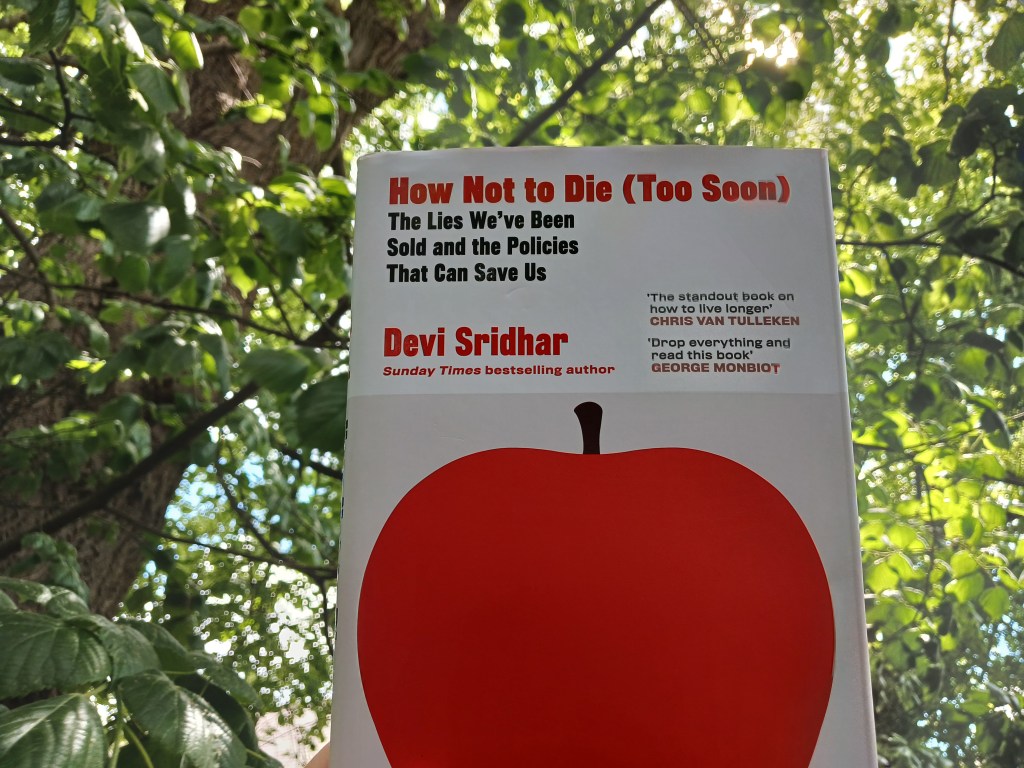
Professor Devi Sridhar comprehensively exposes the ‘lie’ of individualism within the global health crises and challenges us to switch to a narrative of more government accountability for the policy decisions which affect us all. She argues that where you live matters to your life expectancy and that the expected behaviours, driven by government action and inaction within that context, can shape not just your life, but the quality of that life. ‘We know from scientific studies and decades of public health research not only how to increase life expectancy but also how to maintain quality of life.’
Sridhar uses the age of 100 as the collective target for lifespan and explores reasons why this is both attainable and unattainable around the world. She comprehensively chronicles nine of the most important risk factors which impact our ability to live longer lives and challenges us to recognise the bad actors, companies and individuals, which stand in our way. ‘We have been focusing on the wrong thing: namely, we have been focusing on ourselves. This means looking at government policies that promote long lives…nine of the most important risk factors affecting healthy life expectancy in all countries: physical activity, diet, smoking, mental health, gun violence, safe roads and transport, clean water, clean air and access to quality health care.’
Why can’t we all live to be 100 years old?
Again and again Sridhar makes the point that the steps needed to enact these policies for longer living are well known and that it is societal accountability that lies at the crux of the problem. ‘We know how to prevent millions of unnecessary early deaths around the world, both in developing countries and closer to home.’ If we know how to prevent millions of early deaths around the world, the implicit question becomes why have those lives been targeted as being expendable and who has made that choice that some- in most cases, the wealthiest- lives are more valuable and need more protection than others. It would have been too easy for this book to turn into a polemical rant about obstructive capitalists intent on growth over human suffering, but Sridhar side-steps this effectively and instead presents examples where countries and communities have successfully changed, adapted and evolved, to better protect all its citizens. Her goal is clear, ‘My aim with this book is to show you that we know what works in solving the major health challenges.’
‘This is a book about how to live longer’
Sridhar also makes it emphatically clear that, ‘This is not a book about how to die. This is a book about how to live longer.’ There is a strong focus on family and the power of human relationships which echoes through the book, aspects of life which can enhance our human experience. She quotes her ‘Nani’, recently celebrating her ninetieth birthday, whose mindset was ‘it’s not about how to die. It’s about how to live.’ That treasuring the accidents of our lives is important, as ‘life is special because it is finite.’ Therefore, a longer life span is possible, is attainable and should be a birthright of all. Sridhar reminds us that in the mid 19th century, a life expectancy of 40 was not seen as being ‘mid-life’ or ‘middle-aged’. She celebrates how far we have come since then and questions why an extension of a healthy life should not be the new expectation. ‘In 1841, life expectancy at birth was roughly forty years old…Back then, forty wasn’t mid-life: it was life.’
Of course, the nine risk factors which Sridhar explores in the text, were not so prevalent in the mid-nineteenth century, although avoiding cholera outbreaks through drinking unsafe water, which the UK identified through the efforts of John Snow, is still a lived experience for millions around the world today.
Transforming the health expectations
Of the many global examples which are used by Sridhar, the Netherlands is highlighted as an example where ‘it wasn’t always like this’, but rather where the cities were designed and structured to ensure that health was a priority. Therefore, if examples exist, it becomes logical to understand that they can be replicated in other cities and countries. Paris, in France, also aimed to put the health of citizens as an integral part of daily life through its creation of ‘Fifteen- Minute Cities’- whereby ‘a city should be designed so that most of people’s daily errands, work, education and life can be carried out within fifteen minutes (by foot or bicycle) from their home.’ Nothing inherently unusual or controversial there, when building a healthier future was the goal. ‘The way to shift physical activity at a population level, as shown by Amsterdam and Paris, is to build it into daily life so that it becomes practical, invisible, free (or cheap) and social.’
Unfortunately, in recent years, populists have gained traction by referring to these cities as places where you only have ‘15 minutes of freedom’ and that these health measures are ‘Stalinist-style.’ In this, Sridhar identifies some of the obstacles and challenges faced by countries which try and build long term healthier communities for their citizens; that these are delayed by political interests and vested interests, which look to protect their profits and cause division.
Early deaths globally could be prevented through effective change and adaptation to more physically active lifestyles. ‘The World Health Organization (WHO) estimates that 4 to 5 million deaths per year could be averted if the global population were more physically active.’
Sridhar makes the convincing argument that, ‘Just telling people to move doesn’t work if they can’t implement this advice within their daily life and routine.’
Government inaction rather than individual lack of discipline
Changing daily routines such as diet, as well as exercise, should be led by government policy and action, argues the author, where she acknowledges the complexities of relationships with food and the financial implications of eating healthily, but summarises how governments should behave. ‘Make it easier to eat well and harder to eat badly.’ She follows this by emphasising that markers of ill-health indicate where governments have failed. ‘Similarly, a population being overweight is a sign of government inaction, rather than an individual lack of discipline.’
Several examples are highlighted where government regulation and action have led to increased health outcomes for citizens. Sridhar evaluates the positive impacts of the UK government’s measures regarding behaviours around smoking, and how quickly attitudes and the culture around smoking changed, when the government intervened to safeguard the public. ‘First, make it harder to smoke through taxation, minimum purchase age, bans on ‘kiddy packs’, and ensuring cigarettes aren’t visible in shops. Second, reduce the ability of people to be able to smoke in social or work settings. Third, counter the marketing and advertising of tobacco companies which are selling a dangerous product that literally kills.’ With increased health outcomes, this also lessens the strain on access to health services, which is also explored fully by Sridhar, who suggests that these health issues should all be seen as intertwined and connected, rather than discrete issues in their own right. However, she also makes the repeated point that, ‘Regulation only works if it’s enforced.’
Gun control and regulation
Shifting focus to America, Sridhar again highlights how the interests of a few can drive government policy, so that citizens there do not have the same chance of a healthier, longer- life span. She focuses on ‘freedom’ making the clear point that freedom of children to be safe appears to be of less national importance than the freedom of people to have firearms. ‘The gun lobby is a small minority who resist any change because it impinges on their profits.’ She compares school shootings in the USA, with the school shooting in Dunblane, Scotland and draws attention to a powerful group who can bring about change- the parents of dead children. For people to have the equal chance to enjoy longer life, gun control is a successful government measure and demonstrably works. ‘Gun control worked in Britain. As the Gun Control Network says, it ‘proved that good governments acting in the interests of the many, not the few, can overcome the rich and powerful gun lobby.’ She questions why the government does not intervene to protect its people-’If we know what works, why isn’t it being done?’ and notes bluntly that, ‘Getting shot at school is one of the most likely ways for a child to die in America.’ Cutting through the complex ideology and associated cultural identity that is linked with owning a firearm, Sridhar returns clearly to her underlying argument- ‘How Not To Die (Too Soon) in America, answered in part by strict gun control laws.
Access to equality
Sridhar then turns her focus on the inconsistency around the world where access to clean water, clean air and medical care is often problematic. She draws attention to the statistic that, ‘In 2023, the UN estimated that 2.2. billion people did not have access to safe drinking water.’ Over a quarter of the world’s population could not access safe drinking water in 2023- but this is only the beginning. ‘By 2025, the UN predicts two thirds of all people on the planet will live in water-stressed areas. There’s no ambiguity with water compared to other goods: humans, animals and plants cannot live without water. Find fresh water, or die.’
When there are concerns over the safety of drinking water, then this is when private companies swoop in with bottled water- making a profit out of the situation, rather than seeking to remedy a basic human need. When faced with statistics about access to safe drinking water, sometimes readers in Western Europe can feel that they are exempt from these concerns- but, as the recent ongoing sewage concerns and poor health of waterways in the UK demonstrates, having access to clean water affects developed countries as well. Schools have even closed in the US over water issues.
When we have a limited resource, which is necessary for life, then conflicts can begin over ownership of that resource. Sridhar again challenges us to imagine this scenario where a resource is privately owned and monopolised, as well as the extreme situation. ‘Can you imagine a world in which there is no fresh water?’
We are victims of circumstance in terms of geography and economic systems. Some of us can move to avoid the worst impacts and thus experience longer healthier life-spans, but this is not an option available to all. Although some risk factors are within our control, Sridhar turns to the most obvious one which is not in our control, whether we live in Switzerland, India, South Africa or the UK- the quality of our air and the impact of air pollution. ‘Dr Maria Neira of the WHO said, “The problem is that when you’re a citizen, you can’t choose the air you’re breathing. You breathe whatever is available.”’ The need to have clean air to help people enjoy healthier lives didn’t used to be a political football or a partisan issue. It has been viewed as a UK-wide public health issue, until recently, when populists used clean air as ‘anti-car’, once again prioritising the capitalist profits of industries over the health of the population. ‘The backlash against clean air measures is baffling: we all live longer with cleaner air, and the issues should have widespread appeal.’
Being happy with living
‘How Not To Die (Too Soon)’ outlines a blueprint then- a hopeful pathway to a healthier world. A pathway which identifies and challenges why the needs of the many don’t outweigh the needs of the few, or the one. As demonstrated time and time again in the book, countries around the world have identified the risk factors for their own people and have then enacted long-term solutions which change the attitudes and behaviours permanently for the good. Governments can be powerful instruments of good, which leave no one behind. ‘That’s the politics of hope: we must imagine a healthier world and take the public policy steps towards it.’All that remains is to change the political will and to make health a priority, in order to improve life for all within a society.
After all, ‘Life isn’t about not dying too soon. It’s about enjoying and being happy with living.’
-
Review of ‘Is A River Alive?’ by Robert Macfarlane

Rivers are an integral part of the human story. They hold cultural, spiritual, political, geographical significance, as well as holding an intrinsic value of their own. Or, as Macfarlane phrases it, ‘Our fate flows with that of rivers, and always has.’
Macfarlane frames this book through the personal experiences of journeying in and around rivers in Ecuador, India and Canada. He does this to allow the readers to explore the narrative between humans and rivers and to hopefully create a new story which allows protection and love, in multiple forms, for the rivers of the future. There is a thorough immersion into cloud-forests, mycology, waterfalls, paddling through rapids, and forging lasting relationships with water-defenders.
The title of the book has been formed as a question, rather than a declarative sentence to begin to form a community of those who can tell the new stories of rivers. Whether these be those who can make the legal arguments to create legal identities for rivers through the ‘Rights of Nature’ movement, or those who work as river guardians against extractivist developers around the world, we all have a part to play to ensure that the intergenerational value of rivers and life continues. Macfarlane refers to these actors as the ‘ghosts, monsters and angels’ of a watershed.
It is no accident then that the book closes where it begins, with generations of a family cherishing and valuing a river, standing alongside the ghosts of the past and the future. Macfarlane asks the question of what he would say to his descendants, in the hope that he has done enough to be a good ancestor. ‘What would I tell them? That the river is time, and we are always within it, even when we’re standing dry-footed on the bank, watching the current past.’
Language plays its part in creating narratives, but the grammatical and lexical limits can create challenges. Macfarlane notes this when he comments, ‘I wonder how on earth to write about the anima of this place; what language might meet its aboundingly relational being; could convey this emerald pluriverse…’ Rivers are sadly still referred to as objects, with ‘which’ being used, rather than a subject ‘you’. Changing the language changes the relationships in thought and connection.
As Macfarlane journeys in India and Chennai especially, the lament goes up that ‘Cities grow along riversides’, writes Yuvan [Aves], then slowly forget their ecological, hydrological genesis.’ The human sprawl, impact, and exploitation puts a strain on healthy rivers. ‘Humans have lived and died by the rivers of south-east India for 1.5 million years.’ The ghosts of the past, their legacy and view of their river home still has an impact today. He notes the damage and abuse of the water systems of the region, bluntly stating, ‘Chennai’s rivers have been poisoned.’ He notes the ‘Mass fish die-offs in 2014 and 2017’, but acknowledged that, ‘This systematic abuse of water is a relatively recent development in the region.’
When rivers die, marine life, insect life and then bird life plummets with the loss. ‘When a river is dying, life in its aura dies too.’
This destruction of a river system can also be seen in Macfarlane’s story-telling from Canada, where construction of multi-dam complexes challenged the river and the community.
‘From 2009 onwards, Innu communities and others in the region watched the slow death of the Romaine and its catchment.’ Bringing the modern legal frameworks to support religious and cultural beliefs and narratives around rivers is happening around the world. ‘For Innu communities,’ wrote Uapukan Mestokosho, a young Innu woman who became closely involved with the defence of the Mutehekau Shipu, ‘rivers are considered the veins of the territory…more than waterways or resources, they are living beings with their own spirit and agency- and they deserve respect.’
Towards the end of the text, Macfarlane explores the questions we may have for ‘the river’. In this framing, there is a quasi-religious expression, but also a sense of asking a question of our ‘elders’, to learn more about our collective past and future. In this, Macfarlane charts how he has become ‘rivered’- an appropriate verb for an awakening- a ‘baptism’- a physical understanding and connection with rivers. ‘Perhaps the body knows what the mind cannot. Days on the water have produced in me the intensifying feeling of somehow growing together with the river: not thinking with it, but being thought by it. …’Rivers are running through me, I think; I’ve been flowed through and onwards.’
Most of us will not be as lucky as Macfarlane to be immersed in these river-journeys around the world, however rivers can still speak to us, if we choose to listen. ‘What is the river saying?’ echoes as a question throughout the book. It may be that we are in a position where we can answer the question ‘Is A River Alive?’- it may be that our relationship with our rivers and watersheds hasn’t built up to that point yet. Asking the question is the useful first step.
Learning and becoming familiar with our local rivers is key- knowing where we are in a river landscape and how these flow and build and join along their routes is an enriching and powerful story. It is sad that we can navigate the country through the artificial routes of roads and motorways, naming them as we go, but are lost in a country river-scape.
What will we say when we reach that final ford? How will we pay the ferryman to cross the River Styx? Will we say, ‘The river has run on and I didn’t notice.’ Or shall we join him gladly for one last river-journey together?
-
Review of ‘Poisoning The Well: How Forever Chemicals Contaminated America’ by Sharon Udasin and Rachel Frazin

Poisoning The Well is a critical exposé of the pervasive plague of PFAS chemicals and the inability of the US Government to effectively regulate against a raft of toxic chemicals. The publication timing of this book comes when the Trump Presidency in early 2025 moves to reverse state bans on toxic forever chemicals and instead change the way the EPA carries out chemical risk evaluations, with the increased risk to consumers.
This book then should serve as a reference book for the UK and other countries around the world, as it highlights delaying practices from chemical companies and the tactical ‘spin-off’ strategies used by them, to avoid full responsibility, accountability and liability. It is a harrowing read, as we can see how close we are to an environmental disaster and we can also see the lack of action from our government to intervene. Time and again in the book, we see striking similarities between actions from chemical companies abroad and a lack of oversight in our own country. We must learn from the hard lessons of the USA.
As the UK and Western Europe seem to be playing catch up with PFAS chemical regulation, Poisoning The Well identifies the new ultra-short-chain subtypes, such as PFMOAA and PFPrA, promoted by chemical companies, and powerfully argues that research into their impacts needs to be a priority. As noted in the text, ‘In the endless world of emerging PFAS, it’s becoming increasingly clear that the ultra-short-chain subtypes are a troubling new facet of the forever chemical problem.’
Individuals and communities are trying desperately to manage with the active chemical pollution sites which have destroyed lives, but need concerted action, remediation and justice for the widespread chemical pollution of the environment.
“All this time, it’s been in the water, it’s gotten into the food chain. We’re eating it. It’s in plastics. We are sleeping in it. It’s in everything we touch.” – Erin Brockovich
Udasin and Frazin offer an extensive and detailed history of the actions of companies like 3M, DuPont and Chemours and note that the dangers of PFAS have been known on an industry wide level for decades. The similarities between these chemical giants and the actions of Big Tobacco are implicitly alluded to in the text. What makes this text even more shocking is that it does not simply relate industry behaviours from the 1960s and 1970s, but describes legal cases that have been brought in just the last few years as well. ‘In October 2021, the City of Decatur, along with Morgan County and Decatur Utilities, settled with 3M for nearly $100million.’ All too often though, we note that these chemical settlements can often come with a caveat that ‘the agreement is “no admission of wrongdoing or liability.” Therefore, do financial settlements go far enough?
Awakening the public conscience is always difficult, but the film ‘Dark Waters’, about the lawyer Rob Bilott’s efforts to make the chemical company DuPont responsible for its actions, certainly seems to have struck a chord around the world and has acted as a legal precedent in this litigation field.
A lack of regulatory oversight
The authors also argue that a lack of effective regulatory oversight has allowed chemical companies to pollute in an unimpeded manner, with the dangers of self-reporting and under-reporting being rife. ‘In November 2017, it came to light that 3M had alerted the Alabama Department of Environmental Management (ADEM) that it had been underreporting its discharge of PFAS into the Tennessee River- for three years and by a factor of a thousand.’ The links between the lack of regulation in North America and the lack of regulation over the private water companies in the UK, which have been pumping sewage into rivers for years, are made sadly all too clear for a UK audience.
The dangers of sludge spreading and the unknown contents of these bio-solids should also be a lesson to be learned, with toxic contamination rife, with enforcement non-existent. The activist George Monbiot writes of sewage sludge being sold to farmers in the UK with levels of forever PFAS chemicals up to 135 times higher than those considered safe by scientists. This level of contamination and pollution is happening on our watch and so far, is being met with silence. Those who should have been enforcing regulatory standards have been either toothless or complicit. ‘In short, federal oversight has hardly been a panacea for dangerous chemicals. The long-standing struggle between regulators and industry begs the question- Who wields the real power over Americans’ exposure to these toxic substances?’
Switching off these ‘pollution taps’ is only the first step. Combatting the legacy contamination will take both years and levels of financial aid which are eye-watering. A financial responsibility, which chemical companies who have profited from these pollutants, appear unwilling to bear. It becomes then a state lottery as to the levels of protection against PFAS, as Udasin and Frazin note that while some states take preventative action against the toxic chemical pollution, others wait for the health impacts to hit the population. Action is then clearly possible, if the political will is there.
‘Maine became the first state to require that sludge be tested for PFAS and then to ban the materials’s spread.
As of mid-2024, Maine was the only state to have prohibited the presence of PFAS in sludge entirely, although at least sixteen other states were either implementing or considering solutions to this problem.’
Communities count the cost
Understanding that PFAS pollution is a country wide issue for the US is made abundantly clear in Poisoning The Well, as examples are cited from Maine, West Virginia, Alabama, Tennessee, Colorado, Ohio, Delaware, North Carolina and Michigan. In all these states, the authors describe local impacts: from schools being built on landfill sites; fights to ensure that safe drinking water is provided in schools; to neighbours watching their communities being torn apart with cancers and other illnesses, which could have been prevented. Communities with strong military links have also found to be heavily exposed to forever chemicals. The history of ‘aqueous film-forming foam’ of AFFF on US military bases is forensically examined in the book, with the argument being made that the US Navy knew from the late 1970s that AFFF had toxic effects. ‘But the military, like industry, already had some indication of AFFF’s toxic effects decades before such knowledge became public knowledge.’ In terms of PFAS clean up of military sites, the legacy contamination continues, ‘By the end of 2023, the Defense Department had assessed more than 700 bases and found that 574 of them needed remediation.’
Despite this, it will be difficult for military personnel to prove the causal link between their poor health and exposure to toxic chemicals in all cases, and sadly this will be seized on lawyers for chemical companies, both in the US and in the UK, where they will argue that because PFAS is so pervasive, that identifying one source of exposure is too difficult. The playbook of Big Tobacco will be used once again by those looking to escape blame. How military personnel and veterans can be treated this way by an organisation meant to look after them is truly a shocking revelation. To be left to face their health battles alone is a betrayal of their service.
‘Someone’s got to be responsible’
Poisoning The Well is unashamedly a human story. It is not a detached, impartial overview of chemical contamination. Instead, it focuses on individuals and communities. Communities that could be us. That might still be us. The book celebrates those who have fought to raise awareness in their towns and communities, at great personal cost to themselves. Because it was the right thing to do.
Regardless of where we now live, environmental pollution is becoming a dominant issue. Very rarely is contamination accidental. The authors tell moving story after moving story of people whose lives have been turned inside out, owing simply to the geography of where they were born, grew up, went to school, or went to work. Places that they thought were safe. Places that ought to have been safe.
Domestic products were sold to people in huge numbers when health effects were known, argues the book. Now, we have a situation where the ‘sheer number of different compounds out there’ and their individual, as well as cumulative impacts on humans, has created a global contamination crisis. PFAS pollution could be the biggest environmental disaster facing us. But it is not too late to stop the ticking time-bomb of harm.
Someone is responsible for the contamination.
But all of us are responsible for speaking out about PFAS pollution where we can. We, too, have a responsibility to demand action and justice from those who have contaminated our towns, homes and families. Slowly- all too slowly- the eyes of everyday people are being opened to the dangers of PFAS forever chemicals.
If other countries do not learn the brutal and harsh lessons from the USA, and instead pander to mendacious chemical companies for financial gain, then they will be complicit to the toxic poisoning of millions.
-
Review of ‘A Climate of Truth: Why We Need It And How to Get It’ by Mike Berners- Lee
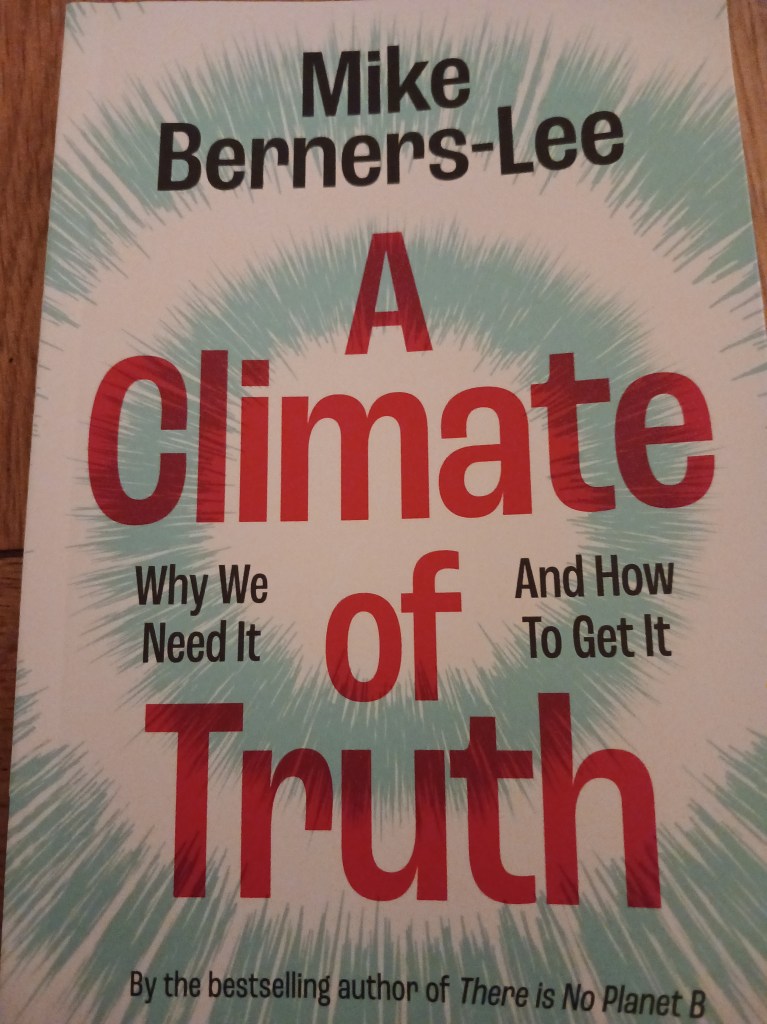
Mike Berners-Lee’s fresh new book challenges us all that we deserve more on climate communication, that we should expect more and finally, that we have the agency to demand more on climate communication. He calls for a new high standard of honesty and truth to reset the moral balance and reminds us that the standard we walk past is the standard we accept. When we choose to support media which lies and distorts. When we choose not to hold politicians to account for their self-serving behaviours and when we support businesses for our own convenience when we are aware of their links to fossil fuel companies.
This text A Climate of Truth follows Berners-Lee’s other famous books, There Is No Planet B and How Bad Are Bananas?, therefore we expect the same rigorous standards and evidence and in this, we are not disappointed. Berners-Lee cautions us that, ‘If humanity is to thrive in the decades ahead, the most critical step is to raise standards of honesty in our politics, our media and our businesses.’
He calls for an interruption to the failed system which has led us to this point and describes an emerging polycrisis of interconnected factors, which requires a new system of political cooperation and functionality to manage and adapt to these new threats. ‘This book is about the fact that humanity is accelerating into a deadly Polycrisis… yet in spite of this, our response continues to be hopelessly inadequate.’
He argues that the challenge facing us requires us to face the habit that has brought us here and then to break this habit, so that socio-economic trends do not continue to rise unabated. He argues, ‘The climate and ecological emergencies we face must transcend party politics and in the end will require a huge evolution of how political systems function and how all parties conduct themselves.’
Growth begets growth
Berners-Lee outlines the seven ‘outer layers’ of the polycrisis- ranging from components such as climate, energy, population, food, biodiversity, pollution and disease. He carefully unpacks each of these in turn and asks the question as to why we aren’t solving some of the technologically solvable problems. He does not present technology to be the silver bullet, but instead warns us about the dangers of ‘techno-optimism, that ‘tech-centricity assumes and hopes that our climate problems are only skin-deep and that our fundamental approach to business, technology, politics and society can remain in place.’
Instead he urges that there should be an interruption to the current systems. ‘You have to interrupt the carbon curve at the global system level.’ He notes that global emissions are still rising even after 28 COPS and that demand-reduction could be a critical pathway. He observes that even the strong pledges and commitments on plastic reduction have not made a dent in this rapacious business model. What we have been doing, has not worked.
‘The world now uses around 500 million tonnes of plastic per year, of which just 6% is from recycled materials and the rest is virgin, made almost entirely from fossil fuels.
Berners-Lee makes no excuse that multiple levers have to be pulled on simultaneously to achieve the necessary dramatic actions that we need, but that the most important lever is to create a culture of truth. ‘Demand reduction is the most critical and under-discussed component of the drive to leave fossil fuels in the ground. The fossil fuel companies hate the idea of using less energy, and they work hard to protect us from understanding the clear-cut need to do so.’
We must consume less and be more.
A Climate of Truth strongly advocates for a circular economy, rather than a consumer driven, capitalist based model. ‘We have developed societies based on consumerism rather than citizenship; we think more in terms of what we can have than in terms of what we can contribute.’ Berners-Lee stresses that we should remember that it is industry which have created these narratives in order to develop and preserve their own financial survival. ‘The fossil fuel industry makes more money the more coal, oil and gas we burn.’
In truth, there are few surprises in this book for an audience who are well versed in the duplicity of the fossil-fuel industry and its shills. Shill who constantly deter and delay the necessary climate action that will keep the level of suffering to a minimum by 2100.
‘In a survey of 380 climate scientist lead authors of IPCC reports since 2018, only 6% think the climate will stay below 1.5℃ compared with 42% who think we will go beyond 3℃.’ To note the countless extreme weather events which are observed in a 1.2℃ world, it is almost impossible to imagine what a possible 3℃ world might look like.
The choice is radical change or untold suffering and death.
The book then investigates the middle layers of the polycrisis before moving onto the core of the issue. Although a lot of ground is covered by Berners-Lee, the book is wrapped around the central pillar that we have to learn from what hasn’t worked and that a deference to the capitalist ideologies and acceptance of untruthful words and behaviours is a choice that we can choose to break. We choose to believe in and accept untruthful politicians. We choose to support dishonest, environmental harm causing companies. We choose to accept corporate dishonesty and media monopolies as the norm. But it doesn’t have to be this way, urges Berners-Lee.
We are urged as individuals, communities and countries to insist on a better narrative- a narrative of Truth. To demand this narrative of Truth.
And this is where our voice can be strong.
‘To start making headway on all these issues and more, a climate of truth across politics, media and business is what we most need. And the wonderful news is that we can get it if we really want it. We just have to not put up with anything less.’
Berners-Lee closes his text with a powerful call to realistic hope. He reminds us that sometimes we can be in the middle of a movement and not see it for what it is- a social tipping point, a collective moment of truth.
Social tipping points can happen fast. We might be on the cusp of one right now. We might not need an unimaginably traumatic event to shake us into action.
We can each be a meaningful part of the change, and that is enough.
-
Review of ‘Scientists On Survival’

Scientists On Survival– a collection of essays, articles and thoughts from Scientists for XR- is the rare beast. A climate book written by experts which isn’t about science, but which is a story about humans. A story of journeys and a story of love.
The writer and campaigner Matthew Todd describes the book this way: ‘This collection of essays is deeply moving, inspiring and profoundly important.’
The climate clock is running out, but before everything is lost in time, we have the opportunity to protect ourselves, other species and our futures. ‘Whereof what’s past is prologue; what to come, in yours and my discharge.’
But it would seem that vested interests of the fossil fuel companies continue to try to dismiss and discredit science and expert scientists- from the courts of Galileo, to President Trump firing NOAA employees. Nothing ever changes it seems. And yet, as we have seen, time and time again throughout history, everything can change.
Chris Packham makes this blunt point in the foreword to Scientists on Survival. Packham is a person who has spent so many years devoted to protecting nature, conserving species and promoting a love of nature and he states: ‘And the truth is undeniable: life on Earth is in desperate peril. Our world is burning, melting, drowning and degrading in ways we can simply no longer ignore. Powerful vested interests- fossil fuels, industrial agriculture and chemical giants- have obscured the facts and silenced the voices of those truth tellers.
This is not a book about the science of climate breakdown or biodiversity loss. It is a collection of human stories told through a fierce love for our natural world.’
Find your Voice
Scientists on Survival is split into three clear and logical sections: scientists’ views and perspectives on where we currently are and the ‘lightbulb moment’ for each of them; what they have each done in response to the situation, in terms of lifestyle changes and mindset shifts; and then finally how they have tried to raise global awareness of the lack of government action on climate issues through non-violent protests.
Dr Ryan Walker asks the burning question, ‘How have we got to this? How could a problem that we have known about for more than 40 years be allowed to get progressively worse?’ A question to which we sadly know the answer. Fossil fuel companies and an insatiable capitalist system have manipulated us into thinking that individual status and wealth are more important than global cooperation and action. Divisions that Dr Abi Perrin also notes which have been artificially created to ensure that the capitalist system and structure remains intact. ‘How had so many years of scientists’ warnings failed to generate political urgency on climate action?
I sit with a fear that, at a time when we desperately need to be pulling together, we are instead seeing further polarization and division in our societies.’
Dr Tristram Wyatt urges us to talk about the climate as much as we can, because being part of a community- even a niche community- is empowering and changes the narrative to a human based one. He argues, ‘It might not be for you, but speaking about the climate crisis can be cathartic. So many conversations are waiting to happen, and finding your own voice is an important part of the process.’
This is a point that Dr Laura Thomas- Walters also endorses- that climate communication can happen everyday and in many contexts. That people listen to other people, especially in close groups, more than they listen to strangers.
‘It rests on the idea that we trust our friends and family more than random advocates from charities or the government, so they are also the best messengers to promote good attitudes and behaviours.
Still the number one easy thing to do is talk! Change the way society perceives climate change. Don’t let the media and government dismiss it as a fringe issue.’
For critics looking for flaws in the book, this argument will undoubtedly arise- why should we listen, or read, the views of scientists, if we are supposed to listen to our close family? Ha! Checkmate! It avoids the secondary question of how your close family has interpreted the information from climate scientists for your home, for your specific community, for your country. Someone always listens, because not everyone is on the sidelines criticising the play. We all have skin in the game.
‘I will not be a bystander’- Emma Smart
There is comfort in not looking at a problem. There is a comfort in allowing calling for climate action to be done by other people. There is a peace that can be found in saying ‘Other people have protested and it hasn’t changed anything, so it never will.’ Dr Stuart Capstick challenges this emotional response head on when he explores the motivation of climate activists. ‘I’ve often wondered what it is that moves someone from being vaguely concerned about the environment, to that visceral grasp of the true scale, horror and injustice of the emergency heading our way. And I feel more vulnerable, confused, heartbroken and afraid than ever. Why do we know but not act? Why do we participate so willingly in our own downfall? Is it the sad truth that we’ll only know what we’ve got once it’s gone?’ The willing blindness, the willing ignorance is the easy option and the wide, straight, easy path. No wonder it’s so popular.
How do we act though, when we knowingly hurt the ones we love?
We will all find chapters and essays which resonate with us personally in the book and this is exactly the point of the multiple voices. Humans make connections with other humans and shared experiences can be a powerful way to start climate conversations. Dr Viola Ross- Smith’s chapter touched and affected me strongly, when she described bringing up a child in this new world and how we, as parents, equip our children to be informed and adapt. With my own eight year old, who could reasonably see 2100, what will that world look like and how could we leave it a better place than it currently is on track for?
‘How do I bring my brilliant boy up so he understands what’s already happening, let alone prepare him for what’s coming? How do I equip him for the future without filling him with despair?
But can I afford not to act when his future is at stake?
What kind of parent would I be if I didn’t try everything in my power to change things for the better?’
Nobody knows what happens next.
Dr Capstick openly acknowledges the sad truth that globally we are off track, but does not give into despair, but instead calls for agency, stating that we are all willing and able to help our friend or neighbour when they need us.
‘Nobody knows what happens next. The climate and ecological emergency is guaranteed to get worse because we have yet to see the full consequences of what we have already set in motion and because globe emissions remain stubbornly colossal… but it’s up to us how much further down this road we go.’
The point being made here is not that scientists are ignorant in their understanding of climate projections, but rather that they are ignorant in their understanding of the impact of global mass movements of humans demanding climate action and how quickly these can be brought to the top of the priority list of governments. Dr Charlie Gardner makes the point in his contribution that there are uncertainties in the future projections precisely because we still have the ability to change the possible outcomes.
‘Ultimately, we don’t know how fast or how high the oceans will rise, because we don’t know how bad planetary heating is going to get. Stabilizing the climate requires slashing greenhouse gas emissions by ending the fossil fuel age and reversing the destruction of nature, which in turn requires a complete transformation in the way our economies and societies operate.
As an activist, I realized, I must do more than just ring the fire alarm: I must also detail the way out of the building and show people how to find it.’
What’s stopping us? ‘Superman’s Not Coming’
To quote the title of Erin Brockovich’s book, Superman’s Not Coming in a discussion about climate action is incredibly pertinent. Why do we always look for the ‘climate saviours’? Or the technology which will magically transform our planet at any cost, as long as capitalism isn’t disturbed as a system? We can point our finger at global leaders, or countries and arrogantly comment that we will act when we see them acting, or we can be the change ourselves that we need.
What needs to change in your local park? Your local community? What is the air pollution like in some of your streets? How can you find out? How can you draw attention to these issues? Who else are you going to talk to about this? One person can become two very quickly. Two people can become twenty. And twenty can start a mass movement.
The final argument from Scientists On Survival should be given to Dr Abi Perrin who comments that the mass movements that we need to see have not yet happened and therefore we have an ‘undiscovered country’ ahead. She states succinctly, It’s hard to know how to end this story. Perhaps that’s because it’s not yet over.’
With role models around the world in a wide range of fields now arguing passionately for much- needed climate action, it’s surely time for a new narrative, because what we have done so far has brought us to this point. What we have been doing hasn’t worked- so what’s left? Dr Perrin and the other scientists in this collection make their plea again- what is stopping us from taking climate action as a species? With the stakes so high, the window of opportunity to change course closing so rapidly, and the opportunity- and responsibility- for scientists to make a difference, what’s stopping us?
This lack of action can’t be our lethargic and apathetic response to the suffering of millions around the world. That we can’t be bothered to do anything to help? That we are happy to leave a world to our children which will contain so much pain? That the Global North will continue its imperialist racism and ignore the desperate cries of the Global South?
When we are ill, or have a fever, we can go to the doctor and listen and follow the expert advice on how to get better. For some reason, we cannot equate that we need to listen to climate scientists on how to lower the Earth’s fever.
A better world is worth fighting for.
After all, we have nothing to lose and only a world- the only one we have- to regain.
-
Review of ‘Dark Laboratory: On Columbus, The Caribbean and the Origins of the Climate Crisis’ by Tao Leigh Goffe
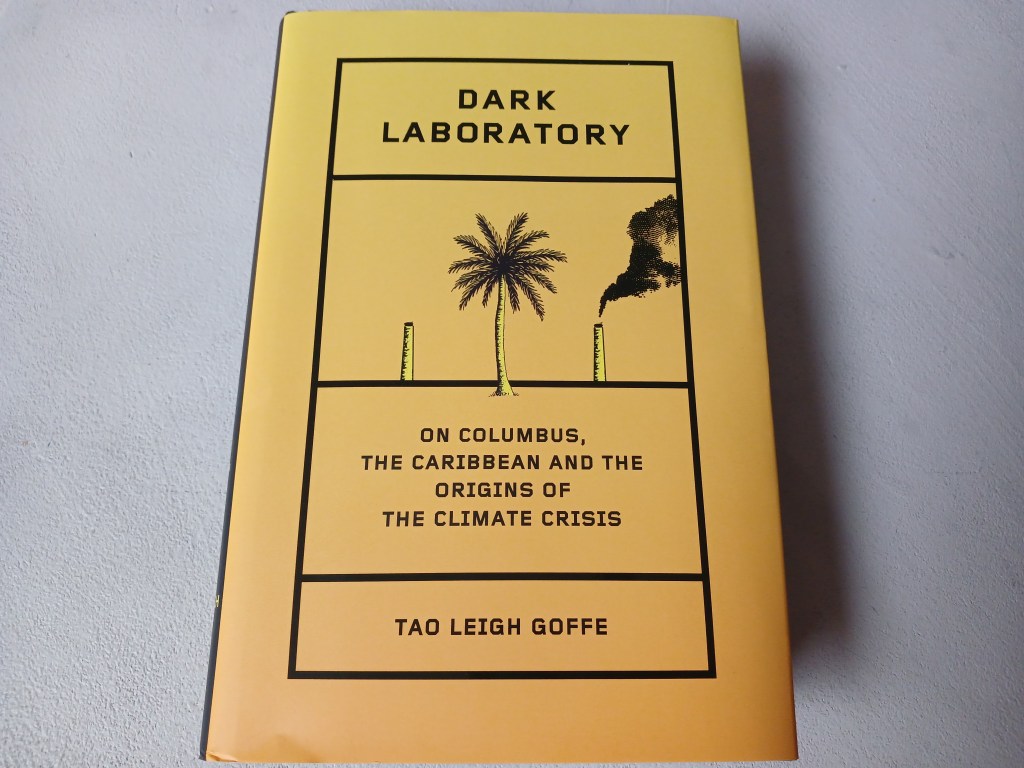
‘Dark Laboratory’ charts and chronicles the embedded and systemic colonial racism primarily from Western Europeans to those in the Caribbean, and argues that this ‘history’ should not have ‘a veil of ignorance’ pulled in front of it, but should be exposed, acknowledged, and a new narrative told. Goffe questions, ‘Yet, as a global community, we continuously fail to address the origin of the problem. Without economic and historical analyses of the origins of the climate crisis, how can we expect to understand its sedimented layers?’
She urges a new narrative that empowers communities long oppressed and which can be used as a powerful guide to help adapt to and mitigate the climate and ecological crisis. ‘We need new stories, new technologies, and new forms of nature writing.’
This book is a comprehensive, evidence-led study of the impact of colonialism and for Goffe this begins in the 1492 ‘discovery’ of the Americas and leads in an unbroken line to the 21st century. The players have changed, but the exploitative and extractive game is the same. ‘We are experiencing the consequences of a centuries-long cycle of exploitation of people of color, whom European colonial powers have forced to extract resources from the earth.’
Although this is a text which consciously looks towards the past, it also aims to break the cycle of the future- that future suffering need not be an inevitable future for millions. She states that not to break this cycle, could make us just as complicit as the arrogant and ignorant users of the past. ‘We must refuse to betray future generations, especially because we have been forsaken by so many before us.’
What’s past is prologue
Goffe calls on past strong, powerful leaders, to support us in our struggle and to have as examples. She reminds her readers of Queen Nanny of the Maroons and her refusal to betray those who would come after her. ‘Queen Nanny’s name echoes across the mountain ranges of the archipelago because she refused to sign the eighteenth-century British Treaty. She refused to betray the future.’ Interestingly, in the UK, Queen Nanny’s name should be well known to a generation of school students, who meet her in national exams, where the question of who gets to write history and who has the power to write history, and who gets to whitewash history, becomes the focus.
It is no accident also that Goffe uses arguably the most colonial Shakespeare play- ‘The Tempest’- to exemplify the historic struggles and conflicts between ‘native’ and ‘invader’. She continues to evaluate the colonial experimentation that played out in the Caribbean and asks, ‘What has the cost of imperialism been for the natural environment?’ She answers her own question by arguing that this European ideology led to the destruction of ‘Eden.’ ‘The mandate for discovery was a justification for ecological degradation.’ And continues that, ‘When Europeans arrived with the cross in the Caribbean, they could not help but see Eden.’
Goffe powerfully argues that racism lies at the foundation of the climate crisis and that the Caribbean has systematically been asset stripped for Western ‘trophy hunters’. ‘Racism structures the climate crisis because it was a part of its origins.’ She challenges modern day readers to accept this argument and to no longer be complicit in continued acts of racism- whether this be in the guise of modern day confrontations in Central Park (Cooper v Cooper), or in the mindset of policing and the justice system to black people, Rastafarians and Indigenous peoples around the globe. ‘To remain willfully blind to race is to enforce racist modes that lead to the premature death of racialized people.’
‘Too much evidence’
‘Dark Laboratory’ calls for a new kind of climate storytelling- one that no longer puts colonial and capitalist expansion as the priority and ‘norm’ of economic models. ‘Ultimately, hope rests on the caesura of capitalist expansion.’ With the book’s comprehensive and forensic analysis of the guano trade, coral coloniality, slavery, plant theft- which led to the rise of Big Pharma, animal theft and land theft, Goffe argues that there is simply too much evidence of the endemic racial ideology for it to be ignored, whitewashed or greenwashed.
She closes the text by imagining the next ‘New World’- ‘Time traveling from 1492 to the far future has been necessary for the scale of imagination of this book and will be necessary to face the climate crisis. Poets and policymakers will be critical to the scale of empathy we need.’
New stories will not however, be enough, by themselves, to stem the tide of rising sea levels, which pose a ‘death sentence’ for the Caribbean and other island states. If we cannot break the modern chains of never-ending capitalist growth, then climate disaster awaits, and the deaths of millions of Caribbean and Polynesian people will once again bloody our hands.
-
Review of ‘Climate Injustice: Why We Need to Fight Global Inequality to Combat Climate Change’ by Dr Friederike Otto

‘Climate Injustice’ by Dr Otto is an uncomfortable read for an audience in the Global North and reminds us of the truth- that if your neighbour’s house is on fire, you don’t argue about the price of your garden hose. You put out the fire.
This is not simply a book about more frequent extreme weather. Instead, ‘This book is about the weather and climate, but it’s also about poverty, sexism, racism, arrogance, ignorance and power.’
By titling the book ‘Climate Injustice’, Dr Otto logical starts by defining what climate justice is and then highlights examples from around the world where the disparity in power and the disparity in responsibility occur. ‘Climate justice means protecting the rights of those most at risk by sharing the burdens of climate change and its effects fairly and across all sections of society.’
When we have powerful Global North leaders who try to tell us that actually there is no fire, that the impacts we witness are ‘fake news’ and reduce their countries’ ability to act in positive directions, it is at this point that we must come to realise that it is their system which is under threat. It is their voices and their narratives that need to be minimised and a new story and a new ideology needs to emerge- one which listens to those who are impacted now by the climate crisis and one which amplifies their experiences. ‘We need constructive, powerful narratives that help us to dismantle traditional, institutionalized, structural inequality, rather than reinforcing it through the consequences of climate change’
Dr Otto leads us on a global tour and explores how climate change is killing the disadvantaged across the world and how existing political, cultural and social constructs are factoring into the impact. She challenges her readers to understand that colonialism and racism are hiding behind climate change. As a white male in the Global North, I questioned whether we needed yet another voice from my demographic to talk about the Global South and its problems through a review- the last thing the Global South needs is yet another ‘white saviour’. However, silence is even more dangerous.
As a result, we do need to talk and we do need to listen. We need to be a ‘we’. Social action can be a powerful tool to challenge and overcome a dominant narrative of injustice. And Otto emphasises that this has happened frequently in the past and therefore the capacity for this to happen again is within our choice. ‘Extremely powerful narratives have been changed throughout history.’
As Otto notes, ‘Similarly, climate change is no asteroid. It is a human-caused reality that escalates the inequality and injustice in our society. An injustice we consider so normal that often we don’t even talk about it. But we need to start talking. And we need to focus the debate on improving peoples’ lives here and now. To talk about climate change is, then, to talk about inequality and injustice- and about the system in which we live.’
Dismantling ‘colonial fossil narratives’
There is an early challenge in ‘Climate Injustice’, which asks the simplest of questions- How many deaths are we happy to live with? Identifying who they ‘we’ are in this question and understanding that it’s largely the Global North who are standing idly by while the death rate continues to grow elsewhere, aided and abetted by a ‘Colonial fossil narrative’, which serves a rich, powerful few, who are rarely, if ever, challenged over their role.
The inequality quickly becomes apparent, or as Otto frames the issue, ‘We aren’t all in the same boat, especially when it’s on fire.’
Why do extreme weather events in Pakistan receive less media attention and less ‘on the ground’ disaster management, than extreme weather events in Western Europe. In part, owing to the perception that it isn’t ‘us’ yet. Otto argues that this is owing to the ‘Colonialism Meets Capitalism’ embedded conflict. ‘While extreme weather in Europe makes headlines for weeks on end- not always the right ones- reports on weather extremes in Africa are practically nonexistent.’
As Dr Otto reminds us, ‘The formula is frighteningly simple: the richer we are and the more privileged our lives, the less susceptible we are to the physical consequences of global warming. To put it another way, those with the least suffer the most from the consequences of climate change.’
Climate justice concerns everyone.
It is this injustice, this well established and created imbalance of power and visibility, that Dr Otto explores in her book and argues that this structure is also one which needs to be addressed. ‘[W]e won’t be able to manage climate change unless we eliminate the historic dynamic of injustice, of domination and dependence, between the countries of the Global North and the Global South.’ She further makes the point that we can ‘unlearn’ the injustice and see it for what is- a strut to prop up an elite way of life. ‘Injustice is learned, and that means it can be unlearned.’
This focus on managing the hidden causes of climate change echoes strongly in the text, as Otto makes the point forcefully that we have all entered a new world. A world which could have been avoided and therefore untold suffering could have been avoided. ‘With warming of 1.2℃ (2.16℉), the Earth is warmer today than ever before in the history of human civilization- warmer than any world humanity has ever known.’
What are we doing here?
As I read this book, the parable of the drowning man resounded powerfully. The man who chooses not to heed repeated warnings that his house and his town is going to flood, because he believes God will save him. Various versions of this story exist, updated to reflect a more modern world, with radio messages, boats and helicopters coming to save the man. The end of the story remains the same- facing God in Heaven the man asks why God did not save him, only to be told that God had sent the radio message, the boat and the helicopter. The story ends with God asking the man, ‘What are you doing here?’
Dr Otto’s message feels a similar one- what are we doing here? We have had the scientific information for decades, we have failed to act and now we are casting around looking for someone to blame- while the colonial fossil narrative goes into overdrive, deflecting any challenge of accountability. ‘We could have and should have learned from these events, especially as we’ve known for years that advancing climate change could make weather phenomena more extreme.’
We have created an extremely unequal world. We have allowed dominant narratives to manipulate us, while political and social constructs continue to keep us repressed.
It is time for the colonial fossil narrative to be broken, so that we can reclaim equality and justice.
-
Review of ‘Catastrophe Ethics’ by Travis Rieder

‘Modern life is morally exhausting. And confusing. Everything we do seems to matter. But simultaneously, nothing we do seems to matter.’
Rieder begins his exploratory text into ethics in a familiar and recognisable manner, making it clear that being faced with a plethora of lifestyle and moral choices and decisions, we can be overloaded and be paralysed into non-action, at a time when energy is needed.
‘Catastrophe Ethics’ should not be read as a scientific book about the current and future impacts of the climate crisis. Instead, it poses challenging questions about the role of the individual in the face of a global dilemma. Participation or non-participation? To choose to be informed or not?
Rieder powerfully challenges us to explore the moral and ethical reasons behind our actions and processes and to evaluate the limitations of these. It does not shy away from stating that climate change must be addressed, but argues that we are not prepared for the morality of climate choices that lie before us.
‘We, as a global society, must address climate change. Doing so is an absolute moral requirement because it is already causing devastation, with the worst yet to come.’
To be complicit in the failed system
Early examples from the text remind the reader that we are dreadfully complicit in failed systems. We happily order from Amazon, despite being aware of working conditions. We enthusiastically watch world cups, when we are aware that the most recent host nation exploited migrant labour. We are seduced by flash and stylish car adverts, when we are aware of the impact of global emissions. We are consumers in systems that cause suffering to others- whether this applies to the latest ‘fast fashion’ company caught for labour exploitation, or food outlets which urge responsible eating, while happily taking your money for unhealthy food. Trying to extricate ourselves from these systems, or to try and rise above them, can be sometimes too much of a challenge- which links with the argument of how do we know for certain that our different ‘ethical’ paths are truly ethical at every stage of the process.
Rieder focuses then on the moral questions and moves away from the scientific certainties. He asks ‘How warm can we allow the planet to get before it causes serious, irreversible harm?’ and urges that this is
a moral question rather than a scientific one. He notes, ‘In all likelihood, the Earth will warm more than 1.5 degrees Celsius in the coming decades, which means we need to ask some important, difficult questions, such as Where are we actually headed? And what will the world be like in that scenario?’
With this in mind, the focus of the book turns quickly to explore the ethical choices that individuals make and where these choices come from- the ‘motivational ethics’ as it were, which drive behaviours. Rieder openly acknowledges that there has been a shift in attention away from the actions of companies and businesses to that of the individual, but repeats that the climate crisis is a collective problem and that whether this shift is a result of ‘big business’ wanting to deflect, like BP’s famous ‘carbon footprint’, Rieder suggests that this could be seen as irrelevant. That the shift has happened isn’t as important as what we do now.
‘In recent years, it has become popular for moral philosophers and environmental activists alike to object to putting the onus on individual responsibility. Why?’
The focus on the individual intrinsically highlights that removing the individual from the ‘system’ is virtually impossible. When bloggers and the media complain about the ‘emission filled’ lifestyles of environmental activists like Greta Thunberg, they implicitly acknowledge that there is no escape from this created, reliant world.
‘After all, in modern society there is virtually no decision that is carbon-neutral. One’s work, hobbies, relationships- all are likely to increase one’s carbon footprint.’
I don’t make a difference
“I mean, I’m just one person on a planet of billions of people. Surely I can’t make a real difference, right?”
Rieder then shifts his ethical exploration into the moral obligations to act and the moral obligations to refrain from behaviours. He asks where the obligation to refrain from needlessly emitting greenhouse gases comes from? Should ‘joyguzzling’ be seen as morally reprehensible? If so, by whom and why? Should eating meat be seen as morally reprehensible and carry with it a moral duty to offset this action? If so, why?
He notes that this fascination with individual choice and freedoms lie at the heart of the problem.‘That’s why individual choice in modern times is a puzzle. It seems both to matter greatly and not to matter at all.’
When we live ‘In a world where just 100 companies are responsible for 71 percent of total human emissions, it seems not only ineffective to focus on individuals but perverse.’
Rieder explores the moral argument of percentages and asks whether we really believe, ‘that a few kilograms of CO₂ will meaningfully worsen a problem that arises only when trillions of tons of GHG collect in the atmosphere.’
He reminds us that blaming the individual is part of a tried and trusted (and successful) playbook from Big Tobacco, as well as the gun lobby. He then uses other relevant and recent examples to allow us to question our moral responsibilities and where these come from.
How to respond to a global threat
It is clear that as a species, we need to ‘flatten the curve’ of greenhouse emissions. Rieder compares concerted climate action with the behaviours that we saw during the global pandemic and asks whether the ‘ground rules’ are sufficiently in place to protect us all. ‘How ought you to act in this strange new world?’ During the pandemic, we all observed the hoarders, the rule breakers, as well as those who followed the rules carefully. Our actions carried a moral responsibility to others- strangers as well as family. The main difference was that any impact, direct or indirect, played out in a matter of days, rather than decades as the climate crisis might. We were concerned when we found out that close family had caught covid. We urged protective measures for ourselves and we judged others when they acted in a manner which did not fit in with the quickly adopted ‘moral manner’. Rieder makes the point that, with this in recent memory, that our actions and lack of action (e.g. non mask wearing) could impact others, climate ethics should now be easier. ‘Covid ethics starts to sound a bit like climate ethics.’
Similar to covid, the solution to a global issue must come from the global society. ‘Climate change is a collective problem, and so it will be solved by collectives or not at all.’ Rieder finishes this section with again highlighting that the reasons behind actions are his focus and words like ‘duty’, ‘responsibility’ and ‘obligation’ all carry weight.
‘Climate change will be devastating if not addressed by the world’s powers, and so they have an obligation to fix it. What does that mean for each of us?’
What do we actually owe to each other and why?
Rieder makes no apologies for the fact that moral responsibility and accountability is complex and that ethical choices may have limitations in how ‘right’ they are. He argues, ‘The challenge of moral motivation is phenomenally difficult.’ He explores moral theory and uses the well known example of the ‘trolley scenario’- often used to rationalise moral decisions- to underpin the argument that, ‘There is a moral difference between doing and allowing harm, and so a serious moral difference between killing and letting die.’
He highlights and refers to other large systems, such as democratic voting in elections, where the actions of an individual, that is, a single vote, may not make much overall difference. He does this to explore the moral reasons for participating in a large system and urges that even with an overall insignificant impact, the participation in the system is vital. He asks us to question why this duty is so vital? Why should we participate in democracy?
Why should we vote in elections- especially when it is far easier not to?
Do we feel we owe a duty to those who fought and suffered for equal voting rights in the past? How long does this duty last- is it intergenerational? Do we vote because we feel we owe a duty to those who fought for democracy against fascism? Do we feel we owe that duty in all areas of all lives? Where does this ‘duty’ and obligation begin and end?
Rieder urges that we do so because we care. ‘As people- as moral agents- we care which actions come from us. We care about the collective efforts in which we participate.’
Everyone else is doing it
‘Catastrophe Ethics’ begins to draw to a close by not offering easy answers. Instead it challenges us to explore our own personal motivation and morality by presenting a number of different scenarios for us to contemplate and reflect on our positions. Rieder explores the morality of tax evasion and tax fraud, end of life care, our position on abortion, our religious viewpoint and the moral duty that comes from belief systems. He finishes on the well worn question of having children while the climate crisis is ongoing- an argument which often appears to ignore that babies were conceived and born during the global pandemic, during World War 2 and during countless threats in the past. Rieder notes that although, ‘We are obsessed with obligation and duty,’ we do not seem to spend too much time contemplating our personal lifestyle choices to understand why we act in certain ways, why we follow these self- imposed moral rules, and what happens when we break them.
It is difficult to read the close of the book and not think of ‘Grease 2’ and the ‘Do it for your country’ song, as one character tries to impose a sexual duty and obligation on another, by arguing a patriotic duty is owed and indeed that everyone else is doing it.
Is doing nothing a moral option?
Rieder concludes by exploring the impact of inaction and the moral duties and obligations which emerge from being passive and not participating. He powerfully argues that other large systems will not be solved by individuals, but that this doesn’t mean we shouldn’t try.
‘Poverty, famine and disease will not be solved by me, and I might even be skeptical that my individual contribution will matter much at all when sucked up into massive multinational charitable organizations. And yet the problem feels like one I can and should address.’
Interestingly, Rieder closes with the use of the word ‘faith’. Perhaps not in a religious sense, but to link this value with accountability and integrity. We should address global problems, because we live in the world at a time when we exist to solve them.
‘It is our job to identify one of the many ways of living a good life- one that aligns with our values, preferences, and even talents and strengths- and then to live it in good faith and with integrity.’
Perhaps the words attributed to John Wesley can summarise this better:
‘Do all the good you can.
By all the means you can,
In all the ways you can,
In all the places you can,
At all the times you can,
To all the people you can,
As long as ever you can.’
-
Review of ‘The Serviceberry- An Economy of Gifts and Abundance’ by Robin Wall Kimmerer

Robin Wall Kimmerer follows the act of love that was ‘Braiding Sweetgrass’, with another book full of joy and gratitude that is ‘The Serviceberry.’ This short book highlights the gift economy that we need, while challenging the economic structure that has been artificially created for us, and one in which we are willing participants of excessive and destructive capitalism. For me, this book echoed with the prayer of St. Ignatius of Loyola, ‘…to give, and not to count the cost.’
Kimmerer urges us to be grateful and to cultivate gratefulness to nature and to the land for providing for us, each in our time. She passionately argues that belonging to a ‘web of reciprocity’ makes us accountable, as well as being valued. ‘All that we need to live flows through the land. It is not an empty metaphor that we call her Mother Earth…Many Indigenous Peoples inherit what is known as a culture of gratitude…Oldest teaching stories remind us that failure to show gratitude dishonours the gift and brings serious consequences.’
She warns us though that the serious consequences are already being felt and challenges why we continue to allow this cannibalistic system to thrive, when alternatives are valued at local community levels.
‘Climate catastrophe and biodiversity loss are the consequences of unrestrained taking by humans. Might cultivation of gratitude be part of the solution?
But so often that production is at the cost of great destruction when an economic system actively destroys what we love, isn’t it time for a different system?
Kimmerer indicates that these ‘gift economies’ already spring into existence in times of need and disaster, when communities rally to provide for those less well off and where care and compassion thrive. She urges though that ‘the challenge is to cultivate our inherent capacity for gift economies without the catalyst of catastrophe.’ By doing so, she believes that communities can form strong bonds that help with resilience, well-being, and keep people safe in the knowledge that they will not be left behind. That a gift of fixing a car today, could be reciprocated by a gift of surplus fruit tomorrow. ‘A gift economy nurtures the community bonds that enhance mutual well-being.’ A change in mindset of what ‘need’ and ‘surplus’ is can change behaviours in communities and regions.
All too easy to put off action today in the hope that someone else will help your neighbour. Or, as Kimmerer summarises, ‘How we think ripples out to how we behave.’
An engine of extinction
The ideology of ‘surplus’ and how this can be shared instead of hoarded echoes throughout the text. Kimmerer identifies the artificial and destructive capitalist systems that are entrenched within some societies, ‘In order for capitalist market economies to function, there must be scarcity, and the system is designed to create scarcity where it does not actually exist.’ These are societies where powerful and faceless institutions have
created a system such that we self-identify as consumers first before understanding ourselves as ecosystem citizens.’
Kimmerer uses the mythology of Indigenous Peoples as an analogy for these avaricious and insatiable economic systems, as a self-created ‘golem’. ‘In fact the “monster” in Potawatomi culture is Windigo who suffers from the illness of taking too much and sharing to a little. It is a cannibal whose hunger is never sated, eating through the world. Windigo thinking jeopardises the survival of the community…
The threat of real scarcity on the horizon is brought to us by unbridled capitalism.’
The constant need for consumption outstrips what can be provided by the capacity of the Earth, creating a demand loop, which urges more and more, in return for less and less.
A regenerative economy on the other hand, argues Kimmerer, is one where ‘ the currency of exchange is gratitude and an infinitely renewable resource of kindness which multiplies every time it is shared rather than depreciating with use.’
We can create these webs of interdependence, outside of a crushing, cannibalistic market economy. Yes, the ‘thieves are very powerful’ which ensnare us, but a cultural transformation is within our power.
The Serviceberry economy
When my neighbour puts out excess windfall apples in a box for passers-by, he does not do so for praise or recognition. The ripples of that simple gift however, create a powerful wave of love into the community. Or, as ‘Margaret Atwood writes, “Every time a gift is given it is enlivened and regenerated through the new spiritual life it engenders both in the giver and in the recipient.”’ Kimmerer urges us to seek out new ‘economies’ which focus on regenerative policies, which value that which brings communities together, rather than those which drive up profits for ‘faceless institutions.’ She quotes Kate Raworth in identifying that, ‘Wealth is much more than what GDP measures, and the market is not the only source of economic value.’
‘We need an economy that shares the gifts of the Earth, following the lead of her oldest teachers, the plants.’
Not one which actively harms what we love. In the truest sense, ‘The Serviceberry’ book itself is a gift- a gift of learning and of love. One that reminds us of a more healthy interdependent economy.
It is ours to spread and heal. It is Kimmerer’s gift to us.
-
Review of ‘The Blackbird’s Song & Other Wonders of Nature’ by Miles Richardson

Miles Richardson’s ‘The Blackbird’s Song’ is a joyous celebration of nature, through the lens and timeframe of a natural year. Although this text chronicles and charts a personal journey of nature connectedness, Richardson urges that a nature connected society is one which is needed now. ‘The twin crises of biodiversity loss and warming climate require a new relationship with nature on a far larger scale.’
Richardson structures his text around the months of the year, offering opportunities for nature related activities in each month, as well as highlighting an ‘Angel per month’- a bird species to particularly notice in the specific month. He argues that there exists, ‘a universal story about our connection with nature.’ A story which has become hidden and obscured by our busy, technologically driven lifestyles.Through forest bathing and breathing in the ‘natural organic compounds or phytoncides given off by the trees’ we can help ourselves regulate our own internal ecosystems.
Richardson draws our focus to a new phenomenon of human existence- ‘Attention Restoration Theory’- which explains how nature can restore us when we are suffering from the cognitive overload that comes with the constant stimulation of modern living.’
He argues that repeated exposure to, and connection with nature can lead to ‘ego dissolution’, where allowing creative opportunities with nature, such as nature photography, nature journaling, creating a pond, or selecting a ‘favourite tree’ and observing its changes throughout the year, can create a nature relationship which is based on love and respect, rather than human dominance.
Richardson highlights the scientific research which identifies that, ‘Our relationship with nature in the UK is particularly poor. With most people not really engaging with or noticing it at all. Inevitably, this is affecting our well-being.’ However, this text- ‘The Blackbird’s Song’- becomes a possible pathway of how this relationship with nature can be restored. But, it is a pathway which we have to choose to journey on.
‘Research has found that some 80% of people rarely- or never – engage with nature by watching wildlife or pausing to smell a wild flower.’
Humans are part of nature
Richardson repeatedly makes the argument that pausing to listen to the messages from nature will help to create a deeper and more meaningful relationship. ‘Nature always has a story to tell, and developing a connection with it is in many ways learning to read those stories.’
He acknowledges that there has been a loss of language and knowledge about nature, arguably coming from our dominant ideology of treating nature solely as an expendable resource and warns that this nadir may not yet have been reached. ‘The decline in the use of words related to nature reflects its diminishing importance in people’s lives, and this is likely to reduce further still. It shows that nature holds less significance for society.’
Richardson also warns about artificial substitutions for nature that are worryingly growing in popularity. ‘It’s early days for research into the impact of immersive virtual reality on nature connection. Might simulation raise expectations such that real nature disappoints and thereby loses its value? Could our search for simplicity and perfection lead to surrounding ourselves with simulated nature?’
Allow nature to speak to you
Richardson powerfully argues that it is the moments in nature and not the minutes in nature which are meaningful. He encourages us to have a ‘sense of shared belonging and embeddedness in the natural world.’ That this sense of belonging and connection will help to enable us to survive and thrive. The concept of nature as a powerful marker of cultural memory is one which is outlined clearly in the text. We know already that both birds and trees carry a deep cultural symbolism and have been used as images of hope and togetherness for many generations. Richardson takes it a step further and argues that trees ‘can carry a nation’s values.’ He also suggests a quasi- religious connection with nature when he comments, ‘…trees play an important part in people’s memories, their nostalgia for them implying a connection to something bigger than themselves.’ The sense that an unidentified ‘something’ is missing when we neglect nature and our relationship with it comes through strongly in the text.
There exists both an intricacy and a dynamism within nature, even in the darker months of winter, when on the surface, life seems paused and stilled.
The power of awe and wonder
Richardson’s book is one of celebration and inspiration. He offers the opportunity for readers to celebrate the large moments in nature such as the winter and summer solstices, but also to celebrate the first bud of spring. He also encourages his readers to feel both a wonder at nature, but that also, we should experience a more ‘old-fashioned’ sense of awe. Richardson signposts a fascinating area of future research and evaluation, when he teases the reader with the power of the unseen and suggests that humans may have an evolutionary link with nature- a discovery which would be a wonderful acknowledgement of our shared relationship. ‘The science is complex, but there’s a serious suggestion that the gut-brain axis in humans has an evolutionary link to the root-leaf axis in plants.’
Although some humans have forgotten the connection with nature, there is more than a suggestion that nature has not forgotten the connection with humans and is patiently waiting for us to once again, recognise and live this shared beneficial life.
Richardson argues that relationships need work, time and space sometimes and that our relationship with nature has become disconnected and broken. Humans are a part of nature and the author stresses that we can be surprised by the everyday joy of rebuilding and restoring the relationship with nature, and that in doing so, we can grow and breathe.
He draws on the one-of-a-kind text ‘The Living Mountain’ by Nan Shepherd and quotes the crucial lines:
‘Knowing another is endless…The thing to be known grows with the knowing.’
-
Subscribe
Subscribed
Already have a WordPress.com account? Log in now.
 Climate Thoughts with Brian