-
Review of ‘Here Comes The Sun’ by Bill McKibben
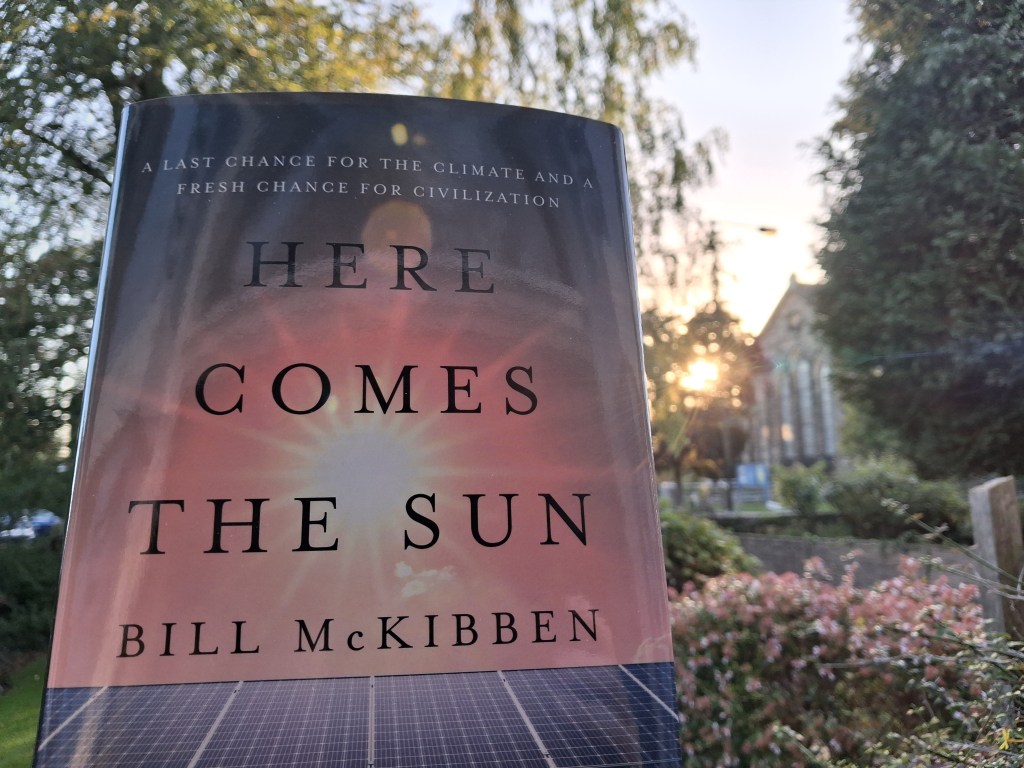
Bill McKibben’s ‘Here Comes The Sun: A Last Chance for the Climate and a Fresh Chance for Civilization’ is a book which throughout highlights the transformative revolution of solar power and which revels in the ability for countries around the world to see past the short-term interests of the fossil fuel industry- desperately clinging on to its profits- to see and build a new world. ‘ And yet, right now, really for the first time, I can see a path forward. A path lit by the sun.’
McKibben admits that the task between now and 2030- a scant 5 years away- is difficult, but also reminds us that there are no longer technical or financial obstacles in the way. ‘…[W]e must cut greenhouse gas emissions in half before the decade is out. That target is on the bleeding edge of the technically possible, and this book is an effort to shove us toward that deadline.’
This is a book which hopes to re-ignite our connection with our sun. McKibben reminds us that, ‘We were all sun worshippers once.’, with the hope that metaphorically, we can be again. He argues passionately that we have an opportunity, a chance in this moment, which is not to be missed- which cannot be missed. ‘Our species, at what feels like a very dark moment, can take a giant leap into the light. Of the sun.’
The revolutionary idea of this book is that it is past time when we should break the habit of burning things. In more poetic terms, the Fires of Isengard have already spread…’and all that was once green and good this world will be gone.’ McKibben notes that changing and converting the economy is as important as changing our power supply. He also highlights that Big Oil will be a difficult hydra to slay. ‘Big Oil will do almost anything to stay in the burning business, because their reserves of oil and gas are currency worth tens of trillions of dollars.’ He hammers this point home effectively arguing that ‘… fossil fuel is going all out to make sure it doesn’t happen. In fact, the entire point of the industry by this point in its history is to make sure we keep burning something. It’s desperate, as we shall see, to slow down this switch by any means necessary.’
As a result of their rapacious extractive measures, McKibben describes the state of humans on the planet through the medical metaphor of being in the ER. ‘We’re very much in the ER- that’s what all those statistics about the jet stream and the bleaching of the Great Barrier Reef mean.’ He highlights the ecological systems around the world which are becoming critically threatened- ‘There are only so many really huge and vital systems on the planet, and now all of them seem to be in some sort of violent flux.’ Global records continue to be shattered by the world that has been forged and created by Big Oil, but McKibben outlines that even though they have tried hard to steer us off course- and despite their best efforts- solar power has undergone one of the most revolutionary successful transformations ever seen.
McKibben effectively reminds us of the many many solar technologies and projects taking off around the world- from Spain and Germany, to Ecuador, to China and to Australia and Pakistan. He points out that many of these revolutions tend not to gain the global attention which they deserve, because they are simply not in the West, calling us out accurately on our ideologies. ‘One reason we’ve missed some of that revolution is because so much of it is taking place in China, and we’re used to thinking that anything important must happen in the West.’
As a result of these extraordinary breakthroughs, McKibben is energised (terrible accidental word- pun) and encouraged to power through our dependency on the fossil fuel industry. ‘Before our decade is out, we have to break the back of the fossil fuel system. We have to land the sun on the earth.’ He ends Section 1 of the book with the alarming comment, ‘It would be unthinkable not to figure this out.’
As the book progresses, McKibben frankly ridicules the arguments trotted out by stooges for the fossil fuel industry- arguments solely designed to slow down the transition away from their product. He first ridicules the ‘Can we afford it?’ argument. ‘Of course we can afford it- the sheer fact that we’re merrily building out terrawatt after terrawatt of solar and wind power is more or less proof that it’s becoming affordable.’
He urges us to consider what the cost implications and ramifications would be if we continued on the fossil fuel path- citing that the insurance industry is already acting to protect its interests by not offering climate cover. ‘First, though, let’s reflect for a moment on what it would cost us to do nothing- that is, to continue lurching slowly through a haphazard transition off fossil fuels that happens too slowly to really arrest climate change.’ McKibben notes that the supply and demand pathway is one which works against capitalism- ‘because energy from the sun and wind is so plentiful and cheap, it can’t make as much profit for investors as oil and gas, which are scarce and dear.’
Throughout, he advises that ‘Emergencies demand urgency’ and that ‘[W]e need to do this now; we can’t afford another miss.’ He asks the very simple questions of what are the obstacles to this solar and wind transformation; who are the players acting against this revolution; and why are they behaving like this. It’s not a land coverage issue, it’s not a battery storage issue, it’s not a recycling of parts issue, it’s an enslavement to the fossil fuel industry issue and we have the power to break those bonds. Dependency on fossil fuel is dead. There’s no reason not to embrace the solar revolution.
McKibben asks us all to turn our faces to the sun once more in wonder and build a world ‘where we no longer set things on fire, but rely instead on the great fire out there in space. A world where we can turn to our star.’
He ends the book exhilarated about the possibilities lying ahead of us and exhorts us all to seize fire from the Gods once more.
‘We’ve been given one last chance…a chance to restart that civilization on saner ground, once we’ve extinguished the fires that now both power and threaten it.’
-
Review of ‘Human Nature: Nine Ways to Feel About Our Changing Planet’ by Kate Marvel

Dr Marvel’s ‘Human Nature: Nine Ways to Feel About Our Changing Planet’ is a wonderfully balanced book. It offers clear and detailed scientific information, which logically ties all the climate clues together, while at the same being unashamedly and unapologetically a personal account of the range of feelings that the climate crisis brings.
Marvel’s writing is peppered with a sharp dry wit and crackles with a passion for climate action. She draws on the wonderful power of storytelling and compares the hubris of modern humans in their fossil fuel lives, with the classical figures of mythology to suggest that the lessons still haven’t been learned. The chapters of the book are entitled with major emotions, such as ‘Wonder’/ ‘Anger’/ ‘Fear’/ ‘Pride’ which read like mythological characters progressing on a quest. Marvel makes the powerful point that the humanity of climate scientists does not cloud their judgment, but rather enhances it with a love of what can be saved. “I’m sad, desperately so, when I think about all the things we’ll lose. I’m afraid of the disasters I know are coming. I’m proud and surprised and hopeful and utterly in love with our beautiful world, I feel so much.”
As a scientist well versed in using climate models to better understand the impact of climate scenarios, Marvel focuses our attention on our living model- one that is our home. “Scientists have used climate models for decades to see possible futures. Now these long-predicted changes are coming to pass…It’s not a toy planet burning; it’s our beloved Earth.” She compares climate scientists to modern day Cassandra- like figures: “We see the tragedy that awaits; we try to warn of it.”
“Yes, it’s real. Yes, it’s us. Yes, it’s bad. Yes, we’re sure.”
Repeatedly in the book, Marvel hammers home the point that the scientific information of climate change has been known for many decades and that we appear to be more interested in ‘watching Rome burn’, than in taking the action which will make us the heroes of our own story. “The evidence is overwhelming, the science unequivocal: The world is warming because of greenhouse gases.” She rails at the ignorance- oftentimes deliberate ignorance- of those who fail to understand scientific uncertainty and attempt to use it to delay further climate action. “I am angry at the cynicism, the lies, and the greed. I feel burning rage when I hear the same tired talking points, the falsehoods repeated credulously by people who should (and do) know better. And I’m absolutely furious when I see the uncertainty inherent in the scientific method twisted into something evil.”
Marvel’s writing style lifts the words off the page. Her command of the cadence and rhythm of language leads to arguments being well balanced and emphasised.
“We are more sure that greenhouse gases are warming the planet than we are that smoking causes cancer…To stop the planet warming, we simply have to stop emitting them.”
Marvel argues powerfully that we are the agents of change and the future that we hand to our children must contain the acknowledgement and apology that humans have been poor guardians of the planet so far. “When we accept our own responsibility, we gain a powerful truth: How bad it gets is up to us. The future is still in human hands.”
The future matters for Marvel and she argues that we have an immense and unprecedented challenge ahead of us, as the planet changes. “The future remains uncertain. But I’m sending my children there, and they are never coming back.” The political choices that humans make now to act cooperatively, will create this future world- whether it is a world of conflict, limited resources and fear, or whether it will be a peaceful world remains in our control. “We can’t predict what future climate disruption will do to geopolitics, conflict, or the risk of war. But it would be unwise to think it will make the world a more peaceful place.” Marvel continues this argument, that our future world depends on our choices now by saying, “It’s true we don’t know what future climate change will look like. And this is mostly because we don’t know what choices humans will make.” Unprecedented human action to fight against this all too real climate monster is a choice that we need to make so that compound climate events do not continue to imperil us.
The world is not supposed to warm this quickly
Marvel negates the arguments from climate deniers and delayers that ‘climate change has always happened’ by adroitly pointing out that, “The planet’s temperature goes up and down irregularly, like many unsynchronised hearts beating together. What it does not do is rise consistently for more than a century.” This pace that we have caused and then witnessed rightfully causes concern. “The pace of recent climate change is stunningly, bewilderingly fast…The world is not supposed to warm this quickly, to change this suddenly. It never has, or at least not since humans (or anything like humans) have existed. It feels wrong. It is wrong.”
Marvel urges that in this climate emergency, we should be ‘throwing everything at the problem’, but cautions against the ‘silver bullets’ of geoengineering, which continue to hold unknown dangers. She acknowledges that, “Miracles are possible. But it’s a terrible strategy to bet the planet on one.”
We are urged not to be the ‘mad scientists’ of shock horror B movies, creating the golems of climate technological saviours, as we have no idea what climate chimeras we might unleash.
Marvel asks instead that we act out of love and compassion- compassion for our world and for ourselves, so that future generations may look on us with pride and gratitude for a job well done. She quotes the great Carl Sagan, “For small creatures such as we, the vastness is bearable only through love.” We are the writers of this new climate story- one which will be passed down generations, as the myths of the classical past have been gifted to us. Marvel describes this simple and powerful act- a journey that no one has gone on before, but a path which we all must chart.
“At bedtime we read stories about heroes and monsters, quests fulfilled against impossible odds. I tell him that to stop climate change, we will have to do something that no one has done before. But that, he knows, is what happens in any story worth telling.”
Leibniz’s words, popularised by Voltaire, bring Marvel’s ‘Human Nature’ to a close. ‘All is for the best in the best of all possible worlds.’ We are reminded again by Marvel that the planet that we have damaged, and continue to damage, is our only home- our once and future home.
“We can only live here, together. Here in the world that we have changed so much. Here, shining out into cold space where there is no darkness, only light we cannot see.”
-
Review of ‘Positive Tipping Points: How to Fix the Climate Crisis’ by Tim Lenton
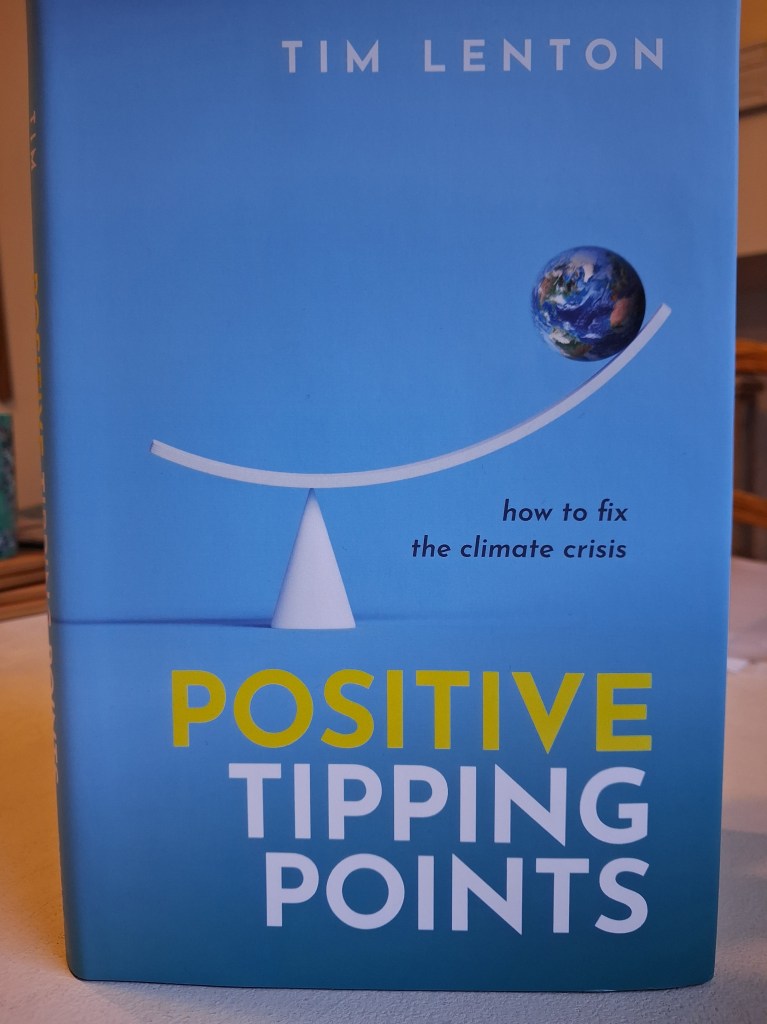
Tim Lenton’s ‘Positive Tipping Points’ does well to remind us all that we have agency to create meaningful change- that as cogs in the societal machine, we have the power to enhance and act transformatively, or to disrupt the current system. As he notes, “To get out of the incumbent, unsustainable state we need a fundamentally social tipping point, because it is people and their actions that either maintain the status quo or oppose it.”
Lenton makes the early point that, “We are in a climate and ecological crisis of our own making.” His focus is on finding the lever which will accelerate positive societal change. “We need to find and trigger positive tipping points that accelerate change in our societies and technology towards sustainability and social justice.”
‘Positive Tipping Points’ highlights well known examples of small actions which had large and significant consequences. He uses the example of the ‘Ever Given’ ship which blocked the Suez Canal to emphasise how the actions and decisions of just a few people ‘can sometimes escalate into global consequences.’ He makes the point that the world is far from the ordered, stable, place that we imagine it to be and that small changes can create large- scale self-propelling social change which could create the positive tipping points of actions and behaviours that are required. “We have been brought up to think that the world is an orderly, predictable place, where if we act in a proportionate manner we’ll get things back under control. But today’s world is not behaving like that.”
Lenton correctly clarifies what he means by a ‘tipping point’, arguing that overuse in the media has led to a confusion in the term. Additionally, he highlights the inherent danger in overstating the inevitability of such tipping states.
“There is also quite a bit of popular confusion over what is and is not a tipping point. This matters because if we overstate the existence of bad tipping points, knowing that they are self-propelling and hard to stop or reverse, we may feel disempowered and fatalistic.”
He gives clear and thorough examples of past ‘tipping points’ which moved societies through stable states to unstable alternatives. He explores nomadic lifestyles and how these were replaced with sedentary cultures; how foraging food made way for farming; how the Industrial Revolution in the UK changed the world; how cars replaced horses; and how previous complex societies collapsed owing to a range of external and internal factors impacting them simultaneously. Creating a ‘new world’ through innovative techniques can never be viewed as truly successful before the change has occurred. Lenton outlines that, “There are two faces to tipping points- they are sometimes creators and sometimes destroyers of worlds.” His argument is that once collapse gets underway, reinforcing and amplifying feedbacks can propel it at a much faster pace.
We are on thin ice
The immediacy of the positive tipping point for climate action is well documented in the text. “Now we are at around 1.5℃ of global warming and our list of potential climate tipping points has grown to sixteen.” Lenton explores how these tipping points might increase the abrupt risk of further points being broken irreversibly, owing to the complex interconnected Earth systems. “Our journey around the tipping elements has begun to reveal how tipping one thing affects the likelihood of tipping another. Hopefully this is intuitive. The Earth is a complex interconnected system where if something breaks it has repercussions elsewhere.”
Changing course
However, this is not a ‘doomist’ text- listing tipping point after tipping point. Instead, Lenton argues that disaster can be averted. He argues that by learning from moments of drastic change in the past, we should have learned to spot the warning signs. “To believe we can change fundamentally, and fast, we need to appreciate that we have done so in the past.” As climate tipping points are a “universal negative to avoid”, Lenton points to successful social movements of the past which brought the necessary change. The abolition of slavery and the Suffragette movement are both explored as movements which reached a ‘critical mass’ where change became inevitable and self-propelling. “Social movements, like the suffragettes or the climate protestors, are a particularly important way of tipping change. Many, if not all, the great social changes in the past had social movements behind them.” Attitudes towards change are driven by core groups, labelled by Lenton as “Innovators, early adopters, early majority, late majority, laggards”. Changing the social norm can be done in short timescales when intention and a better vision are part of the messaging. Society has changed its attitude towards smoking in a relatively short timeframe. Solar power, EV cars, vegetarianism and other changes in diet, have also broken through quickly as group dynamics ‘nudge’ others into taking action. The rise in technology in the past 20 years, and the acceptance and reliance on this technological innovation, also indicates how significantly society can change its attitude.
Government policy can play an impactful role when rapid change is required. This was ably demonstrated when the ozone layer was threatened with CFCs. Government and industry worked quickly together to reduce the harm and risk. “We urgently need such a tipping point of international coordination to tackle climate change”
Lenton pulls no punches in addressing this need for government policy, nor the bad actors at play, delaying climate action or promoting untested geoengineering proposals. “Policy is particularly important, because the transformation we need now is a rapid and intentional one.”
‘Revolution is impossible until it is inevitable.’
Lenton closes by quoting Trotsky’s famous line that ‘Revolution is impossible until it is impossible’. He urges that waiting until we have reached the point of an impending climate tipping point before acting would be risky and foolhardy. “Common sense says it would be a very risky strategy to wait until we are near certain about impending catastrophe before we act together.”
The stress on resources of climate migration could be well founded as humans move beyond their ‘climate- niche’ of stable survival. Hundreds of millions of people could be displaced in the coming decades and could become climate migrants, leading to an impact on welcoming countries and unwelcoming countries alike.
“The take home message from all this is that if we carry on knowingly towards 3℃ of global warming many people will have an existential risk to deal with, and in the worst case, we could be heading for a tipping point of societal collapse.”
Acting proactively rather than reactively may make all the difference to creating the necessary, critical mass social change. We can see the very real danger ahead- the alarm is sounding- our course needs to be altered.
“For all these reasons we need to act fast, well in advance of the point of impact, if we are to avoid it.”
Margaret Mead’s words may become prophetic once again,as we each consider what part we want to play in the positive tipping points to come.
“Never doubt that a small group of thoughtful, committed citizens can change the world. Indeed, it is the only thing that ever has.”
-
Review of ‘Science Under Siege: How to Fight the Five Most Powerful Forces that Threaten Our World’ by Michael Mann and Peter Hotez

When two world-class science heavyweights take the time to warn us about scientific endeavour being under attack by bad actors, it is incumbent upon us to listen. Doctors Michael Mann and Peter Hotez have spent much of their professional life being targeted by the political and ideological opposition to science at enormous personal cost and this book serves as a both a warning and a call to arms to recognise and fight against the orchestrated disinformation efforts of those who would focus on short- term profits over the threats to human life. In this very timely book, the authors identify the five forces that fuel this antiscience narrative. “In Science Under Siege we seek to provide a succinct yet detailed delineation of the five forces behind the modern-day antiscience movement (the five p’s, we’ll call them- the plutocrats, the petrostates, the pros, the propagandists, and our press).”
The authors stress that it is vital that these forces are recognised for what they are and that we do not allow them to fan the flames of division, especially at a time when our way of life is threatened by the twin crises of global pandemics and the climate crisis.
“The future of humankind and the health of our planet now depend on surmounting the dark forces of antiscience.” The disinformation tactics of attempting to isolate an individual scientist to discredit them can be seen as an attempt to quell the pursuit of science among younger generations, who then see science as a career where you are derided and reviled, rather than the industry of respect that it was in the latter part of the 20th century. Indeed, the authors go further here, and note the silence from the scientific community when one of them comes under repeated and targeted attack. The silence of friends- fearful of their own career reputation, or personal attack, can be a useful tool to isolate and ‘gag’ scientists.
“In the end, we will remember not the words of our enemies, but the silence of our friends.” So far, the silence has- in some instances, been deafening.”
Mann and Hotez argue that, “Mistrust in science is now escalating in certain demographics because of a targeted campaign against us- antiscience predation for someone else’s financial or political gain.” Instead of being seen as a significant social wedge issue, the attack on science to seed and sow state-sponsored disinformation, becomes a means of destabilising democratic societies around the world.
Mann and Hotez remind their readers that the fossil-fuel industry has been well aware of the dangers of the climate threat for almost 50 years and highlight that the delaying obstacles and challenges to government action are not physical or technological- but rather that they are entirely political. The ideological motivated efforts to deny the threat of the COVID-19 pandemic more recently follow this same pattern of political division and delay- sadly with human lives hanging in the balance.
“Meanwhile, the world’s largest fossil-fuel companies already understood the climate threat. In an internal report from 1982 that was eventually leaked into the public domain, ExxonMobil’s own scientists accurately predicted the increase in CO₂ concentrations and warming that would occur today in the absence of efforts to curtail fossil-fuel burning.”
Mann and Hotez make the repeated argument that we do not have to be passive receivers of this well-funded campaign of antiscience, but that by ‘knowing our enemy’, we can become armed into neutralising this threat and that metaphorically, sunlight can be the best disinfectant to this highly organised dangerous ideology.
“While there is urgency- unlike any we’ve ever known- there is still agency. We can still avert disaster if we can understand the nature of the mounting antiscience threat and formulate a strategy to counter it.”
A Candle in the Dark
“Happiness can be found, even in the darkest of times, if one only remembers to turn on the light.”- Albus Dumbledore.
The authors then begin to turn the spotlight onto each of the 5 ‘ps’ in turn, those oftentimes defenders of the powerful special interests and political agendas which actively promote anti-science as their repeated mantra for their own culture wars. They begin with the plutocrats, where power is held and controlled by a small minority of high-net-worth individuals and name them as malevolent players. Names which are familiar to us, such as the Koch family, Rupert Murdoch, Zuckerberg, Musk and Bill Gates. The point is made that “Today’s malevolent plutocrats frequently operate through a complicated web of entities as they wage war against science and scientists” and note that this ‘dark money’ can be difficult to follow and its users are protected by a lack of accountability. The impact of the Koch family casts a long shadow. “Koch Industries is the world’s largest privately held fossil-fuel company, with an obvious financial interest in fossil fuels.” The importance of funding for the disinformation campaign has led to bad actors appearing ‘untouchable’ and appearing to have a disproportionate amount of power.
“Elon Musk, the world’s richest man, the tech bro of tech bros and cryptobro of cryptobros, has become a leading spreader of disinformation writ large.” As a result of the distractions and delay caused by these plutocrats, the necessary government action has effectively been nullified. When Musk bought Twitter, he then “converted Twitter into a forum for far-right extremism…which in turn, led to “[t]he evaporation of science from platforms like Twitter launched an exodus of science from the public conversation.” When there is a vacuum of communication, with scientists forced out by trolls and bot armies, only one narrative remains powerful, which sets humanity back decades. Very recently, we have seen the return of some climate scientists to this platform- scientists unwilling to yield large amounts of online space to bad actors for free. This might be the start of a reclamation of the space by the science community, which would be welcome, as it has left those remaining active voices very marginalised.
Who is standing up for science?
In the fight to discredit accurate and robust science communication, plutocrats can merge with another ‘p group’- that of the petrostate. “Petrostates are often run by dictators, plutocrats, and oligarchs who acquire political or economic power (often without accountability) through the wealth they derive from extractive industries.” Some petrostates are more well known than others, but there are commonalities- one of which is to choose not to lead on any concerted global action on climate, but to remain firmly in delaying action for as long as possible. Mann and Hotez understandably focus on events in the United States and ‘the American petrostate’ and are persuasive in their arguments that politics is not only divisive- it is deadly. There has been a long game strategy played by the fossil-fuel industry, to slowly move their policy makers into position, even if this takes years and decades- but now they are in place. “During the 1990s the fossil-fuel industry began to invest heavily in conservative policy groups, think tanks, and front groups advocating policies friendly to the fossil-fuel industry. Meanwhile, they funded conservative climate-denying politicians, most of who were from oil states.”
With President Trump’s second term as President, the attack on science has become more vitriolic and dangerous on a global scale. The National Oceanic and Atmospheric Administration (NOAA) has faced significant cuts, seen by many to be a malicious attack on climate science and climate partnership with other leading organisations. More recently, the Department of Energy published a report claiming scientific concern about the climate crisis is overblown and exaggerated. A hand-picked team of science contrarians were selected for this report, which was viewed as an attempt to replace legitimate science with pseudoscience and has been fact checked for misinformation. The respectable Carbon Brief organisation, counted more than 100 false or misleading scientific claims contained within this report. In the authors’ minds then, it is clear that this is just the latest in the concerted attack on science.“There is unquestionably, a coordinated, concerted attack on science by today’s Republican Party- the American petrostate, if you will- with climate and biomedicine as focal points of the assault.”
The authors powerfully argue that the end result is to halt science progress in the United States and then by extension, hold back meaningful global action on climate- at the least, disrupt any action. This chapter ends, and indeed this argument ends, by ‘calling out’ the political attack on science.
“The fact that antiscience has been embraced so fully by one of the two major parties in the United States is grave cause for concern.”
Pros and propagandists
Mann and Hotez next focus on the twins of ‘pros’ and ‘propagandists’- figures with huge social media presence who regularly appear as ‘experts’ on media platforms touting for the fossil-fuel industry. “Pros include individuals with scientific credentials who have been financially lured by polluters and plutocrats and weaponized into a force to attack mainstream science and scientists. There are also the paid propagandists with no scientific credentials but plenty of media savvy and access to wide platforms.” These players are linked to the science-denial machine and appear to be free from the same funding scrutiny that is applied by them to the science community and to science communicators. Dissemination of misinformation now reaches tens of millions of people, through the power of social media, with platforms taking little to no responsibility for the toxic content of propagandists. “The propagandists now benefit from the extraordinary amplifying power of social media, including a Musk-weaponized Twitter, disinformation podcasts with huge reaches, and now most recently, AI. Slowing or stopping them is a complicated endeavor that requires disrupting their weapon of choice, antisocial media and other high-visibility disinformation-promoting vehicles.”
However, Mann and Hotez highlight that the playbook of antiscience has shifted now that the impact of climate change has become too obvious to deny outright. “Climate denial is untenable today with the vast majority of our population because they are witnessing profound impacts already playing out…They have instead largely turned to other tactics- delay, deflection, division, and so forth.” The resurgent weapon of choice is now the use of conspiracy theories. Conspiracy theories run rampant and there is an overlapping Venn diagram of anti-vaccine posters and anti-climate science posts online, which are amplified disproportionately to create the impression that they are the majority. This would come to no surprise to the average online user- even sheltered in their own echo chambers. Online trolls and misinformation impacts all of us and with algorithms constantly pushing targeted material onto us all, it can be difficult to take the time to sift through the overwhelming quantity of media information.
The partisan press?
There has been a manufactured campaign against the media, with partisan media groups gaining access and those promoting science being sidelined, especially by US politicians, with President Trump famously demonising news outlets as being ‘fake news’. We are all aware that press outlets will cater to their target audience and that how the public consumes their news is very different from a world of even 20 years ago. Capturing attention and holding the attention of the public has become the sensationalised strategy, rather than a ‘golden age’ quest for truth. The press undoubtedly have a part to play in good science communication, though as an industry, they appear to be excoriated by Mann and Hotez. “The press, as we have already seen, has engaged in widespread attacks on both science and scientists. Beyond the usual suspects- Fox News, the rest of the Murdoch media empire and other conservative media- even mainstream outlets like the New York Times have in recent years miscommunicated the science behind climate change and COVID.” They argue that creating the false equivalence between robust science and conspiracy theories and allowing “bothsideism” has built the illusion of equal weight to competing arguments. They are clear that there are some networks which act deliberately to attack science, while others can sometimes act unwittingly to create ‘doomist narratives’ that misrepresent the science, whether this is regarding the climate or global pandemics. The concern of the authors is that the framing of science stories can lead to the support and promotion of untested technological ‘silver bullets’, most of which allow for ‘business as usual’ for the fossil- fuel industry. “How doomist framing has led to support for potentially dangerous geoengineering schemes as desperation measures.”
“Fellowship of the Planet”
Mann and Hotez then lay out their ‘battle plan’ to push back against the tide of antiscience, arguing, “We need to restore the rightful role of science in our political and societal discourse if we are to maintain the capacity to address the major challenges we face, including the climate crisis and worsening pandemics.”
They acknowledge that ‘the hour is late’ for a new found faith in science, but argue that as we can see the actions of the ‘antiscience industry’ in delaying meaningful action, are we just going to allow them to destroy our way of life without putting up a fight? “We wish that humanity had followed a more enlightened path decades ago when the climate crisis had clearly emerged, or back in 2020 when we were given a golden opportunity to implement pandemic policies- guided by the best available science- to ensure the health of both our species and our planet.”
Mann and Hotez urge that by: communicating constructively; defeating disinformation; and supporting scientists, we can be led in our actions, not by partisan politics, but by the best scientific understanding at this given point.
Mann and Hotez close their book by referring to the powerful story and imagery of “The Lord of the Rings”. They connect with the repeated analogy of the industrial fossil-fuel furnace rooms of Sauron and Saruman, and offer the stark warning that if we don’t act, then we risk losing ‘The Shire’. [I]f humanity fails to combat the great global crises we face today, there won’t be an Earth- at least not the one we’d recognize. Yes, there will still be a large spherical planet rotating around the sun. There will be life, but we will lose the welcoming planetary home we know today, with its rich forests and oceans and ecosystems teeming with diverse, interconnected life forms.”
Science disinformation is a plague which threatens to destabilise us all. We must make a stand, to push forwards. To say that we will take the first step against the forces of disinformation, even if we ‘do not know the way’, and even if we do not know how that story finishes. We know the ending of the story if the fossil-fuel industry and anti-pandemic responses continue their stranglehold on science education, policy and action. We don’t know the ending if we fight for a pro- science tipping point, but we do know that if the fossil- fuel industry and agents of geoengineering miracles come for us, then we must be doing something right.
“We fight for a livable planet, for us, our children, and future generations. Because it’s worth fighting for.”
-
Review of ‘They Poisoned The World: Life and Death in the Age of Forever Chemicals’ by Mariah Blake

Blake’s book is a detailed, comprehensive, chronological investigation into how synthetic PFAS chemicals polluted and contaminated town after town in America. It focuses on the dogged and determined individuals, who fought against chemical companies which delayed, obfuscated and denied the extent of their PFAS pollution.
Most of the narratives come from individuals concerned about the impact on their family and looking for ways to limit and reduce exposure to harmful chemicals.
‘How can they protect their families and communities from an insidious group of chemicals that permeates the bodies of all living beings from the moment of conception until death?’
‘They Poisoned The World’ charts the struggles, especially of the Hickey family, and repeatedly makes the point that responsibility and accountability for truth, information and protection should come from the chemical industry, and should not rely on individuals researching information to better protect themselves from dangerous forever chemicals which have been ‘grandfathered’ into legislation.
Blake notes that, ‘We live in a synthetic world. Our homes and workplaces are brimming with man-made materials. Our bodies are saturated with their chemical residue.’ PFAS chemicals have now been found to pollute on a global scale- from the oceans to the Arctic to Mount Everest. ‘They also pollute the bodies of virtually every person on the planet. Once inside us, they stay there like a ticking time bomb of disease.’
3M, Chemours, DuPont, and more, all come under the spotlight in this vital exposé- one which details the long history of the development and profits of these chemical companies, from the early 20th century, through the arms development of World War 2, through to the domestic sphere of the 1950s and 1960s which followed. ‘The push by companies like 3M to turn wartime innovations into peacetime profits would transform American life.’ All too often, the chemical giants became the main employer in US towns, causing whistleblowers and local impacted people to come under incredible pressure to tow the line and not to cause waves. Thankfully, in recent decades, these companies have now become infamous and synonymous with corporate malpractice and betrayal. More attention and more truth-telling has appeared through the efforts of campaigners and litigators. Public awareness has exploded with the likes of films like ‘Dark Waters’, ‘Erin Brockovich’, and others which highlight real life cases of pollution by chemical companies, as well as their efforts to hide the truth.
This isn’t a text then just about the struggles of towns and families in the US to force litigation to bring these companies in check. Blake’s book is the roadmap for countries which are behind on chemical regulation to understand the delaying tactics used by chemical companies when finally it is their turn to be ‘exposed’. Blake argues that companies rely on the delayed action from the public, as the public find it challenging and difficult to accept that a stalwart of a community could equally be responsible for polluting a town.
‘All too often, we respond to grave environmental threats with a kind of collective paralysis.’ Her argument is that speaking out and building local communities to safeguard and protect families becomes a duty for us all, even if it takes years and decades.
‘It is up to us to protect ourselves and make a safer future for our grandchildren and great-grandchildren, who will reap the consequences of the choices we make now.’ Now that we know that those who were charged with providing safe products and a safe environment, actively betrayed that trust, while making huge profits, means that that trust has been broken forever.
Blake outlines the many ‘household names’ like Teflon, Gore-Tex, ScotchGard and Tefal, which brought their chemicals into our homes. As an aside,it is interesting to note that on Tefal’s website in 2025, it states directly, ‘Tefal was one of the first manufacturers to eliminate PFOA from its non-stick coatings over a decade ago.’ It does not have the same transparency over its actions and behaviours over its 60 years history. ‘The synthetics revolution also brought thousands of new chemicals into American homes.’ Blake notes how profits became the focus over consumer safety by DuPont. ‘Teflon…would become revolutionary both for DuPont, which parlayed it into a billion-dollar-a-year business.’
Just like Big Tobacco, the chemical industry knew of the dangers of their products, but did little to safeguard and protect the public. ‘Up until this point, [1958] DuPont had avoided marketing Teflon for use in home kitchen products because of toxicity concerns.’
Parkersburg, West Virginia
Perhaps the most well-known toxicity story that emerges focuses on the Tennant family and their litigation against DuPont in the late 1990s, through the lawyer Rob Bilott. Following a court order, DuPont turned thousands of documents over to Bilott, who painstakingly went through them all.
‘Gradually, the entire horrifying story came into focus: DuPont and 3M had been studying the chemical [PFOA] for decades. They knew that it was toxic and that it was polluting drinking water and human blood thousands of miles away from its factories, but they had concealed most of these findings. The papers also showed that DuPont had used the landfill near the Tennants’ farm as part of an increasingly elaborate cover-up.’
‘They Poisoned The World’ also details how the chemical industry began to respond to the emerging litigation by their own PR machine, by holding ‘information sessions’, and by lobbying hard in congressional races and political action committees to limit chemical regulation and to attempt to obtain gag orders against Bilott. At the same time, they began to court public opinion by admitting that PFOA was present but that the levels were ‘safe’. ‘In late October 2000, a letter written largely by DuPont officials went out on Lubeck Public Service District letterhead. It informed residents that there was a chemical called C8, or PFOA, in the water, but claimed the levels were safe to drink.’
Flint, Michigan
The other famous case of the contamination crisis in Flint, Michigan is also addressed in Blake’s book. It is noted that President Obama in 2015 declared a state of emergency, but Obama also famously lost the trust of the public by failing to drink water supplied to him from Flint at a public meeting. Once public trust is lost, it never comes back. ‘All their lives, they had trusted that there were systems in place to protect them, and now that trust had been shattered.’
In 2016, the EPA finally unveiled new “lifetime health advisories” for PFOA and PFOS combined. ‘Suddenly, more than five million Americans in nineteen states and several U.S. territories were informed that their drinking water contained unsafe levels of these chemicals.’ In order to be better informed of the possible health impacts, many Americans began voluntary blood tests in order to find out the levels in their blood. Blood levels then began to appear on protest signs as public anger began to mount against the chemical companies.
The dangers of GenX
What campaigners constantly fight against is the seeming inability to regulate forever chemicals. By the time litigation reaches court, the chemical company has already stopped using that specific chemical and replaced it with shorter chain chemicals, like GenX, which means that the whole process of linking health impacts to exposure to the new chemical needs to start again.
‘In early June 2017, a North Carolina paper broke the news that more than two hundred thousand people downstream of the Chemours plant were drinking water heavily polluted with GenX.’
Campaigners need to have stamina and be aware that legal action against chemical companies can take years, by which time, those suffering health impacts often will have passed away and will never have their ‘day in court’. For the Hickey family, which is the thread in Blake’s book, their story began in 2010 and ‘finished’ in 2021- four years before the publication of this book. The impact on campaigners can be huge- from social ostracisation to personal and family pressures, to economic concerns. These all play into the hands of the chemical companies.
The first step to limit the level of chemical pollution and contamination is to ‘turn off the tap’, and ban the production and sale of PFAS products. Following that, extensive remediation is necessary, while the dangers of simple disposal are well known.
‘In 2023, the European Commission introduced a wholesale ban on the production and sale of PFAS and products containing them, the most sweeping chemical regulation in the bloc’s history….
Moreover, the methods used to clean up PFAS pollution often end up returning the chemicals to the environment instead. The landfills where we bury forever-chemical waste, for instance, simply belch them back into the air.’
We are discovering more and more previously unknown PFAS, and lesser studied ones are now ‘breaking through’ into public awareness. The extent of TFA pollution is incredibly shocking, continues today, and ‘may only be the tip of the iceberg.’
‘They Poisoned The World’ is then a breathtaking account, sadly both literally and figuratively. It offers hope though, that the long battle against those companies and bodies which pollute us, can be won. Now we know the industry’s playbook, we can be better informed when these strategies are used, as more PFAS pollution hotspots appear in communities around the globe.
“It shows just how much individual people and communities standing up and speaking out can do and the dramatic change they can put in motion,” he said. “It took us way too long to get here, but it’s happening.”
-Rob Bilott
-
Review of ‘Love, Anger & Betrayal’ by Jonathon Porritt

Just Stop Oil.
Now pause and consider the emotional response you just had to those words.
Was it pride? Frustration? Anger? Apathy? From where did those emotions arise? How did you form that opinion, and has a dominant narrative shaped your response to this group of activists? Jonathon Porritt gathers together testimonies, contributions and profiles from 26 young climate activists and co-authors, to present an alternative reading of much needed climate activism.
Porritt notes, ‘The principal purpose in writing this book is to allow readers to find out a whole lot more about who these campaigners are, their hopes and fears and why they have chosen to live in ‘civil disobedience’. And why all of this is so directly relevant to all of us.’ He urges a wider view of climate protest, one which allows for climate messaging to be heard, instead of being shut down as recent UK judges have tried to do. Silencing the motivation behind non-violent, or peaceful direct action potentially leads to a worrying precedent, one, which to date, UK juries have not been led by. ‘As well as providing a more balanced view of what Just Stop Oil was, and particularly its young activists are, trying to achieve.’
He argues that their impact and profile have been hugely significant and follows the actions of powerful resistance groups of the past. ‘Few, if any, campaigning organisations have achieved such a high profile in such a short period of time.’ From 2022 until 2025, their many high profile actions of civil resistance have caused mainstream environmentalists, as well as the media and the general public, to focus more on their actions, rather than their motivations. ‘Just Stop Oil ‘burst on the scene in a blaze of orange’ back in March 2022. Three years on, it announced that it would be bringing to a close all its campaigning activities within the month. During that time, 3,500 Just Stop Oil Supporters were arrested with around 180 instances of people sentenced or held on remand.’
Their actions are meant to be disruptive. They are meant to polarise.
‘[Just Stop Oil] organises disruptive actions specifically designed to polarise opinion, and to encourage the ‘still undecided’ to decide which side they are on.’
It is noticeable that the media have highlighted and made more prominent actions by Just Stop Oil over their 3 year campaign- focusing on those which are the most disruptive, as well as those which are symbolic. It may be that Just Stop Oil is just the last incarnation of climate protestors from Extinction Rebellion to Insulate Britain, to Just Stop Oil. As the job remains unfinished, there is still a space for a radical movement to challenge those in power. “As the climate movement’s Radical Flank, Just Stop Oil was not there to be liked either. And its activists asked the same questions of the mainstream environment movement: What has your sympathy for the cause achieved in practice?”
It remains true that how a group or an individual presents their direct action impacts how the message is ‘heard’. Far too often we have heard, ‘I agree with them, but I don’t agree with what they are doing.’ Leading to the interesting question, of what action would the public prefer to see which matches the urgency of the climate crisis. A stereotypically British response of a stern letter? Furthermore, for some reason, the public chose who to accept and listen to, even though science methods and findings are the same. David Attenborough, yes. Greta Thunberg, no. Climate Scientists, no. 20 year old activists, no. Though there is no difference between where Attenborough has gathered his information and where other climate scientists and environmentalists have gathered theirs. In acknowledging this, Porritt continues to ask, ‘Why are most politicians still so indifferent to scientists’ warnings about the climate crisis?
There is also a real contradiction in the narrative and perception of the need for climate justice and needed climate action. From polls and surveys, Just Stop Oil is viewed negatively, though at the same time, the public, across countries, are worried about climate change and its effects and the lack of climate action from governments. The last YouGov survey on Just Stop Oil in 2023, noted that 66% of respondents had an unfavourable view of the group. Towards the end of 2024, a YouGov survey across European countries found that well over 60% of respondents were worried about climate change and its effects. At the same time, over 70% of respondents accepted that the world’s climate is changing as a result of human activity.
Radical resistance has a long history
Repeated links and comparisons are drawn throughout the text between the activists of Just Stop Oil and the powerful voices of the past who fought for change, from the Suffragettes, the Freedom Riders, the Civil Rights Movement, Gandhi’s protests against the British. Porritt is careful to limit the comparisons though, acknowledging the awful violence committed by the state to those who dared to challenge the status quo and raise their voices. From the horrific violence of Birmingham, Alabama, and too many towns and cities in America, to the sexual and physical violence against the Suffragettes, the ‘Radical Flank’ of resistance movements has always faced persecution.
What is happening to the right to protest in the UK?
Porritt details and explores the ‘manifestly excessive’ prison sentences meted out to Just Stop Oil activists, using the example of Roger Hallam’s 5 year sentence for planning a direct action, suggesting that they too are a persecuted movement. ‘Lady Justice Carr described the five-year sentence for Roger Hallam as ‘manifestly excessive’, reducing it to four years.’
‘The right to peaceful protest remains a basic human right, but you sure as hell wouldn’t know that here in the UK any longer.’
What will happen to those who have been arrested for holding ‘Palestine Action’ signs and for those showing support for the state of Palestine, once the UK acknowledges the genocide committed there and acknowledges the state of Palestine? Will their arrests be erased? What will happen to climate activists when the reasons for their actions become manifestly obvious?
Porritt argues that the UK state is using its given power to oppress any challenge to its lack of climate action. He quotes John Locke’s famous saying from 1689: ‘wherever law ends, tyranny begins’. But what if the laws by which you as a citizen are bound are themselves tyrannous? In other words, using power or authority in a cruel and oppressive way. That is exactly what is happening here in the UK today.’ Porritt uses the example of a police raid on a Quaker House to highlight the direction of police action and asks in whose interest this is in. In the past week alone, 4 Just Stop Oil supporters were given conditional discharges for marching in the road- or for ‘interfering with key national infrastructure’- a law solely created to target Just Stop Oil activists. Take a moment there. The UK Government took legal action in order to ensure that peaceful direct action would be criminalised. Of course, a simple internet search would reveal many other protests which have marched on ‘national infrastructure’ without any lengthy prison sentences following- so what is it about Just Stop Oil which the UK Government objects to?
Porritt eviscerates the UK Government by pouring scorn on plans that we can come back from a climate ‘overshoot’ through direct air capture schemes, or recarbonising the soil. He is scathing of the current UK Prime Minister’s climate credentials. ‘Keir Starmer himself does not have a climate-friendly bone in his body. He’s been forthright about his contempt for Just Stop Oil. He quotes Starmer’s speech in 2024, where he said, ‘I will not sacrifice Great British industry to the drum-banging, finger-wagging Net Zero extremists.’ He continues in a blunt manner, ‘The harsh truth is that politicians are making a catastrophically bad job of addressing this challenge.’ He concludes that there will be a time of climate reckoning, as the scientific methods make this clearer and that those who delay the necessary climate action need to be accountable.
“I cannot find it in my heart to rationalise the vast majority of politicians’ indifference and inertia, let alone to forgive it.”
Porritt then quotes George Monbiot who asks why there is a fervent drive to silence and imprison climate activists for speaking out, while ignoring the real guilty parties. “‘Why do the mass killers of the fossil fuel industry walk free while the heroes trying to stop them are imprisoned?…Why, when we know so much, do we permit a handful of billionaires to propel us towards predictable catastrophe?’” To support this argument, Porritt draws attention to the direct support for fossil fuels which is still ongoing around the world. “The US Federal Government in 2022 stumped up an extraordinary $757 billion in direct and indirect support for fossil fuels. How can one interpret this as anything other than a conspiracy against the American people by their own Government?”
There is a moral reckoning, as well as a legal and political reckoning to the climate crisis. Porritt returns to the tradition of peaceful resistance from the past to make the point that simply waiting to be given justice has never been successful, as those with power will cling tenaciously and desperately to any vestige of control. It does make one think more of post-apartheid South Africa with this reasoning, that a political present is not always ‘just’.
“When Martin Luther King said that the ‘arc of the moral universe is long, but it bends towards justice’, he sure as hell didn’t mean that justice will simply arrive, so sit back and wait for the happy outcome! Such justice is never freely given by those who have power; it is only ever won.”
Porritt rings out the clear warning that narrowing the right to protest and the right of freedom of expression will inevitably lead to more protestors heading to prison for ‘crimes’ which are questionable. “As the climate crisis worsens, repressions of resistance will increase, and the bar for going to prison will get lower and lower as the government continues to try and deter us from taking further effective non-violent action.” It is curious to note that the far right in UK politics argue that the freedom of expression of the far right is being restricted, but these are also the ones most opposed to Just Stop Oil. There is never any challenge to Just Stop Oil’s freedom of expression being infringed by the state from these groups and indeed the right wing media in the UK- clearly climate action and climate protest is so beyond the pale, despite millions demonstrating around the world in 2019 in the biggest climate protests in history.
Who are the real ‘dangerous radicals’?
“We are on the brink of an irreversible climate disaster. This is a global emergency beyond any doubt. Much of the very fabric of life on Earth is imperilled.”
Porritt concludes by successfully arguing that climate change is not an environmental issue, nor that it should be labelled ‘an issue’ at all.
“Climate change is not, and has never has been, ‘an environmental issue’. It is not, and never has been, ‘an issue’ of any kind. It is an unfolding physical and geopolitical reality that is already affecting the lives of the vast majority of human beings, and will, in the not too distant future, become the single most significant influence determining the future of our entire species.”
António Guterres, the Secretary-General of the UN, makes it clear where he sees dangerous radicalism. ‘Climate activists are sometimes depicted as dangerous radicals. But the truly dangerous radicals are the countries that are increasing the production of fossil fuels. Investing in new fossil fuel infrastructure is moral and economic madness.’
Guterres is always stark in his analysis and never shies away from telling climate truths. It is this point where Porritt chooses to conclude this intergenerational, challenging read. An argument which draws together all the threads of the 26 climate activists, focusing on the starkness of the climate action that is drastically required.
‘We have a choice. Collective action or collective suicide. It is in our hands.’
-António Guterres
-
Review of ‘No Straight Road Takes You There’ by Rebecca Solnit

‘With courage nothing is impossible.’ Sir William Hillary, founder of the RNLI.
These words of Hillary matched the theme of Solnit’s ‘No Straight Road Takes You There’ so aptly that they seemed like the epigraph. In both cases, saving lives at sea and climate activism, the work of volunteers is vital. Those people who understand that something must be done and who don’t wait for Superman to turn up to alter lives positively. People who understand that the right thing to do is still the right thing to do, even in the face of difficulty and challenge. The metaphorical storms of fossil fuel deniers and delayers meet the physical storms of oceans and seas and remind us that we can still steer to safety. As Solnit states, “In embracing the truth that, although we may not know how and why something might matter when we do it, may nevertheless matter immensely.”
This structured ‘meander’ through past essays by Solnit reinforces that activism and community building makes a difference. A difference perhaps not realised until years have passed. After all, as Tolkien writes, ‘Not all those who wander are lost,’ and the unconventional path of bravery and long-termism outlined in this text might create new paths and futures that are, as yet, undreamed.
Travelling to the New World
There is no doubt that when Solnit wields words that they have power. She is a visionary storyteller, who understands that we are on a journey to a new time and a new place, one which will require the power and magic of stories to bind us in unity of purpose..
“We are leaving behind our old familiar world whose stability we can remember as a great kindness and entering into a rough new set of circumstances. Like refugees leaving a place, we are leaving a time. What should we carry with us?… We will need stories more than ever.”
Recognising and identifying this new world requires not forgetting the past, but accepting that it is us, now, who have been brought to this time and place to be the guides for those who will follow. “We must have landmarks and dreams ahead of us to orient ourselves, to remember that it has been different and could be different. We must have a vision of what our toil is for and how we will know when we get there.” As a species, we have been bound by stories, by great stories and tales, which have helped us understand our world and our place within it. “We were guided by stories, the old ones passed on, the new ones we made like rafts in a flood, the ones we told like water to pour on fire. Stories arose from this time, of this time, who did what was needed and those who stood in the way, and those who changed minds with their stories, of those new stories in which we saw a new heaven, a new Earth and a new humanity.”
Action is shaped by vision
Solnit argues convincingly that actions and words can bring about change, which can sometimes build under the surface until the moment comes and that nothing is as powerful as an idea whose time has come. “In embracing the truth that, although we may not know how and why something might matter when we do it, may nevertheless matter immensely.” She follows this concept of actions making a difference, by stating, “But even when the rock’s on the bottom of the pool, the ripples are still spreading.” Leaving the reader to wonder whether a new world can be brought into being simply by using the words to imagine that hopeful state. “Once you create a new idea of what is possible and acceptable, the seeds are planted.” Solnit quotes Joe Lamb, who reframed the ‘those who forget the past are doomed to repeat it’ aphorism and instead draws hope and courage from the many successes of the past and that the unforeseen happens more regularly than history notes. “We need to remember that we can learn from and repeat the successes of our past.” The tipping point of actions, words and community building may be closer than we think and all that is needed to activate this seed of an idea is to provide it with supportive water and care. What then blooms, could be transformative.
Solnit repeatedly reminds us that a new story of climate activism is possible and that a drip of water can eventually wear down a stone. In an up-to-date example, the International Court of Justice has recently ruled that countries must prevent harm to the climate system and that failing to do so could result in their having to pay compensation and make other forms of restitution. In a landmark case, brought about after years of campaigning from a group of Pacific Island law students, climate justice and a legal precedent for the future has now been created by an international court. The UN Secretary- General António Guterres said “This is a victory for our planet, for climate justice, and for the power of young people to make a difference.’
‘With courage nothing is impossible.’
A new evolution and a new story has been created by threatened islanders who understood that there would be no straight and easy path to their outcome, but that they had to make a path for others to follow. Solnit quotes Antonio Machado’s words:“Walker, there is no path; the path is made by walking.” For so many of our destinations, no straight road takes us there. The route is over mountains or through forests and beyond what we know.”
No Fate, but what we make
Solnit openly acknowledges that there are forces that try to obscure and obstruct the new possible stories of optimism. “Despairs’ cheerleaders offer the same message that institutions all around us do: that we are powerless, that power resides in the few, at the center, at the top. Part of resistance must consist of refusing to believe them, and that can be reinforced by better versions of history and theories of change.” She argues that despair’s message relies on trying to force the belief that the future is preordained and that we have no escape. Instead she argues, “If we can recognize that we don’t know what will happen, that the future does not yet exist but it is being made in the present, then we can be moved to participate in making that future.” Or in a more film-friendly manner- ‘No fate but what we make.’
What a powerful story- that we are the agents of the future. That we can decide ‘what to do with the time that is given us.’ That we can be the best of all ancestors. We are trying to be good ancestors, to make a world in which the land that, in the past, fed many species, including ours, will feed them in the future.
There is a risk to hope, in that it challenges those who wish for the story to be unchanged. Without speaking out and fighting for change, those with power will continue to silence those voices whom they deem as lesser. A democracy of voices is what can be brought into being.
“To hope is to risk. It’s to take a chance on losing. It’s also to take a chance on winning, and you can’t win if you don’t try.”
Changing the Climate Story
Perhaps new climate stories are being told if we have eyes to see. Walt Disney’s ‘Moana’ does not at first sight seem a strong contender as being a climate story, but when we have an island under attack, with crops failing and fish disappearing and our heroine being told repeatedly not to sail beyond the reef and change the story, but to accept what is happening- all at once the climate bells start to ring. By choosing to listen to her ancestors, in the guise of her grandmother and visions, Moana leaves this narrative of isolation behind and remembers the power of ‘We were voyagers’ and that seeking a new world and a new story is an option for us all.
Solnit also argues that “We are hemmed in by stories that prevent us from seeing, or believing in, or acting on the possibilities for change.” But that to become true agents of the future we need to inspire and create new traditions. “In order to do what the climate crisis demands of us, we have to find stories of a livable future, stories of popular power, stories that motivate people to do what it takes to make the world we need.”
Everything we can save is worth saving
Solnit concludes by reminding us that vested interests want us to be silent and to accept their story. “They want you to feel powerless and to surrender and to let them trample everything and you are not going to let them. You are not giving up, and neither am I. The fact that we cannot save everything does not mean that we cannot save anything and everything we can save is worth saving.”
I may be forgiven for returning to Tolkien once again by quoting this in full.
“It’s like in the great stories, Mr. Frodo. The ones that really mattered. Full of darkness and danger they were. And sometimes you didn’t want to know the end. Because how could the end be happy? How could the world go back to the way it was when so much bad had happened? But in the end, it’s only a passing thing, this shadow. Even darkness must pass. A new day will come. And when the sun shines it will shine out the clearer. Those were the stories that stayed with you. That meant something, even if you were too small to understand why. But I think, Mr. Frodo, I do understand. I know now. Folk in those stories had lots of chances of turning back, only they didn’t. They kept going, because they were holding on to something. That there is some good in this world, and it’s worth fighting for.”
-
Review of ‘Total Garbage- How We Can Fix Our Waste and Heal the World’, Edward Humes

‘You will swallow 285 pieces of plastic today. You will do it again tomorrow, and the next day, and the next.’
‘Total Garbage’ by Edward Humes opens with shocking facts about the level of plastic pollution that we have in our world today. He helpfully visualises the extent of the plastic that we are ingesting and says, ‘Think of it as pulling a credit card out of your wallet, chewing it and swallowing it. All of it. Up to once a week, every week. Forever.’ An image and action that we would not do willingly and yet, we are now aware of the levels of plastic pollution and waste, but are we doing enough to reduce this impact?
This is a thorough and extensive text that goes some way to help make the invisible, visible. Sometimes it can be hard to notice the everyday items that are wasteful and this, Humes argues, is a created phenomenon.. A lack of awareness, at times a wilful blindness over personal convenience, or has it been a carefully crafted advertising narrative that is built upon the extension of the continued capitalist practice of waste? ‘Wastefulness is driven by choice, habit and marketing, rather than by necessity, inevitability, and economic sense. We are neither helpless nor hopeless to act.’
The amount of waste that has become integral to our lives is chronicled in a variety of societal areas, from energy consumption, to plastic pollution, to transport, to house design to indoor cooking methods. Time and time again, Humes challenges us to start at the end of the process rather than the start and ask ourselves, if we knew fully about the dangers of a behaviour, would we be willing to undertake that risk?
Our disposable age
Humes uses the phrase and label, ‘Our disposable age’. A phrase that ‘says it all: the branding of waste not as a problem but as a way of life’. The use of single use plastic is seized upon by Humes as his opening example of how pervasive waste is in our world. He acknowledges that, ‘Unlike metal, wood, clay, and glass, plastic does not occur in nature. It is a 100 percent human-made thing,’ He then outlines the level of excessive use of plastic and the amount that could be recycled, were it not for deliberate ‘consumer confusion’ from a range of ‘recyclable’ labels. ‘And we Americans use about 54 billion disposable “paper” cups a year’. Our consumer choices continue in our homes and in the amount of ‘single use’ plastic containers that lurk in bathrooms and kitchens from shampoos, hand washes, conditioners, toothpastes, mouthwashes, dishwasher detergents and cleaning products. As a public, we can see these objects, but their true impact appears invisible.We are urged by Humes to think about what happens to a container once the contents have been used and how energy efficient this action might be.
‘Thinking about what will happen to a product or package at the end of its useful life before you buy is key.’
We might happily ‘recycle’, feeling a sense of righteousness and high morality at doing so, but ignoring all the other aspects of the waste hierarchy and just focusing on the end action, will never help solve the underlying issue. Trying to reduce waste from the Great Garbage Patch for example, is an effective action in itself, but it would be better to ensure that the waste and plastic doesn’t arrive there in the first place.
Producer responsibility
Humes makes the powerful argument that businesses and companies should shoulder the responsibility for their product and increase the energy usage of their product. ‘Businesses must accept responsibility not only for the creation of their disposable plastic products but for their death as well’. He terms this ‘extended producer responsibility’ and argues that this could be a shift to turbocharge the narrative of waste. Many international companies simply aren’t there yet. By 2030, Coca-Cola’s plastic waste alone in the oceans is expected to reach 602m kilograms. There are many fears over human health risks posed by the spread of microplastic pollution and marine life doesn’t stand a chance against this level of waste being dumped unceremoniously out at sea. Coca-Cola also has reduced its recycled packaging targets from 50% down to only 35-40% by 2035, continuing its pollution over the next decade.
Industry has long tried to shift the responsibility and accountability for waste onto the end consumer rather than business. The ‘Crying Indian’ advertising campaign, carefully omitting any brand packaging, with its slogan, ‘People start pollution, people can stop it’ became the ‘single most effective piece of greenwashing in history’ according to Humes, and helped create a narrative and ideology of burden shifting.
‘Taxpayers were to blame for the problem, and that individual action, not producer responsibility laws, provided the only solution.’
Lifestyle ‘choices’
Humes then begins to examine in depth a range of other so-called lifestyle ‘choices’ and argues that with government intervention and a top down approach, the burden of reducing waste would not land with the individual and therefore meaningful change could happen.
He details the level of energy waste in housing designs and identifies ‘Passive Houses’ as being more efficient- ‘A Passive House uses up to 90 percent less energy than a conventional home for heating and cooling, and 70 percent less energy overall.’
This, therefore, raises the question- if this type of house design is both economically and energy efficient, why isn’t every new home a ‘Passive House’?
Humes tries to challenge us to disentangle ourselves from the emotional bonds of two more wasteful areas- that of car usage and that of indoor gas stove cooking. For both these two emotional issues, Humes argues that our relationships are artificial ones, which have been carefully curated by the automobile industry and the food industry to give us ‘freedom’ and therefore, we emotionally respond when this is challenged. ‘We need to rethink what a car is and what we should pay for it. And we don’t need to wait for car companies to tell us what we need or want. We can tell them.’
Statistical information is given about the amount of road traffic deaths and the economic burden of owning and using a car. ‘The economic costs of vehicle air pollution in America, both toxic and heat-trapping, are estimated to be $180 billion a year.
Humes acknowledges that ‘cars are inescapable’ to the American identity, but points out that this wasn’t always the case, but has simply become the accepted ‘norm’.
‘But we’ve made them too central to our lives. Cars aren’t freedom. They aren’t irreplaceable. They are way too expensive. They are tools- just like bikes are tools.’ Having a rethink about how much you use your car, what your average journey is and more importantly why your city hasn’t been designed around sustainable, energy efficient transport options, leads to the conclusion, that it is in someone’s interest for as many people as possible to drive energy inefficient cars, which cause significant road traffic deaths globally. There are examples given in ‘Total Garbage’ of towns and cities, primarily in the USA, which have undergone a transport revolution and have made the sustainable switch successfully. Why can’t this be rolled out and who is fighting against this roll out?
With indoor gas stoves, Humes directs the reader to think about the premise in reverse. Would you willingly have in your family home a product which could increase the risk of your family developing health issues? ‘Besides the heat-trapping pollutants methane and carbon dioxide, stoves emit poisonous carbon monoxide, particulate pollution, asthma-triggering nitrogen oxides and the carcinogens formaldehyde and benzene.’ Humes continues to support his argument rationally by drawing on research, ‘Children living in a home with a gas stove have a 42 percent greater risk of developing asthma symptoms, according to a groundbreaking study in 2013.’ Cooking with induction stoves is proposed by Humes and food experts in the book as a way of reducing energy, household costs and also reducing health impacts. Breaking formed habits which can be dangerous for us, just seems sensible in the long term. ‘For better and sometimes for worse, we have a long history of replacing billion-dollar industries and entire ways of life with astonishing speed when it suits us.’
How to bring about change
Throughout ‘Total Garbage’, Humes gives multiple examples of how consumers and individuals can take action in their daily lives and feel empowered, whether this is with the clothes they wear and use, or their relationship to food and food waste. The aim is not to try and change everything at once and feel overwhelmed by the amount of either physical waste, economic waste, or energy waste that is your figure now.
Understanding that this has been brought about by a system that has encouraged you to have a ‘disposable’ lifestyle and planned obsolescence especially in tech gadgets, doesn’t benefit the world, but the companies’ profit margins, can help you mobilise communities to be less wasteful. Neighbourhood garbage cleans of local parks, trash collections, planting community fruit and vegetable allotments can all encourage others to feel that change is possible. A bottom up approach can drive change from councils, cities and governments. ‘Change comes in two ways. It can be driven from the top down…Polluters should pay, not taxpayers is the theme here…Fortunately, change is also driven from the ground up, home by home, neighbourhood by neighbourhood, and community by community.’
Deciding how to act and where to act, as well as the motivation to act can seem overwhelming. Compare this to going to the gym, or starting a new diet and you can see that old habits can be powerful. We have a choice- to allow our societies to be wasteful, or to understand that through action, we can be the ones who turn up, who inspire and motivate others, who change the narrative to a new story- it does not have to be this way. Our future does not have to be like our past, We are the agents of the future. We can choose to be better ancestors.
‘Putting a stop to our wasteful ways will not immediately undo the damage our waste has already done- the plastic ocean, the toxic chemicals, the climate-disrupting pollutants. That will take generations, and those in the future will not thank us for taking so long to act.’
‘Those who say it can’t be done are usually interrupted by others doing it’
– James Baldwin
-
Review of ‘Climate Capitalism: Winning the Global Race to Zero Emissions’ by Akshat Rathi

‘It’s now cheaper to save the world than destroy it.’
Rathi’s ‘Climate Capitalism’ starts with a stark economic argument, one which might resonate with economists, company directors and policy makers, but misses the mark somewhat with the public.
The book charts so-called ‘unlikely heroes’ who have had long-term visions and through timing, solutions and being the right person at the right time, have started shaping the solutions to help some companies on the path to net zero. It is difficult and challenging to read a book which urges us to break the narrative that capitalism and capitalists are ‘bad’, especially when Rathi himself is clear from the outset, ‘There is no denying that unfettered capitalism has contributed to warming the planet.’
However, he does not advocate an overthrowal of this capitalist system, instead arguing that transformation from within the system will lead in a timely fashion to emissions falling. ‘Climate Capitalism is about how we tackle climate change within the world’s dominant economic system and ensure that the wheels of progress don’t come to a halt, or, worse, go into reverse.’
He correctly praises individuals, sectors, countries and organisations who have ‘seen the writing on the wall’ and which have implemented systematic change, but then also notes and acknowledges that many companies still engage fully with ‘greenwashing’ practices, which eventually lead to their shareholders attempting to influence the direction of the company. ‘Greenwashing is rife in the corporate world, and companies rarely live up to those promises.’ But are we left with a satisfactory argument and resolution? Those named and praised in the book- those pushing innovation, still end up with their companies profiting- and their time scale is in decades. They have a long-term vision, but can they scale this up in the short term? Rathi argues that ‘Getting to zero emissions on a deadline will mean changing everything.’ At the same time, he appears to contradict himself by saying, ‘How far we push them is up to those in power. If they don’t act, then it’s unlikely the vast majority of people will sit still and suffer the consequences.’
He appears to leave change to those ‘in power’, arguing correctly that organisations are made up of people who can determine the direction of the future, but the stakes of a stable climate seem to be too high to be left to a few. Without serious and significant consequences for those countries and organisations who don’t follow the ‘nudge’ of good climate behaviour, there seems to be little incentive for them to act.
Simply exchanging the evil, old capitalists of the 20th century, for the transformed, new capitalists of the 21st century, hoping that they will be our economic saviours, is an argument that fails to be persuasive.
Overall, this book didn’t quite connect.
Yes, it identifies sectors, countries and organisations that have shown promise and holds them up to be praised. Yet, this seems an empty gesture while global emissions continue to rise and extreme weather events happen on a daily basis around the world. It seems empty and nowhere near the scale urgently needed to argue, ‘We can still be profitable and ‘green’’. It spends a chapter praising the ‘poster child of the energy transition’- Ørsted- but acknowledges that we don’t have the luxury of time anymore, leaving readers confused as to the overall point of this chapter. It is not enough to praise a company for a change over decades and then conclude by saying, ‘But we don’t have this time anymore!’ ‘And it happened, not over years, but decades. That’s not the kind of luxury available under tighter climate deadlines.’
‘Climate Capitalism’ has been touted as the book to transform the market place and with language like ‘entrepreneurs’, ‘venture capitalists’, ‘investors’, ‘financiers’, and ‘opportunities’ it seems to have a clear target demographic, for rational, logical, efficient investors who are looking to fund new technology to reduce emissions, within the capitalist system. New technologies such as direct air capture plants and carbon capture and storage technologies are floated as being within grasp, but then the book weakens its own argument by acknowledging that ‘CCS hasn’t been able to shake off its link to the fossil fuel industry and attempts by these powerful companies to sow doubt about climate science.’
The external levers suggested in the book such as rampant customer demand for greener products and carbon taxes also have not fully materialised as market changing. The book describes the ‘Unexpectedly fast decline in the cost of solar power, of about 90% between 2009 and 2019.’ It focuses on India and the Pavagada Solar Park, but does not fully make the links as to why solar panels have not changed the fossil fuel marketplace, despite their low price.
This book raised more questions than it answered unfortunately. Can we really trust economists to save our way of life and lives around the world? When capitalism has brought us to this point, why do they then deserve such trust, when they have exploited that trust for decades? It appears to also ignore populist political parties and individuals with large and proven links to the fossil fuel industry, which repeatedly delay climate action and pathways to reduce emissions. A clear example would be Reform UK, a newly formed right-wing party in the UK, who recently stated, ‘We at Reform serve notice to wind and solar developers and investors Invest at your own political peril’.
What is needed to win the global net zero race?
Perhaps ultimately, it’s the focus on people and their drive and determination to change the world in ‘Climate Capitalism’, where hope and optimism can be found.
Multiple levers all pulled at the same time will help the global race for zero emissions. Can capitalism help? Yes. But an energy transition suggests just that- a transition. Exclusively using the same models of the past and having economic growth as the sole goal, will not bring about the sustainable energy transition that the world needs.
‘It’s no longer climate against capitalism; it’s clear that increasingly the champions of capitalism want climate to be a problem that capitalism can solve rather than worsen.’
-
Review of ‘Confronting Climate Coloniality: Decolonizing Pathways for Climate Justice’ edited by Farhana Sultana

In the 2025 documentary “Ocean with David Attenborough”, industrialised modern fishing trawlers were described as ‘modern colonialism at sea’. A stark phrase which highlights the argument central to ‘Confronting Climate Coloniality’- that a colonial mindset is still at the heart of over-exploitation, resource stripping and profit building. The documentary stated, “Few wealthy nations are starving local communities of the food they have relied on for millennia. Modern colonialism at sea.” Confronting this colonialism by acknowledging, exposing, defying, challenging, transforming and replacing this narrative will help us grapple with the most critical issue of our time. Colonialism exists and attempts to deny its power and be wilfully blind to the imbalanced power dynamics thereof leads to climate injustice. Or as Farhana Sultana summarises, ‘…colonialism still haunts the past, present and future through climate coloniality in multiple ways.’
In the text, Sultana powerfully argues that, ‘Climate lays bare the colonialism and imperialism of not only the past, but an ongoing coloniality that governs and structures lives, institutions, laws and policies, which are so-constitutive of processes of capitalism, imperialism, international development, and geopolitics.’ She exposes a ‘culture’ of hyperconsumption and land control from dominant parties, whether countries or organisations have severe consequences for local peoples and biodiversity. ‘Extraction and exploitation leave behind place-specific pollution, devastation, and loss, much of which is irrevocably irretrievable or recoverable.’
The Fossil Fuel Empire
Different contributors to the chapters then develop this initial argument and frame climate coloniality as resistance to the fossil fuel empire and its impact. Joshua Long argues that, The coloniality of power runs through the history of the climate crisis. It is arguable, its most dominant throughline.’ He explores the term ‘climate apartheid’ within the context of this ‘coloniality of power’. Bernardo Jurema and Elias Kȍnig explore how states continue to exert and maintain ‘control’ by creating and fortifying their monopolies of fossil fuel infrastructures and profits, ‘Imperialism has made quite a comeback.’ They argue that blocking challengers to their markets has allowed states and organisations to prosper in this colonialism space. ‘Intervention can serve both to secure access to fossil fuels and supply routes, but also to destroy/ block challengers to existing monopolies.’ Jurema and Kȍnig do note however, that historically imperialist states are often successfully challenged and imagine a future where this legacy is left in ruins and a cooperative future is built. ‘This tradition carries the hope that the ruins of fossil empire will one day be inhabited by relationships of solidarity, care and repair- a future worth fighting for.’
The shapeshifter of ‘colonialism’
As noted by Andrew Curley, colonialism remains a shapeshifter and no more in the guise of cooperation and negotiation- at the expense of Indigenous communities.Jamie Haverkamp warns about the scarcely hidden colonialist ‘knowledge extraction’ from Indigenous peoples.
‘Recommendations to “share” Indigenous knowledge and technologies with high adaptation potential and mitigation co-benefits are put to Local Communities and Indigenous Peoples Platform (LCIPP) from various state-and expert-led bodies within the UNFCCC.’ This point is echoed by Andrew Kalani Carlson, when he argues that,
‘When climate change mitigation strategies replicate and perpetuate coloniality, they are ultimately counter-productive and ineffective.’ Decolonizing for climate justice then, does not just mean inviting Indigenous peoples and threatened communities ‘to the table’- a table already skewed and imbalanced with fossil fuel interests- but instead to systematically redefine the parameters of the injustices. As Sultana argues, ‘It is not just about having a seat at the table, but determining what the table is.’
Who controls the land?
Throughout the text, the implicit and core question of land ownership and control repeats strongly. How one party creates a narrative that an area of land or space is worthless or empty, so that they can exploit it for their own purposes. This form of capitalist imperialism is thoroughly discussed by Danielle Zoe Rivera and Eliza Breder when they explore the impact of Elon Musk’s SpaceX facility in the Rio Grande Valley, raising vital questions about land use, land control and who has the financial power to gain the stronghold. They argue that the false and misleading narratives of terra nullius– ‘nobody’s land’- as a means of appropriating land, ignore sites which are central to the sacred sites of Indigenous communities. ‘An empty space narrative both on earth and in outer space enables climate coloniality through extractivism.’ Rivera and Breder conclude, ‘Claims of empty-ness or no one-ness should be met with a default of skepticism. These narratives evoke the classic colonial mindset of terra nullius, which has been used for centuries as a tool of dispossession and environmental degradation.’ They continue, ‘No land is “empty”, it is embedded with histories, culture and stories creating places that cannot be found elsewhere. Protecting these spaces from pollution and land control simultaneously protects them from erasure.’
Therefore, the ‘Gulf of Mexico’ cannot simply be renamed the ‘Gulf of America’ because President Trump demands this to be the case. And yet, online maps were changed to this new nomenclature, erasing and eradicating the previous title. Is this how simple it is to erase an established claim, simply on the basis of a capitalist, exploitative narrative?
Resistance is not futile
How we break, resist, or confront this capitalist colonialism relies on decolonizing societal structures and our mindsets. Sultana argues, ‘Ultimately, there is no single blueprint for decolonizing climate, as decolonization is a process and not an event…This is because hyperconsumption and land control have severe consequences for local peoples, biodiversity and ecosystems.’ Manisha Anantharaman asks us, especially those of us in the Global North, to be ‘comfortable with the uncomfortable’, by bearing witness and to acknowledge the past. ‘Decolonizing means acknowledging history, bearing witness and from this place of unrelenting discomfort, attempting to configure pathways to remove colonial and imperial powers in all their forms.’
The climate crisis is here. Methods of mitigating the suffering and reducing harm will not ultimately be successful if they rely on the colonial methods that have led us to this point. A new, ethical, just and inclusive narrative is needed now to help build the future that allows for climate justice.
‘Climate change is no longer a distant threat; it’s a harsh reality inflicting untold suffering across the globe.’
-
Subscribe
Subscribed
Already have a WordPress.com account? Log in now.
 Climate Thoughts with Brian