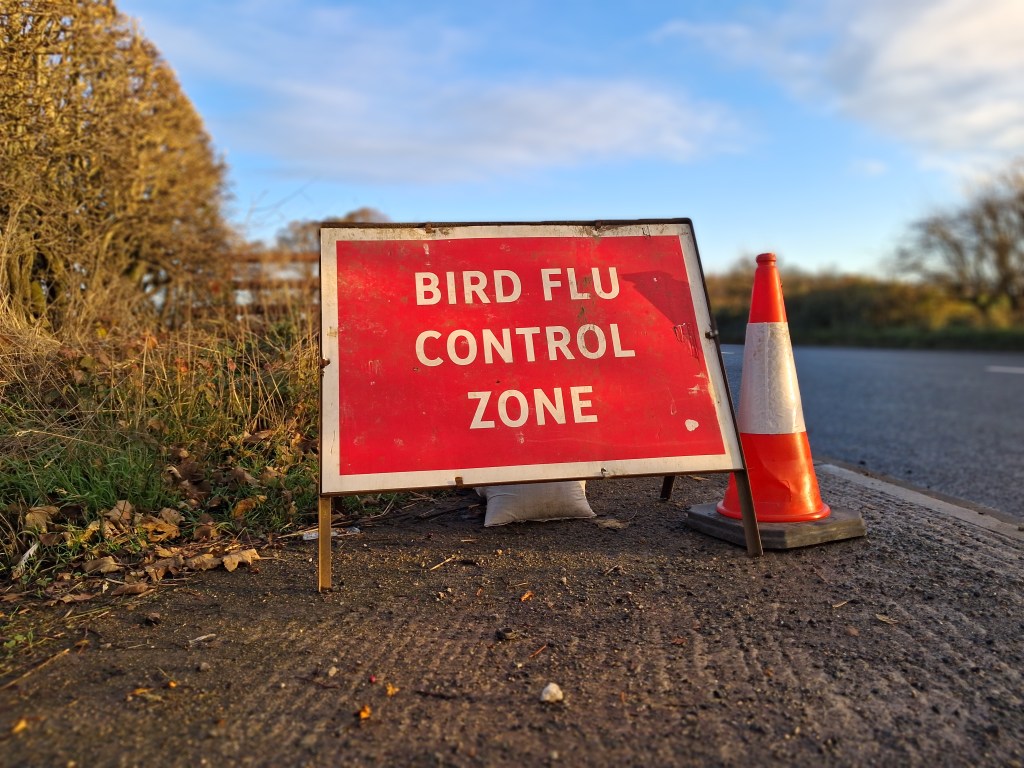
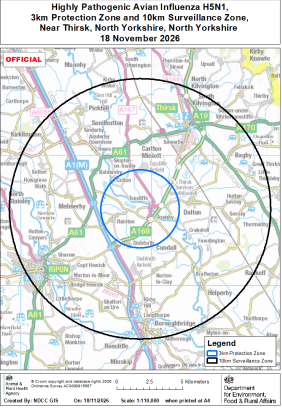
Campaigners against the proposed 2.7 million chicken factory in the quiet village of Melmerby, North Yorkshire warned that their objections to the industrial site were being brushed aside, even as avian flu sweeps over the country. The latest outbreak of avian flu in North Yorkshire is only a few miles from the proposed site and having 360,000 chickens packed close together at any one time, is a disaster waiting to happen.
Insurers are already proving resistant to repeated payouts for culled poultry and farmers are being impacted financially from the loss of their flocks.
Avian flu concerns being ignored
Campaigners question whether the applicant for the Melmerby site, Forest Poultry, has mitigated fully for the risks associated with avian flu and highlight other issues of concern which appear not to be fully addressed in the application. The group ‘Communities Against Factory Farming’ argued that, ‘The risk of bird flu in IPUs is high. IPUs are recognised facilitators for the spread of highly pathogenic avian influenza (HPAI) H5N1. There are close properties nearby. This poses an unacceptable zoonotic risk. With recent cases of H5N1 crossing into mammalian hosts, including cattle and humans, scientists warn that H5N1 may be the next pandemic, and urgent action is needed to strengthen preparedness, starting with local authorities.’ They go further and state, ‘The current application lacks sufficient information to assess the public health hazards of chronic exposure to bioaerosols, the risk of a potential pandemic outbreak, or biosecurity protocols. There is no assessment regarding the risks and mitigation strategy in the case of avian influenza. The LPA cannot properly assess implications for disease risk.’ They urged the local planning authority to request more information on how this development would mitigate against the risks of avian influenza- information which still hasn’t been published.
AIr pollution concerns being ignored
The latest objections from the ‘9 Villages Group’ highlight a series of omissions and inaccuracies in the application. They argue that the application in its current state fails the National Planning Policy Framework requirements to comply with national PM₂.₅ targets. They state that there is a ‘complete omission of dust, PM₂.₅, and Bioaerosol Health Assessments’ within the application and question the assertion from the applicant that air pollution is addressed, as no chapter contains an assessment of PM₁₀, PM₂.₅, dust, or bioaerosols. With the air pollution coming from the nearby A1 and A6055 mixing with the planned aerosols from the planned development- campaigners argue that this is a significant omission.
Ecological impact concerns being ignored
Campaigners also argue that the application directly conflicts with Natural England’s Standing Advice for Local Authorities, advice which states, ‘If background pollution is already exceeding critical levels or loads, any proposal adding further emissions could undermine the objective. Applicants cannot use a habitat developing tolerance to high nitrogen levels as the only justification for further increasing nitrogen deposition.’ Submitted objections to the application note that the impact on the local Ripon SSSI units could be significant, as these sites are already highly vulnerable and stressed. 5 out of the 17 units are failing to improve or are actively deteriorating and therefore campaigners argue that the application fails to meet Natural England’s guidelines which state that ‘where baseline pollution already exceeds critical loads, adding further emissions directly undermines conservation objectives.’
Campaigners additionally point out that North Yorkshire Council could commit a material error of law, if they approve the current application. They submit that the applicant has omitted and excluded the impact on Salmist Beck Carr SINC (a locally designated wildlife site within 1.7 km), which was completely omitted from the in-combination assessment. They refer to the legal judgement in the High Court Precedent of R (Caffyn) v Shropshire Council [2025] EWHC 1497, where a planning permission for an intensive poultry development was quashed because the local authority accepted an in-combination assessment that excluded surrounding livestock projects operating under environmental permits.
Water consumption concerns being ignored
It is also notable that Yorkshire Water does not appear to have been consulted on the application. An objection from Chrisopher Lay asks whether the infrastructure can support the additional level of demand which would come about from the development. He notes that the application suggests water consumption to be around 1230 litres/ tonne, though acknowledges that the application does not make clear whether this is just drinking water or whether it includes the water for shed washing. Using the applicant’s own figures, this would create a consumption of 6,097,356 litres of water per year.
Lay notes however, that the chicken industry figure from Farmers Weekly, suggests that over its lifespan a broiler chicken consumes approximately 6 litres of water. With 2.7 million chickens, this amounts to 16,200,000 litres of water- a figure dwarfing the applicant’s own claim, leaving Lay to wonder where this additional water is going to come from, with Yorkshire Water already facing rising demands from customers.
Despite amended documents being uploaded from the applicant- seemingly after campaigners highlight serious omissions and flaws in original documents- it appears that this application for a 2.7 million chicken mega-factory in a quiet North Yorkshire village is under intense scrutiny, which in turn, puts pressure on North Yorkshire council planners to ensure that planning requirements are upheld.

