https://www.flickr.com/photos/worldmeteorologicalorganization/55484135012/in/album-72157717964599896 Credit Muhammad Amdad Hossain / WMO
Levels of carbon dioxide and other major greenhouse gases in the atmosphere reached unprecedented highs in 2025, according to a new report from the World Meteorological Organization (WMO), thus locking in more long-term temperature increase for the planet.
The globally averaged surface concentration of CO2 in 2025 was 426.8 parts per million, or 153% of the 1750 pre-industrial baseline. The WMO Greenhouse Gas Bulletin also noted that concentrations of methane and nitrous oxide- the second and third most important long-lived greenhouse gases related to human activities- also rose to a new record.
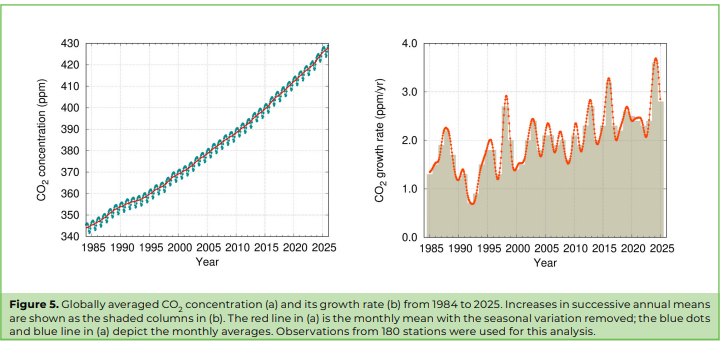
CO2 growth rates tripled
The report noted that ‘Growth rates of CO2 have tripled since the 1960s, accelerating from an annual average increase of 0.8 ppm per year to 2.4 ppm per year in the decade from 2011 to 2020. From 2024 to 2025, the global average concentration of CO2 rose by 2.8 ppm – above the decadal average but slightly less than the exceptional surge of 2023/2024.’
WMO senior scientific officer Oksana Tarasova commented, ‘However, a 2.8 ppm annual increase is still a substantial addition of carbon to the atmosphere from fossil fuel burning. We can expect to see a further increase in concentrations in 2026 because of fossil fuel burning and the development of a powerful El Niño which will impact land carbon sinks as it did in 2023/2024. The risks of reduced CO2 uptake by the ocean are also increasing in our changing climate.’
Key information required for COP 31
The annual Greenhouse Gas Bulletin creates the authoritative scientific information required for negotiators at the upcoming UN Climate Conference, or COP 31, in Antalya, Türkiye, beginning in just a few weeks.
WMO Deputy Secretary-General Ko Barrett sounded the need for much- needed concrete climate action, when she noted, ‘Another year, another new record. Greenhouse gases are trapping an unprecedented amount of heat in the atmosphere, providing energy for more extreme weather and associated risks to our economies and societies. The past 11 years have been the warmest on record and this trend is set to continue. CO2 has a very long life-time and so will affect the global climate not just for years but for decades and even centuries.’
A hothouse future?
Bill McGuire, Professor of Geophysical & Climate Hazards at UCL, responding to the WMO report, warned about governments reversing climate action and green measures, under pressure from fossil fuel corporations. He said,
‘The 1.5C limit is dead in the water, and – according to this week’s UNEP Emissions Gap report – to have a ‘good’ chance of staying this side of 1.7 – 1.8C, emissions need to fall by 45 percent within 15 years. The reality is that we continue to pump out the weight equivalent in CO2 of 800,000 Titanics every year, and emissions are still rising, so there is not a cat in hell’s chance of this happening.’
He continued, ‘We are rewinding the climate clock back millions of years to a time when the climate was much hotter, and humans had yet to appear. As governments row back on green measures, and fossil fuel corporations plan for expansion, it is clear that we are sleepwalking into a hothouse future that will challenge the very existence of our civilisation and, quite possibly, our species.’
World renowned climate scientist, Professor Michael E. Mann, focused on the need for a clean transition away from fossil fuels, when responding to this WMO report.
He highlighted the importance of democratic, political upcoming elections, when he said,
‘There is a lot of support among the public for a clean energy transition. The problem is that the fossil fuel industry currently owns our government. But there are reasons for optimism that we might begin to turn the corner with the midterm elections. If they return one or both houses of congress to the Democrats, there will be the possibility of Congress acting as a check on the destructive policies of the Trump administration and in a couple of years, with new leadership at the presidential level, the U.S. could once again reassert leadership on climate.’
He noted the positives also from the recent Emissions Gap Report, emphasising that, ‘There is some good news here—the report emphasizes the fact that there is substantial progress being made, i.e. with the slowing emissions growth in the G20 (not considering the U.S.). Much of the progress is actually coming from the east, e.g. China. Ultimately we will need to see the rest of the world put political and economic pressure on the bad actors that are obstructing a fossil fuel phase out. These are petrostates like Russia, Saudi Arabia, and under Trump & GOP, the United States.’
Professor Mann was clear though that, ‘We have to transition rapidly away from fossil fuel burning. There’s simply no other way. Without regulating them and imposing an incentive structure that leads them to move toward clean energy, nothing else is really going to matter.’
‘Every fraction of a degree matters’
António Guterres, the Secretary General of the UN, commented on the possibilities of positive climate action, revealed in the recent UN Emissions Gap report, when he said,
‘The world can no longer avoid overshooting the 1.5 degree limit. And the consequences are already devastating. Deadly floods. Brutal heatwaves. Raging wildfires. Lost lives. Crippled economies. Deepening inequalities. And those least responsible are suffering first and worst.
But overshoot is not surrender.
We can still keep it as small and as short as possible- and bring temperatures back below 1.5 degrees before the end of the century….Cutting global greenhouse gas emissions by 18% by 2030 and 45% by 2035- compared with 2025 levels. That’s close to 6% every single year until 2035. Yet emissions remain at record levels. And national climate plans and current policies fall dangerously short- pointing to 2.6 to 2.8 degrees of warming.
But we have the tools to change course and pull back from the brink….
Governments must go much further and faster. Accelerate clean energy and electrification across every sector. Adopt credible roadmaps to transition away from fossil fuels- with clear timelines and protection for affected workers and communities.
Every fraction of a degree matters. Every year of delay makes the way back steeper. Let us close the gap now.’

