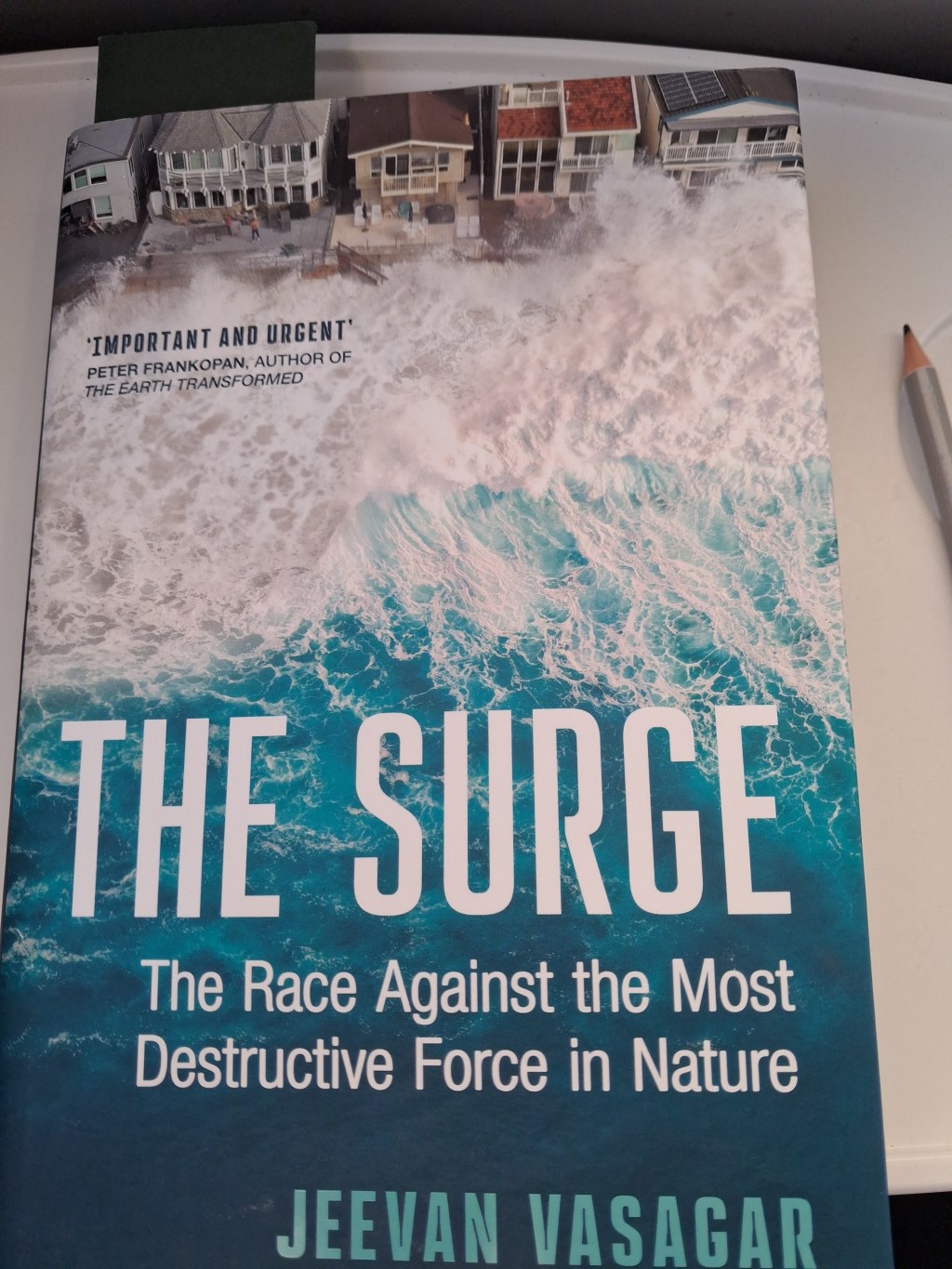
‘The Surge’ is an incredibly timely focus on humanity’s relationship with water and how we remain at the mercy of the waves, as government after government fails to properly protect its peoples. Governments instead, like the UK Government recently, warn the public to ‘prepare for emergencies’ and ensure they have enough resources for a few days, expecting power failures, flood damage and even deliberate cyber attacks.
Vasagar points out the central theme of his book, ‘The question at the heart of this book is whether humans will continue to enjoy the illusion of complete mastery over nature, or whether sea, river and rain, supercharged by greenhouse gas emissions, will overwhelm any defence and demand a radical shift in our thinking.’ We have been failed by a cultural and ideological narrative that comes from being an island state in the UK- but recently we are being forced to face the truth that our safety from the waves is more fragile than we may believe.
‘The Surge’ highlights the various attempts from countries around the world to live with water and to have a productive and positive relationship with arguably the ‘most destructive force’ on our ‘Blue Planet.’ The dichotomy of options does not leave flexibility for other solutions. ‘Resist the rising waters or accommodate them. It’s a choice as old as human history.’
We almost fall into the trap in Vasagar’s book of chronicling and listing various flood catastrophes in the UK and around the world and quantifying the number of dead, displaced and financial consequences of each disaster, without developing the plans and strategies of learning the lessons. We move on too quickly and leave the flood victims with delayed recourse to the financial support they need and homes which have become uninsurable in our world. Vasagar notes, ‘Floods don’t just cause physical destruction and social upheaval: they have financial consequences too. As rainfall becomes more intense and sea levels rise, parts of the world may become uninsurable before they are uninhabitable.’
He quotes an industry estimate that leaves people vulnerable to future flood impacts, ‘The industry estimate is that around 2 millions homes would no longer be able to access insurance for floods.’
We have already seen the first of UK climate refugees and this is a number which will grow as the planet continues to warm. Vasagar strongly contends that the UK is woefully unprepared for future floods and has learned little from catastrophes such as Canvey in the past. ‘The country is sleepwalking towards a perilous future, in which the government will struggle to bear the cost of maintaining and reinforcing sea defences everywhere and people are likely to be forced to abandon their homes.’
He continues, ‘Sea levels off the UK coast are expected to rise by half a metre by the end of this century, and with this rise, around a fifth of England’s existing coastal defences will be vulnerable to failure.’ With this half metre sea level rise, ‘around
200 kilometres of England’s present-day coastal defences would be vulnerable to failure.’ And we know this in advance, but mitigation and action appear missing.
Vasagar rightly warns about the rise of climate denying organisations and politicians who find themselves in power and rule in an authoritarian manner. All this does is expose the most vulnerable people to increased climate risks, while the wealthy protect themselves.
‘As the effects of climate change have become ever more visible, with increasingly destructive floods, heatwaves and wildfires, it’s become harder to deny that the planetary climate is changing. But the retreat of democracy in the world’s most fragile states and the rise of the populist right in the rich world are frustrating efforts to deal with both the causes and consequences of this shift.’ As his example, he fully explores the impact of the floods in Derna, Libya in 2023 and the delayed response of emergency aid and support to Hurricane Katrina victims in the US.
He then turns his attention to the current United States and powerfully comments that,
‘Few wealthy countries now look quite as vulnerable to disaster as the US, with its main disaster relief agency ill-prepared for catastrophe and its government increasingly unwilling to listen to scientists.’
It is staggering to witness the recent appalling floods in Nepal of September 2026, owing to glacier collapse, but somehow forget the floods of Northern Pakistan in 2022, where melting glaciers also released unusually large volumes of unstoppable water. In an ominous note, Vasagar warns, ‘Pakistan has more than 7,000 glaciers, more than any other country outside the Arctic Circle.’
He questions whether our societies can have the long-term vision required to build for a more flooded world than before, when he asks, ‘Floods raise two profound questions for us when we face a greater risk of extreme weather than at any time in human history. The first is whether we can heed the warnings of scientists about a changing world and secondly, whether our societies are capable of change on a scale we find hard to imagine.’
He simplifies the message that a change in mindset and belief is required. We are not as safe as we think we are. ‘Living in an era of more powerful and destructive floods will require change.’
‘The Surge’ does finish on a hopeful note though. Vasagar openly and honestly acknowledges that, as this is primarily a problem of our own making, we have agency to respond and prevent future catastrophes, by strong and decisive action.
‘If disasters can be caused by human miscalculation, making the right decisions ahead of time can save lives. We have created a world of floods. Now it’s time to work out how we live with it.’

