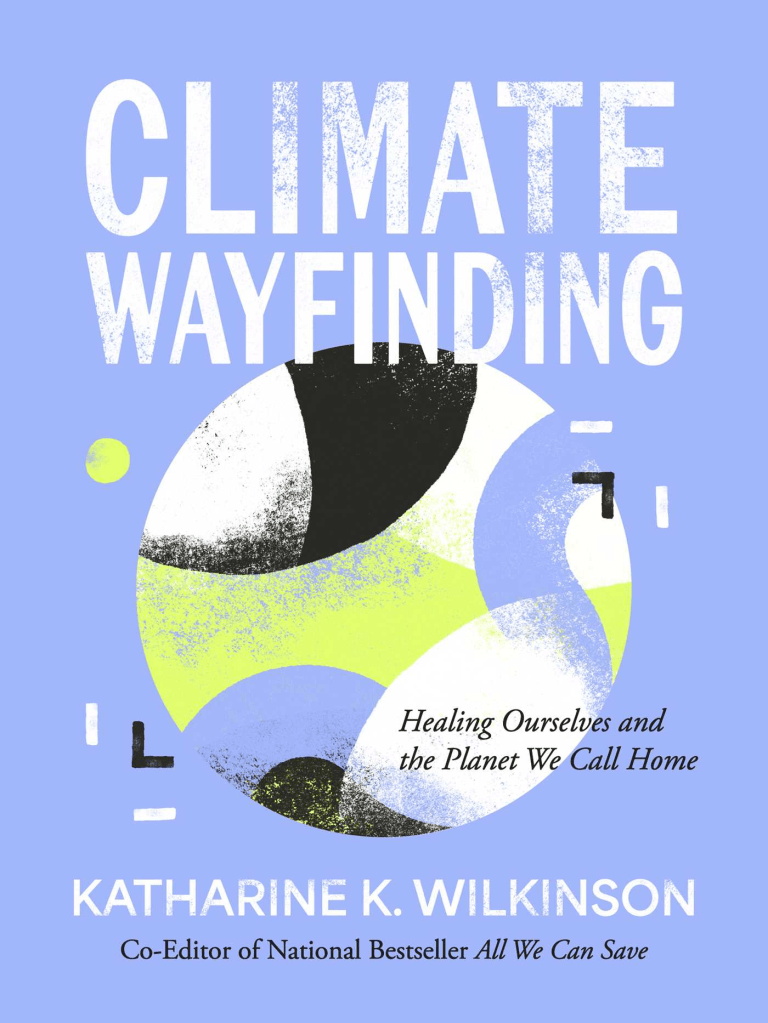
Wilkinson’s book crackles with purpose and the potential of what might be possible. It reminds us that there is a ‘we’ at the heart of this journey and that we are bound and bonded by a common framework of humanity.
‘Climate Wayfinding’ is a book which encourages- even demands- time for reflection; time for strengthening those links with others; and time to breathe. As Wilkinson notes, ‘Climate Wayfinding is about finding our way forward and conjuring the future, yes. But it is also about remembering.’ It offers a map to guide us on our future, a map, which until now, did not exist.
The book acts as a guide, to help navigate questions about identity- about who we are, about whom we impact and about why we care about the issues we care about. ‘What does it mean to be human, here and now? To help tend to a changing planet? To devote ourselves to the genuinely common good? What futures can we dare to dream?’ It is purposefully a meditative book, which asks us to gently confront our position on the path and to look around to work towards a positive, potential future. ‘We need to look inward with care, look outward with curiosity and then look forward with courage.’
Wilkinson does not shy away from the fact that many peoples around the world are already facing climate breakdowns and injustices. ‘All of it is happening in a profoundly unequal world, with those who are already in jeopardy or facing injustice, and who have scarcely contributed to this crisis, suffering most. Our new troubles inflame existing ones.’
Based on first impressions, ‘Climate Wayfaring’ may appear to some as being a superficial pathway, as being a gentle approach, when more direct action is needed. The book, however, reminds us that there is a strength and a power which comes from looking at the world which we care about with love. ‘I long for climate healing motivated not from wanting to fix something but from wanting to love something’
We re-learn that each one of us is not an isolated ‘cell’, but instead part of various networks and communities, which spread out from us and are a part of us. ‘Each of us is a node of possibility for healing the climate crisis— whoever we are and whatever we’ve got to give.’ We are not one identity- we are many- from being a child, from being a parent, from being a volunteer, a sports coach, part of a tennis club, a neighbour, a friend, a carer or a stranger. We are multi-faceted beings, with strong bonds to each other and the world. ‘When facing a planetary crisis, as with a personal one, it’s best not to go it alone.’
‘Climate Wayfinding’ unashamedly puts people at the heart of its strategies, concepts and narratives and warns that a ‘peopleless approach’ risks missing the opportunity to bring people along on the journey. ‘Because if the problem of climate change originates in human activity, then planetary healing must as well.’ Wilkinson puts her reader at the heart of her text and reminds us of our awesome power to effect change. ‘So much about our world is out of your hands and mine, yet potential also sits right at our fingertips.’ She celebrates Dr. Elizabeth “Beth” Sawin, who said, ‘The bottom line is this: You write in order to change the world, knowing perfectly well that you probably can’t, but also knowing that literature is indispensable.… The world changes according to the way people see it, and if you alter, even by a millimeter, the way a person looks or people look at reality, then you can change it.’
Wayfinding or Wayfaring?
Curiously, there has been an unconscious subliminal ‘error’ which has crept in whenever I have written the title of this book for this review. Far too often, I have written ‘Climate Wayfaring’ instead of ‘Climate Wayfinding’ and there may be something worth exploring in this slip. How we travel, and how we fare on the path are of equal importance
Wilkinson concludes by acknowledging the limits of ‘Climate Wayfinding.’ That the path continues on and on, opening up new futures to travel. ‘Climate Wayfinding’, then, cannot bring us to a final terminus or clear conclusion, and it shouldn’t try to. This chapter of life is reminding me, viscerally, that the act of finding our way will only continue to open.’
She finds great solace from her belief that we are equipped, curious, and ready for the path ahead, that we all have a part to play and decisions lie ahead of us. ‘We are built for the necessary work of our era. We have within us a seedbed of narrative, imagination, and navigation. We have within us a seedbed of the world we want to grow.’
When facing climate breakdown and considering that the problem is too great, it is fitting to remember the words of Tolkien and to gain comfort and strength in the thought that maybe, maybe we are meant to be the ones who are here- to be alive at this time, in this place, with our powers to change the world for the better.
“I wish it need not have happened in my time,” said Frodo.
“So do I,” said Gandalf, “and so do all who live to see such times. But that is not for them to decide. All we have to decide is what to do with the time that is given us.”

