‘Tomorrow, and tomorrow, and tomorrow,
Creeps in this petty pace from day to day,
To the last syllable of recorded time;
And all our yesterdays have lighted fools
The way to dusty death.’
Shakespeare’s words, from over 400 years ago, seem shockingly relevant today, as we face an existential climate crisis, but we witness no real decisive climate action. We have been brought to this moment- we are the ‘lighted fools’- and appear to have learned nothing from the lessons from our ‘recorded time’.
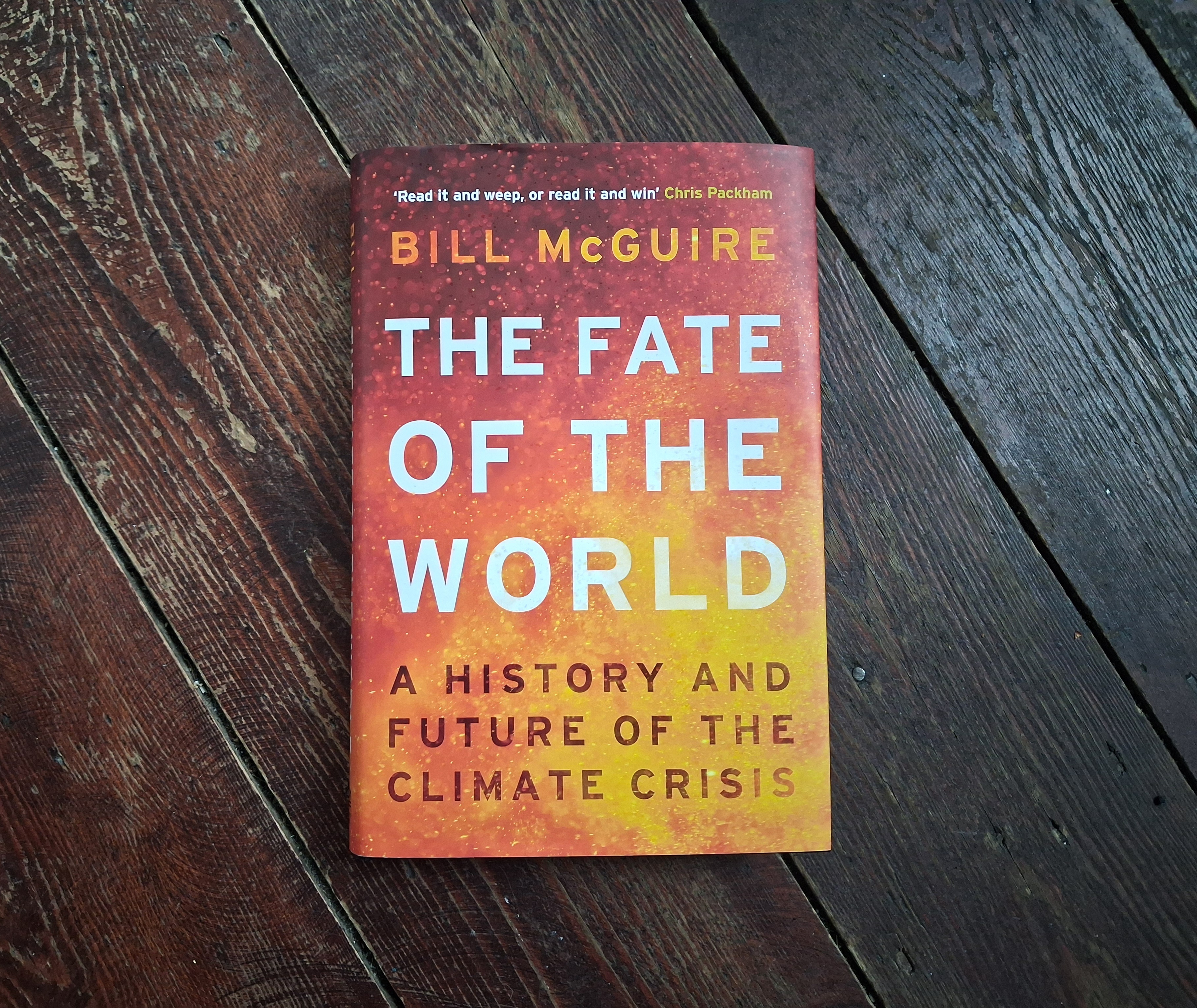
McGuire’s ‘The Fate of the World’ offers a comprehensive and thorough lesson into our planet’s deep geological time and warns that our climate conditions are close to matching those of the last interglacial period- the Eemian- and could even match the Pliocene conditions, last seen on this planet over 2.5 million years ago. A prehistoric future which needs to be avoided.
Make no mistake- this is a challenging, difficult, and relentless read. On the other hand, ‘The Fate of the World’ should be a necessary and compulsory read, if we are to change the looming future. It is dedicated ‘To all who come after us’,and they will inherit our Earth. What that world looks like then will depend on our actions now. ‘Never have the actions of one generation meant so much for those that follow.’
McGuire urges us to be good ancestors and shake off the short-term shackles which are keeping us prisoner to the fossil-fuel status quo. ‘Yet future generations have no say in what actions we take today, nor do those making decisions in the first quarter of the twenty-first century have to live with the worst of their consequences.’
McGuire does not shy away from giving blunt scientific assessments and his expert climate views are important if we are going to change our current trajectory of economic and capitalist ‘business as usual’,while the planet burns. Or as McGuire comments, ‘It is an insane situation, and it can’t go on.’
McGuire’s ‘history book about the future’ then, details the scientific arguments about the impact on our world of our Sun, how what we see as a ‘constant’ has been anything but in its life cycle, and still has a future of its own to complete. He discusses the varying levels of carbon in the atmosphere over the life of the planet; how the planet has witnessed deep freezes and incredible oceans; how the Earth remains restless, while still giving humans the ‘Goldilocks’ conditions we need to survive, by its place in the solar system; and the real risks involved by a weakened AMOC. ‘It is no exaggeration to say that what happens to the AMOC will play a huge role in determining the course of future climate breakdown.’
McGuire notes and acknowledges that species rise and fall on our planet is inevitable and that humanity’s ego and arrogance is a dangerous combination. ‘Something like three-quarters of a billion species of animals, plants and fungi are thought to have existed since life first emerged on our planet, of which 99.9 per cent are now extinct.’
‘There can be no doubt that our beloved planet, as we have come to know it, is in deep, deep trouble.’
Extreme weather events around the globe are certainly causing people to realise that something is out of kilter; that our world today is different from that of 50 or 100 years ago. Droughts, floodings, wildfires, extreme heat and sea-level rise are all adding up to a world on the move- desperate to escape climate conditions in their own environment. Climate migration will become a more familiar term in the coming decades. ‘2024 was not only the hottest year on record but probably since the last interglacial period 125,000 years ago. And it won’t stop there. The truth is that, as global heating continues to flourish, 2024 will eventually prove to be one of the coldest years of the twenty-first century.’
McGuire quotes a 2020 report by the Geological Society of London, which stated, ‘The current speed of human-induced CO₂ change and warming is nearly without precedent in the entire geological record.’ An unbelievable indictment of humans as ‘conscious accomplices on the journey towards our own demise.’ McGuire debunks the climate-denying tropes that ‘the Earth has been hotter before’ or that ‘Levels of carbon dioxide in the atmosphere have been higher in the past’, by focusing on the crux of the climate issue- often deliberately missed by deniers- that the rate of change offers humanity little chance of adapting to a new world. ‘And this is the crux of the climate emergency facing us today- not the absolute temperature, nor the level of carbon dioxide in the atmosphere, but the staggering and unprecedented speed with which they are rising.’
The fires of Isengard
To enter into Tolkien’s world, the fossil-fuel fires of Isengard have been burning for far too long. The character of Merry warns, ‘The fires of Isengard will spread. And the woods of Tuckborough and Buckland will burn. And…and all that was once green and good in this world will be gone. There won’t be a Shire.’
McGuire does not go so far as to fall into the ‘doomist paralysis’ narrative. ‘Do we just give in? Absolutely not. The future unravelling of society will be brutal, but it doesn’t negate the need to fight today to keep every tonne of fossil carbon out of the atmosphere.’
He repeatedly urges that drastic global emission cuts can still make a difference to aid with climate resilience. ‘I haven’t completely lost hope, and neither should you. I did not write this book to dismay or dishearten, to foster panic or to feed inertia but to galvanise action to do what needs to be done: to cut emissions as fast as possible; to prepare for a new and much harsher world.’
He repeats this message throughout ‘The Fate of the World’, with his typical pragmatism. ‘All is not lost, however. If we take the urgent action required in the next few decades to rapidly row back on emissions, it may yet be possible to dodge PETM or early Eocene conditions.’
He acknowledges that the will to act quickly, sadly still lies in the hands of politicians and world leaders and that collective action is still sorely missing. ‘We have the means within our grasp- even at this late stage- to head off Armageddon. But we lack the collective will to do what needs to be done.’
‘No fate but what we make’
The map of our world has been redrawn in the past and will be redrawn again in the future. With a best estimate for the global average temperature rise of 2.7℃ by 2100, based on current policies and actions, it feels that our fate has already been sealed.
As McGuire points out, we can no longer hide behind the shield of scientific ignorance- climate scientists have been warning us for decades of the likely track ahead if we continue to allow carbon emissions to rise unchecked. By now we need to ask, why are we doing this on purpose to ourselves and the planet?
‘We can no longer pretend to be sleepwalking into climate catastrophe. We are doing it consciously, with our eyes wide open, and hang the consequences.’
But.
Our future- our fate- is not yet carved in stone.
We can still be a great people, if we wish to be. Our path has been lighted from the past and we now have the light to show the way to climate justice and climate resilience for all.
We all now get to write ‘The Fate of the World’ ourselves. We carry the fate of us all.
 Climate Thoughts with Brian