-
European heat records are broken by spring heat dome
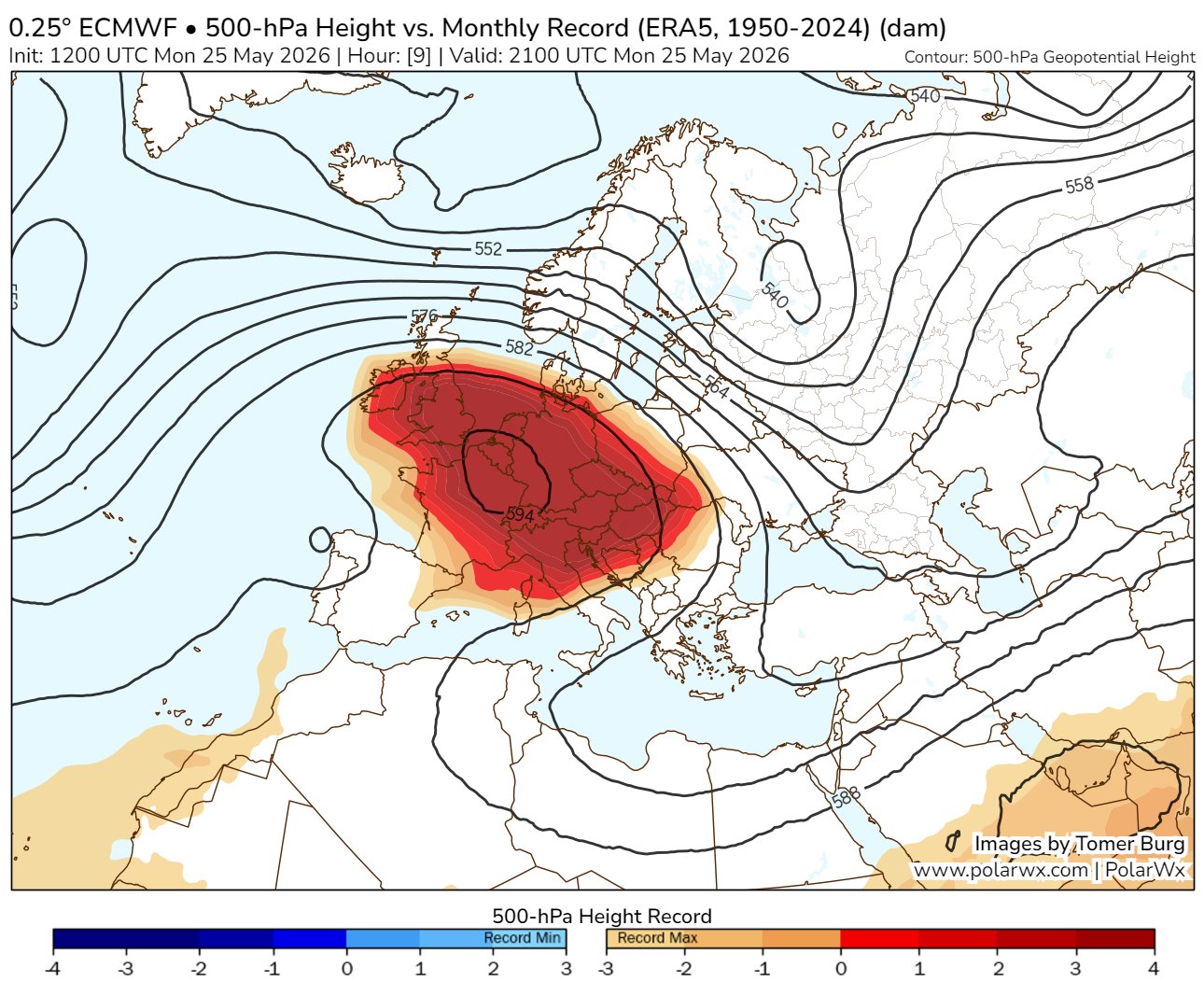
Credit @Tomer Burg
The UK has just set a provisional new May heat record with 35.0C recorded in West London, exceeding the 34.8C reached yesterday. France has also seen record breaking heat with 36C recorded in the country’s southwest on Monday as a heat dome sits across much of western Europe.
Friederike Otto, Professor of Climate Science, Imperial College London said:
“This record-breaking heat has the fingerprints of climate change all over it. Temperatures on this scale were once exceptional even at the height of summer. Seeing 35C in the UK during spring is absolutely astonishing, but the science is very clear – climate change makes these heatwaves hotter, longer, and far more frequent.
The climate we are living in today is simply not the one we grew up with, and our buildings and infrastructure are woefully unprepared for what’s next. While we have made some progress in cutting emissions, it is not fast enough. Temperature records will continue to tumble until we fundamentally halt global emissions and reach net zero.”
Dr Garyfallos Konstantinoudis, Lecturer at the Grantham Institute – Climate Change and the Environment, Imperial College London said:
“This exceptional spring heatwave is far more than an uncomfortable disruption to our sleep, work, or study. For vulnerable groups without access to cooling – particularly the elderly, the very young, and those with underlying health conditions – these temperatures are quite simply dangerous, and potentially fatal.
“Early-season heatwaves are especially hazardous because our bodies have not had time to acclimatise. Our modeling estimates that we could see more than 250 additional deaths during this heatwave in England and Wales. This aligns with a broader analysis we conducted across 854 European cities last summer which revealed that heat caused thousands of preventable deaths – with two-thirds of those fatalities driven directly by the additional heat from climate change.”
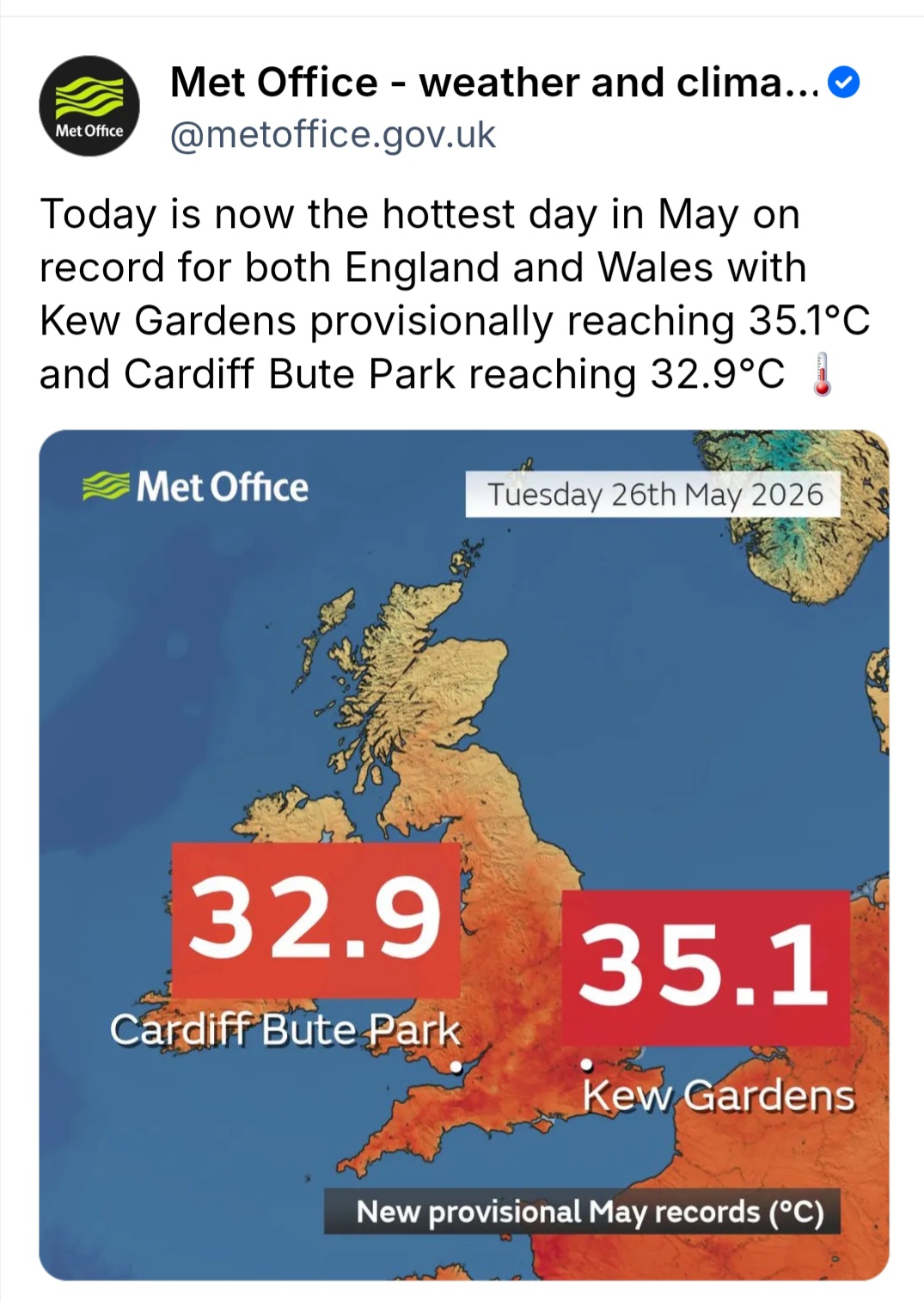
With the UK Climate Change Committee recently warning that the UK is not prepared for climate impacts, the summer ahead could simply be a staggering one: with infrastructure at risk of failing, lives put at risk; and food and water security being threatened.
The climate crisis is here now. The UK Government would do well to listen to the local communities up and down the country who are up in arms asking for a televised national climate emergency briefing to address the threats and risks posed by the rise in extreme weather impacts.
-
Thousands of people across the country protest against sewage pollution
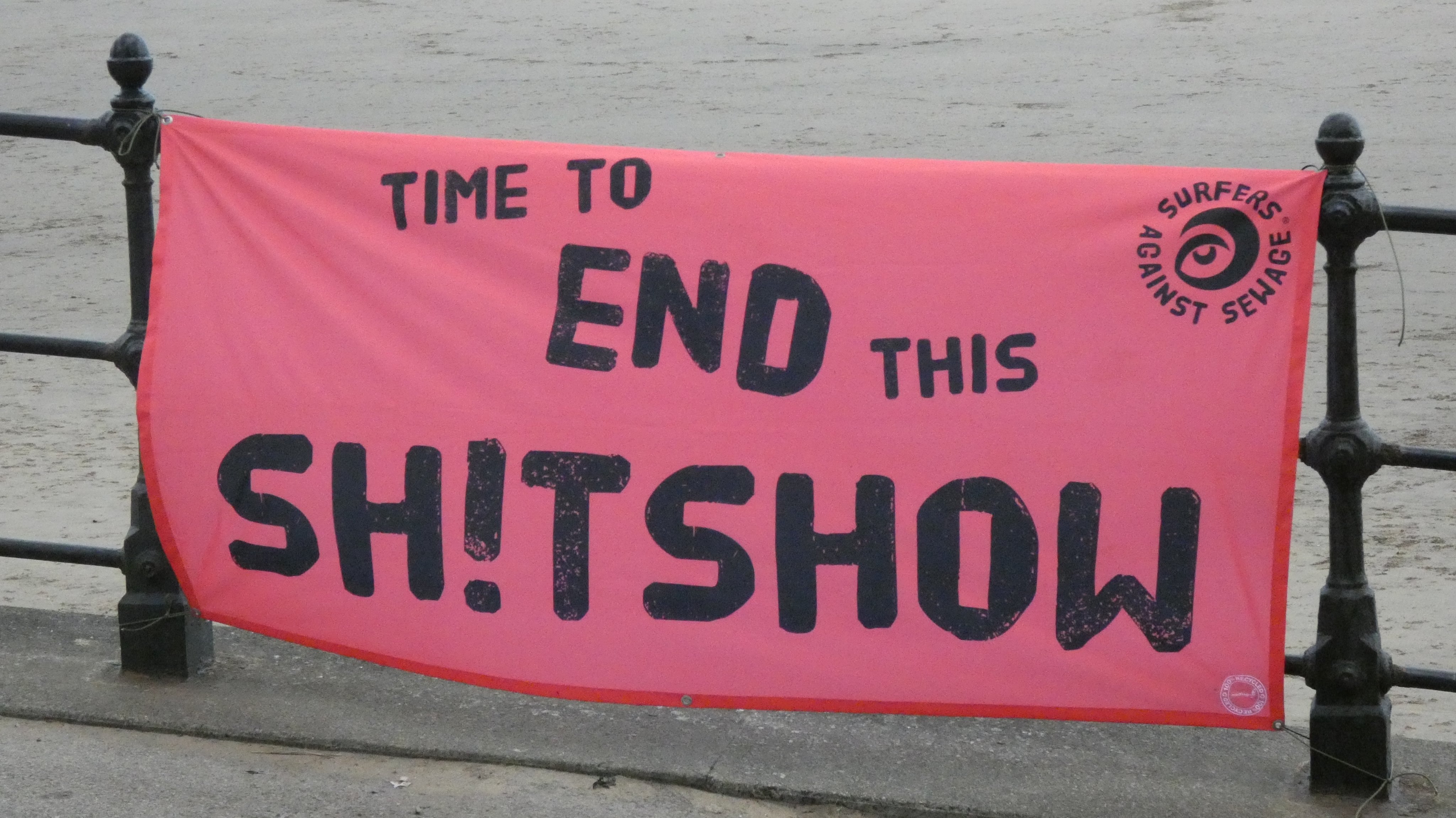
Pictures of Scarborough Surfers Against Sewage Protest credit @torysmasher
In over 50 locations across the country, people gathered today to express their outrage at the ongoing sewage pollution of waterways, rivers and the coastline around the UK.
Organised by Surfers Against Sewage, these ‘Paddle Out Protests’ aim to protest against the sewage pollution by the water monopolies as well as the Government’s failure to tackle it. The announcement this week of the Clean Water Bill, is felt by many campaigners to lock in the current failed privatised system.
Giles Bristow, Surfers Against Sewage Chief Executive said: “The Clean Water Bill is nothing more than a whitewash, locking in a failed system that has seen pollution, shareholder profits and consumer bills soar over three decades. That is why thousands of us are paddling out in protest.
“Public support for privatised water has all but vanished and while thousands take to the beaches in protest the Government is burying its head in the sand. Sir Keir should have learned the lesson from Mr Bates vs the Post Office: the public have caught the stink and demand action on the sewage scandal. If he and his government continue to prop up this dirty business, they must be prepared to face the consequences.
“Whether you’re a surfer, swimmer, cold-dipper or water-bill payer, this is our chance to stand up to the polluters, paddle out, and demand that the Government’s reforms bring an end to sewage pollution. Turn up, paddle out and join the fight.”
Mandate for Change
New polling coinciding with the protests reveals the scale of public dissatisfaction. Just 17% of adults in England believe ministers are holding water companies to account, and just 15% believe the Government is willing to challenge the interests of water company shareholders. The actions of water companies have even led 1 in 4 (26% of adults in England) to consider not paying their water bill.
The mandate for change is overwhelming. Just 7% of the public believe water companies should remain privately owned and able to make a profit for shareholders, while 77% back a change in operating model, including more than a third (35%) supporting full public ownership.
Sewage dumped over 290,000 times in 2025
Privatised water companies dumped sewage over 290,000 times in 2025 – the equivalent of nearly 800 spills a day. Water companies were also responsible for 14,700 sewage discharges on dry days, incidents that are often illegal because they’re unrelated to storm overflow events. SAS data shows that this trend has worsened in 2026. Sewage has been dumped into bathing waters across the UK for over 89,000 hours so far this year with England’s water companies responsible for more than 69,000 hours of spills.
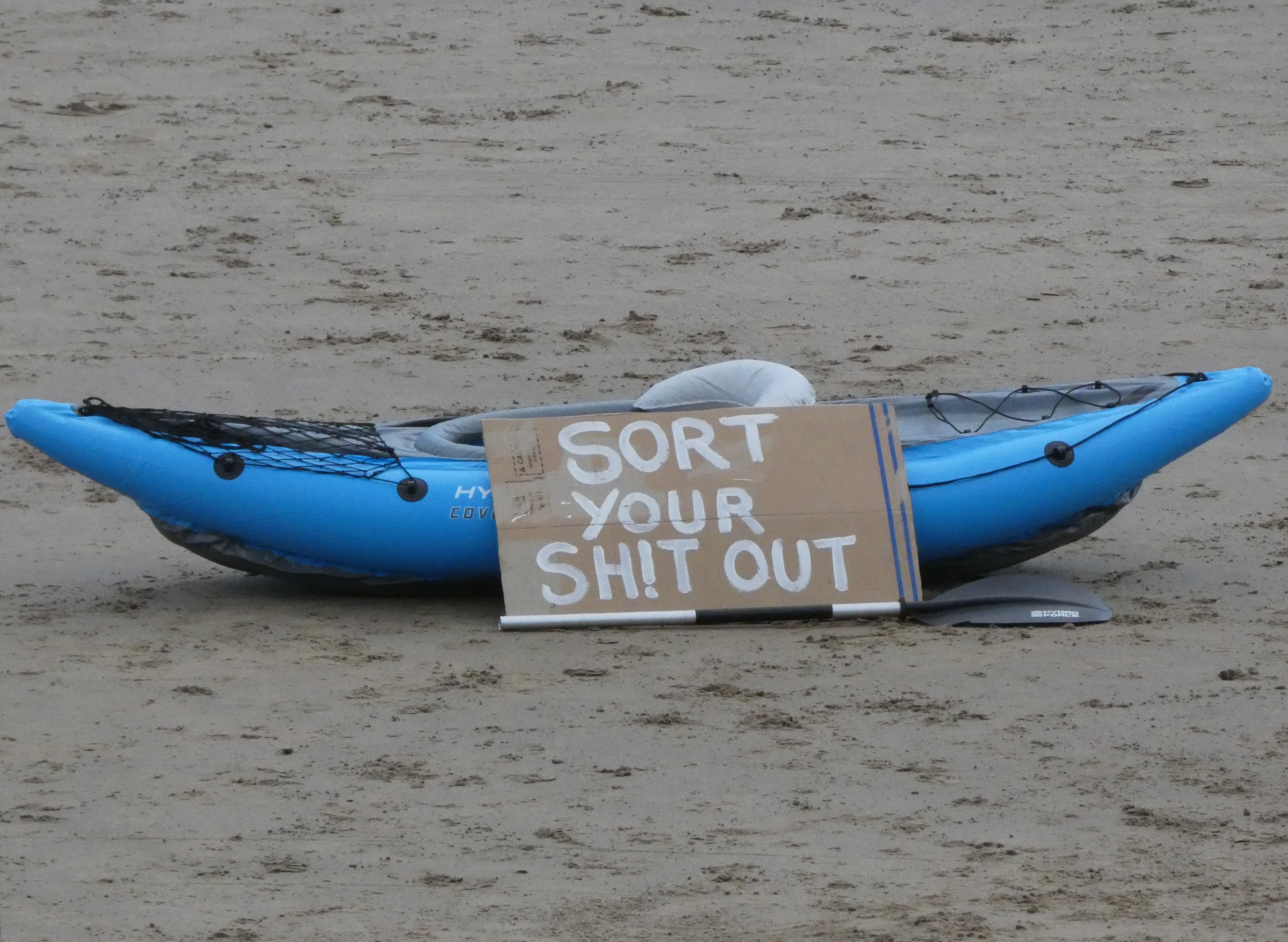
Pictures of Scarborough Surfers Against Sewage Protest credit @torysmasher
In Yorkshire, York was one of the few places chosen for the ‘Paddle Out Protest’. Robin Norton, Millennium Bridge, York Protest Lead said, “I’m one of around a thousand rowers, kayakers and paddle boarders in York that regularly enjoy the River Ouse. We often get splashed and sometimes fall in. Many of us are very aware of the water quality and I feel that if anyone is going to stand up for what is going into York’s rivers and their tributaries, it can start with water sports.’
He continued, ‘Beyond us: kids paddle in the river, dogs swim in it, anglers pull fish out of it and wild swimmers brave, immersing themselves in it. Our rivers should be clean. Let’s end sewage pollution.’
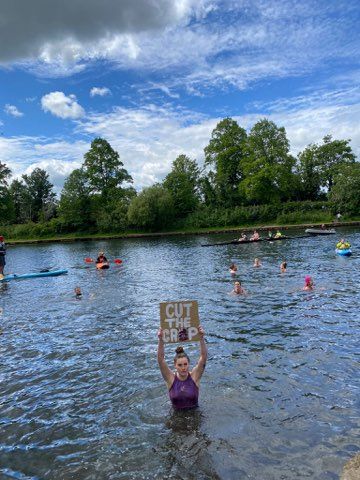
Protesters in York Since 2019, Surfers Against Sewage has received over 7,600 reports from people who have fallen ill after using the water, including extreme cases resulting in hospitalisation and ongoing health problems.
Time to end the ‘dirty business’
Among those joining the protests are Julie Maughan, whose daughter Heather Preen tragically died from E. coli after visiting a Devon beach in 1999, and actors from the docu-drama ‘Dirty Business’, which told their stories and has drawn comparisons with Mr Bates vs the Post Office.
Julie Maughan, mother to Heather Preen, who died after contracting E. coli from a Devon beach, was one of the protesters in Falmouth today. She said:
‘I lost my daughter Heather to dirty water, and I will not stop fighting until no other family has to go through what mine has. This government has had every opportunity to fix the broken water system and chosen not to. People are getting seriously ill and families are afraid to get in the water. That’s why I’ll be paddling out alongside thousands of people across the UK standing up for their right to swim without getting sick.’
Following the nationwide Paddle Out Protests, SAS is urging the public to sign the ‘People Before Payouts’ petition calling on the UK Government to end the current privatised water industry. In Scotland and Wales, the charity is encouraging people to push their newly elected MSPs and MSs for better-funded regulation, increased water quality transparency, monitoring and testing in Scotland and Wales.
-
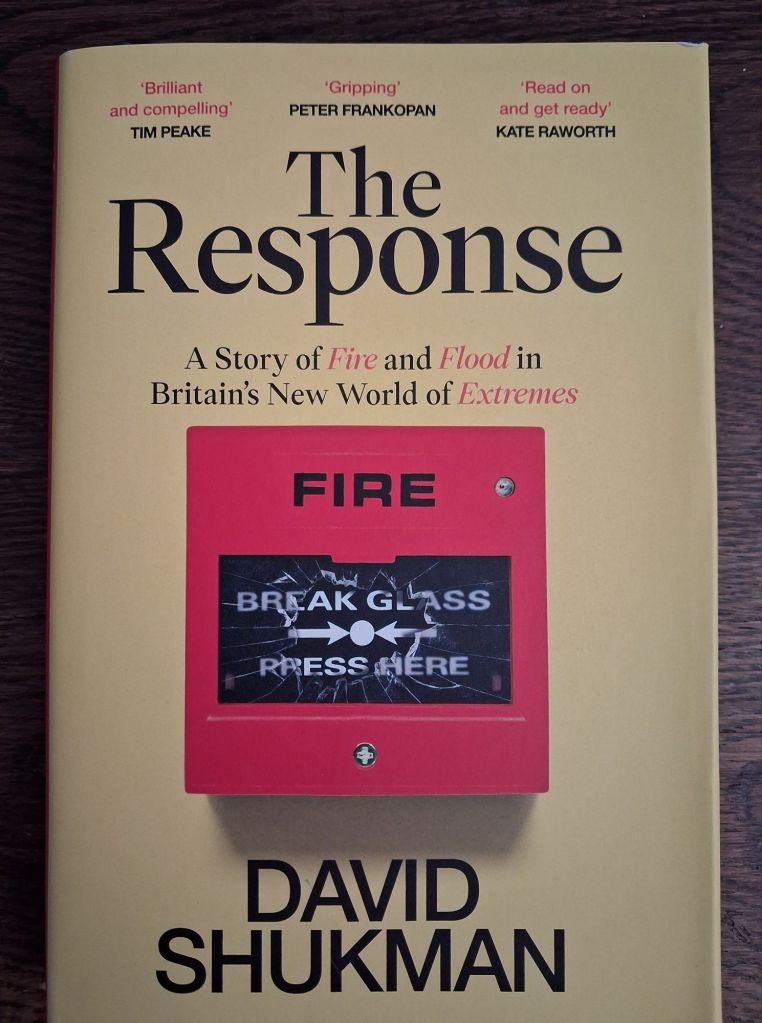
Review of ‘The Response: A Story of Fire and Flood in Britain’s New World of Extremes’, by David Shukman
‘We’re not remotely ready to deal with the worsening conditions that are confronting us now, let alone those still to come.’
David Shukman’s book ‘The Response: A Story of Fire and Flood in Britain’s New World of Extremes’ opens with the stark message that the UK is far away from being resilient to the rising challenges of the climate crisis. From his reporting background, he has witnessed, and has been on the front line of, weather extremes over the decades. As well as detailing the experiences of those impacted by extreme weather, he offers ‘What if?’ scenarios- scenarios which once upon a time may have been unthinkable, but which now are emerging as potential catastrophes.
His scenarios may indeed become prophetic and to have had these warnings and for them to be ignored, while putting the public at risk, appears to be a dereliction of public duty from the UK Government.
Shukman repeatedly warns about the crumbling networks of infrastructure which underpin our safety and warns that network after network is no longer robust enough in the face of the rising climate crisis. ‘A new climate requires new thinking, not just about our bodies, but about our infrastructure too.’
He begins by drawing desperate attention to the rail network and how coastal tracks, which radioactive waste is transported on, are ‘increasingly coming under attack. Storms are strengthening, floods are becoming more severe and the level of the sea keeps rising.’
He warns about ‘minor problems’ which lead to a ‘cascade of failures that cause death and destruction’ and urges that responding to the dangers which are here and now prevents those risks becoming magnified in the future. ‘Too often we’re so preoccupied with looking ahead that we miss the reality of now. We don’t spare a glance for the state of the ground we’re standing on to check if it’s likely to collapse, flood or burst into flames.’
Wildfires and heat
Shukman then chronicles the lessons which ought to have been learned from the UK’s summer of 2022, when wildfires ‘ringed’ London and put incredible strain on firefighters. But for incredibly good luck and wind shifts, utter devastation was averted- how long the UK can gamble on good luck to escape with only a ‘near-miss’ is a dangerous gamble which puts us all at risk. ‘Wildfires are becoming more frequent and harder to contain. In England alone there are around 30,000 wildfires every year- most of them small and relatively easily dealt with. But the larger ones have doubled in number over the last decade.’ Shukman follows this statistic up with another shocking number. ‘[R]esearch by the Ordnance Survey finds that a mind-blowing 1.8 million homes in England are at risk from wildfire.
The alarming detail which emerges from this comprehensive overview of events is the lack of coordinated communication between the water companies and fire departments. ‘Pressure reductions’ by the privatised water companies were not communicated to fire departments, meaning that the flow of water could not be relied upon when needed most. ‘It’s bad enough knowing that more homes will burn under hotter skies. Even worse to think that there might not be enough water to save them and that the supplies, which are in private hands, might be reduced for reasons that are never explained.’
Widespread evacuations may have to be implemented swiftly, decisively and with public safety in mind. As Shukman argues, ‘I’m not aware of any wildfire evacuation plans that have been shared with the British public.’ That aside, even if the public listened to such emergency evacuations, and put their trust and faith rightfully in science, would the UK’s road network cope with such sudden demand- or would the public be caught out in the open and trapped?
Effective disaster management comes before any crisis and is proactive.
A reactive response is already too late.
A record breaking 2026?
With an emerging El Niño predicted for this year, Shukman draws our attention to the dangers of heat and how the new levels of heat which we are seeing in our warming world- driven by human activities- is a silent killer. ‘In the British summer of 2022, with five heatwaves including the 40℃ episode, nearly 3,000 more people died than normal, and around the record-setting day of 19 July, there were more than 1,000 more deaths than expected.’ Many vulnerable people will be more at risk, a risk perhaps not helped by the climate media messaging which continues to display the public enjoying soaking up the sun. Shukman notes that, ‘The upshot is that new levels of heat are forcing us to confront the fact that our bodies and our infrastructure have limits that we never realised existed. Possibilities that once seemed ludicrous can really happen.’ A national system of alerts as a suggested pathway forward may already have been unwittingly negated by this kind of visual communication. And this is before the social media deluge from politicians, in cahoots with, and financially supported by the fossil fuel industry, who rail against anything other than business-as-usual. Adam McKay’s satirical ‘Don’t Look Up’ may be far too close to the knuckle to be funny.
National security risks
As the text progresses, Shukman widens out his scope to encompass the risks involved with supply chains- especially of food- in a changing world. A threat which even the UK’s intelligence services has previously warned needs to be more resilient.
He explores the risks posed by air pollution and the car-focused narrative; how the insurance industry is responding to climate issues impacting their business models and leaving homeowners- well, not quite high and dry- in a desperate situation, forced to abandon unsellable homes, creating ‘climate abandonment areas’.
Air pollution in the UK is raised as another ‘silent killer’ along with heat. With Ella Adoo-Kissi- Debra’s death, a 9 year old, who became the first person in the UK to have air pollution recognised as a factor in her death, there have been renewed pushes to establish clean air as a human right, under ‘Ella’s Law’. Shukman notes bluntly that, ‘Every day, the simple fact of breathing British air puts thousands of children at risk.’ His comments are so shocking that they deserve to be quoted here at length.
‘Incredibly, 1 million children are receiving treatment for asthma in the UK. Every two and a half minutes, a child has an attack of a kind that could threaten their life. In London in 2023, according to one study, at least 15,000 children under the age of five were admitted to hospital with serious breathing difficulties…Every ten seconds someone has an asthma attack. More than 5 million are currently receiving treatment.’
Protect What You Love
Shukman completes his chronicles of climate catastrophes by acknowledging the simple truth- that we have the answers and solutions, but what is missing is political will. ‘There’s no shortage of answers; it just comes down to political choices.’
He highlights the alarming removal of climate language from US government websites, which serve only to mask the climate reality which can no longer be ignored. ‘The word ‘climate’ is being expunged from US government websites- not unlike regimes that have burned books that didn’t suit…The purge of any acknowledgment of the dangers of burning fossil fuels is more extreme than anything that’s happened before.’
As we now know, the fossil fuel industry knew decades ago that their ‘product’ was warming the planet and driving up carbon dioxide levels. Their formula and mantra of ‘denial, doubt, delay and distract’, means that ignoring the climate crisis is no longer their game- continued profits at any cost is their model.
The UK’s Climate Change Committee in 2025 warned that, ‘Progress on getting ready for new extremes is ‘either too slow, has stalled or is heading in the wrong direction.’ Therefore, who is stalling preventative measures that can reduce the impact on the public of extreme weather events and why are they not being castigated daily in the media for their self- interest?
As Shukman concludes, the situation we now find ourselves in has been entirely preventable. ‘We didn’t need to end up here. If anyone had listened to the scientists or realised how the oil companies were hiding, fudging and delaying, there wouldn’t be such strong demand now for ‘resilience solutions’.
He warns finally that the climate crisis can no longer be thought of as being ‘far away and over there.’
‘No longer is this about graphs or polar bears. It’s about you and your home.’
C.S. Lewis once wrote that “pain insists upon being attended to. God whispers to us in our pleasures, speaks in our conscience, but shouts in our pains: it is His megaphone to rouse a deaf world.’
Surely, we are not waiting for global climate suffering, before we finally wake up to the dangers posed by our own actions? The futility of that approach would doom us all. -
2024 global temperature record is consistent with model predictions
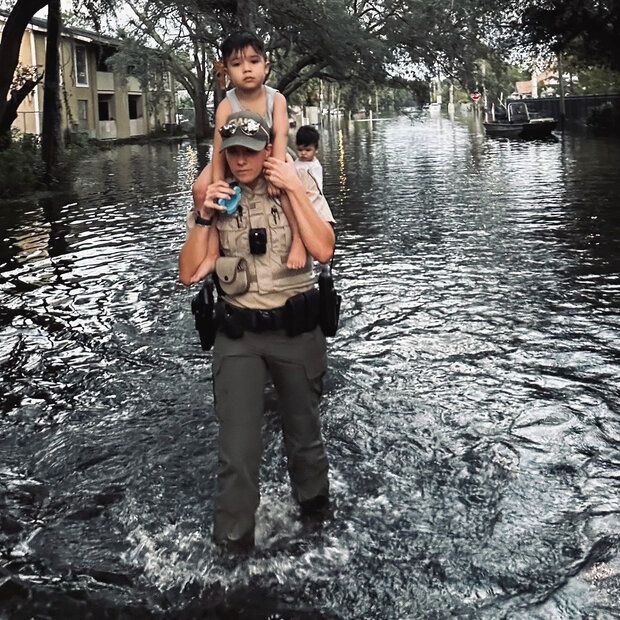
Credit Florida Fish And Wildlife A new study published in Proceedings of the National Academy of Sciences argues that the record warmth was entirely consistent with expectations on a warming planet. When accounting for human-caused warming alongside natural climate variability like El Niño and La Niña climate patterns, the 2024 temperatures actually showed that climate models today are capturing the ongoing warming of the planet well.
Research from climate scientist Michael Mann, Presidential Distinguished Professor of Earth & Environmental Science, and colleagues vindicates climate models and reframes the record heat of 2024.
To counter the sensationalisation of climate science reporting, which can sometimes lead to ‘doomist’ narratives’ which in turn ‘freeze’ public and political action, Mann wants to rebuild trust in the complexities and nuances of science.
‘The truth is bad enough’
Mann commented, ‘Overstating the mystery of events like 2024 feeds the narrative that scientists are either hiding something or don’t know what they’re doing, neither of which is true. The truth is bad enough. We don’t have to invent or exaggerate the gravity of the climate threat to establish the case for urgent action.’
With global temperatures reaching a new high in 2023 and 2024, and with 2024 being declared the hottest year on record, Mann felt that some scientists appeared to be suggesting that this warming was inexplicable, or that the warming was outside what climate models had suggested. He argued, ‘That framing is unfortunate,’ he says. ‘It makes it sound like we don’t understand what’s driving climate change.’
Mann and his team used a modeling technique that combined real-world temperature observations with climate model results to generate 40,000 synthetic climate simulations, essentially creating tens of thousands of alternative versions of climate history. Mann calls this a sort of “climate multiverse,” where human-caused warming remains constant across all simulations, but unpredictable events like El Niño and La Niña get randomized.
The simulations showed that 2024’s record-setting heat was far from an anomaly. When accounting for human-caused warming, the researchers estimated it had roughly a 12 percent probability of occurring—in other words, it could be expected to occur on average once in eight years.
‘There has been a lot of discussion recently about whether the extraordinary warmth of that year means something unexpected is happening in the climate system, including suggestions that models can’t explain what we’re seeing,’ says co-author Xueke Li, an assistant professor at City University of Hong Kong who was formerly a research associate at Penn. ‘Our results show that recent record temperatures would have been extremely unlikely without human influence—but they are entirely consistent with expectations from global warming.’
‘A strong vote of confidence in climate science’
The findings offer a strong vote of confidence for current climate models, which have long incorporated the warming response to human-generated carbon pollution as a core input. Mann says the results are a clear signal that human-caused warming is now the most dominant force shaping our climate—without it, he notes, those temperature highs from two years prior would have been essentially impossible.
‘One of the most important conclusions of the paper is that climate models are doing their job, at least when it comes to the overall warming of the planet,’ Li adds. ‘Rather than contradicting climate models, the 2024 temperature spike—and the ability of the models to explain it—actually reinforces their credibility.’
The paper published today reinforced that climate models were a sound basis for climate policymaking and found no evidence for any departure from expectations of typical natural climate- that there has been no ‘unexpected surge’. ‘Our results show that recent record temperatures would have been extremely unlikely without human influence—but they are entirely consistent with expectations from global warming.’
The paper concluded, ‘Recent record warmth, in conclusion, does not contradict state-of-the-art climate model historical simulations and future projections of GMST. Such models continue to provide accurate assessments of planetary warming and a sound basis for climate policymaking.’
Urgency and Agency
Mann also argued that the same climate models that flag risks of rapid ice sheet disintegration or prolonged heatwaves, flooding and droughts, also point toward a reason for hope: ‘One thing the models tell us with greater confidence now is that the warming of Earth’s surface will cease shortly after we reduce our carbon emissions to zero. There’s urgency, but there’s agency, too.’
Will the 2024 record be broken soon?
Those models also point to what’s coming. Forecasters currently estimate a 60 to 70 percent chance of a new El Niño emerging in mid-2026. ‘When—not if—another big El Niño happens, we shouldn’t be surprised when the 2024 record is broken,’ says co-author Byron Steinman, a professor at the University of Minnesota Duluth. -
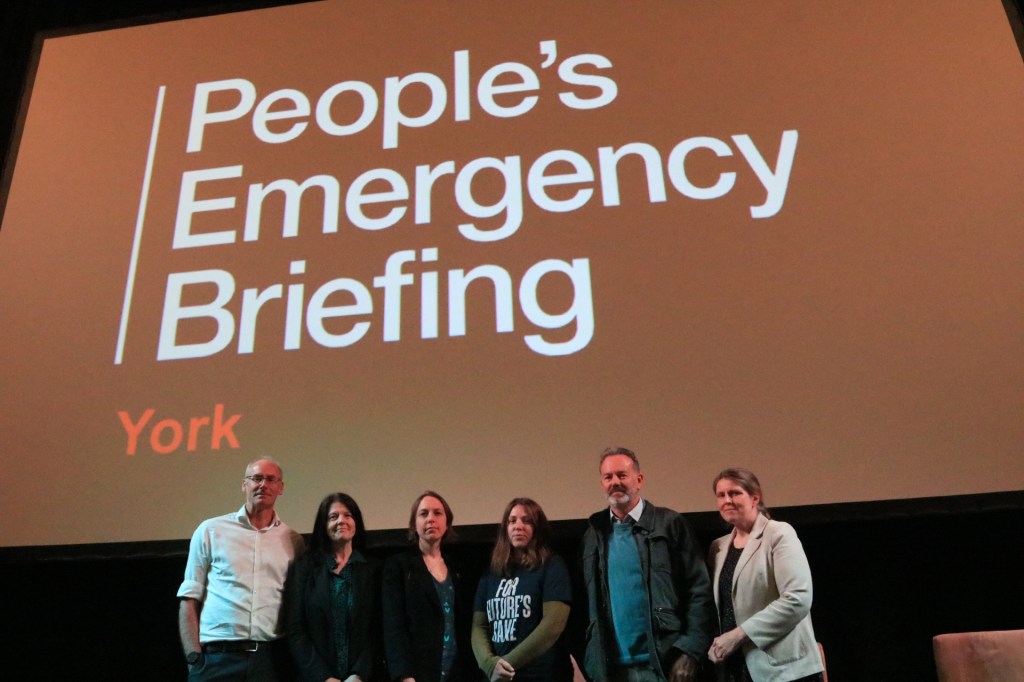
Politicians and public attend Climate Emergency Briefing in York
Credit Sophia Chen
Chris Packham: ‘You must listen to the science. Because if you don’t, then things go wrong and lives are lost.’
A dynamic and purposeful viewing of the National Emergency Briefing took place in York yesterday to a packed Tempest Anderson Hall. Over 850 screenings have now taken place around the country, from church halls, to community centres to festival pop-up screenings with the aim of promoting public awareness of the extent of the climate crisis and an appropriate response. All that remains is for the Government to respond to the public pressure and make a televised National Emergency Climate Briefing to the public in a prime-time slot. Barely 100 MPs and members of the devolved assemblies have openly signed for such a televised event and as viewings around the country grow, the hope surely is that the inevitable will follow.
York Climate Connect organised this latest climate viewing, followed by a productive discussion of how people responded to the viewing. Various panellists attended ranging from the political, educational and community spheres. It was particularly notable that Rachael Maskell, the MP for York Central made a point of attending, as decision- makers and policy makers need to be fully informed of issues and crises which will impact their constituents. Sadly, only about a third of MPs attended last year’s successful National Climate Briefing in Westminster Hall.
Rachael Maskell commented, “As we face a growing national emergency, it is important that we are all aware of the risks facing us, which is why the National Emergency Briefing initiative is so important. The positive focus of the briefing helps us all to look forwards and understand that the efforts we make now can help our future. During my time as an MP, I have consistently championed work on the environment and the future of our planet and will continue in this endeavour to improve the future for all in York Central.”
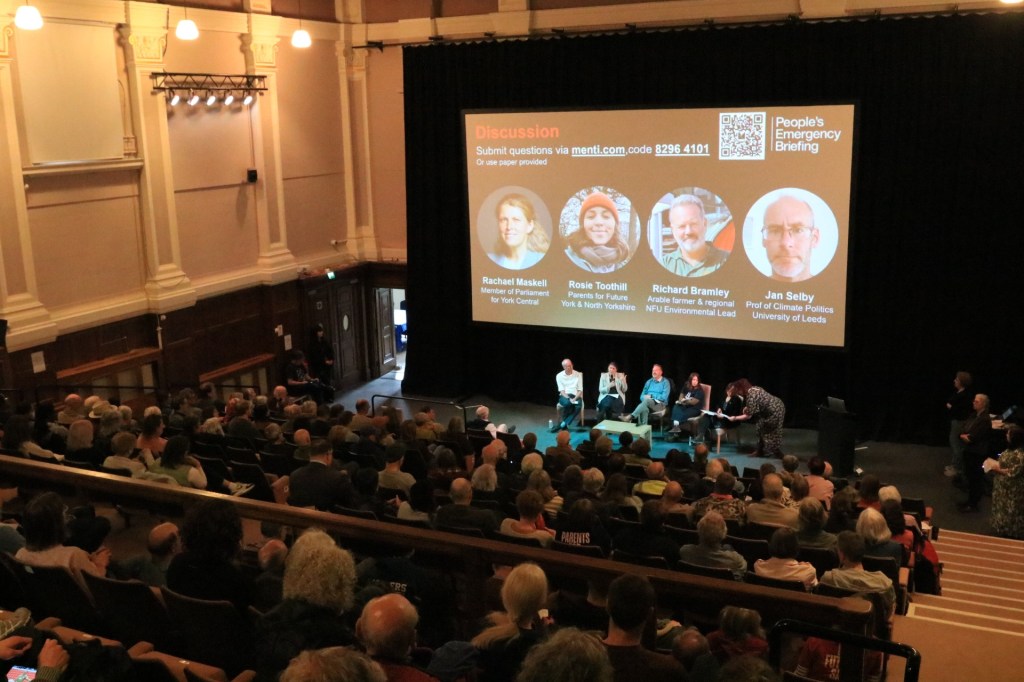
Credit Sophia Chen
A ‘compelling case’ for climate action
Professor of International Politics and Climate Change at the University of Leeds, Jan Selby, was also a panellist at yesterday’s event and commented, “The briefing makes a really compelling case for why we need to accelerate action on climate and nature now, before it’s too late. Watch it! And then act!”
Leading environmentalist Chris Packham openly called for more awareness to continue to break through with the public. “I’d encourage people everywhere to attend a screening. It creates exactly the kind of honest local conversation we now urgently need, both about what these changes mean where we live, and about what we can do together to address them.”
In comments last year to parliamentarians, he added, ‘We must be able to know what is really going on, and none more so than many of you. Those that we have elected to represent us, to guide us, to protect our future. You must listen to the science. Because if you don’t, then things go wrong and lives are lost.’
‘The public deserves the truth’
Rosie Toothill, from Parents for Future, voiced her concerns as a parent for the state of the planet Earth for her children. “As a parent of 2 young boys the reality of the climate crisis really scares me, which is why I am a member of Parents for Future, and why I believe the National Emergency Briefing is such an important campaign. I really believe the public deserves, and must know, the truth of what we face within years, if we do not tackle the climate emergency, and demand stronger action from our leaders. But also more importantly that the public and local community within York know there is so much that can be done, especially when we act as a collective.”
Over 200 York residents and visitors made a point of giving up their free time on a Saturday afternoon to be more proactive in the fight against the climate disinformation which seems to deluge social media sites. Climate disinformation which is then spread by populist politicians, simply intent on continued support from fossil fuel companies and interests.
The calls for a national televised event are growing and politicians who wish to be leaders and not followers, will surely amplify these calls, until what seemed like an impossible task- to have a televised emergency briefing- becomes inevitable.
-
Review of ‘Climate Wayfinding: Healing Ourselves and the Planet We Call Home’ by Katharine K Wilkinson
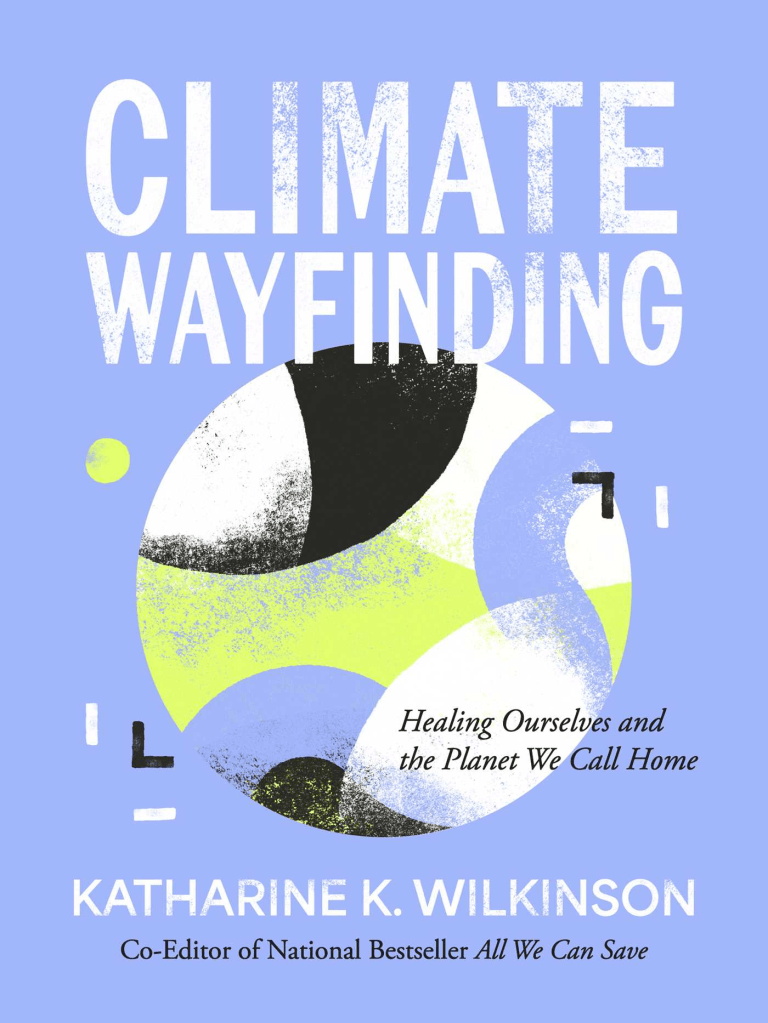
Wilkinson’s book crackles with purpose and the potential of what might be possible. It reminds us that there is a ‘we’ at the heart of this journey and that we are bound and bonded by a common framework of humanity.
‘Climate Wayfinding’ is a book which encourages- even demands- time for reflection; time for strengthening those links with others; and time to breathe. As Wilkinson notes, ‘Climate Wayfinding is about finding our way forward and conjuring the future, yes. But it is also about remembering.’ It offers a map to guide us on our future, a map, which until now, did not exist.
The book acts as a guide, to help navigate questions about identity- about who we are, about whom we impact and about why we care about the issues we care about. ‘What does it mean to be human, here and now? To help tend to a changing planet? To devote ourselves to the genuinely common good? What futures can we dare to dream?’ It is purposefully a meditative book, which asks us to gently confront our position on the path and to look around to work towards a positive, potential future. ‘We need to look inward with care, look outward with curiosity and then look forward with courage.’
Wilkinson does not shy away from the fact that many peoples around the world are already facing climate breakdowns and injustices. ‘All of it is happening in a profoundly unequal world, with those who are already in jeopardy or facing injustice, and who have scarcely contributed to this crisis, suffering most. Our new troubles inflame existing ones.’
Based on first impressions, ‘Climate Wayfaring’ may appear to some as being a superficial pathway, as being a gentle approach, when more direct action is needed. The book, however, reminds us that there is a strength and a power which comes from looking at the world which we care about with love. ‘I long for climate healing motivated not from wanting to fix something but from wanting to love something’
We re-learn that each one of us is not an isolated ‘cell’, but instead part of various networks and communities, which spread out from us and are a part of us. ‘Each of us is a node of possibility for healing the climate crisis— whoever we are and whatever we’ve got to give.’ We are not one identity- we are many- from being a child, from being a parent, from being a volunteer, a sports coach, part of a tennis club, a neighbour, a friend, a carer or a stranger. We are multi-faceted beings, with strong bonds to each other and the world. ‘When facing a planetary crisis, as with a personal one, it’s best not to go it alone.’
‘Climate Wayfinding’ unashamedly puts people at the heart of its strategies, concepts and narratives and warns that a ‘peopleless approach’ risks missing the opportunity to bring people along on the journey. ‘Because if the problem of climate change originates in human activity, then planetary healing must as well.’ Wilkinson puts her reader at the heart of her text and reminds us of our awesome power to effect change. ‘So much about our world is out of your hands and mine, yet potential also sits right at our fingertips.’ She celebrates Dr. Elizabeth “Beth” Sawin, who said, ‘The bottom line is this: You write in order to change the world, knowing perfectly well that you probably can’t, but also knowing that literature is indispensable.… The world changes according to the way people see it, and if you alter, even by a millimeter, the way a person looks or people look at reality, then you can change it.’
Wayfinding or Wayfaring?
Curiously, there has been an unconscious subliminal ‘error’ which has crept in whenever I have written the title of this book for this review. Far too often, I have written ‘Climate Wayfaring’ instead of ‘Climate Wayfinding’ and there may be something worth exploring in this slip. How we travel, and how we fare on the path are of equal importance
Wilkinson concludes by acknowledging the limits of ‘Climate Wayfinding.’ That the path continues on and on, opening up new futures to travel. ‘Climate Wayfinding’, then, cannot bring us to a final terminus or clear conclusion, and it shouldn’t try to. This chapter of life is reminding me, viscerally, that the act of finding our way will only continue to open.’
She finds great solace from her belief that we are equipped, curious, and ready for the path ahead, that we all have a part to play and decisions lie ahead of us. ‘We are built for the necessary work of our era. We have within us a seedbed of narrative, imagination, and navigation. We have within us a seedbed of the world we want to grow.’
When facing climate breakdown and considering that the problem is too great, it is fitting to remember the words of Tolkien and to gain comfort and strength in the thought that maybe, maybe we are meant to be the ones who are here- to be alive at this time, in this place, with our powers to change the world for the better.
“I wish it need not have happened in my time,” said Frodo.
“So do I,” said Gandalf, “and so do all who live to see such times. But that is not for them to decide. All we have to decide is what to do with the time that is given us.”
-
NOT A SINGLE COMPLETED WATER COMPANY PROSECUTION FOR POLLUTION INCIDENTS IN LAST FIVE YEARS
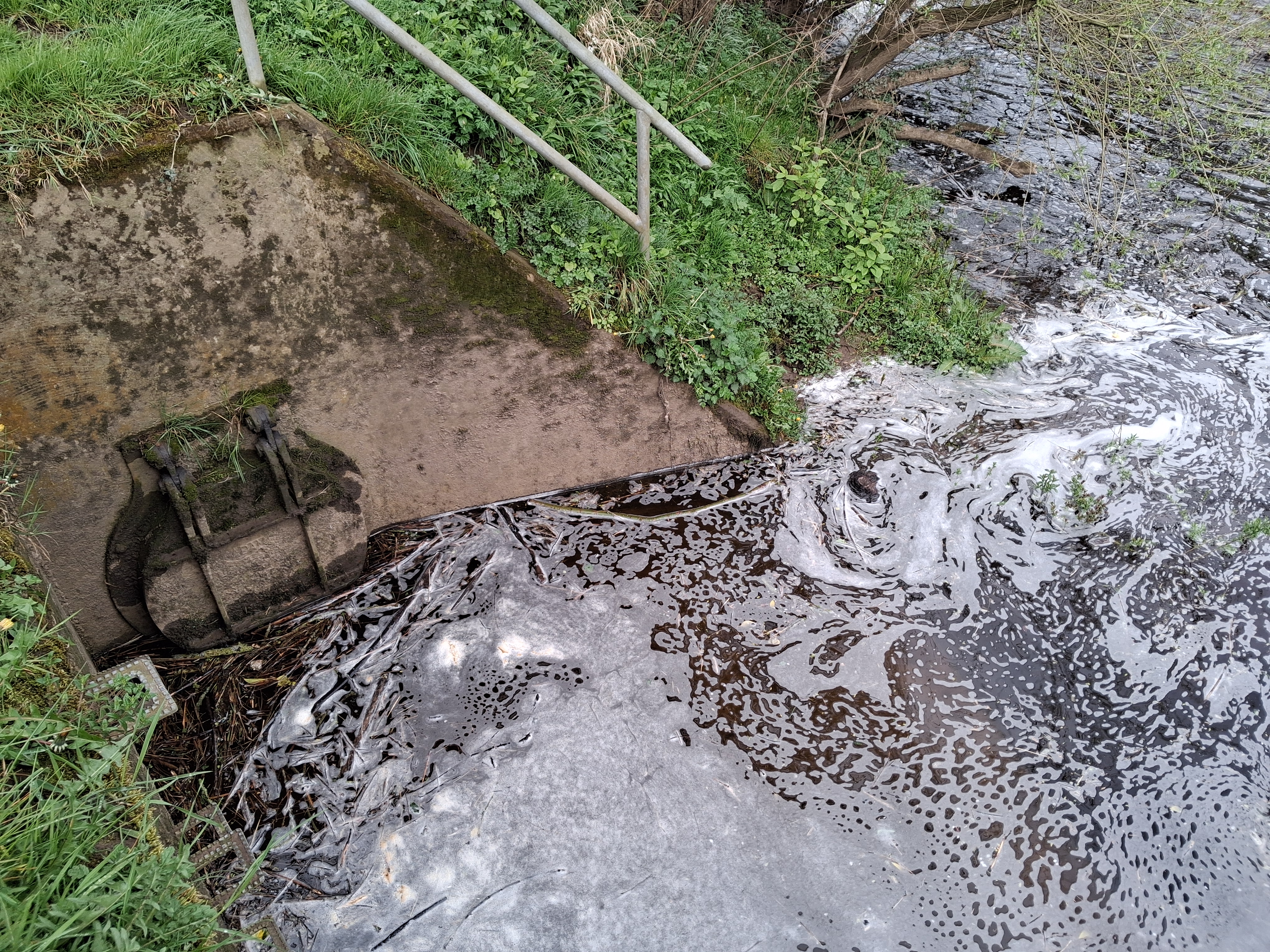
In yet another exclusive on pollution incidents, Channel 4 revealed last night (Wed 6th May) that the Environment Agency has not completed a single prosecution of a water company for any pollution occurring in the last five years, despite almost 2 million sewage discharges.
None of the completed prosecutions relate to the thousands of serious pollution incidents that happened since mid- 2021.
Channel 4 pointed out that while there have been examples of water companies facing sentences over the past five years, that every prosecution relates to incidents prior to mid-2021. The most recent water pollution incident to be successfully prosecuted was Welsh Water, who were fined £90,000 in 2024 for “exceeding permitted levels of sewage effluent” into the River Wye between August 2020-June 2021.
58 prosecutions out of 11,474 investigations
According to the EA’s own data, in the past decade there have been very few prosecutions. In a letter to parliament’s Environment Committee, the EA’s Chief Executive Philip Duffy said that between 2015-2025 there were 11,474 water company investigations, but only 58 of these resulted in a prosecution- a prosecution rate of just 0.5%.
Avoiding criminal convictions
The Environment Agency however, blamed the time for investigations to reach court, sometimes taking years, and they claim there is a viable, quicker alternative – the “Enforcement Undertaking” (EU).
Rather than face prosecution, undertakings mean water companies can offer to make payments, sometimes exceeding £1 million, to environmental trusts or charities to compensate for their offence.
But undertakings allow water companies to avoid criminal conviction entirely. By paying a charity for serious offences, they avoid a court appearance and are given ‘a get out of jail free card.’
Whistleblower Robert Forrester, an EA employee for more than 20 years, and who appeared in Channel 4’s recent docudrama “Dirty Business”, portrayed as a female Environment Agency employee who, like Forrester himself, leaked data to sewage campaigners, commented:
“It’s not like these serious crimes aren’t happening. They’re actually happening more and more…[EUs mean] the deterrent effect is no longer there…It’s a way of avoiding the criminal system.’
A ‘Get out of Jail Card’
Feargal Sharkey, the waterways campaigner, who appeared on the Channel 4 broadcast, argued that the fines simply don’t work and that prison sentences should happen.
‘For water companies, it’s simply a get out of jail card. It’s a very cheap alternative to what actually should be the consequences for them.
What we need to change is the behaviour of these water companies. The fines don’t work. It’s time we actually started upholding the law and sending some of these directors and executives to jail.’
What we need to do is actually now demonstrate to these companies we are prepared to enforce the law as it stands to hold them accountable and to properly remedy the situation, not simply let them off with what effectively is a slap on the wrist.’
If we put one water boss in jail for 6 weeks, the whole industry would utterly transform itself at 9 o’clock tomorrow morning when those companies open for business.’
The whole thing is a sham and it’s an avoidance scheme by government. And, in fact, government now for me, have become as wilfully complicit in all of this as the Environment Agency, by knowingly, blatantly, deliberately refusing to enforce the law and letting these companies carry on this fraud and a criminal fraud against billpayers in England and Wales.
EUs are ‘a brilliant tool’
Defending the use of Enforcement Undertakings (EUs), Helen Wakeham, the EA’s Director of Water argued,
“They are a brilliant tool for the Environment Agency. In the past year, the Environment Agency secured £8.5 million for the water environment through enforcement undertakings. The reason why we use them is they are faster than criminal prosecutions, so a prosecution can take us years to bring to court and take up a lot of our time.”
She added, “We do take action on every water pollution incident report that we receive. Some of those are exceptionally minor, a handful are serious, and those are the ones that we investigate very thoroughly.”
However, a prosecution rate of pollution incidents of just 0.5% between 2015-2025 is not enough to fool the public into thinking that serious enforcement is happening.
Downgrading serious incidents to ‘minor’ problems
The Environment Agency’s rules state that they would not normally accept an EU for the most serious incidents of Category 1 and Category 2, but FOI data indicates the systematic downgrading of thousands of serious incidents to ‘minor’ problems, without even visiting the site where the pollution occurred.
Between 2016-2025, there were almost 6,000 examples of this downgrading.
Public interest not served by court trials
In a shocking admission, Water UK, which represents the water industry, told Channel 4 News: “The Government’s independent review of the water sector concluded that the public interest was not always best served by years of court proceedings. Undertakings can ensure faster accountability and deliver funding directly into the environment.”
With over 100,000 signatures on a referendum to bring the water industry into public ownership, it appears that the public do not take kindly to industry deciding what is in their best interest. Not when they can’t swim in rivers, seas and waterways, while pollution incidents continue unabated.
UK Government has no intention of nationalising water companies
The UK Government responded to this public petition, saying, ‘The Government has no intention of nationalising the water sector currently and does not believe that a national referendum would deliver faster improvements for customers or the environment. Any move to nationalisation would take many years to implement, involve significant legal and operational complexity, and risk prolonged uncertainty and disruption across the sector.’
-
Review of ‘The Fate of the World: A History and Future of the Climate Crisis’ by Prof Bill McGuire
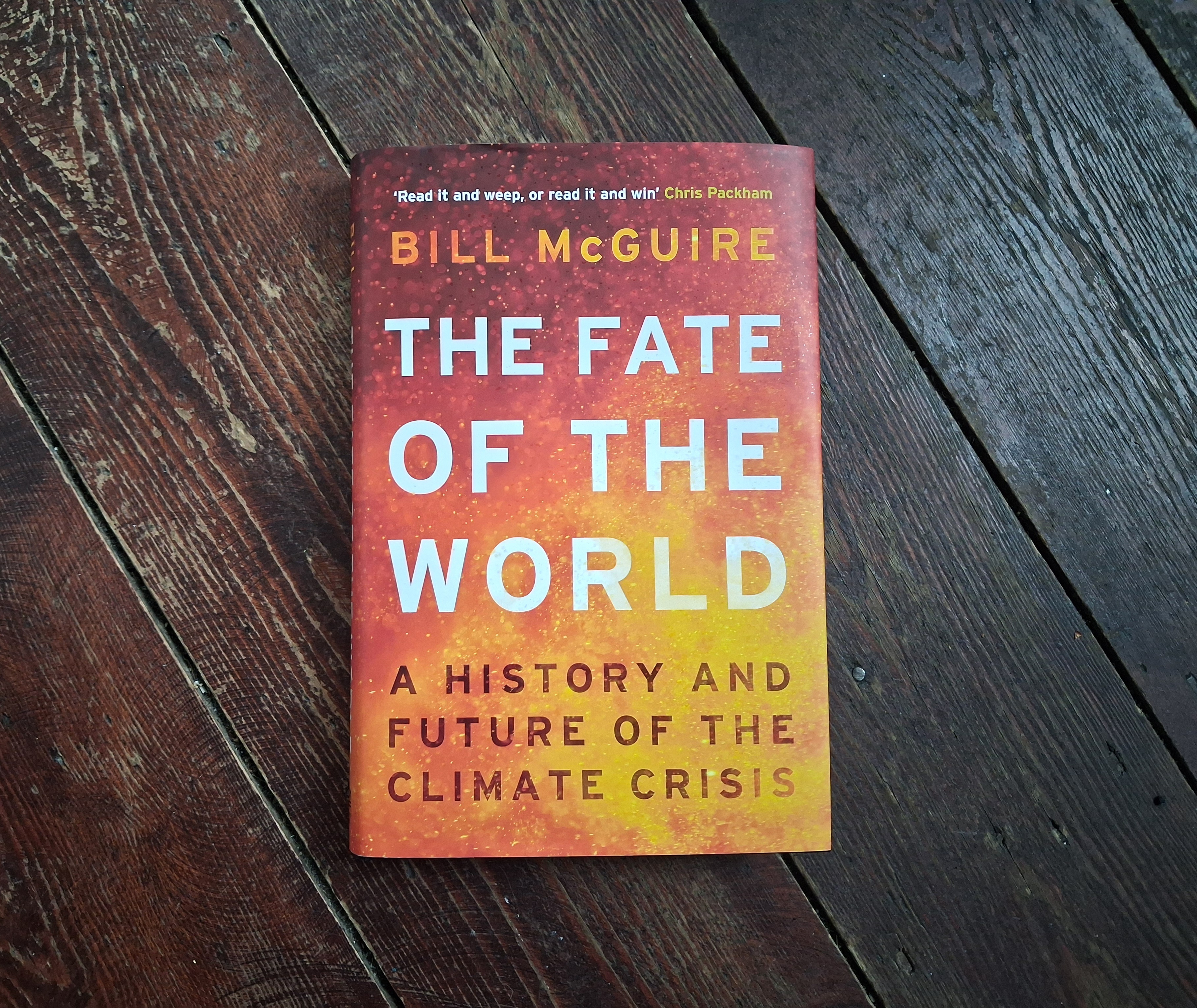
‘Tomorrow, and tomorrow, and tomorrow,
Creeps in this petty pace from day to day,
To the last syllable of recorded time;
And all our yesterdays have lighted fools
The way to dusty death.’
Shakespeare’s words, from over 400 years ago, seem shockingly relevant today, as we face an existential climate crisis, but we witness no real decisive climate action. We have been brought to this moment- we are the ‘lighted fools’- and appear to have learned nothing from the lessons from our ‘recorded time’.
McGuire’s ‘The Fate of the World’ offers a comprehensive and thorough lesson into our planet’s deep geological time and warns that our climate conditions are close to matching those of the last interglacial period- the Eemian- and could even match the Pliocene conditions, last seen on this planet over 2.5 million years ago. A prehistoric future which needs to be avoided.
Make no mistake- this is a challenging, difficult, and relentless read. On the other hand, ‘The Fate of the World’ should be a necessary and compulsory read, if we are to change the looming future. It is dedicated ‘To all who come after us’,and they will inherit our Earth. What that world looks like then will depend on our actions now. ‘Never have the actions of one generation meant so much for those that follow.’
McGuire urges us to be good ancestors and shake off the short-term shackles which are keeping us prisoner to the fossil-fuel status quo. ‘Yet future generations have no say in what actions we take today, nor do those making decisions in the first quarter of the twenty-first century have to live with the worst of their consequences.’
McGuire does not shy away from giving blunt scientific assessments and his expert climate views are important if we are going to change our current trajectory of economic and capitalist ‘business as usual’,while the planet burns. Or as McGuire comments, ‘It is an insane situation, and it can’t go on.’
McGuire’s ‘history book about the future’ then, details the scientific arguments about the impact on our world of our Sun, how what we see as a ‘constant’ has been anything but in its life cycle, and still has a future of its own to complete. He discusses the varying levels of carbon in the atmosphere over the life of the planet; how the planet has witnessed deep freezes and incredible oceans; how the Earth remains restless, while still giving humans the ‘Goldilocks’ conditions we need to survive, by its place in the solar system; and the real risks involved by a weakened AMOC. ‘It is no exaggeration to say that what happens to the AMOC will play a huge role in determining the course of future climate breakdown.’
McGuire notes and acknowledges that species rise and fall on our planet is inevitable and that humanity’s ego and arrogance is a dangerous combination. ‘Something like three-quarters of a billion species of animals, plants and fungi are thought to have existed since life first emerged on our planet, of which 99.9 per cent are now extinct.’
‘There can be no doubt that our beloved planet, as we have come to know it, is in deep, deep trouble.’
Extreme weather events around the globe are certainly causing people to realise that something is out of kilter; that our world today is different from that of 50 or 100 years ago. Droughts, floodings, wildfires, extreme heat and sea-level rise are all adding up to a world on the move- desperate to escape climate conditions in their own environment. Climate migration will become a more familiar term in the coming decades. ‘2024 was not only the hottest year on record but probably since the last interglacial period 125,000 years ago. And it won’t stop there. The truth is that, as global heating continues to flourish, 2024 will eventually prove to be one of the coldest years of the twenty-first century.’
McGuire quotes a 2020 report by the Geological Society of London, which stated, ‘The current speed of human-induced CO₂ change and warming is nearly without precedent in the entire geological record.’ An unbelievable indictment of humans as ‘conscious accomplices on the journey towards our own demise.’ McGuire debunks the climate-denying tropes that ‘the Earth has been hotter before’ or that ‘Levels of carbon dioxide in the atmosphere have been higher in the past’, by focusing on the crux of the climate issue- often deliberately missed by deniers- that the rate of change offers humanity little chance of adapting to a new world. ‘And this is the crux of the climate emergency facing us today- not the absolute temperature, nor the level of carbon dioxide in the atmosphere, but the staggering and unprecedented speed with which they are rising.’
The fires of Isengard
To enter into Tolkien’s world, the fossil-fuel fires of Isengard have been burning for far too long. The character of Merry warns, ‘The fires of Isengard will spread. And the woods of Tuckborough and Buckland will burn. And…and all that was once green and good in this world will be gone. There won’t be a Shire.’
McGuire does not go so far as to fall into the ‘doomist paralysis’ narrative. ‘Do we just give in? Absolutely not. The future unravelling of society will be brutal, but it doesn’t negate the need to fight today to keep every tonne of fossil carbon out of the atmosphere.’
He repeatedly urges that drastic global emission cuts can still make a difference to aid with climate resilience. ‘I haven’t completely lost hope, and neither should you. I did not write this book to dismay or dishearten, to foster panic or to feed inertia but to galvanise action to do what needs to be done: to cut emissions as fast as possible; to prepare for a new and much harsher world.’
He repeats this message throughout ‘The Fate of the World’, with his typical pragmatism. ‘All is not lost, however. If we take the urgent action required in the next few decades to rapidly row back on emissions, it may yet be possible to dodge PETM or early Eocene conditions.’
He acknowledges that the will to act quickly, sadly still lies in the hands of politicians and world leaders and that collective action is still sorely missing. ‘We have the means within our grasp- even at this late stage- to head off Armageddon. But we lack the collective will to do what needs to be done.’
‘No fate but what we make’
The map of our world has been redrawn in the past and will be redrawn again in the future. With a best estimate for the global average temperature rise of 2.7℃ by 2100, based on current policies and actions, it feels that our fate has already been sealed.
As McGuire points out, we can no longer hide behind the shield of scientific ignorance- climate scientists have been warning us for decades of the likely track ahead if we continue to allow carbon emissions to rise unchecked. By now we need to ask, why are we doing this on purpose to ourselves and the planet?
‘We can no longer pretend to be sleepwalking into climate catastrophe. We are doing it consciously, with our eyes wide open, and hang the consequences.’
But.
Our future- our fate- is not yet carved in stone.
We can still be a great people, if we wish to be. Our path has been lighted from the past and we now have the light to show the way to climate justice and climate resilience for all.
We all now get to write ‘The Fate of the World’ ourselves. We carry the fate of us all.
-
Europe is warming more than twice as fast as the global average

Image credit Saiyna Bashir European State of the Climate report provides comprehensive overview of climate indicators
Findings released today from European Centre for Medium- Range Weather Forecasts (ECMWF) and the World Meteorological Organization (WMO) highlight key changes in climate indicators for the world’s fastest warming continent. A range of factors are addressed in the report ranging from cold environments, marine ecosystems, the threat to biodiversity, wildfire risks and glacier loss.
The European State of the Climate report, highlighted that, ‘At least 95% of Europe experienced above-average annual temperatures in 2025.’ It highlighted that the sea surface temperature is the highest on record and that the annual sea surface temperature for the European region was the highest on record, and 86% of the region experienced at least ‘strong’ marine heatwaves.
Unequivocal climate change signals
Dušan Chrenek, Principal Adviser for Digital Green Transition at DG Clima, said: “The climate change signal remains unequivocal across Europe, and the European State of the Climate 2025 report is a stark reminder that we must sustain and accelerate both adaptation and mitigation efforts. This edition provides compelling evidence of the profound impacts of climate change on intensity of extreme weather events, biodiversity and economy, while reinforcing Europe’s strategic ambition to further strengthen its Earth observation capabilities by harnessing cutting-edge technologies.”
Fears are already building about the coming summer temperature for Europe, with a possible ‘super El-Niño’ developing this year. Increased temperatures put lives at risk, whether this is through wildfires, droughts, heat stress and flooding. Wildfires are already blazing in Britain, with Saddleworth Moor being one of the areas around Greater Manchester seeing recent blazes. The European State of the Climate report states that, ‘Wildfires burnt around 1,034,550 hectares, the largest area on record.’ With a long summer still ahead of the UK, more areas may be at risk, causing significant levels of damage and loss.
‘Climate change is our present reality’
Samantha Burgess, Strategic Lead for Climate at ECMWF, said: “The ESOTC 2025 paints a stark picture: the pace of climate change demands more urgent action. With rising temperatures, and widespread wildfires and drought, the evidence is unequivocal; climate change is not a future threat, it is our present reality. In confronting the impact on biodiversity loss, we need to match the speed of adaptation happening in the clean energy transition and at the same time, ensure robust science continues to underpin our policies and decisions.”
Rising wildfire risk is a key priority for the European Commission, as the IPCC indicates that wildfire threats are likely to increase across all regions of Europe.
Record marine heat and ocean warming
The report also noted the global ocean has absorbed about 90% of the excess heat caused by human-induced greenhouse gas emissions. In 2025, the European ocean region experienced its highest annual sea surface temperature on record, marking the fourth consecutive year of record warmth.
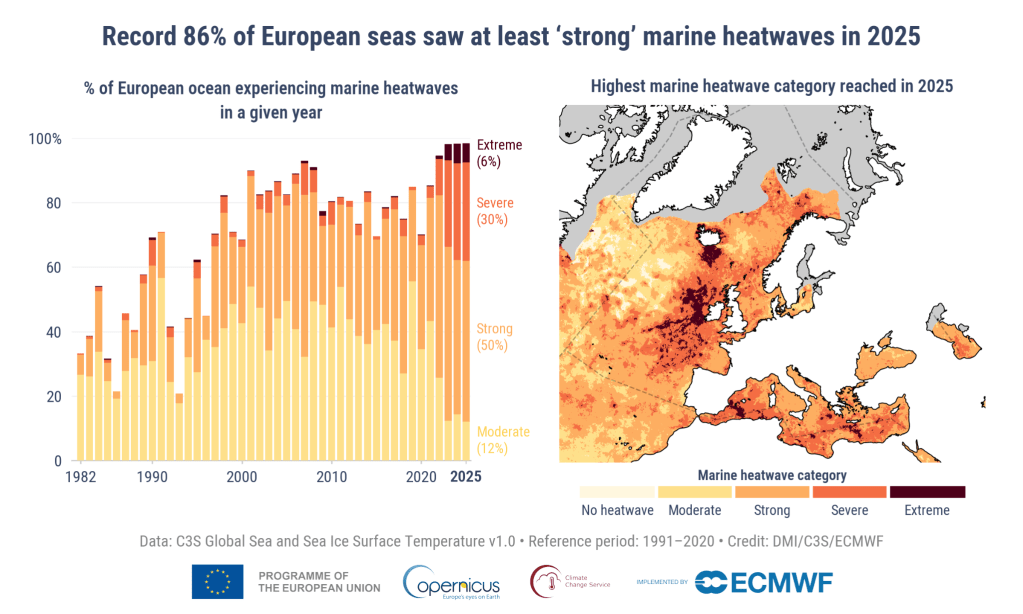
Percentage of the area of the WMO RA VI (Europe) ocean region experiencing marine heatwave conditions each year from 1982 to 2025
Celeste Saulo, Secretary-General of the World Meteorological Organization, said: “The WMO State of the Climate has revealed the imbalance of energy on our planet, and the European State of the Climate produced jointly by WMO and ECMWF reflects the impacts for Europe. Our joint effort to produce the ESOTC reflects how climate change is impacting biodiversity and the bold initiatives taken by European policy makers to protect and restore it.”
Climate indicators are flashing, but is anyone listening?
As well as wildfire risks and above-average temperatures, the impact on Europe’s glacier loss was also fully addressed in the report. Glaciers experienced a net mass loss, with Iceland recording its second-largest glacier mass loss on record. Additionally, the Greenland Ice Sheet lost 139 gigatonnes (139 billion tonnes) of ice – around 1.5 times the volume stored in all glaciers in the European Alps.’ With these ice losses, more people are exposed to water pressures, with every centimetre increasing exposure to an additional 6 million people to coastal flooding.
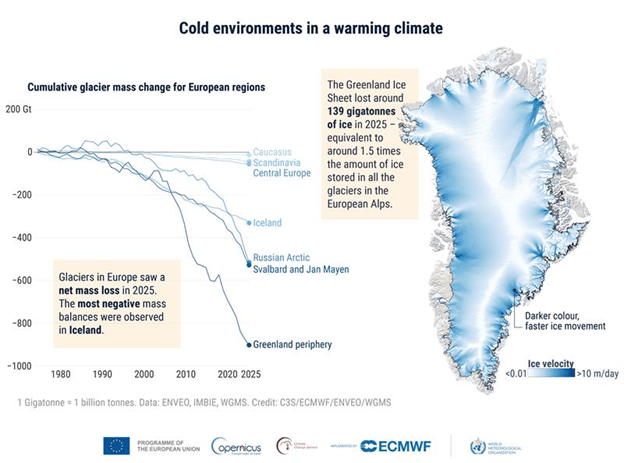
The impact on biodiversity
As well as the risks posed to humans, nature is also being placed under increased stress due to shrinking and shifting habitats, Sensitive ecosystems, such as seagrass meadows in the Mediterranean Sea and peatland wildfires are being impacted by the rising climate change indicators. Marine and terrestrial biodiversity is recognised as vital for a sustainable future, but is currently being degraded by climate change. European policies and frameworks strongly connect climate and biodiversity, with a clear focus on ecosystem resilience.
Informing policy decisions
Mauro Facchini, Head of Copernicus Unit at the European Commission, said: “The European State of the Climate 2025 report demonstrates once more the value of our joint efforts to have a world-class European Earth observation system. Maintaining our own state-of-the-art, reliable data records of our Earth system is vital for making informed policy decisions in our rapidly changing climate. Copernicus is pivotal to help us preserve our sovereignty, our environment, food systems, safety, and economy.”
-
CHANNEL 4 NEWS EXCLUSIVE: KING’S PRIVATE ESTATE TRIED TO SELL TOXIC LAND TO COUNCIL
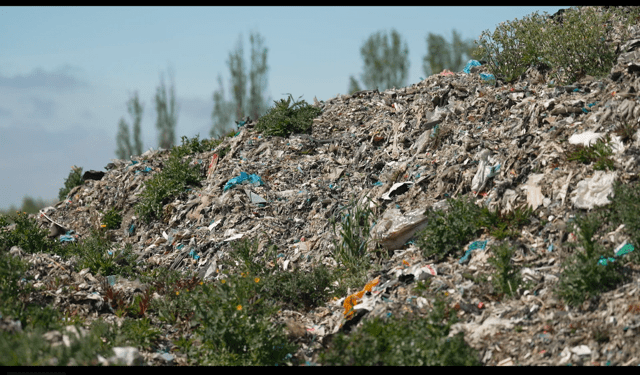
Image supplied by Channel 4
Channel 4 News has uncovered the King’s private estate tried to sell land contaminated with toxic illegal waste in Wigan to the local council.
In January, Channel 4 News revealed the 25,000-ton site, dubbed UK’s “most dangerous illegal waste dump”, was on land largely owned by the Duchy of Lancaster – the King’s extensive private portfolio of properties and estates.
When approached by the programme the Duchy said it had offered to transfer the land to Wigan Council in July last year.
However, correspondence between the council and the Duchy, obtained by Channel 4 News via a Freedom of Information request, to be shown tonight (MON) reveals it actually tried to sell the site to the council at full market price.
Then in February, after the Channel 4 News investigation aired, the Duchy followed up with the Council explicitly offering to transfer the land for free.
The Duchy wrote: “We have discussed the matter with the Duchy Solicitor who has confirmed the Duchy will transfer the property to the Council for nil value and with each party bearing their own costs in the hope that that will assist the Council in dealing with the property in conjunction with its own adjoining land.”
Initially, the council tried to keep the correspondence hidden from the public, rejecting the FOI request due to ‘legal privilege’. Channel 4 News appealed to its Legal, Governance and Election’s Division, eventually the council apologised and provided the documents.
Emails from the Duchy’s solicitors, Farrer & Co, show in addition to the transfer offer, the Duchy attempted to sell the contaminated land at market value to the council.
In July, the Duchy wrote: “… it may be possible to sell the land to you. Any sale would have to be at open market value and the Duchy of Lancaster’s valuers, and our costs would have to be paid as well.”
Wigan Council today (MON) told Channel 4 News it “respectfully declined” the Duchy’s offer.
Member of Parliament for Makerfield, Josh Simons, told Channel News: “My constituents have suffered for years because of this disgusting illegal waste dump, put there by organised criminals. The idea that anyone would profit from this land is disgraceful. The opposite should be true: everyone, no matter who they are, should roll up their sleeves to help solve the problem.”
Last month, Greater Manchester Mayor, Andy Burnham, told the programme that the Duchy’s plan to hand contaminated land to the local council is “not an acceptable response”. Since then, the government announced it will fund the clean-up of the Wigan site, although this has yet to begin.
A Duchy of Lancaster spokesperson told Channel 4 News: “We continue to work with Wigan Council to try and find an effective resolution to the illegal waste site.”
-
Subscribe
Subscribed
Have a WordPress.com account? Log in now.

