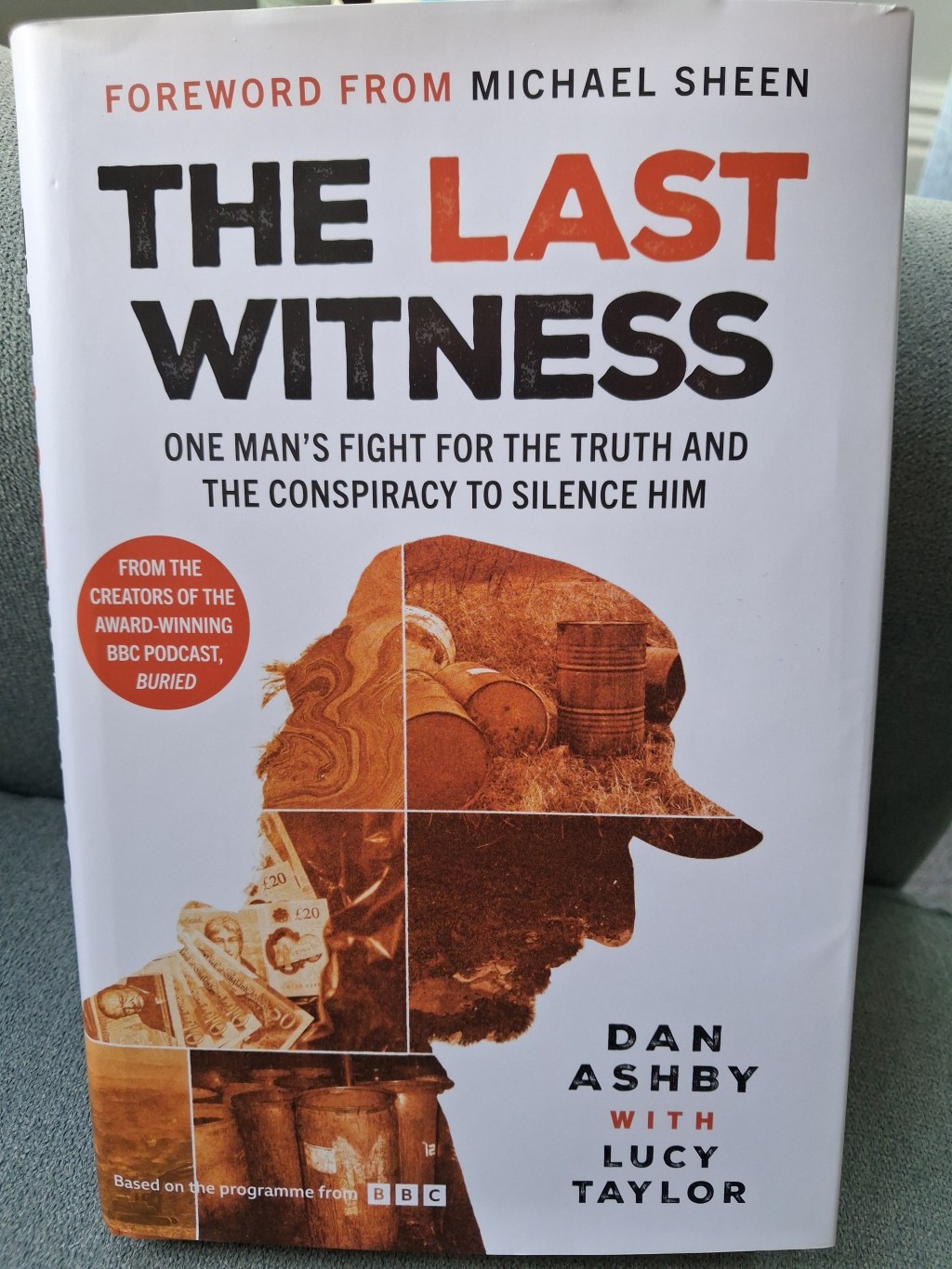
‘The Last Witness’ is a shocking account of Douglas Gowan’s struggle from the 1960s on to draw attention to widespread pollution of toxic chemicals in Wales. These chemicals were dumped by the giant chemical company Monsanto and contained dangerously high levels of PCBs. This book follows the initial podcast and the BBC documentary, ‘Buried’, as the investigators, alongside the actor Michael Sheen, attempt to separate the facts from fantastical fiction, to discover what historical risks and impacts there were to communities, as well as ongoing health risks and concerns.
As Sheen comments, ‘Douglas’s story is also the story of our times. Tens of thousands of tonnes of the chemical in question are buried all over the UK. And more than seven million forever chemicals are in production right now. We must all understand what is happening, because a crisis is unfolding that touches every single one of us.’
That toxic chemicals were dumped is not in question. ‘The spot sampling from the farm had revealed that PCBs reached 50 parts per million in the water during heavy rain, and 20 parts per million in the soil.’ Brofiscin Quarry in Rhondda Cynon Taf, South Wales widely described as one of the most contaminated toxic waste sites in Britain. What is most concerning is that the pollution is not limited to one small area in Wales. As the authors, Dan Ashby and Lucy Taylor write, ‘The spread of PCBs is a global environmental catastrophe that will haunt the planet for hundreds of years. And yet, it is emblematic of a broader crisis that is unfolding. PCBs have given birth to more than 10,000 forever chemicals that lace our blood, food and drinking water.’ They draw attention to the ground-breaking (pun intended) work of the environmental group Watershed Investigation, which in 2024 uncovered that there are over 21,000 historical landfills in the UK, all potentially oozing toxic chemicals into natural areas, communities and even straight into schools. Their pollution map is freely available to the public and should be carefully checked, especially if anyone is thinking of buying a home in a different part of the country and is unaware of historical industries which operated there.
Ashby and Taylor chronicle that ‘Through the 1990s, scientists began to realise that Monsanto and other companies had either manufactured or dumped so much PCB that the chemicals had spread almost everywhere…By 2000, they were listed as among the ‘dirty dozen’ most dangerous chemicals in the world by the UN.’
They conclude their evaluation of PCBs by saying, ‘As far as environmental disasters go, the dispersal of PCBs and the birth of the forever chemical age is near the top.’
Other toxic examples from around the world are explored in ‘The Last Witness’, as the authors delve into the common-place practices of some chemical companies and their seeming disregard for safety. They follow the US example of Anniston, where Monsanto and its spin-offs agreed to pay out more than $700 million- the biggest settlement of its kind in history.
They follow Robert Bilott’s investigation into PFOA contamination in West Virginia and his exposure of the DuPont chemical company for its practices and reticence to be honest with communities. The town of Bentham in North Yorkshire, UK- home to one of Britain’s biggest manufacturers of fire-fighting foam- is also highlighted as a place where it was uncovered that the groundwater there had some of the worst forever chemical contamination ever seen in the UK- approximately 2,400 times over the EU’s proposed ‘standard’ level. The authors repeatedly ask in the text- what scandals lie all around without us realising?
They ask, is Britain covering up a chemical secret? And note that, ‘In 2007, the Environment Agency did the first-ever widespread soil testing around the country. It tested in more than 300 locations and found PCBs in every single one.’
The question of how many potentially contaminated sites exist in Britain and more importantly what councils and companies are doing to remediate the risk has a very chilling answer. ‘When Friends of the Earth asked Welsh councils how many ‘potentially’ contaminated sites existed in Wales alone, the answer came back as 43,000. Only 82 of the sites have officially been designated as ‘contaminated’.
Throughout the course of their investigation then, Ashby and Taylor conducted blood tests to discover the impacts on human health- they included themselves and Michael Sheen in these tests and the shock at those discoveries can be seen plainly in the documentary, ‘Buried’. Their results of PCB findings give rise to the question of how they could have become contaminated in a world where they have been repeatedly told that they are safe.
‘For years, decades even, governments have reassured us that the chemicals aren’t getting out at high enough levels to hurt local communities. Our blood results suggest otherwise.’
Ashby and Taylor did not conduct this investigation with blinkers on. They were conscious throughout that their star witness, their ‘last witness’ , had a difficult relationship with factual events and evidenced events and they acknowledged that openly. They are also conscious that it was a useful campaign from Monsanto to ‘play the man’ and not the ball.
‘So many characters and institutions in this story have blemished records and a complicated relationship with the truth, and Douglas was no exception.’
They close this chapter of their investigative work, by arguing that there is more to come. That other chapters and revelations are waiting to be written. We all don’t need to be Erin Brockovich, or Robert Billot, or Rachel Carson for that matter, but we do need to be informed- as our world is now in unprecedented territory.
‘In some ways, it is the tale of one eccentric gentleman against one poisonous pool that seeps into his beloved country. But it’s not really just that, is it? Douglas represents all of us, flailing around in the poison, while companies wash their hands and move on to the next product with scant regard for the environmental and human damage. We are living in a time of unprecedented mass production and unprecedented mass contamination.‘

