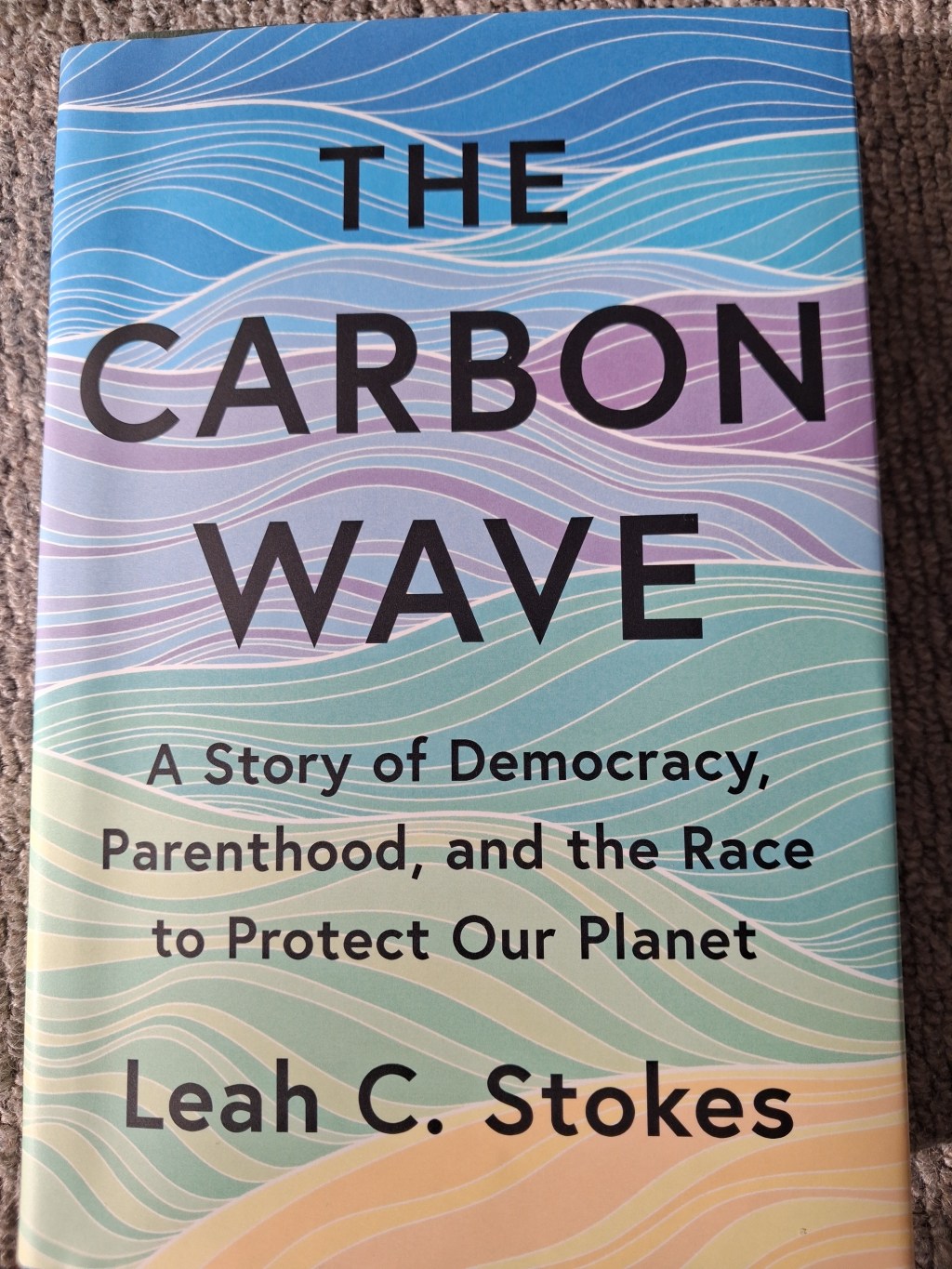
‘Climate change is not our destiny. Together we can change the future.’
It is important to read that again.
‘The Carbon Wave’ chronicles the story of how bold climate legislation in the United States was passed, but it does so through the lens of personal narratives of determination and sacrifice to leave the world a better place for our children. A vision especially shared by parents, but also by those who wish to be better ancestors.
Stokes’s narrative is focused on North American political manoeuvrings and negotiations, which may appear confusing to a UK audience, which do not necessarily align their identity so closely with political ideologies. The idea of challenges and difficulties with bipartisan bills, and the complexities and nuances of succeeding in getting a Bill passed, is perhaps an unusual one. Change the words, however, and it can be seen clearly that political action can often lag behind popular opinion and desire for change. Even when those climate changes, in the guise of extreme weather, are bringing hurricanes, wildfires and droughts, the political juggernaut can seem slow.
But the political system is made up of people and that is where the hope lies.
‘The Carbon Wave’ speaks to, and celebrates, the steely determination and dedication of many individuals, who worked on separate projects and pulled on different levers, but who collectively are part of the wave of climate policy writers and climate activists. What is more remarkable, is that all of these people working for climate policy and legislation, are not working in silos, like automatons- they are humans and are fragile. They put in incredible hours to drive climate policy forward, to work on op-eds and policy statements, conduct media interviews, and evaluate the financial funding for projects, all while managing somehow to balance pregnancies, young children and family life. Even when trees crash through their roofs in extreme weather, they don’t give up. Even when personal sacrifices become health issues, they don’t give up. ‘Pregnancy, childbirth and motherhood, and activism: all of it had started to catch up with me. My hands broke out in a rash. Then I started to have chest spasms, making it difficult to breathe.’ Adrian Deveny, Director of Energy and Environmental Policy for Senate Majority Leader Chuck Schumer, notes, ‘To be a part of these historic pieces of legislation, you put yourself on the line, and you make sacrifices because it’s important. It’s much bigger than you, and your needs, or your sleep.’
They understand that it is a mountain worth climbing.
Progress is being made and it is a real testament to those who move the wave forward, bringing a real truth to the words attributed to Margaret Mead- ‘Never doubt that a small group of thoughtful, committed citizens can change the world; indeed, it’s the only thing that ever has.’
Stokes acknowledges that change can be difficult against a financial behemoth like the fossil fuel industry, with their narratives of personal ‘carbon footprints’. She notes, ‘We have all too easily accepted the idea that we’re all to blame for the climate crisis.’ The delaying and denying playbook from the ‘merchants of doubt’ is a well thumbed strategy of manipulating the public. ‘It was 2007, and “carbon footprints” were all the rage. The claim was that we were each responsible for producing some amount of emissions, and we each needed to work, relentlessly, to reduce them.
No individual can reduce their carbon emissions to zero- no amount of personal sacrifice will do it. Until we get rid of fossil fuel infrastructure in every corner of our society, individual behaviour changes are mere nibbles around the edges of the problem.’
Instead Stokes champions that collective individual actions can come together in a powerful manner once we realise that our actions bring others along with us, and that it takes less than we think it does to get others to follow and hope. Her aim is summed up thus: ‘Let’s replace the carbon footprint with a new idea: the carbon wave.’
This ‘carbon wave’ could bring about the biggest climate changes necessary for a sustainable future, but it is incumbent upon us all to at least try.
‘We don’t yet know if we will be able to rip out all of the world’s fossil fuel infrastructure by 2050. But I know that it’s up to all of us- including you, the reader of this book- to try and make that happen.’
Stokes imagines a possible world where our collaborative approach as a species to solve the biggest threat we have faced, can be successful.
‘But this story is not just a work of history: it’s a reminder that we can and must join together to tackle the climate crisis. The choices we make now will determine our future.’
We have now been given a call in ‘The Carbon Wave’ – let’s get to work.
P.S. Carbon Brief is worth reading alone for the powerful testimony of Dr Stokes to senators.
‘I’d like to close by sharing something personal…I have two newborn babies that are two months old at home right now, and I have left them to come here and speak with you all because I know the urgency of this moment. I’m here not just to speak on behalf of my newborn children but on the behalf of all the children in the United States. I’m also here to speak on behalf of young people who are deeply fearful of what their future holds. And quite frankly, I’m here to speak on behalf of all of us, because we are already seeing what climate change is doing to the places and the people we cherish most. This is a pivotal moment in history. The world is watching. Either Congress will pass a bold climate investment package this fall or we will lose the last best opportunity we have and waste another decade. We don’t have any more decades to waste to act on the climate crisis.’

