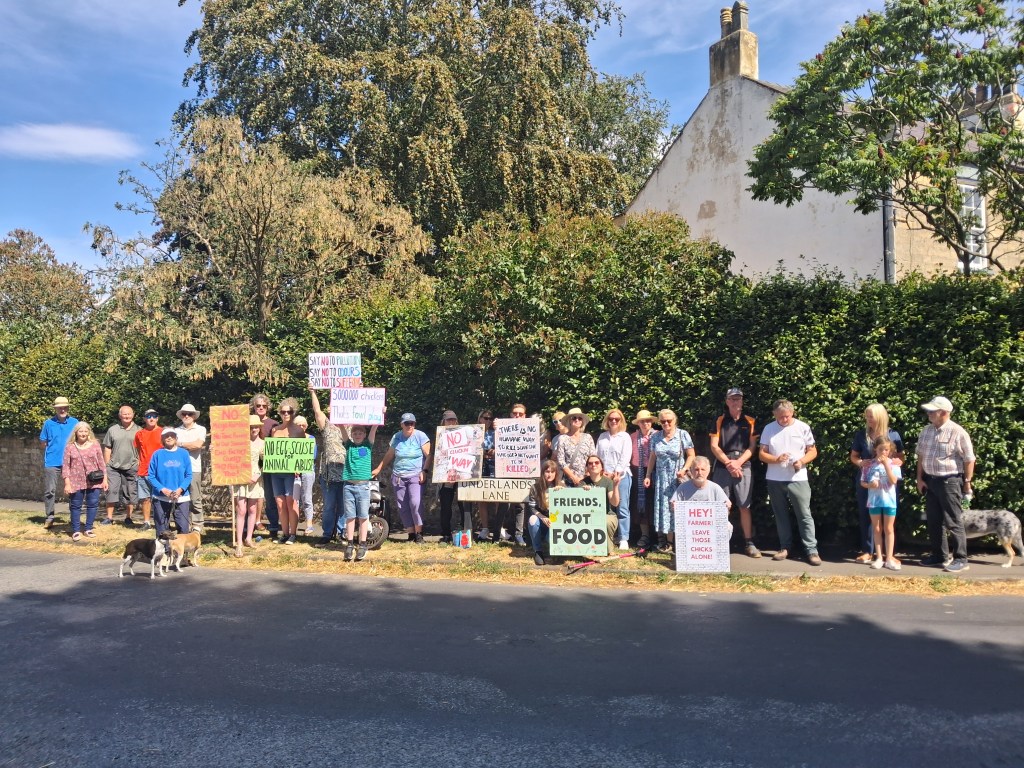
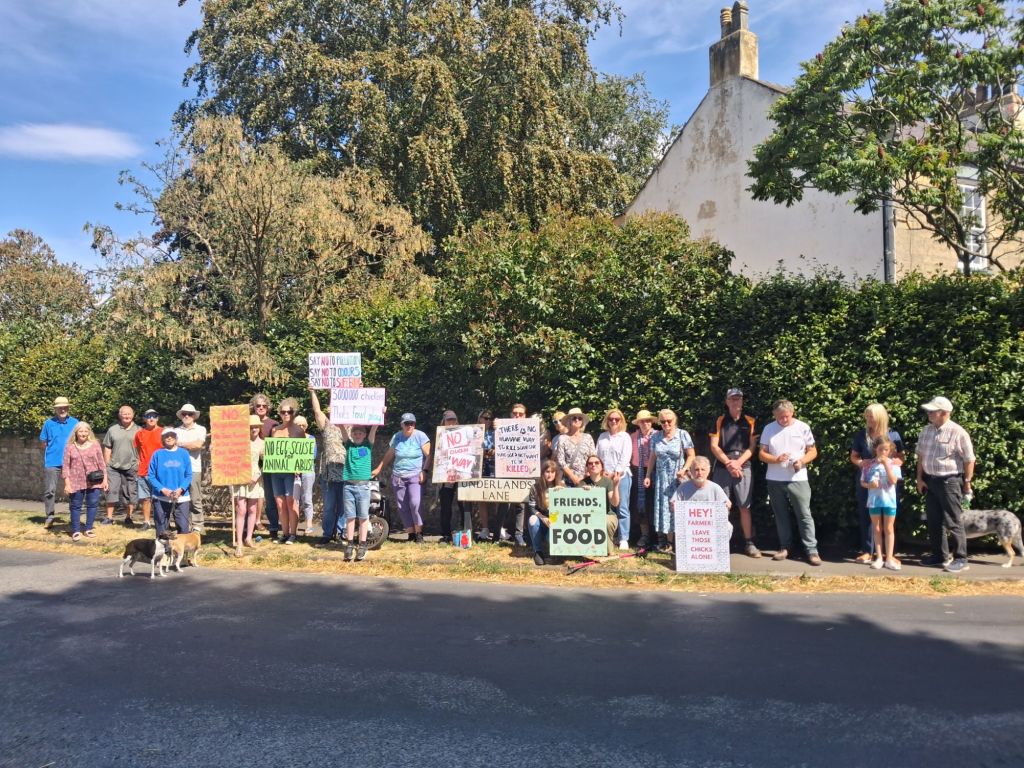
Local campaigners have today lodged a further objection to the 2.7 million chicken factory planned for the quiet village of Melmerby in North Yorkshire.
Their objection follows a revised form of the National Planning Policy Framework, published in August 2026, which according to the applicant, Forest Poultry Ltd, gives the green light for their proposal.
Forest Poultry Ltd have submitted a planning application to erect six poultry housing units, 126 metres in length, to produce approximately 2.7 millions birds each year. Each house would accommodate approximately 60,000 birds, resulting in a total capacity of 360,000 birds across the site.
Harrison Pick, the planners for the proposal, argue that the revised NPPF, under the section ‘Achieving sustainable development’ outlines a clear presumption for planning authorities in their decision-making in favour of sustainable development. They outlined their view on the public council portal saying,
‘Policy S5(1)(a) establishes that development for agriculture should be approved outside settlements unless the benefits are substantially outweighed by adverse effects. Agricultural development is the first category of acceptable outside-settlement development in the Framework. The presumption operates in favour of approval.’
They continued, ‘Policy E2(1)(b) requires that substantial weight be given to the benefits for domestic food production, animal welfare, and/or the environment that can be demonstrated through farm and agricultural modernisation. All three of those benefits are engaged by this application.
Taken together, the provisions of the August 2026 NPPF strongly support the principle of the proposed development. The framework establishes both a presumption in favour (Policy S5) and a requirement to give substantial weight to the identified benefits (Policy E2), while specifically endorsing improved livestock accommodation as a supported category of rural development (Policy E4). There is no conflict with any national policy provision that would require refusal.’
Benefits do not outweigh environmental impacts
A comprehensive and detailed objection however, published by the ‘9 Villages Local Group’, which highlights many inconsistencies and concerns with the application documents, argues that the development has not been shown to be sustainable and that therefore the presumption of the revised planning policies would not apply.
‘We conclude that the proposed IPU does not constitute sustainable development
because, when assessed as a whole, its economic benefits are not demonstrated to
outweigh its significant environmental and social impacts, including its potential
detrimental effect on public health as well as the taxpayers’ burden. The proposal
would permanently develop BMV Grade 2 agricultural land, a finite resource
important for food production, while introducing an industrial-scale poultry operation, that would generate additional ammonia, particulate matter including PM2.5, odour and noise, together with substantial HGV and other vehicle movements.’
The group highlights that sufficient mitigation has not been completed by the application and indeed is contrary to the principles aimed for in the revised National Planning Policy Framework.
‘The proposal therefore fails to demonstrate that its environmental and social costs can be satisfactorily avoided or mitigated, particularly in relation to BMV agricultural land, cumulative air pollution, biodiversity, and traffic impacts. Accordingly, the development would represent an unsustainable form and location of development, contrary to the NPPF’s sustainable-development principles and the statutory requirement under
section 38(6) of the Planning and Compulsory Purchase Act 2004 to determine the application in accordance with the development plan unless material considerations indicate otherwise.’
‘Serious deficiencies’
The ‘9 Villages Local Group’ also emphasise assessments in the application which they argue are inaccurate, each of which they claim would constitute a ‘serious deficiency’ and thereby supporting the argument that this development is not ‘sustainable’ and that the harms outweigh any benefits. These range from the detrimental impact on air quality, waste management and disposal, public health issues and biosecurity, and the UK food security.
‘The ES (Supporting Information, July 2026) contains a self-defeating ammonia
admission drawn from the Applicant’s own background figures; a CCIA that does not,
on its own evidence, satisfy the Finch test; it claims to meet waste management
strategy that depends on a power station whose operator has publicly stated its
future is in doubt because the Government’s Renewable Obligation Certificate
support expires in March 2027 and no successor scheme has yet been confirmed; a
food security narrative built on unsourced industry data, distorted percentages, and
an internal contradiction (a development justified by reducing imports that is itself
critically dependent on imported feed); no guarantee whatsoever that the product of
this development will serve the UK market it claims to support; a misapplication of
planning law in scoping out the loss of irreplaceable Grade 2 agricultural land; an
understated and undated period of severe visual harm to a public right of way; a
human health assessment that omits an entire recognised exposure pathway while
leaning on a permit that may not yet exist; fails to assess the human and
environmental impact of particulate matter; amenity safeguards that are managerial
promises rather than binding conditions; and a transport assessment that treats the
absence of historic collisions involving traffic that does not yet exist as reassurance.
Individually, each of these is a serious deficiency.’
They note, for example that the Thetford Biomass Power Station’s future is in real doubt.
‘The Applicant does not confirm whether Thetford Biomass Power Station’s continued
operation beyond March 2027 is secure. There is no evidence of a contract with
Thetford Power Station for the disposal of waste – nor any indication of the prospect
of one. If Thetford closes as predicted, this proposed site’s approximate 3,968
tonnes of poultry manure will presumably be at the back of the queue of Thetford’s
current clients searching for an alternative waste disposal route.’
The objection urges the Planning authority to ‘require the Applicant to provide a fully evidenced alternative waste disposal strategy that does not depend on the continued operation of Thetford and should commission independent advice on whether any such strategy exists at the scale required. The LPA would surely be justified in enquiring of the Applicant: “Where is all this poultry manure actually going to go?”
The campaign group further notes that the food security argument and narrative pushed by the industry ‘collapses entirely’, when the production figures for this site suggest a contribution of approximately 0.2% of national demand.
‘The facility would produce approximately 4,957 tonnes deadweight per year against UK poultry consumption of approximately 2.5 million tonnes per year (Defra, 2026) — a contribution of approximately 0.2% of national demand. It would not, on any credible analysis, make a meaningful dent in a national supply shortfall, and the ES makes no attempt to quantify its contribution in those terms. When the food security argument is tested against the Applicant’s own production figures, it
collapses entirely.’
What happens next?
North Yorkshire’s Planning Committee have two planned meetings later this year to discuss any proposals which appear on those proposals. It may be that this application for a 2.7 million chicken factory in the heart of North Yorkshire will prove to be a test case for the application of the revised NPPF. It should be noted that the same policy which Forest Poultry Ltd is relying on for approval for this development also open the door for any transport, energy, water and telecommunications infrastructure, therefore, solar farms, onshore wind farms and data centres could all be summarily approved, unless the benefits of doing so would be substantially outweighed by any adverse effects.
Those wishing to celebrate the proposed chicken factory would also be ushering in other energy infrastructure destroying remaining arable and green belt land in the country, or destroying the Best and Most Versatile agricultural land from productive use.
‘Sustainable farming practices’
Maya Pardo of Communities Against Factory Farming, told me that,
“The new National Planning Policy Framework makes it very clear that animal welfare and the environment are on the same footing as domestic food production – see policy E(1)(b). Councillors should feel confident that they can reject cruel industrial poultry units due to the poor welfare that will be experienced by the Frankenchickens, whose short five weeks on this earth are not a life worth living, in these animal factories.
“We’ve been warned by the government that animal farming at its current scale, which relies on soya imports from South America to make up 18% of animal feed, is a threat to national security. We’re importing over a million tonnes of soya every year to feed Frankenchickens in industrial sheds. Instead of expanding this harmful and cruel industry, food policy should focus on reducing meat production and supporting farmers to transition to sustainable farming practices to grow food for human consumption.”

