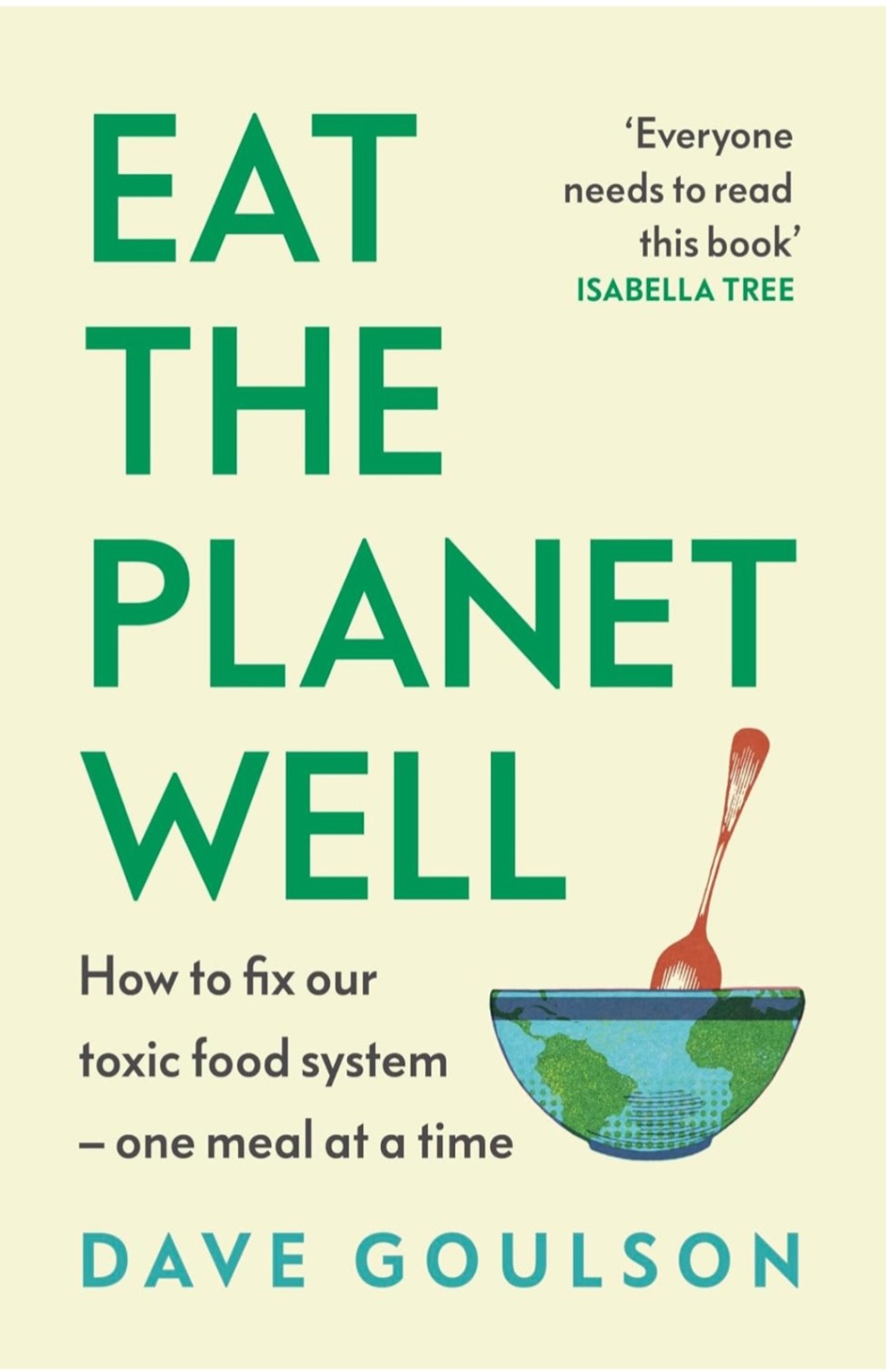
Certainly, I missed the parade of ‘Eat The Planet Well’ by Dave Gouson, when it was published earlier this year, and what a shame.
This is a delightfully informative book which takes the reader on a journey through our ‘toxic food systems’ and suggests a pathway, which is more than just a ‘faddy diet plan’, but instead one which works with the natural world to feed us in a healthy, sustainable manner.
This book is very timely, as we currently lurch from climate crisis to climate crisis, and more and more pressure is placed upon threatened ecosystems, whether through drought, floods, deforestation or government narratives which are not moving fast enough to fend off a greedy and profit-orientated food industry. As Goulson points out, ‘Our food system has become toxic: toxic to us, and toxic to our planet.’ He paints a shocking picture of our current world, a world where ‘soils have become degraded and lifeless; our rivers are awash with a toxic mix of chemical fertiliser, human and livestock excrement, pharmaceutical drugs, pesticides and plastics; landfills overspill with rotting food waste and used disposable nappies; our climate careens towards chaos.’
Goulson, however, is too shrewd to offer us a doom-laden scenario, without offering us individual choices which we can make. Here the book comes into its own- there is more emphasis on the individual consumer, indeed there is a chapter called ‘Don’t Wait For the Government’, which seems both sensible and appropriate. This is very much what the environmental and sustainability audience need- a reminder of the power of the individual and to quote Erin Brockovich- a reminder that ‘Superman Isn’t Coming’ and that we are neither hapless nor helpless, but active agents and stakeholders in our own stories, with the power of choice.
‘Eat The Planet Well’ effectively explores the nuance of complex systems, while tackling issues such as ‘Is Organic Food Healthier’, ‘The Rise of Ultra-Processed Food’, ‘Do Livestock Suffer?’. The chapters are packed full with concise factual information, with the repeated underlying message that this book is not meant to be a didactic one, but rather a book about family. He quotes Michael Pollan who echoed the idea of moderation,when he said, ‘Eat food. Not too much. Mostly plants.’ Goulson explains that by ‘eat food’, Pollan means eat real food– or as he puts it another way, ‘food that your grandmother would recognize’.
Goulson evaluates the trade-offs that consumers might balance, when trying to avoid foods which have been sprayed with pesticides, foods which are ‘greenwashed’ to look and be labelled healthy, and a confusing smorgasbord of accredited organisations which offer ‘guarantees’ that the food is sustainable or healthy. He understands the ‘grey’ between positions, that when the ‘Global Western’ world suddenly decides to cut off a product like palm oil, that there are direct impacts on local livelihoods elsewhere.
‘Even if one could somehow engineer a global collapse in the demand for palm oil, another likely adverse consequence would be the loss of thousands of rural jobs in low- income countries, and of millions of jobs involved in transporting and processing palm oil.’
Goulson is advocating informed choices and decision making from those who can. He cautions against the dangers of industry lobbying and media campaigns. He urges us to remember that ‘Perfect is the enemy of Good’ and that we can take action- a key area described in the book is that of food waste, which is somewhat in our control.
‘Overall, enough food is wasted in the EU each year to fill 3 million articulated lorries.’
He continues, ‘The scale of food wasted by households is staggering, particularly in the Global North. For example, in the UK we throw away 12 per cent of the food we buy, about 4.4 million tonnes, equivalent to 160 kilograms of food per household per year.’ He argues that from a household financial perspective, this also has the benefit of saving money, which could be used elsewhere.
The book is packed with details on the impacts of pesticides, GM crops, and meat and milk alternatives for those shocked by animal welfare conditions. In addition, Goulson gives many examples of places and ventures where sustainable eating and living work hand in hand with nature, rather than against. He applauds and advocates farms where ‘growing food sustainably means looking after the soil and working with nature.’
Goulson concludes the book with advice, which is well-known by now. And this is an important point- despite a powerful industry narrative against consumer choice- the path forward is agreed. Despite a powerful meat lobby, vegetarianism is becoming more popular, plant-based meals are more available and even lab-created food is here.
‘[M]ost of us should eat only a little meat and fish, less sugar and processed carbs, and more nuts, fruits and vegetables– is broadly agreed across the scientific community.’
Successfully tackling food waste, improving water use efficiency and finding more equitable means for the distribution of fertilisers amongst the world’s farmers can help us achieve a global food transformation, worthy of Norman Borlaug.
For a fast-paced 21st century world, where everything must be available all-year-round, slowing down would do us wonders. Working with nature, whether we have our own allotments or small window boxes, would help us re-connect with the world beneath our feet.
Goulson finally encourages us that ‘Wonderful food is out there’. He closes the book with many recipes and resources to help empower his audience to recognise food which is healthy, cheap and with a low environmental footprint. These are the real ‘super-foods.’

