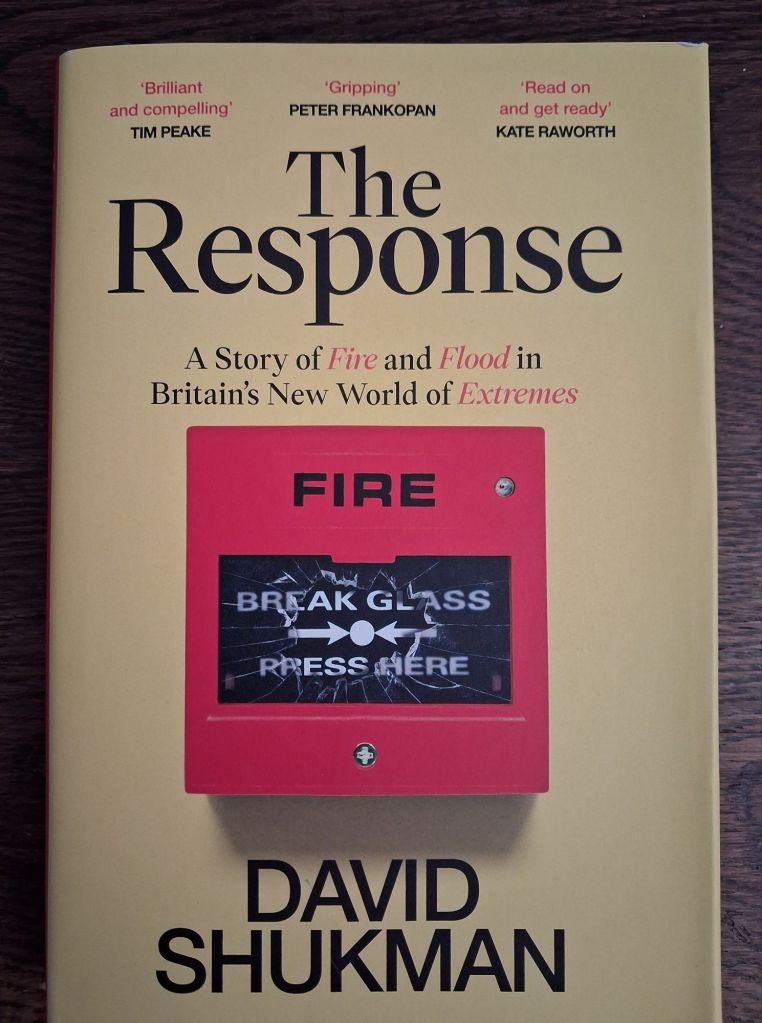
‘We’re not remotely ready to deal with the worsening conditions that are confronting us now, let alone those still to come.’
David Shukman’s book ‘The Response: A Story of Fire and Flood in Britain’s New World of Extremes’ opens with the stark message that the UK is far away from being resilient to the rising challenges of the climate crisis. From his reporting background, he has witnessed, and has been on the front line of, weather extremes over the decades. As well as detailing the experiences of those impacted by extreme weather, he offers ‘What if?’ scenarios- scenarios which once upon a time may have been unthinkable, but which now are emerging as potential catastrophes.
His scenarios may indeed become prophetic and to have had these warnings and for them to be ignored, while putting the public at risk, appears to be a dereliction of public duty from the UK Government.
Shukman repeatedly warns about the crumbling networks of infrastructure which underpin our safety and warns that network after network is no longer robust enough in the face of the rising climate crisis. ‘A new climate requires new thinking, not just about our bodies, but about our infrastructure too.’
He begins by drawing desperate attention to the rail network and how coastal tracks, which radioactive waste is transported on, are ‘increasingly coming under attack. Storms are strengthening, floods are becoming more severe and the level of the sea keeps rising.’
He warns about ‘minor problems’ which lead to a ‘cascade of failures that cause death and destruction’ and urges that responding to the dangers which are here and now prevents those risks becoming magnified in the future. ‘Too often we’re so preoccupied with looking ahead that we miss the reality of now. We don’t spare a glance for the state of the ground we’re standing on to check if it’s likely to collapse, flood or burst into flames.’
Wildfires and heat
Shukman then chronicles the lessons which ought to have been learned from the UK’s summer of 2022, when wildfires ‘ringed’ London and put incredible strain on firefighters. But for incredibly good luck and wind shifts, utter devastation was averted- how long the UK can gamble on good luck to escape with only a ‘near-miss’ is a dangerous gamble which puts us all at risk. ‘Wildfires are becoming more frequent and harder to contain. In England alone there are around 30,000 wildfires every year- most of them small and relatively easily dealt with. But the larger ones have doubled in number over the last decade.’ Shukman follows this statistic up with another shocking number. ‘[R]esearch by the Ordnance Survey finds that a mind-blowing 1.8 million homes in England are at risk from wildfire.
The alarming detail which emerges from this comprehensive overview of events is the lack of coordinated communication between the water companies and fire departments. ‘Pressure reductions’ by the privatised water companies were not communicated to fire departments, meaning that the flow of water could not be relied upon when needed most. ‘It’s bad enough knowing that more homes will burn under hotter skies. Even worse to think that there might not be enough water to save them and that the supplies, which are in private hands, might be reduced for reasons that are never explained.’
Widespread evacuations may have to be implemented swiftly, decisively and with public safety in mind. As Shukman argues, ‘I’m not aware of any wildfire evacuation plans that have been shared with the British public.’ That aside, even if the public listened to such emergency evacuations, and put their trust and faith rightfully in science, would the UK’s road network cope with such sudden demand- or would the public be caught out in the open and trapped?
Effective disaster management comes before any crisis and is proactive.
A reactive response is already too late.
A record breaking 2026?
With an emerging El Niño predicted for this year, Shukman draws our attention to the dangers of heat and how the new levels of heat which we are seeing in our warming world- driven by human activities- is a silent killer. ‘In the British summer of 2022, with five heatwaves including the 40℃ episode, nearly 3,000 more people died than normal, and around the record-setting day of 19 July, there were more than 1,000 more deaths than expected.’ Many vulnerable people will be more at risk, a risk perhaps not helped by the climate media messaging which continues to display the public enjoying soaking up the sun. Shukman notes that, ‘The upshot is that new levels of heat are forcing us to confront the fact that our bodies and our infrastructure have limits that we never realised existed. Possibilities that once seemed ludicrous can really happen.’ A national system of alerts as a suggested pathway forward may already have been unwittingly negated by this kind of visual communication. And this is before the social media deluge from politicians, in cahoots with, and financially supported by the fossil fuel industry, who rail against anything other than business-as-usual. Adam McKay’s satirical ‘Don’t Look Up’ may be far too close to the knuckle to be funny.
National security risks
As the text progresses, Shukman widens out his scope to encompass the risks involved with supply chains- especially of food- in a changing world. A threat which even the UK’s intelligence services has previously warned needs to be more resilient.
He explores the risks posed by air pollution and the car-focused narrative; how the insurance industry is responding to climate issues impacting their business models and leaving homeowners- well, not quite high and dry- in a desperate situation, forced to abandon unsellable homes, creating ‘climate abandonment areas’.
Air pollution in the UK is raised as another ‘silent killer’ along with heat. With Ella Adoo-Kissi- Debra’s death, a 9 year old, who became the first person in the UK to have air pollution recognised as a factor in her death, there have been renewed pushes to establish clean air as a human right, under ‘Ella’s Law’. Shukman notes bluntly that, ‘Every day, the simple fact of breathing British air puts thousands of children at risk.’ His comments are so shocking that they deserve to be quoted here at length.
‘Incredibly, 1 million children are receiving treatment for asthma in the UK. Every two and a half minutes, a child has an attack of a kind that could threaten their life. In London in 2023, according to one study, at least 15,000 children under the age of five were admitted to hospital with serious breathing difficulties…Every ten seconds someone has an asthma attack. More than 5 million are currently receiving treatment.’
Protect What You Love
Shukman completes his chronicles of climate catastrophes by acknowledging the simple truth- that we have the answers and solutions, but what is missing is political will. ‘There’s no shortage of answers; it just comes down to political choices.’
He highlights the alarming removal of climate language from US government websites, which serve only to mask the climate reality which can no longer be ignored. ‘The word ‘climate’ is being expunged from US government websites- not unlike regimes that have burned books that didn’t suit…The purge of any acknowledgment of the dangers of burning fossil fuels is more extreme than anything that’s happened before.’
As we now know, the fossil fuel industry knew decades ago that their ‘product’ was warming the planet and driving up carbon dioxide levels. Their formula and mantra of ‘denial, doubt, delay and distract’, means that ignoring the climate crisis is no longer their game- continued profits at any cost is their model.
The UK’s Climate Change Committee in 2025 warned that, ‘Progress on getting ready for new extremes is ‘either too slow, has stalled or is heading in the wrong direction.’ Therefore, who is stalling preventative measures that can reduce the impact on the public of extreme weather events and why are they not being castigated daily in the media for their self- interest?
As Shukman concludes, the situation we now find ourselves in has been entirely preventable. ‘We didn’t need to end up here. If anyone had listened to the scientists or realised how the oil companies were hiding, fudging and delaying, there wouldn’t be such strong demand now for ‘resilience solutions’.
He warns finally that the climate crisis can no longer be thought of as being ‘far away and over there.’
‘No longer is this about graphs or polar bears. It’s about you and your home.’
C.S. Lewis once wrote that “pain insists upon being attended to. God whispers to us in our pleasures, speaks in our conscience, but shouts in our pains: it is His megaphone to rouse a deaf world.’
Surely, we are not waiting for global climate suffering, before we finally wake up to the dangers posed by our own actions? The futility of that approach would doom us all.

