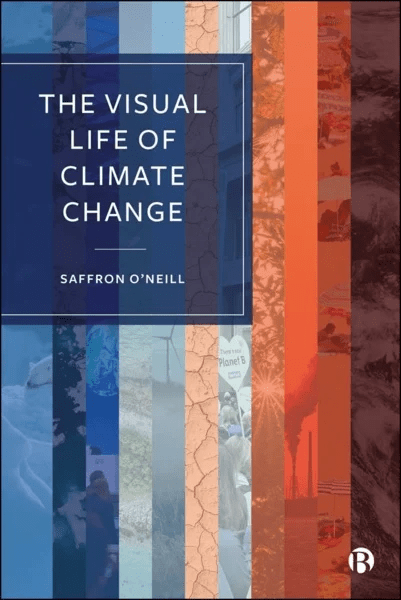
‘The Visual Life of Climate Change’ is an enthralling exploration and evaluation of the efficacy of climate related images and challenges the reader to be more critical of the ideologies and narratives posed by any image.
O’Neill makes the early point that, ‘Images are not simply facile illustrations accompanying the ‘serious’ work of textual communication, but have substantial power to shape the world around us’. The decisions of fast-paced news desks to locate and then use relatable and accessible images can significantly impact the actions and attitudes of the intended audience. O’Neill’s message is to move us towards a more inclusive and responsible climate visual discourse, one which reinvigorates the tired and over-used imagery which is lacking in ‘punch’. Changing our images about what a different future may look like, will be the foundations and cornerstone for working towards this more positive future.
Climate change has an image problem
The author effectively argues that we are surrounded by a world of images, which engage us on many levels, including emotionally. They are vibrant, rich, memorable and can intrinsically link our understanding of a topic to a meaningful summative ‘snapshot’. How we then ‘frame’ these images to understand and ‘decode’ their meaning can create its own problems, as the meaning is attached to an individual’s own understanding and experiences of the world. O’Neill points out that the ‘wrong images’ can be limiting at conveying a message at best, while at worst, they can reinforce prejudices, historical injustices and narratives surrounding colonialism, or the ‘white saviour’. The dangers of using unrelatable images can also distance and disconnect an audience from action, leaving them feeling helpless and insignificant. ‘Climate visuals can marginalise and exclude some of the most vulnerable people, places and non- humans.’ As long as climate related images choose to ignore, reduce and redact, then our understanding of the climate issue is that it is compartmentalised and trivial. But, climate imagery remains largely confined to a narrow set of visual tropes: such as polar bears, melting icebergs, wind turbines, the Earth in space or a politician behind a lectern. Climate images are often distant from people’s everyday lives and experience.’
Despite this, O’Neill is at pains to point out that she is not engaging in a ‘blame game’, but rather highlighting the processes which lead to these image outcomes of marginalisation and saturation. ‘It is important to note here that the intention is not to condemn any particular images, their makers or readers.’ She acknowledges that, ‘Climate visuals move through a complex, global media ecosystem’ and that better climate journalistic training and creating bespoke visual libraries may be needed to reshape better climate discourse. She notes the rise of AI generated imagery and argues that this ‘risks reinforcing cliched, stereotyped, biased, inaccurate, misleading or unethical visual content.’
Adaption imagery is necessary
O’Neill repeats that adaptation imagery is necessary with regards to heatwaves, sea-level rise, flooding and energy use. Adaptation imagery is important because it reflects and shapes how we think and feel about living with climate risk. She urges that a more equitable, just and representative narrative for climate adaptation, one which is both respectful and sensitive to the needs of different audiences.
She cautions against the Global North tendency for ‘fun in the sun’ images of heatwaves and notes that heatwave visuals marginalise vulnerable people in a way that is seen less in the Global South., ‘Global South countries have a strong visual discourse portraying the impacts of extreme heat on vulnerable people, and the ‘fun in the sun’ visual frame is less common.’
With regards to the ‘framing’ of sea-level rise, O’Neill cautions against a Global North ideology that ignores the land-ocean relationship of ‘small island states’ and posits the sea as inherently threatening. As Tuvaluan Taukiei Kitara explains: We see ourselves as not small island states, but large ocean states… we include land and sea together. They’re both in one.’
‘The Visual Life of Climate Change’ continues this clinical dissection of climate images, as it explores the narratives contained in the ubiquitous imagery of polar bears, the visual tropes of energy use, through smokestacks and wind turbines, as well as the iconography of the ‘Madonna and Child’ victim images of extreme weather disasters. Her overall energy message is one of reframing energy stories away from issue-based narratives and towards action- based stories.
O’Neill then offers examples of climate imagery which has been successful in raising climate awareness- with the examples of the ‘Climate Spiral’ and the ‘Climate Stripes’. She highlights that there exists ways of creating images which resonate strongly with the non-scientific public, which can be amplified and made freely accessible. The ‘correct’ visuals can act as a means of bridging the gap between public consciousness and government policy change.
Climate visuals move through a complex, global media ecosystem
O’Neill finally comments on the role of the media system and their role in influencing visual climate discourse and climate representation. Sadly, she also notes the business model of many media outlets and their desire for engagement and shareability, especially in an online world to increase viewers and revenue. She acknowledges that this may in turn favour certain types of visual coverage, including the ‘doom and gloom messaging’, which is beginning to dominate, and lead to a greater sense of apathy and alienation and therefore be counter-productive to the aim of climate messaging.
We need to see more climate visuals which lead to us being empowered to take action and O’Neill’s book charts the various issues which are currently holding us back.

