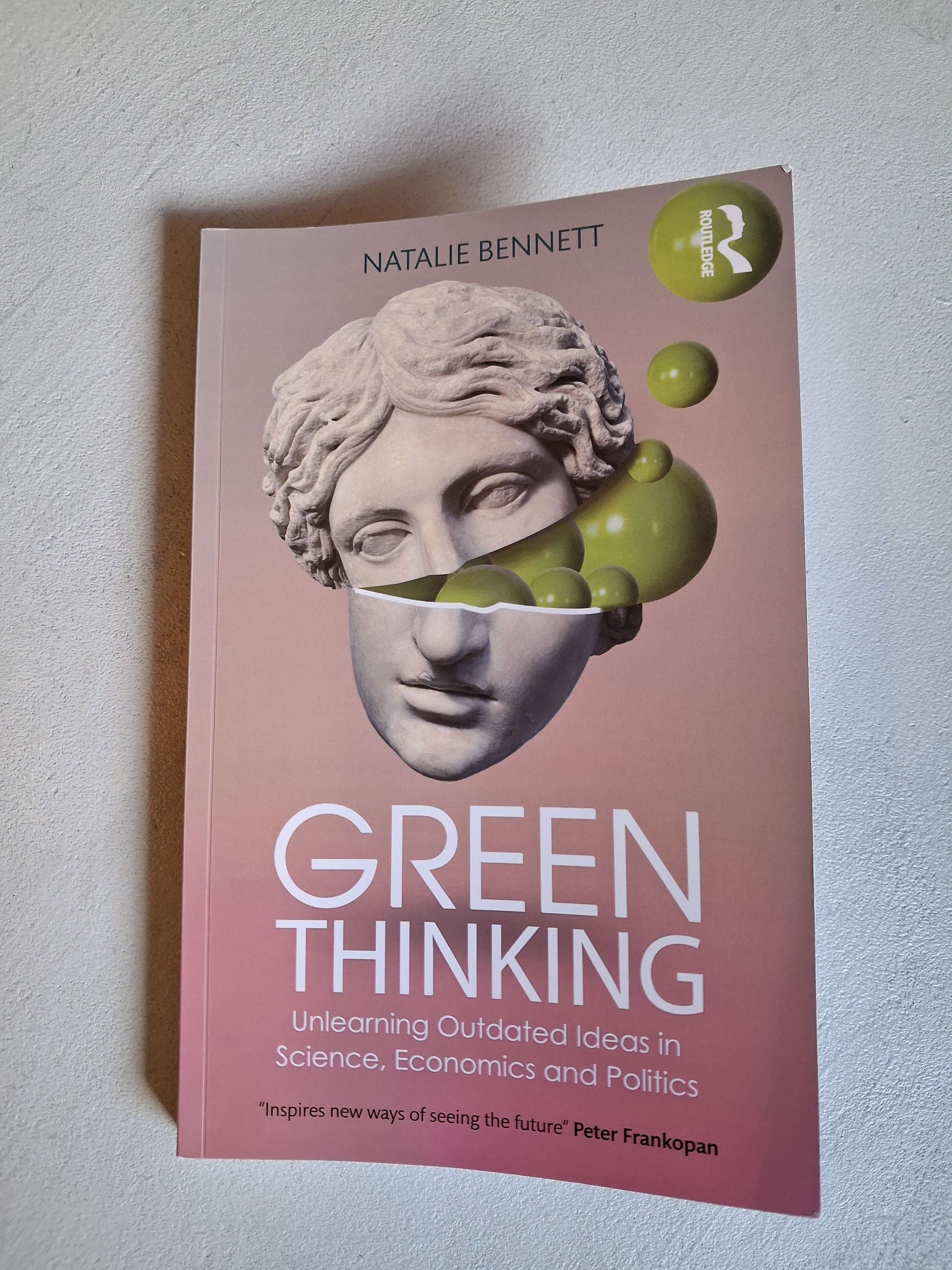
In ‘Green Thinking’, Natalie Bennett calls for a deep, transformative, ‘breaking the chains’ moment, to move us away from outdated ideas which promote harmful outcomes. It challenges assumptions and models and really is a ‘breakthrough book’- the transformative model that we need for the 21st-century.
She argues that, ‘We are in the Age of Shocks- economic, geopolitical, political, environmental, health.’ Shocks which have been built on and come from, as yet, an insidious, intertwined ideology which is simply self-serving. ‘The status quo is embedded. It is backed by powerful economic forces that have come to dominate under the current thinking.’
‘Green Thinking’ urges us to unlearn. To unlearn, question and scrutinise previous modes of thought and behaviour which have caused much of the planet-trashing mess that we are in. Bennett reminds us that ‘History is not prewritten, but made by the actions of people.’ Therefore, a way of thinking, relevant to the 21st-century built on new modes of symbiotic thinking rather than the ‘old ways which lead only to disaster.’ We are asked to unlearn economic competition and the dangers of free-market politics. We are asked to unlearn human arrogance and be more humble in our relationship with other species. We are asked to unlearn that ‘money makes the world go around’ and to unlearn the ‘deification’ of national and global leaders, who will not solve our problems. Bennett asks us to look at, though not exploit Indigenous teachings and modes of thought. ‘We need to unlearn the idea that true knowledge comes only from our own tradition.’
Avoiding a planetary disaster
She warns, with great clarity, that 20th-century economic, geopolitical, commercial led interests, have left us with an increasing threat to manage.
‘The 20th-century answer was markets- let them, which increasingly meant the financial sector- decide what was “good”, what knowledge should be generated and implemented. That has got us into the planet- trashing mess we are now.’
She acknowledges that exposing the threats from these outdated modes, based on human superiority and ‘egotism’ over the rest of the planet- where resource stripping and exploitation are to be celebrated and labelled as success, will be a difficult one for us to face. The idea that humans are the peak of evolution and the rest of life on the Earth here, is ready and almost willing, for our exploitation and control, is hugely pervasive in our political practice and daily life.
But, at the same time, she challenges the reader to ask why these systems are in place in the first place and who they benefit. ‘This book seeks to lay out and expose the profound failure of 20th-century approaches. I can only expect a reaction from calling out the failure of many deeply embedded beliefs, but they must be confronted, their deeply damaged nature and threat exposed.’
Cooperation and collective interests, rather than vested ones should be the dynamic and transformative thinking required for our place in the 21st-century world. Doing what we have done before and expecting things to change magically through innovative technology, can only lead us deeper into collective ruin. ‘Competition not cooperation, individualism rather than working together, more finance and fewer relationships, working harder and longer within the system we have now, can only amplify our problems. They are what got us here in the first place.’
Bennett finds hope in the evidence that at times, humanity has displayed the courage and action to make the systemic changes that are needed. ‘We have as a species and a genus have displayed wisdom before.’ She explores the relationship between humans and nature and demonstrates that our understanding of non-human life is still being extended further and that we are still learning more about our fellow species on the planet and that we should, ‘Change our behaviour in line with our 21st-century knowledge of the sophisticated intelligence, emotions and relationships of our relatives and compatriots of the more-than-human world, to remove the blinkers carefully maintained by commercial interests.’
Bennett makes it clear that it is up to us to choose- to decide- what the 21st-century has in store for us. Ideologies that suited a few in the past cannot now suit the majority of humans on the planet. Times, societies and moral imperatives have all changed dramatically in the past 100 years and the nostalgic, rose-tinted views of past economic lives and communities, are fooling us to believe in the status quo at all costs. She maintains that there are, ‘No excuses, the responsibility is ours’
‘Green Thinking’ or ‘green thinking’ finally asks us to move away from the 20th-century stock reply of ‘can we make a profit from doing this?’ to a more cooperative and preventative question of ‘should we be doing this?’
Bennett’s ‘Green Thinking’ is meant to be challenging. It is meant to expose the self-serving ideologies of the past and move us as a species away from the ‘dead hand of financial dictatorship’ to a ‘post-growth, probiotic’ style of politics- one which encompasses rather than excludes.
 Climate Thoughts with Brian