‘Planet Earth is being pushed beyond its limits’ UN Secretary-General António Guterres.

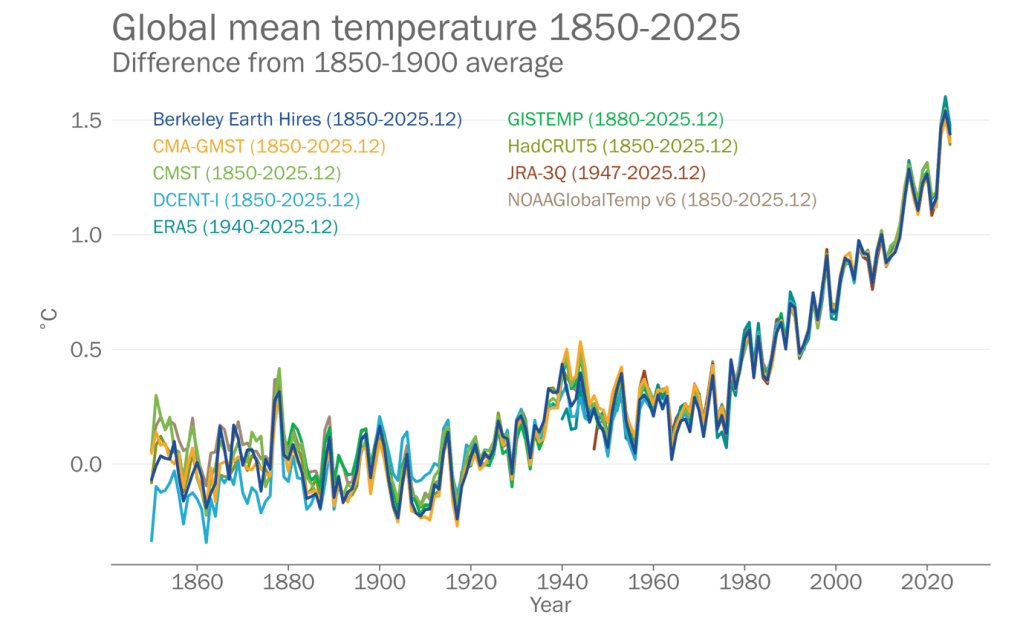
The State of the Global Climate 2025 report, published today by the World Meteorological Organization (WMO), confirms that 2015-2025 were the hottest 11 years on record and highlights that the Earth’s energy imbalance is at its highest in sixty five-year record. With 2025 being the second or third hottest year on record, at about 1.43 °C above the 1850-1900 average, depending on the dataset used, the consequences on more vulnerable peoples and societies are being highlighted as even more urgent. The report summarised these dangers saying, ‘These rapid large-scale changes in the Earth system have cascading impacts on human and natural systems, contributing to food insecurity and displacement where hazards intersect with high vulnerability and limited adaptive capacity.’
Across a range of indicators such as: greenhouse gases; global mean near-surface temperature; ocean heat content; global mean sea level; ocean acidification; glacier mass balance; sea-ice extent and extreme events and impacts emergency alerts are now being urgently signalled.
“The State of the Global Climate is in a state of emergency. Planet Earth is being pushed beyond its limits. Every key climate indicator is flashing red,” said UN Secretary-General António Guterres.
“Humanity has just endured the eleven hottest years on record. When history repeats itself eleven times, it is no longer a coincidence. It is a call to act,” said Mr Guterres
Increasing concentrations of greenhouse gases
One of the key findings from the report, focused on the inexorable rise of atmospheric carbon dioxide. The report noted that, ‘In 2024, the atmospheric concentration of carbon dioxide reached its highest level in the last 2 million years. Levels of methane and nitrous oxide reached their highest levels in the last 800 000 years.’ It also emphasised that the increase year on year should also be of importance, ‘The increase in the annual carbon dioxide concentration in 2024 was the largest annual increase since modern measurements began in 1957.’ The report was frank in its identification of the drivers of climate change. ‘The human-caused increase in the concentration of CO2 in the atmosphere is the largest driver of climate change.’
The WMO Secretary- General Celeste Saulo commented that, ‘Human activities are increasingly disrupting the natural equilibrium and we will live with these consequences for hundreds and thousands of years.’
She continued, ‘“Scientific advances have improved our understanding of the Earth’s energy imbalance and of the reality facing our planet and our climate right now. On a day-to-day basis, our weather has become more extreme. In 2025, heatwaves, wildfires, drought, tropical cyclones, storms and flooding caused thousands of deaths, impacted millions of people and caused billions in economic losses.”
‘Observing Today, Protecting Tomorrow’
WMO’s flagship ‘State of the Global Climate 2025’ report was released on World Meteorological Day on 23 March, which has the theme ‘Observing Today, Protecting Tomorrow.’ For the first time the Earth’s energy imbalance was included as one of the key indicators of change. This ‘imbalance’ is simply the difference between the amount of energy the Earth receives from the Sun and the amount of energy the Earth radiates back into space. ‘The Earth’s energy imbalance is a key climate indicator that measures how fast the heat trapped by anthropogenic emissions of greenhouse gases is accumulating in the climate system. The heat warms the ocean, continents and atmosphere, and melts ice.’ Using this comprehensive and holistic approach of quantifying changes in all parts of the climate system, a better prediction of changes tomorrow can take place.
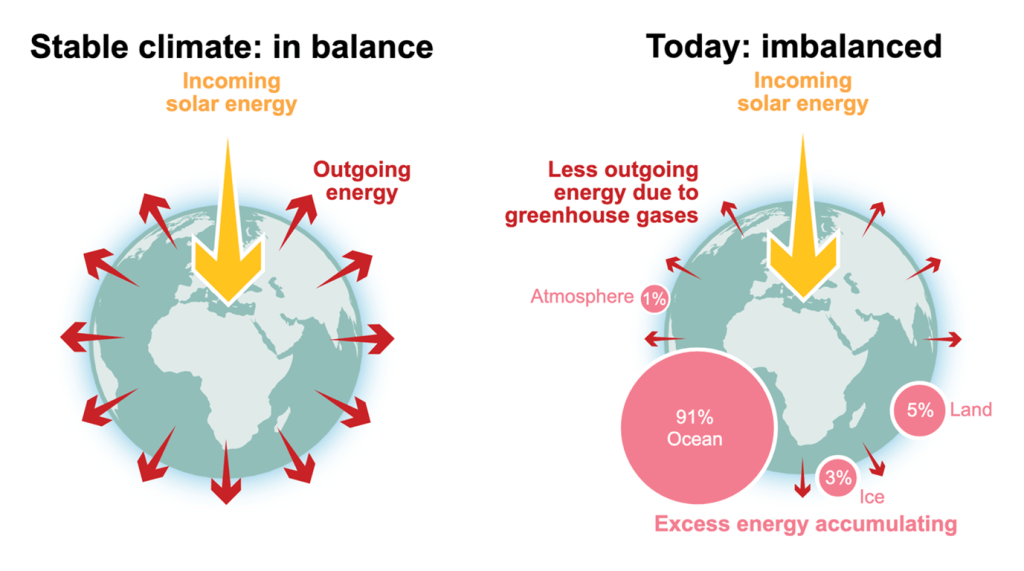
The extent of this warming has an impact in the Arctic and Antarctic regions. The report notes that in both regions, the extent of sea-ice was below 1991-2020 averages respectively. ‘The annual average Arctic sea-ice extent for 2025 was the lowest or second lowest on record in the satellite era, and the average Antarctic sea-ice extent for 2025 was the third lowest after 2023 and 2024.’
The warming of the oceans, also has the effect of changing the level of acidification of the oceans- potentially causing significant impacts to marine life.

‘The ocean has also absorbed around 29% of the anthropogenic emissions of carbon dioxide in the past decade. While this helps to buffer the effects of climate change, it also alters the chemical composition of the ocean water.’ The report suggests that the oceans have ‘been absorbing the equivalent of about eighteen times the annual human energy use each year for the past two decades.’
Warming oceans and melting sea-ice, in turn, are also driving the long-term rise in global mean sea level- with the interconnected climate systems once again demonstrating how risks can be multiplied and cascaded.
Climate chaos is accelerating: delay is deadly
The UN Secretary-General additionally commented that the interests of the fossil fuel industry are still being prioritised by countries and governments over global security and climate action. Whether any government will have the courage to better serve the people and planet of tomorrow remains to be seen.
“And in this age of war, climate stress is also exposing another truth: our addiction to fossil fuels is destabilizing both the climate and global security. Today’s report should come with a warning label: climate chaos is accelerating and delay is deadly,” said Mr Guterres.
 Climate Thoughts with Brian