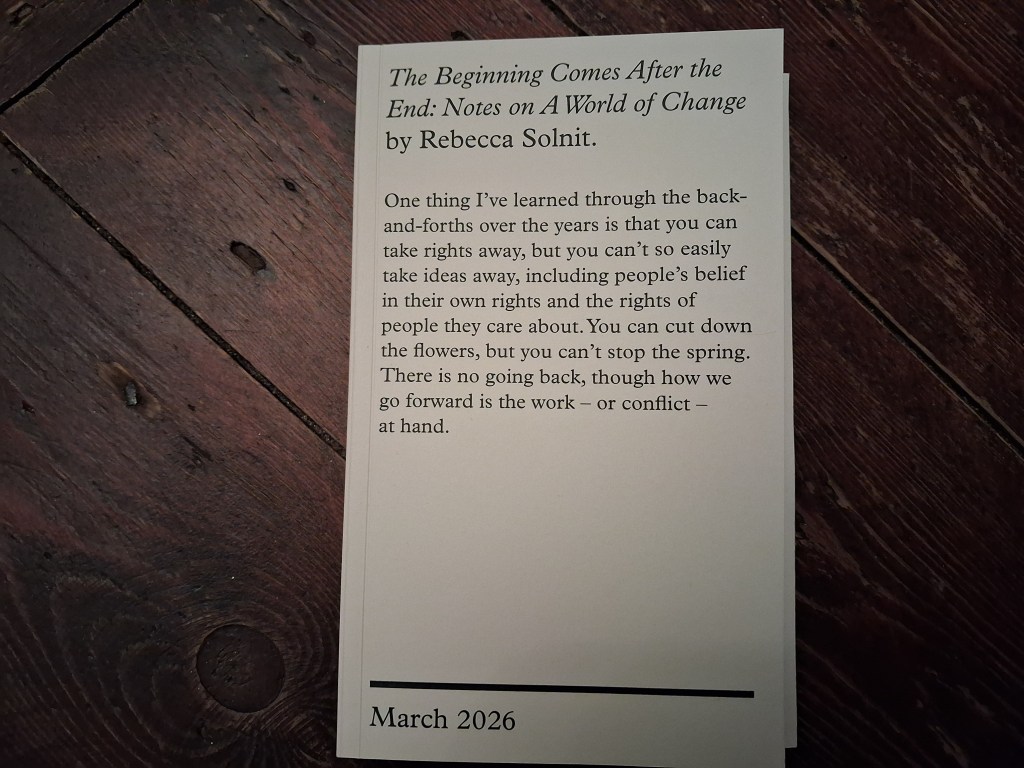
When Solnit speaks, the world should listen.
Her writing, spanning the years, has echoed with a deep personal voice, rooted in place, as well as optimistic activism. She charts and traces the changes that have transformed society and the world in the past, and reminds us that the power to change the world is within our reach and lies within us all.
This is not a ‘radical’ book- unless the power of ideologies and stories is radical in itself. Solnit has mastered the power of language long ago and the clarity and vision with which we have come to expect from her, resonates once again. Without doubt, this is a powerful vision which she lays out in ‘The Beginning Comes After the End’, one, which if adopted as a blueprint for the 21st century, would create a world and societies that would be worthy of the human race. This ‘blueprint’ would be, ‘A shift towards the idea that everything is connected, that the world is a network of inter-related systems, that the isolated individual is at best a fiction, and that the natural and social realms run more on collaboration and cooperation than competition.’
There are too many of us who are rooted in the last century- whose birth year begins with ‘19__’. We straddle both the past to which we are tethered and anchored, while the 21st century stretches out ahead of us- waiting for us to be the good ancestors for those who follow our footsteps along the path of our species. Solnit reminds us that, ‘We in the 2020s live in a world that would be unbelievable and maybe inconceivable to people sixty or seventy years earlier.’
As I read these words, I think of my father in his last 80s. Born in 1939, on the cusp of the Second World War- an event which defined the 20th century in so many ways- I think that his world and my world are incredibly different and that the changes since the mid-20th century are too numerous to mention. The changes which would have beyond his generation’s ken and yet, which we take for granted on a daily basis. Yet, Solnit does not ask us to romanticise the past or to wish to recreate a ‘lost world’, with all its attendant baggage. Indeed, she warns against this. She argues that choosing to allow ourselves to listen to the lessons from the past, can bring us out from beneath the shadows of the past into a new world. ‘But it’s the past that shows us the possibilities, how the world has changed, how power can appear in places and among peoples assumed to be powerless and irrelevant, how the most foundational things can be transformed’
‘We are such stuff as dreams are made on’
We all imagine and believe that the future will be different, but perhaps don’t realise that we could be the agents of these changes. As Madonna Thunder Hawk reminds us: “We’re the ancestors of tomorrow.” Solnit herself comments that incremental changes can collectively change the course of history and the future. ‘I’ve lived through a lot of the changes they helped launch, most of them happened so incrementally that they unfolded invisibly, but a thousand steps add up to a considerable distance.’ She urges us to accept what history has shown us- more clearly than anything else- that change is possible. That the ideas cemented into the fabric of our identity and society can be broken and disturbed. ‘Our world has changed more than almost anyone imagined, in ways both wonderful and terrible, often in ways no one anticipated, and the sheer profundity of change in the past guarantees that this change will continue.’
The only constant that is guaranteed is that change happens. ‘Change is a constant, but social change has sped up in our time, altering the very fundamentals of how we think about ourselves and the natural and social worlds, and also who defines what “we” means.’ She identifies the social nudges of change, which have helped us build towards integration and interconnected relationships, rather than a distancing and ‘othering’ ‘Changes build on changes; one shift makes another possible.’
We are not at the end of history, says Solnit- we are simply the navigators in the middle of the journey- the creators of a new story. A story which will shape what the future looks like as we move through the time of this century. A simple task may be for us to try and pierce the mists of time and to imagine what the world could be like by 2100. How would that be accomplished? What, or who, would be the catalysts for this new direction? How many false starts and stumbles would happen along the way? ‘This is a reminder that you do not have to picture the destination to reach it or at least draw closer to it, you just need to choose a direction and keep on walking…’
‘A new heaven and a new earth’
Solnit quotes the words of Antonio Gramsci, when she argues that the birthing of this new changed world is a slow process. ‘The old world is dying. The new one is slow in appearing. In this light and shadow, monsters arise.’ She contends that ideas and stories have power- a power feared by those who wish to cling to the wreckage of the old world, for fear that who they are will be lost. ‘Ideas have power, and while those who support them often dismiss that power, those who fear them recognize they can change the world.’ She also notes the wisdom of Thomas Berry, when she acknowledges that the lack of a certain future path appears to some as though the path does not exist at all. Lack of certainty is not lack of existence.
“We are in trouble because we do not have a good story. We are in between stories. The Old Story- the account of how the world came to be and we fit into it- is not functioning properly and we have not learned the New Story.”
For Solnit, the power of stories can create new ‘forests of possibility’ and it is in this ‘possibility’ where new worlds dare to breathe. What is wonderful is that this imagery continues, as Solnit exhorts us to root ourselves in the past to reach the future.
‘What if our best hope reaches for the future by sinking its roots deep in the past? What futures can we build on these other versions of the past, these other voices with other stories to tell? What beginnings come after such an end?’
A Brave New World
As I look at the sleeping face of my 8-years-old son, I imagine the world of 2100, a time where he will almost be the same age as my father is now. It is a world which I cannot imagine, but one which I know will be different from this one.
I cannot walk with him into that brave new world, but I can hold his hand for as long as possible, to be his guide, until he carries his own dreams of change. I am reminded of the popular motivational poster that once was displayed in his room- ‘Let him sleep, for when he wakes, he will move mountains.’
I know that he will move these mountains, not by scaling the heights in a dangerous, desperate rush, but by slowly moving one stone at a time.
‘The Beginning Comes After the End: Notes on a World of Change’ is the most personal and uplifting book about the power of ideas and about our ability to be transformed.
We are all dreamers.
“We are living through a revolt against the future. The future will prevail.”
–Anand Giridharadas
 Climate Thoughts with Brian