https://www.publicdomainpictures.net/en/view-image.php?image=46552&picture=wood-burning-stove
Woodburners identified as trebling the risk of indoor pollution exposure
A recent study in the Journal of Environmental Management identified woodburners as the highest source of exposure to air pollution in Welsh primary aged schoolchildren. The study measured exposure to air pollution in the participants’ homes, in their schools, and in their daily commute, using portable air quality monitors carried by the children.
Its findings suggested that the highest levels of exposure to children were to be found within home environments and that the sources of indoor combustion was a key contributor to higher levels of exposure. ‘Results showed that children’s highest and most variable PM2.5 exposure occurred within home environments, where indoor sources such as wood burning and smoking were major contributors.’
Comparing the two schools- one urban and one rural in Anglesey the study measured the homes which had woodburners and/or fireplace to identify potential sources of pollution. It highlighted that, ‘Approximately 53 % of students at School B reported having a wood burner and/or fireplace at home, compared to 21 % at School A. This suggests that indoor biomass combustion is likely a significant contributor to higher PM2.5 exposure.’
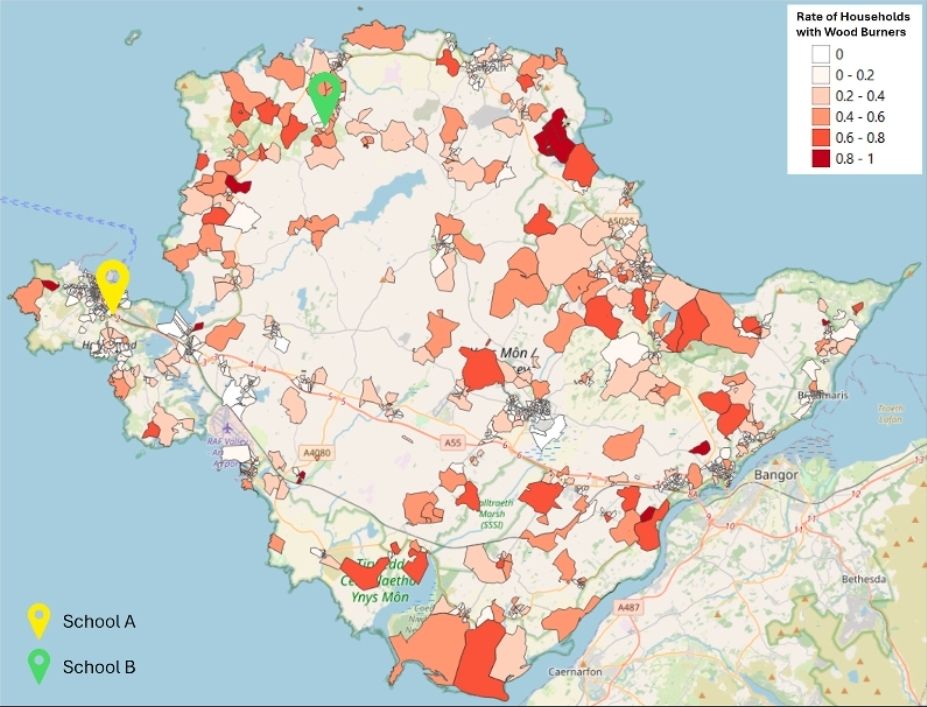
Distribution of household wood burners in Anglesey
Impact of domestic wood burning
The study continued to emphasise the high level of firewood and woodburners in Wales and the impact of this usage on PM2.5 levels.
‘In Wales, domestic wood burning significantly impacts PM2.5 levels, especially along the north coast and during winter (Welsh Government, 2024). A survey indicated that up to 75 % of households in rural Wales use firewood (Jennifer and James, 2013).’
Currently, the Department for Environment, Food & Rural Affairs is running a consultation until mid March calling for stricter emissions limits for new stoves; mandatory labelling for stoves and fuels and increased enforcement penalties. In the overview to this consultation, Defra state bluntly that ‘Air pollution is one of the largest environmental risks to human health. Fine particulate matter (PM2.5) – tiny particles that can enter the lungs and bloodstream – is linked to conditions such as heart disease, asthma, and premature death. Vulnerable groups, including children, older people, and those with existing health conditions, are most affected.’ This statement continued, with an equally strong comment that, ‘Domestic burning of solid fuels such as wood and manufactured solid fuels is a major source of PM2.5 emissions.’
Charities, such as Asthma + Lung UK, criticised this consultation for falling ‘well short’ of what is needed to protect people from this exposure, when they argued that the consultation ignored ‘the pollution from existing stoves which is one of the UK’s biggest sources of air pollution.’
Jonathan Blades, Head of Policy at Asthma + Lung UK, said: ‘The public consultation on domestic wood burning is a welcome acknowledgment of the harm caused by domestic burning, but the policy measures proposed fall well short of what is needed to protect the public from dangerously high levels of emissions. Air pollution is first and foremost a health issue. It is linked to up to 43,000 premature deaths every year in the UK and domestic burning is the only source of harmful fine particulate matter known as PM2.5 that has risen since 2003.’
Blades continued, ‘If this government is serious about protecting public health, reducing the amount of PM2.5 we breathe must be a priority, and the government should be consulting on bold, ambitious and supportive measures to bring down levels from domestic burning.’
The Government consultation document itself says, ‘We all deserve to live in an environment where our everyday lives are not negatively affected by the quality of the air that we breathe. The burning of solid fuels, including the use of woodburning stoves in domestic settings, is growing in popularity and leading to more harmful emissions entering our air.’
‘It is a public health crisis’
Joseph Carter, Chair of Healthy Air Cymru and Head of Asthma + Lung UK Cymru told me that:
“Air pollution is the biggest environmental threat to public health, second only to smoking. At a cost £1bn per year to our NHS, air pollution is draining our resources, straining our health system and cutting short over 2000 lives a year in Wales. It is a public health crisis.
The idea of glowing embers in a wood burner in your home might sound appealing, but the reality is, it could be putting you, your family and community’s lung health at risk.”
He continued, “Although we are thankfully seeing an increased awareness in Wales of the health dangers posed by wood burning, many people are still unaware and we want that to change. Sadly we are not surprised by the results of the study. It highlights the air pollution dangers of not only domestic burning, but also smoking and vehicle idling. This study confirms the important role that the decision of adults has on the air that children breathe, whether it is their parents, teachers or adult neighbours driving vehicles and burning wood. It shows the importance of awareness and education, and we hope the Welsh Government considers this report when planning an awareness campaign.”
Whether air pollution studies like the recent one in Wales, or the current government consultation will then lead to bans or partial bans on woodburners, remains to be seen. The pressure does appear to be mounting and possible health warnings on products could signal that public awareness and consumer led choices might change the market forever.
 Climate Thoughts with Brian