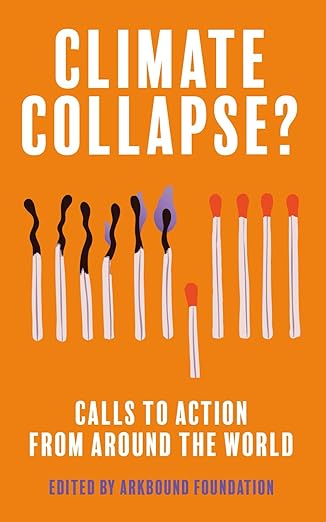
Voices from around the world speak out on climate solutions that they have experienced, to highlight that the ‘waiting for Superman’ approach is not appropriate when managing climate collapse and that local communities have the power themselves to act in a powerful manner to deliver climate action.
‘Climate Collapse?’ is, at times, blunt, critical and unforgiving, perhaps matching the topic under discussion. From, the ecological resistance of women peasants in South Korea; to women’s contributions to combating climate disorder in Haiti; to Brazil’s Landless Workers Movement; to a story of abundance amidst collapse in Sudan; to the conflict between Western conservation and ecocide in Kenya, these global voices speak out about climate injustices and offer clear avenues of hope.
All-pervasive climate breakdown is here, now.
Prof Bill McGuire, from the UK, opens the collection of voices, with his typical style, highlighting that avoiding facing facts is perilous.
‘Whether we accept it or not, our climate is already broken to such a degree that it will have a colossal impact upon every aspect of our lives, the lives of our children and their children, and the lives of those to come, not just for years, but for millennia.’
He points out the fact often forgotten, that in some ways, we are too late, that some impacts are already locked in. ‘The bottom line is that climate catastrophe is already locked- in. Things are going to be bad, and our children and many generations thereafter will inevitably face tough times. Deciding just how tough, however, is still within our gift– to some extent at least.’ He uses the Biblical proverb from Hosea when he forces us to face the fact that this climate breakdown that we are experiencing now is down to human actions. ‘We have sown the wind and now, finally, we are beginning to reap the whirlwind.’
Brian Tokar then begins the argument of how can we find hope and optimism within the world which Maguire describes. Toaker notes, ‘Images of climate-driven disasters have come to dominate our awareness on nearly a weekly basis.’ He asks the question, ‘How can hopes and dreams for a better world be sustained amidst this overt authoritarianism, disruption and chaos?’ This book’s focus imagines the world of tomorrow and how that can be built into being, as well as highlighting climate action today which moves us in this direction. A complete revolution in our thinking is required to understand the fragile equilibrium of our planet and how we are threatening our own home. “Let us make no mistake: the climate crisis is also a crisis of culture, and thus of the imagination.”— Amitav Ghosh
Cultures in conflict
The white saviour syndrome of the Global North, aiming to intervene in the Global South is addressed fully in the collection of voices. This cultural perspective is often seen as one which remains tainted by narratives of colonialism and arrogance. Matthew Azouley makes the argument that an equal playing field must exist between cultures to foster the building of global solutions. ‘Nevertheless, I have learnt enough to know that Indigenous and Global South perspectives on ecological collapse—including the climate crisis— are fundamental to a global understanding of our predicament.’ Western approaches to conservation and ecology still dominate over Indigenous knowledge, whether this is Kenya or Haiti. Powerful ideas about gender roles exist in many communities creating more divides over allowed ‘roles’.
Sharma Aurelien offers a detailed exploration of this very issue of the intersection between feminism and colonialism when she analyses women’s actions in response to climate change in Haiti. She argues that, ‘Haitian women farmers are therefore more exposed to climate effects due to their belonging to three marginalized groups: they are rural people, they are women, and they are nationals of a low- income country.’ However, these women and this community are not ‘left behind’- instead voices keep fighting to advance rights and freedoms. ‘In Haiti’s fragile sociopolitical context, women’s organizations and leaders keep advocating and acting for women’s and girls’ rights.’
Hyojeong Kim makes a similar argument about female rights in South Korea when they ask, ‘How can feminism in general respond to the climate crisis and its gendered dimensions? The emergence of a new ecofeminist women’s movement is urgently required along with a transnational solidarity beyond the nation state so as to cope with the climate crisis.’
Rising from the Ashes
Gail Bradbrook, the co-founder of Extinction Rebellion, begins to conclude the collection of these global voices by embracing the global community and the ideas about protection and regeneration. We need to acknowledge and accept that some parts of our world will never be the same again and that many things may be lost as climate breakdown continues. However, giving everything up is not an option, as this is our collective planet and our collective home.
‘For this book, people from across the world have been asked what they think, with a concern for hearing beyond the usual “whitestream” voices and in care for humanity hearing from itself in our richness and diversity. Let’s take time to be fed by words, thoughts, experiences, ideas from many orientations and cultures. Let’s take time to breathe, to feel, to think together. Then to keep walking together, perhaps with a bit more wisdom in the direction we choose.’
Bradbrook encourages us to re-find our shared humanity as our new compass direction for what remains of the 21st century.
‘We will mostly now witness the breaking down, the drowning, the burning; with our energies increasingly fixed on the challenges of survival. Nevertheless, how we approach and rise to those challenges might also contain possibilities for becoming more humane and more alive together, for a new paradigm to emerge – phoenix- like from ashes – if we focus on building cultures of repair, resistance and regeneration together.’
 Climate Thoughts with Brian