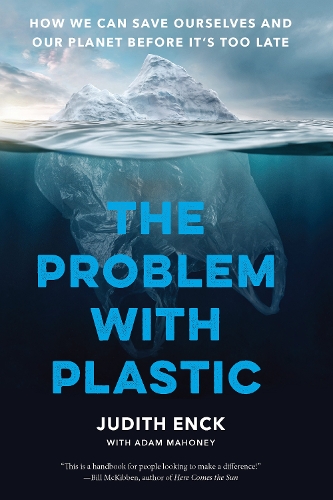
Plastic pollution and contamination sadly seems to be so ingrained into our environment that yet another book on the issue appears to be superfluous. That being said, Enck and Mahoney peel back the veneer of company ‘plastic-washing’ and false promises to challenge the dominant and overwhelming narrative from the plastics industry (read fossil-fuel industry) that if individuals were just better at recycling, then the problem would be solved.
They make the early point that despite plastics being a relatively new invention, they have colonised the world, making us overly-dependent and addicted to their use. ‘What began as a marvel of modern science has been woven so tightly into the fabric of our lives that imagining a world without it seems impossible.’
Humans once lived in a world without plastic and this seems hard to fathom now. ‘In just seventy- five years, plastic has cradled our planet in a synthetic embrace.’ Enck and Mahoney address the systemic issues at the core of the plastic crisis and explore the links to environmental injustices, using repeated examples of neighbourhoods and communities blighted by plastic pollution, with attendant increased health risks. They call out big business as being a knowing actor in the ‘plastic racism’ and argue that short-term profits are more of a priority to these companies than real solutions to reduce the production of plastic. ‘Despite the mounting evidence against the plastics industry, those in charge continue to double down on false solutions, successfully misleading the public and hindering real progress.’
No place untouched by plastic
Enck and Mahoney remind the reader that, ‘Today, there isn’t a place on Earth untouched by plastic.’ From plastic bags deep in the Mariana Trench to plastic pollution on the slopes of Mount Everest, to inside the human body with microplastics and nanoplastics, the contamination is everywhere, with the tap of production not even close to being shut off. For an industry that is not older than the oldest person alive today, this shocking impact on our world is the worst of achievements. ‘Half of all the plastic ever created has been around only since 2007’
The authors make the point that massive production of plastic will thwart and dwarf the best efforts of recycling, or even ‘chemical recycling’, which continues to stand at less than 10% globally. The same fossil-fuel playbook of hoping for a technological ‘magic bullet’ solution, which will allow production to continue and profits to prosper, has been successfully used by the plastic industry and it is this that the authors want us to be alerted about. This should be no surprise as the vast majority of plastics are made from fossil fuels and it is the same industry pushing both products.‘Plastics are made from fossil fuels and chemicals. The world’s biggest oil and gas companies are also the biggest plastic producers.’ … ‘In less than a century, plastic has changed the world. In 1950, the world produced just 2 million tons of plastic. It now produces over 450 million tons per year.’
‘With microplastics seemingly everywhere—in the air, water, and food we consume—it’s easy to feel overwhelmed.’
Against this industrial plastic behemoth, it can feel that our efforts and voices are insignificant and that it is easier to not challenge their narrative, however Enck and Mahoney argue that this is far from the case, and that the plastic edifice is beginning to crumble. They highlight communities where local protests have successfully repelled fracking industries, incinerators and landfill operators. ‘Most people experience plastic in passing as a brief relationship with a throwaway item. The bulk of the consequences, though, are saddled upon the local communities where plastic is fracked, cracked, dumped, and burned: from the Indigenous, to the free towns, to the poor working class. In short, plastic kills. Yet organized resistance to plastic is spreading across the globe.’ It appears that it is the communities which are threatened the most which are standing up the most against the polluters, but they need the help of powerful, unafraid governments, which are not content with solutions that ‘skim the surface’, but which apply rigorous regulation to industry. ‘As with traditional landfills, incinerators and toxic ash landfills are overwhelmingly located in low-income and minority communities where residents bear the brunt of the health and environmental impacts from plastic pollution.’
The authors call for meaningful and significant change to phase out this plastic pollution.
‘Meaningful changes that significantly reduce plastic production and waste must occur on a vast scale, one that matches the current volume of plastic produced and consumed…Achieving such large-scale change requires the introduction of new laws that compel industries to take actions they have otherwise failed to initiate on their own.’
The authors make the repeated point in ‘The Problem with Plastic’ that,
‘If the science is clear and the damage so severe, why hasn’t the crisis been meaningfully addressed?’
A cleaner, healthier future is in our hands
In order to achieve this cleaner and healthier future, Enck and Mahoney powerfully argue for a two-pronged attack- one which is government led and one which is consumer led. They urge that meaningful choices for customers away from plastics cannot happen magically on its own and need the helping hand of a necessary Big Government. The current unrealistic self-policing practices of the plastics (fossil-fuel) industry must come to an end.
‘Governments must implement strict regulations to curb plastic production, enforce transparency in corporate sustainability claims, and eliminate subsidies for plastic production under the guise of recycling innovation. And we, as consumers, must be empowered with better choices, clearer labeling, and access to plastic-free alternatives that are genuinely sustainable. The petrochemical industry will continue pushing misleading solutions unless there is strong pushback from communities, policymakers, and environmental advocates.’
The authors close by reminding us that profound transformation is possible and that inventions, although they can’t be ‘un-invented’, can be refined (!), improved upon and in many cases, left behind, as more sustainable, efficient and safe options become widely accessible.
‘Yet this is no natural catastrophe; it is human-made, and that means it can be unmade. Plastic pollution, climate change, and environmental injustices are not inevitable; they are the results of choices made by businesses, governments, and, to a lesser extent, you and me.’
The path forward to save ourselves and our planet from this plastic juggernaut will likely not be an easy one. It is reliant on individuals moving away from convenience to choice, from being fettered to plastics to freedom, and from apathy to action. When held against the healthy vision of the world, just over the horizon, this surely is a price worth paying.
‘The way forward is daunting but not impossible. It requires courage, persistence, and a shared vision of what the world can be.’
 Climate Thoughts with Brian