
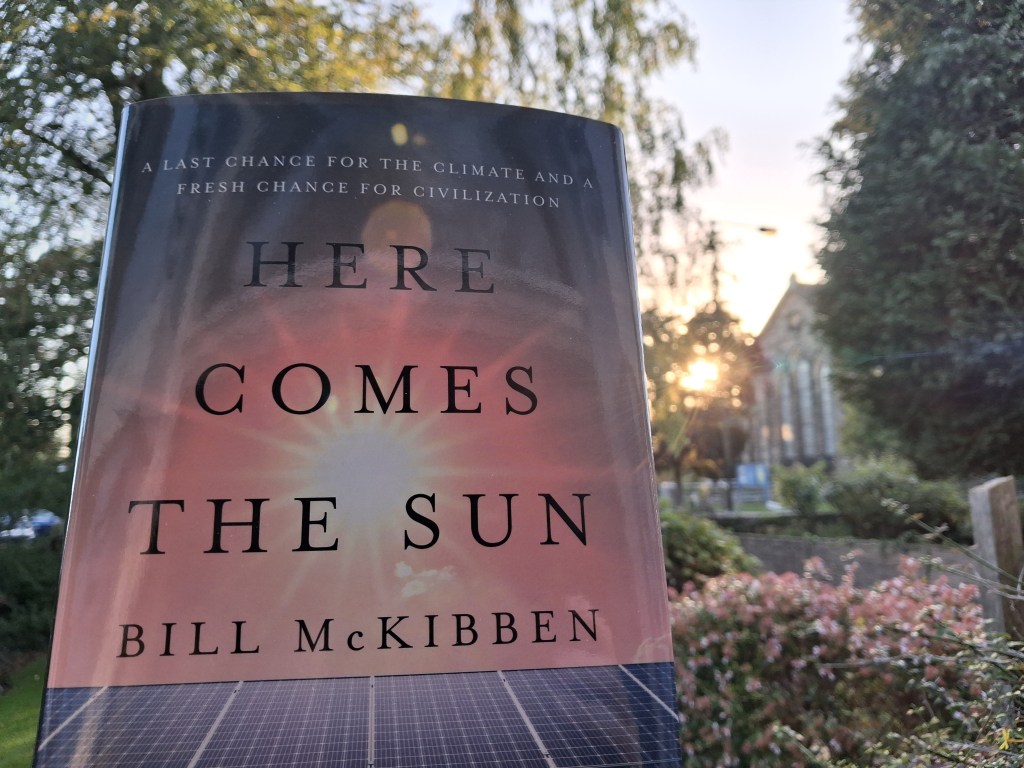
Bill McKibben’s ‘Here Comes The Sun: A Last Chance for the Climate and a Fresh Chance for Civilization’ is a book which throughout highlights the transformative revolution of solar power and which revels in the ability for countries around the world to see past the short-term interests of the fossil fuel industry- desperately clinging on to its profits- to see and build a new world. ‘ And yet, right now, really for the first time, I can see a path forward. A path lit by the sun.’
McKibben admits that the task between now and 2030- a scant 5 years away- is difficult, but also reminds us that there are no longer technical or financial obstacles in the way. ‘…[W]e must cut greenhouse gas emissions in half before the decade is out. That target is on the bleeding edge of the technically possible, and this book is an effort to shove us toward that deadline.’
This is a book which hopes to re-ignite our connection with our sun. McKibben reminds us that, ‘We were all sun worshippers once.’, with the hope that metaphorically, we can be again. He argues passionately that we have an opportunity, a chance in this moment, which is not to be missed- which cannot be missed. ‘Our species, at what feels like a very dark moment, can take a giant leap into the light. Of the sun.’
The revolutionary idea of this book is that it is past time when we should break the habit of burning things. In more poetic terms, the Fires of Isengard have already spread…’and all that was once green and good this world will be gone.’ McKibben notes that changing and converting the economy is as important as changing our power supply. He also highlights that Big Oil will be a difficult hydra to slay. ‘Big Oil will do almost anything to stay in the burning business, because their reserves of oil and gas are currency worth tens of trillions of dollars.’ He hammers this point home effectively arguing that ‘… fossil fuel is going all out to make sure it doesn’t happen. In fact, the entire point of the industry by this point in its history is to make sure we keep burning something. It’s desperate, as we shall see, to slow down this switch by any means necessary.’
As a result of their rapacious extractive measures, McKibben describes the state of humans on the planet through the medical metaphor of being in the ER. ‘We’re very much in the ER- that’s what all those statistics about the jet stream and the bleaching of the Great Barrier Reef mean.’ He highlights the ecological systems around the world which are becoming critically threatened- ‘There are only so many really huge and vital systems on the planet, and now all of them seem to be in some sort of violent flux.’ Global records continue to be shattered by the world that has been forged and created by Big Oil, but McKibben outlines that even though they have tried hard to steer us off course- and despite their best efforts- solar power has undergone one of the most revolutionary successful transformations ever seen.
McKibben effectively reminds us of the many many solar technologies and projects taking off around the world- from Spain and Germany, to Ecuador, to China and to Australia and Pakistan. He points out that many of these revolutions tend not to gain the global attention which they deserve, because they are simply not in the West, calling us out accurately on our ideologies. ‘One reason we’ve missed some of that revolution is because so much of it is taking place in China, and we’re used to thinking that anything important must happen in the West.’
As a result of these extraordinary breakthroughs, McKibben is energised (terrible accidental word- pun) and encouraged to power through our dependency on the fossil fuel industry. ‘Before our decade is out, we have to break the back of the fossil fuel system. We have to land the sun on the earth.’ He ends Section 1 of the book with the alarming comment, ‘It would be unthinkable not to figure this out.’
As the book progresses, McKibben frankly ridicules the arguments trotted out by stooges for the fossil fuel industry- arguments solely designed to slow down the transition away from their product. He first ridicules the ‘Can we afford it?’ argument. ‘Of course we can afford it- the sheer fact that we’re merrily building out terrawatt after terrawatt of solar and wind power is more or less proof that it’s becoming affordable.’
He urges us to consider what the cost implications and ramifications would be if we continued on the fossil fuel path- citing that the insurance industry is already acting to protect its interests by not offering climate cover. ‘First, though, let’s reflect for a moment on what it would cost us to do nothing- that is, to continue lurching slowly through a haphazard transition off fossil fuels that happens too slowly to really arrest climate change.’ McKibben notes that the supply and demand pathway is one which works against capitalism- ‘because energy from the sun and wind is so plentiful and cheap, it can’t make as much profit for investors as oil and gas, which are scarce and dear.’
Throughout, he advises that ‘Emergencies demand urgency’ and that ‘[W]e need to do this now; we can’t afford another miss.’ He asks the very simple questions of what are the obstacles to this solar and wind transformation; who are the players acting against this revolution; and why are they behaving like this. It’s not a land coverage issue, it’s not a battery storage issue, it’s not a recycling of parts issue, it’s an enslavement to the fossil fuel industry issue and we have the power to break those bonds. Dependency on fossil fuel is dead. There’s no reason not to embrace the solar revolution.
McKibben asks us all to turn our faces to the sun once more in wonder and build a world ‘where we no longer set things on fire, but rely instead on the great fire out there in space. A world where we can turn to our star.’
He ends the book exhilarated about the possibilities lying ahead of us and exhorts us all to seize fire from the Gods once more.
‘We’ve been given one last chance…a chance to restart that civilization on saner ground, once we’ve extinguished the fires that now both power and threaten it.’
 Climate Thoughts with Brian