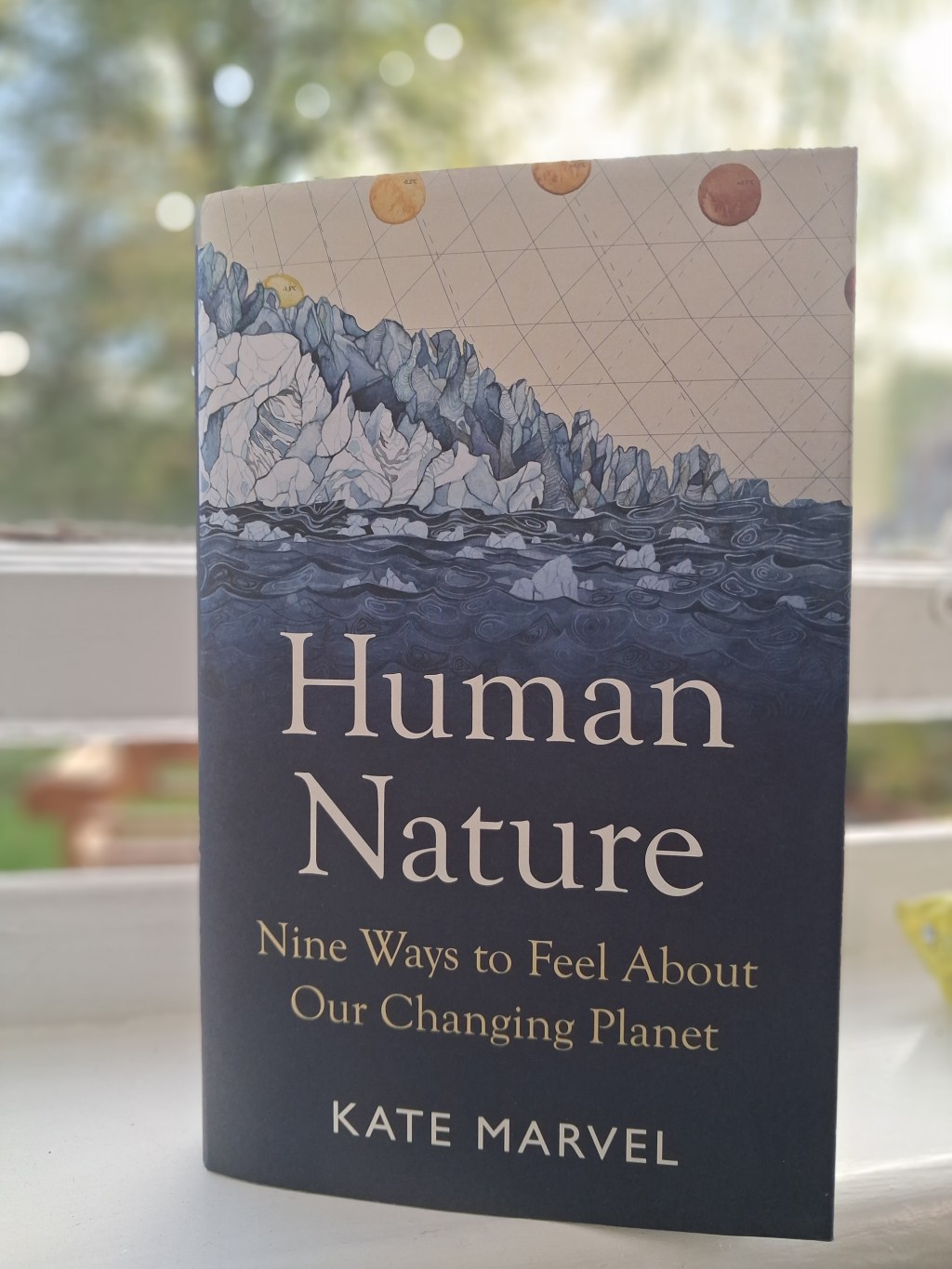

Dr Marvel’s ‘Human Nature: Nine Ways to Feel About Our Changing Planet’ is a wonderfully balanced book. It offers clear and detailed scientific information, which logically ties all the climate clues together, while at the same being unashamedly and unapologetically a personal account of the range of feelings that the climate crisis brings.
Marvel’s writing is peppered with a sharp dry wit and crackles with a passion for climate action. She draws on the wonderful power of storytelling and compares the hubris of modern humans in their fossil fuel lives, with the classical figures of mythology to suggest that the lessons still haven’t been learned. The chapters of the book are entitled with major emotions, such as ‘Wonder’/ ‘Anger’/ ‘Fear’/ ‘Pride’ which read like mythological characters progressing on a quest. Marvel makes the powerful point that the humanity of climate scientists does not cloud their judgment, but rather enhances it with a love of what can be saved. “I’m sad, desperately so, when I think about all the things we’ll lose. I’m afraid of the disasters I know are coming. I’m proud and surprised and hopeful and utterly in love with our beautiful world, I feel so much.”
As a scientist well versed in using climate models to better understand the impact of climate scenarios, Marvel focuses our attention on our living model- one that is our home. “Scientists have used climate models for decades to see possible futures. Now these long-predicted changes are coming to pass…It’s not a toy planet burning; it’s our beloved Earth.” She compares climate scientists to modern day Cassandra- like figures: “We see the tragedy that awaits; we try to warn of it.”
“Yes, it’s real. Yes, it’s us. Yes, it’s bad. Yes, we’re sure.”
Repeatedly in the book, Marvel hammers home the point that the scientific information of climate change has been known for many decades and that we appear to be more interested in ‘watching Rome burn’, than in taking the action which will make us the heroes of our own story. “The evidence is overwhelming, the science unequivocal: The world is warming because of greenhouse gases.” She rails at the ignorance- oftentimes deliberate ignorance- of those who fail to understand scientific uncertainty and attempt to use it to delay further climate action. “I am angry at the cynicism, the lies, and the greed. I feel burning rage when I hear the same tired talking points, the falsehoods repeated credulously by people who should (and do) know better. And I’m absolutely furious when I see the uncertainty inherent in the scientific method twisted into something evil.”
Marvel’s writing style lifts the words off the page. Her command of the cadence and rhythm of language leads to arguments being well balanced and emphasised.
“We are more sure that greenhouse gases are warming the planet than we are that smoking causes cancer…To stop the planet warming, we simply have to stop emitting them.”
Marvel argues powerfully that we are the agents of change and the future that we hand to our children must contain the acknowledgement and apology that humans have been poor guardians of the planet so far. “When we accept our own responsibility, we gain a powerful truth: How bad it gets is up to us. The future is still in human hands.”
The future matters for Marvel and she argues that we have an immense and unprecedented challenge ahead of us, as the planet changes. “The future remains uncertain. But I’m sending my children there, and they are never coming back.” The political choices that humans make now to act cooperatively, will create this future world- whether it is a world of conflict, limited resources and fear, or whether it will be a peaceful world remains in our control. “We can’t predict what future climate disruption will do to geopolitics, conflict, or the risk of war. But it would be unwise to think it will make the world a more peaceful place.” Marvel continues this argument, that our future world depends on our choices now by saying, “It’s true we don’t know what future climate change will look like. And this is mostly because we don’t know what choices humans will make.” Unprecedented human action to fight against this all too real climate monster is a choice that we need to make so that compound climate events do not continue to imperil us.
The world is not supposed to warm this quickly
Marvel negates the arguments from climate deniers and delayers that ‘climate change has always happened’ by adroitly pointing out that, “The planet’s temperature goes up and down irregularly, like many unsynchronised hearts beating together. What it does not do is rise consistently for more than a century.” This pace that we have caused and then witnessed rightfully causes concern. “The pace of recent climate change is stunningly, bewilderingly fast…The world is not supposed to warm this quickly, to change this suddenly. It never has, or at least not since humans (or anything like humans) have existed. It feels wrong. It is wrong.”
Marvel urges that in this climate emergency, we should be ‘throwing everything at the problem’, but cautions against the ‘silver bullets’ of geoengineering, which continue to hold unknown dangers. She acknowledges that, “Miracles are possible. But it’s a terrible strategy to bet the planet on one.”
We are urged not to be the ‘mad scientists’ of shock horror B movies, creating the golems of climate technological saviours, as we have no idea what climate chimeras we might unleash.
Marvel asks instead that we act out of love and compassion- compassion for our world and for ourselves, so that future generations may look on us with pride and gratitude for a job well done. She quotes the great Carl Sagan, “For small creatures such as we, the vastness is bearable only through love.” We are the writers of this new climate story- one which will be passed down generations, as the myths of the classical past have been gifted to us. Marvel describes this simple and powerful act- a journey that no one has gone on before, but a path which we all must chart.
“At bedtime we read stories about heroes and monsters, quests fulfilled against impossible odds. I tell him that to stop climate change, we will have to do something that no one has done before. But that, he knows, is what happens in any story worth telling.”
Leibniz’s words, popularised by Voltaire, bring Marvel’s ‘Human Nature’ to a close. ‘All is for the best in the best of all possible worlds.’ We are reminded again by Marvel that the planet that we have damaged, and continue to damage, is our only home- our once and future home.
“We can only live here, together. Here in the world that we have changed so much. Here, shining out into cold space where there is no darkness, only light we cannot see.”
 Climate Thoughts with Brian