
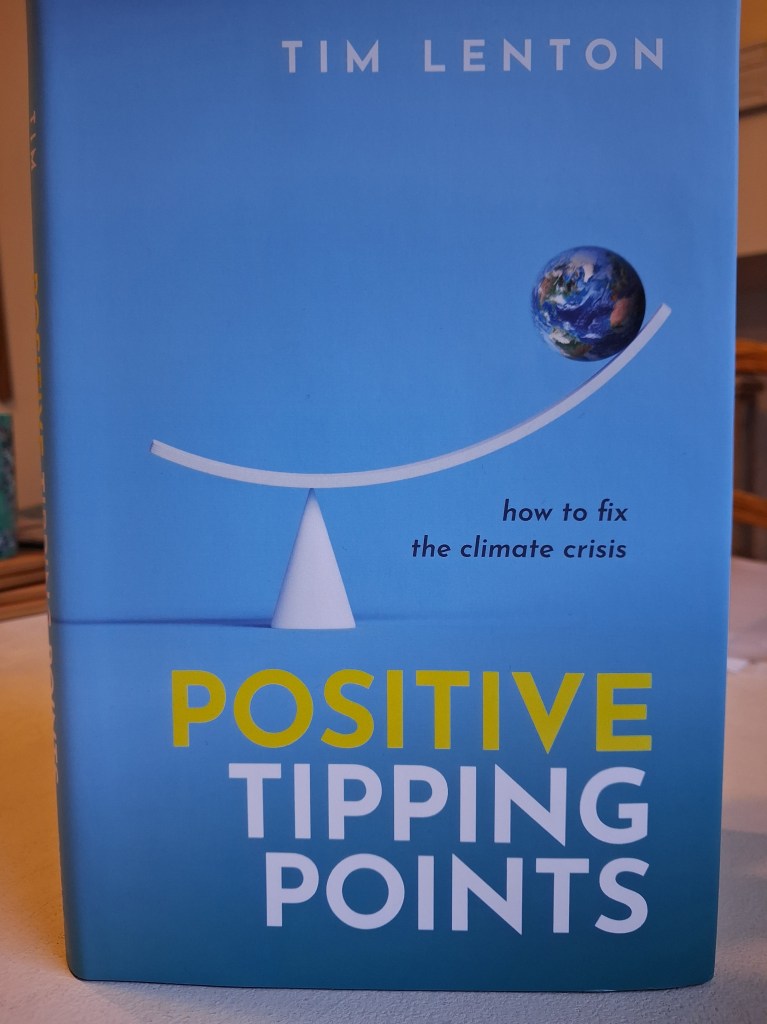
Tim Lenton’s ‘Positive Tipping Points’ does well to remind us all that we have agency to create meaningful change- that as cogs in the societal machine, we have the power to enhance and act transformatively, or to disrupt the current system. As he notes, “To get out of the incumbent, unsustainable state we need a fundamentally social tipping point, because it is people and their actions that either maintain the status quo or oppose it.”
Lenton makes the early point that, “We are in a climate and ecological crisis of our own making.” His focus is on finding the lever which will accelerate positive societal change. “We need to find and trigger positive tipping points that accelerate change in our societies and technology towards sustainability and social justice.”
‘Positive Tipping Points’ highlights well known examples of small actions which had large and significant consequences. He uses the example of the ‘Ever Given’ ship which blocked the Suez Canal to emphasise how the actions and decisions of just a few people ‘can sometimes escalate into global consequences.’ He makes the point that the world is far from the ordered, stable, place that we imagine it to be and that small changes can create large- scale self-propelling social change which could create the positive tipping points of actions and behaviours that are required. “We have been brought up to think that the world is an orderly, predictable place, where if we act in a proportionate manner we’ll get things back under control. But today’s world is not behaving like that.”
Lenton correctly clarifies what he means by a ‘tipping point’, arguing that overuse in the media has led to a confusion in the term. Additionally, he highlights the inherent danger in overstating the inevitability of such tipping states.
“There is also quite a bit of popular confusion over what is and is not a tipping point. This matters because if we overstate the existence of bad tipping points, knowing that they are self-propelling and hard to stop or reverse, we may feel disempowered and fatalistic.”
He gives clear and thorough examples of past ‘tipping points’ which moved societies through stable states to unstable alternatives. He explores nomadic lifestyles and how these were replaced with sedentary cultures; how foraging food made way for farming; how the Industrial Revolution in the UK changed the world; how cars replaced horses; and how previous complex societies collapsed owing to a range of external and internal factors impacting them simultaneously. Creating a ‘new world’ through innovative techniques can never be viewed as truly successful before the change has occurred. Lenton outlines that, “There are two faces to tipping points- they are sometimes creators and sometimes destroyers of worlds.” His argument is that once collapse gets underway, reinforcing and amplifying feedbacks can propel it at a much faster pace.
We are on thin ice
The immediacy of the positive tipping point for climate action is well documented in the text. “Now we are at around 1.5℃ of global warming and our list of potential climate tipping points has grown to sixteen.” Lenton explores how these tipping points might increase the abrupt risk of further points being broken irreversibly, owing to the complex interconnected Earth systems. “Our journey around the tipping elements has begun to reveal how tipping one thing affects the likelihood of tipping another. Hopefully this is intuitive. The Earth is a complex interconnected system where if something breaks it has repercussions elsewhere.”
Changing course
However, this is not a ‘doomist’ text- listing tipping point after tipping point. Instead, Lenton argues that disaster can be averted. He argues that by learning from moments of drastic change in the past, we should have learned to spot the warning signs. “To believe we can change fundamentally, and fast, we need to appreciate that we have done so in the past.” As climate tipping points are a “universal negative to avoid”, Lenton points to successful social movements of the past which brought the necessary change. The abolition of slavery and the Suffragette movement are both explored as movements which reached a ‘critical mass’ where change became inevitable and self-propelling. “Social movements, like the suffragettes or the climate protestors, are a particularly important way of tipping change. Many, if not all, the great social changes in the past had social movements behind them.” Attitudes towards change are driven by core groups, labelled by Lenton as “Innovators, early adopters, early majority, late majority, laggards”. Changing the social norm can be done in short timescales when intention and a better vision are part of the messaging. Society has changed its attitude towards smoking in a relatively short timeframe. Solar power, EV cars, vegetarianism and other changes in diet, have also broken through quickly as group dynamics ‘nudge’ others into taking action. The rise in technology in the past 20 years, and the acceptance and reliance on this technological innovation, also indicates how significantly society can change its attitude.
Government policy can play an impactful role when rapid change is required. This was ably demonstrated when the ozone layer was threatened with CFCs. Government and industry worked quickly together to reduce the harm and risk. “We urgently need such a tipping point of international coordination to tackle climate change”
Lenton pulls no punches in addressing this need for government policy, nor the bad actors at play, delaying climate action or promoting untested geoengineering proposals. “Policy is particularly important, because the transformation we need now is a rapid and intentional one.”
‘Revolution is impossible until it is inevitable.’
Lenton closes by quoting Trotsky’s famous line that ‘Revolution is impossible until it is impossible’. He urges that waiting until we have reached the point of an impending climate tipping point before acting would be risky and foolhardy. “Common sense says it would be a very risky strategy to wait until we are near certain about impending catastrophe before we act together.”
The stress on resources of climate migration could be well founded as humans move beyond their ‘climate- niche’ of stable survival. Hundreds of millions of people could be displaced in the coming decades and could become climate migrants, leading to an impact on welcoming countries and unwelcoming countries alike.
“The take home message from all this is that if we carry on knowingly towards 3℃ of global warming many people will have an existential risk to deal with, and in the worst case, we could be heading for a tipping point of societal collapse.”
Acting proactively rather than reactively may make all the difference to creating the necessary, critical mass social change. We can see the very real danger ahead- the alarm is sounding- our course needs to be altered.
“For all these reasons we need to act fast, well in advance of the point of impact, if we are to avoid it.”
Margaret Mead’s words may become prophetic once again,as we each consider what part we want to play in the positive tipping points to come.
“Never doubt that a small group of thoughtful, committed citizens can change the world. Indeed, it is the only thing that ever has.”
 Climate Thoughts with Brian