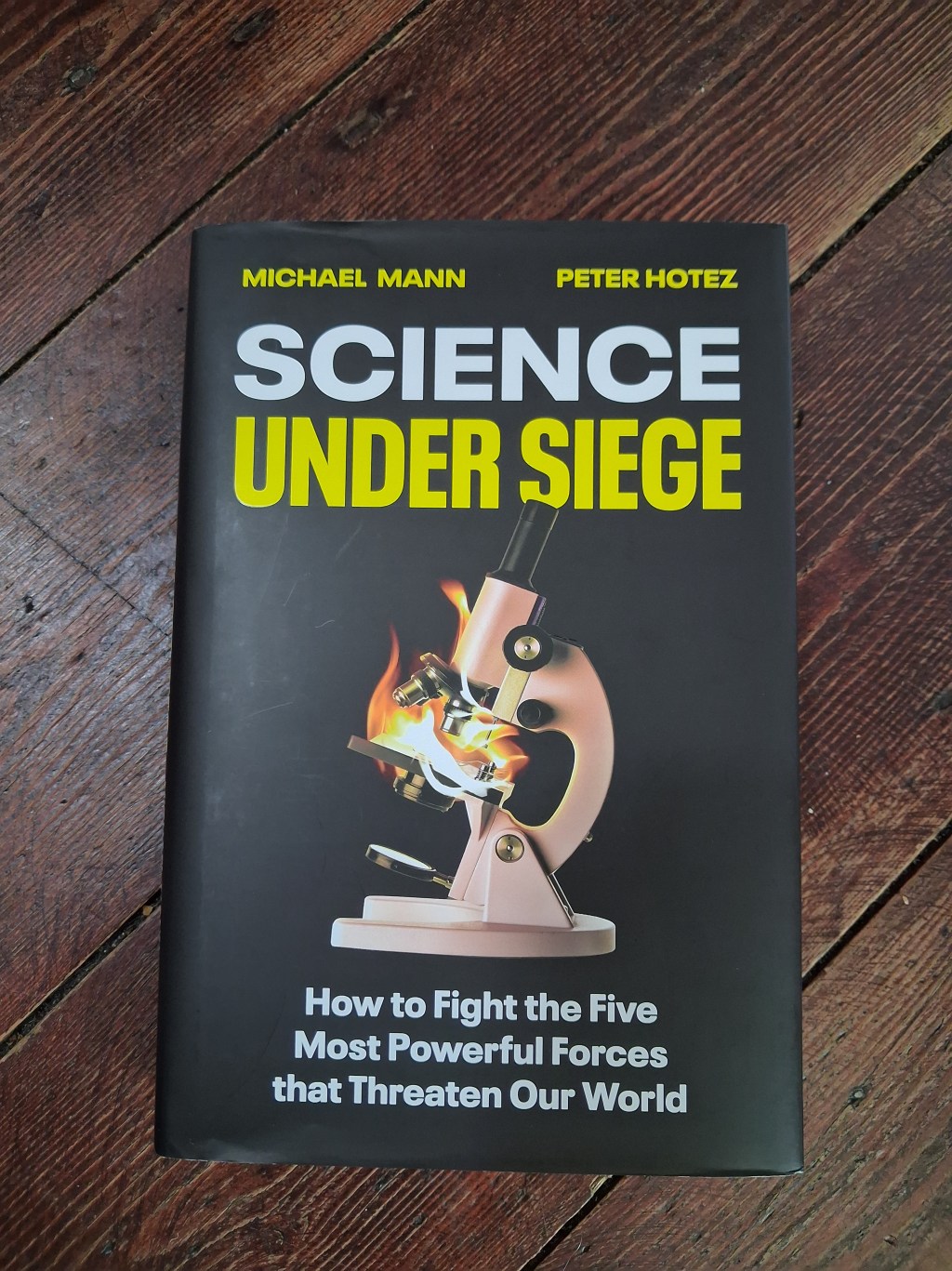

When two world-class science heavyweights take the time to warn us about scientific endeavour being under attack by bad actors, it is incumbent upon us to listen. Doctors Michael Mann and Peter Hotez have spent much of their professional life being targeted by the political and ideological opposition to science at enormous personal cost and this book serves as a both a warning and a call to arms to recognise and fight against the orchestrated disinformation efforts of those who would focus on short- term profits over the threats to human life. In this very timely book, the authors identify the five forces that fuel this antiscience narrative. “In Science Under Siege we seek to provide a succinct yet detailed delineation of the five forces behind the modern-day antiscience movement (the five p’s, we’ll call them- the plutocrats, the petrostates, the pros, the propagandists, and our press).”
The authors stress that it is vital that these forces are recognised for what they are and that we do not allow them to fan the flames of division, especially at a time when our way of life is threatened by the twin crises of global pandemics and the climate crisis.
“The future of humankind and the health of our planet now depend on surmounting the dark forces of antiscience.” The disinformation tactics of attempting to isolate an individual scientist to discredit them can be seen as an attempt to quell the pursuit of science among younger generations, who then see science as a career where you are derided and reviled, rather than the industry of respect that it was in the latter part of the 20th century. Indeed, the authors go further here, and note the silence from the scientific community when one of them comes under repeated and targeted attack. The silence of friends- fearful of their own career reputation, or personal attack, can be a useful tool to isolate and ‘gag’ scientists.
“In the end, we will remember not the words of our enemies, but the silence of our friends.” So far, the silence has- in some instances, been deafening.”
Mann and Hotez argue that, “Mistrust in science is now escalating in certain demographics because of a targeted campaign against us- antiscience predation for someone else’s financial or political gain.” Instead of being seen as a significant social wedge issue, the attack on science to seed and sow state-sponsored disinformation, becomes a means of destabilising democratic societies around the world.
Mann and Hotez remind their readers that the fossil-fuel industry has been well aware of the dangers of the climate threat for almost 50 years and highlight that the delaying obstacles and challenges to government action are not physical or technological- but rather that they are entirely political. The ideological motivated efforts to deny the threat of the COVID-19 pandemic more recently follow this same pattern of political division and delay- sadly with human lives hanging in the balance.
“Meanwhile, the world’s largest fossil-fuel companies already understood the climate threat. In an internal report from 1982 that was eventually leaked into the public domain, ExxonMobil’s own scientists accurately predicted the increase in CO₂ concentrations and warming that would occur today in the absence of efforts to curtail fossil-fuel burning.”
Mann and Hotez make the repeated argument that we do not have to be passive receivers of this well-funded campaign of antiscience, but that by ‘knowing our enemy’, we can become armed into neutralising this threat and that metaphorically, sunlight can be the best disinfectant to this highly organised dangerous ideology.
“While there is urgency- unlike any we’ve ever known- there is still agency. We can still avert disaster if we can understand the nature of the mounting antiscience threat and formulate a strategy to counter it.”
A Candle in the Dark
“Happiness can be found, even in the darkest of times, if one only remembers to turn on the light.”- Albus Dumbledore.
The authors then begin to turn the spotlight onto each of the 5 ‘ps’ in turn, those oftentimes defenders of the powerful special interests and political agendas which actively promote anti-science as their repeated mantra for their own culture wars. They begin with the plutocrats, where power is held and controlled by a small minority of high-net-worth individuals and name them as malevolent players. Names which are familiar to us, such as the Koch family, Rupert Murdoch, Zuckerberg, Musk and Bill Gates. The point is made that “Today’s malevolent plutocrats frequently operate through a complicated web of entities as they wage war against science and scientists” and note that this ‘dark money’ can be difficult to follow and its users are protected by a lack of accountability. The impact of the Koch family casts a long shadow. “Koch Industries is the world’s largest privately held fossil-fuel company, with an obvious financial interest in fossil fuels.” The importance of funding for the disinformation campaign has led to bad actors appearing ‘untouchable’ and appearing to have a disproportionate amount of power.
“Elon Musk, the world’s richest man, the tech bro of tech bros and cryptobro of cryptobros, has become a leading spreader of disinformation writ large.” As a result of the distractions and delay caused by these plutocrats, the necessary government action has effectively been nullified. When Musk bought Twitter, he then “converted Twitter into a forum for far-right extremism…which in turn, led to “[t]he evaporation of science from platforms like Twitter launched an exodus of science from the public conversation.” When there is a vacuum of communication, with scientists forced out by trolls and bot armies, only one narrative remains powerful, which sets humanity back decades. Very recently, we have seen the return of some climate scientists to this platform- scientists unwilling to yield large amounts of online space to bad actors for free. This might be the start of a reclamation of the space by the science community, which would be welcome, as it has left those remaining active voices very marginalised.
Who is standing up for science?
In the fight to discredit accurate and robust science communication, plutocrats can merge with another ‘p group’- that of the petrostate. “Petrostates are often run by dictators, plutocrats, and oligarchs who acquire political or economic power (often without accountability) through the wealth they derive from extractive industries.” Some petrostates are more well known than others, but there are commonalities- one of which is to choose not to lead on any concerted global action on climate, but to remain firmly in delaying action for as long as possible. Mann and Hotez understandably focus on events in the United States and ‘the American petrostate’ and are persuasive in their arguments that politics is not only divisive- it is deadly. There has been a long game strategy played by the fossil-fuel industry, to slowly move their policy makers into position, even if this takes years and decades- but now they are in place. “During the 1990s the fossil-fuel industry began to invest heavily in conservative policy groups, think tanks, and front groups advocating policies friendly to the fossil-fuel industry. Meanwhile, they funded conservative climate-denying politicians, most of who were from oil states.”
With President Trump’s second term as President, the attack on science has become more vitriolic and dangerous on a global scale. The National Oceanic and Atmospheric Administration (NOAA) has faced significant cuts, seen by many to be a malicious attack on climate science and climate partnership with other leading organisations. More recently, the Department of Energy published a report claiming scientific concern about the climate crisis is overblown and exaggerated. A hand-picked team of science contrarians were selected for this report, which was viewed as an attempt to replace legitimate science with pseudoscience and has been fact checked for misinformation. The respectable Carbon Brief organisation, counted more than 100 false or misleading scientific claims contained within this report. In the authors’ minds then, it is clear that this is just the latest in the concerted attack on science.“There is unquestionably, a coordinated, concerted attack on science by today’s Republican Party- the American petrostate, if you will- with climate and biomedicine as focal points of the assault.”
The authors powerfully argue that the end result is to halt science progress in the United States and then by extension, hold back meaningful global action on climate- at the least, disrupt any action. This chapter ends, and indeed this argument ends, by ‘calling out’ the political attack on science.
“The fact that antiscience has been embraced so fully by one of the two major parties in the United States is grave cause for concern.”
Pros and propagandists
Mann and Hotez next focus on the twins of ‘pros’ and ‘propagandists’- figures with huge social media presence who regularly appear as ‘experts’ on media platforms touting for the fossil-fuel industry. “Pros include individuals with scientific credentials who have been financially lured by polluters and plutocrats and weaponized into a force to attack mainstream science and scientists. There are also the paid propagandists with no scientific credentials but plenty of media savvy and access to wide platforms.” These players are linked to the science-denial machine and appear to be free from the same funding scrutiny that is applied by them to the science community and to science communicators. Dissemination of misinformation now reaches tens of millions of people, through the power of social media, with platforms taking little to no responsibility for the toxic content of propagandists. “The propagandists now benefit from the extraordinary amplifying power of social media, including a Musk-weaponized Twitter, disinformation podcasts with huge reaches, and now most recently, AI. Slowing or stopping them is a complicated endeavor that requires disrupting their weapon of choice, antisocial media and other high-visibility disinformation-promoting vehicles.”
However, Mann and Hotez highlight that the playbook of antiscience has shifted now that the impact of climate change has become too obvious to deny outright. “Climate denial is untenable today with the vast majority of our population because they are witnessing profound impacts already playing out…They have instead largely turned to other tactics- delay, deflection, division, and so forth.” The resurgent weapon of choice is now the use of conspiracy theories. Conspiracy theories run rampant and there is an overlapping Venn diagram of anti-vaccine posters and anti-climate science posts online, which are amplified disproportionately to create the impression that they are the majority. This would come to no surprise to the average online user- even sheltered in their own echo chambers. Online trolls and misinformation impacts all of us and with algorithms constantly pushing targeted material onto us all, it can be difficult to take the time to sift through the overwhelming quantity of media information.
The partisan press?
There has been a manufactured campaign against the media, with partisan media groups gaining access and those promoting science being sidelined, especially by US politicians, with President Trump famously demonising news outlets as being ‘fake news’. We are all aware that press outlets will cater to their target audience and that how the public consumes their news is very different from a world of even 20 years ago. Capturing attention and holding the attention of the public has become the sensationalised strategy, rather than a ‘golden age’ quest for truth. The press undoubtedly have a part to play in good science communication, though as an industry, they appear to be excoriated by Mann and Hotez. “The press, as we have already seen, has engaged in widespread attacks on both science and scientists. Beyond the usual suspects- Fox News, the rest of the Murdoch media empire and other conservative media- even mainstream outlets like the New York Times have in recent years miscommunicated the science behind climate change and COVID.” They argue that creating the false equivalence between robust science and conspiracy theories and allowing “bothsideism” has built the illusion of equal weight to competing arguments. They are clear that there are some networks which act deliberately to attack science, while others can sometimes act unwittingly to create ‘doomist narratives’ that misrepresent the science, whether this is regarding the climate or global pandemics. The concern of the authors is that the framing of science stories can lead to the support and promotion of untested technological ‘silver bullets’, most of which allow for ‘business as usual’ for the fossil- fuel industry. “How doomist framing has led to support for potentially dangerous geoengineering schemes as desperation measures.”
“Fellowship of the Planet”
Mann and Hotez then lay out their ‘battle plan’ to push back against the tide of antiscience, arguing, “We need to restore the rightful role of science in our political and societal discourse if we are to maintain the capacity to address the major challenges we face, including the climate crisis and worsening pandemics.”
They acknowledge that ‘the hour is late’ for a new found faith in science, but argue that as we can see the actions of the ‘antiscience industry’ in delaying meaningful action, are we just going to allow them to destroy our way of life without putting up a fight? “We wish that humanity had followed a more enlightened path decades ago when the climate crisis had clearly emerged, or back in 2020 when we were given a golden opportunity to implement pandemic policies- guided by the best available science- to ensure the health of both our species and our planet.”
Mann and Hotez urge that by: communicating constructively; defeating disinformation; and supporting scientists, we can be led in our actions, not by partisan politics, but by the best scientific understanding at this given point.
Mann and Hotez close their book by referring to the powerful story and imagery of “The Lord of the Rings”. They connect with the repeated analogy of the industrial fossil-fuel furnace rooms of Sauron and Saruman, and offer the stark warning that if we don’t act, then we risk losing ‘The Shire’. [I]f humanity fails to combat the great global crises we face today, there won’t be an Earth- at least not the one we’d recognize. Yes, there will still be a large spherical planet rotating around the sun. There will be life, but we will lose the welcoming planetary home we know today, with its rich forests and oceans and ecosystems teeming with diverse, interconnected life forms.”
Science disinformation is a plague which threatens to destabilise us all. We must make a stand, to push forwards. To say that we will take the first step against the forces of disinformation, even if we ‘do not know the way’, and even if we do not know how that story finishes. We know the ending of the story if the fossil-fuel industry and anti-pandemic responses continue their stranglehold on science education, policy and action. We don’t know the ending if we fight for a pro- science tipping point, but we do know that if the fossil- fuel industry and agents of geoengineering miracles come for us, then we must be doing something right.
“We fight for a livable planet, for us, our children, and future generations. Because it’s worth fighting for.”
 Climate Thoughts with Brian