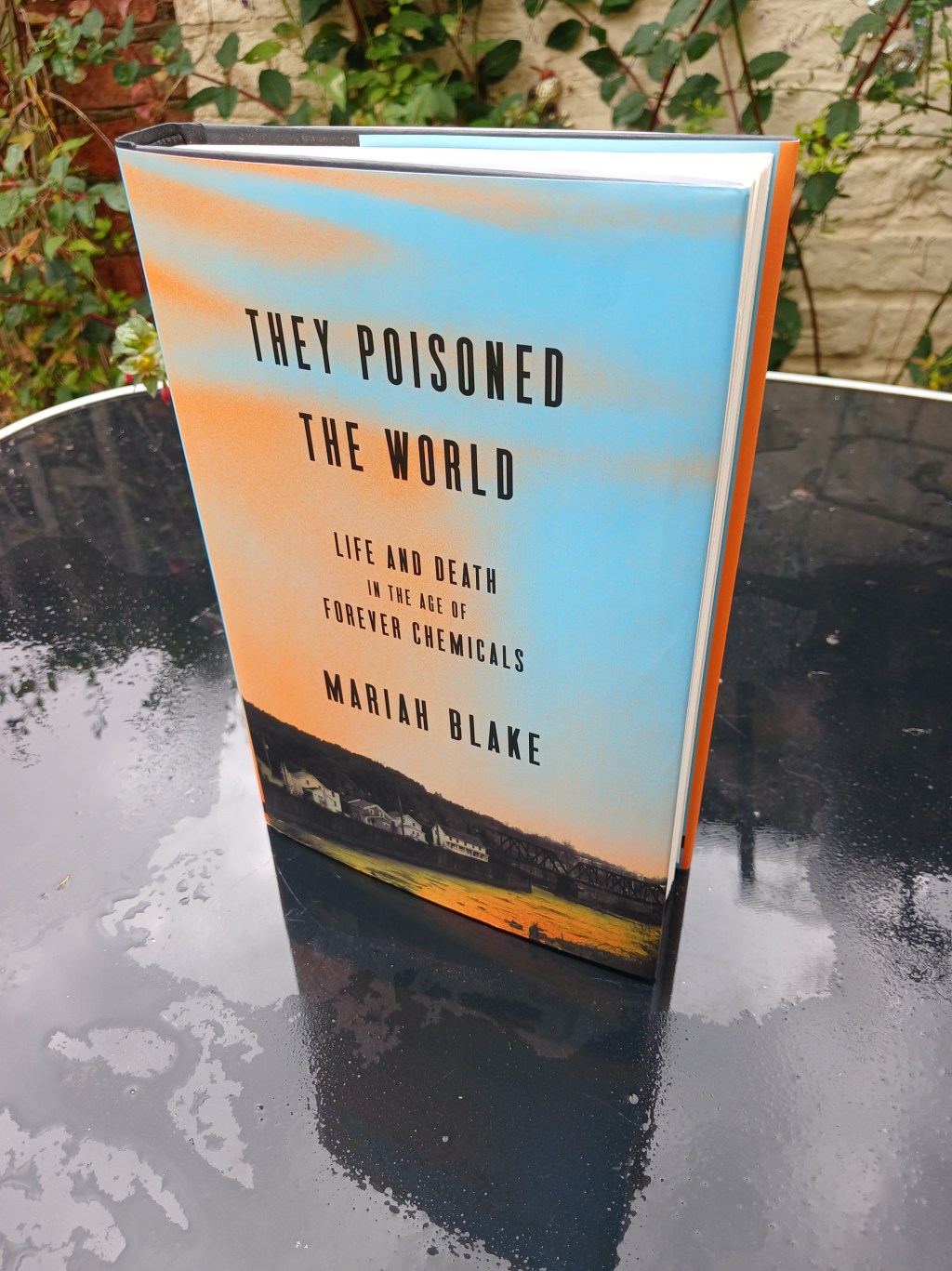

Blake’s book is a detailed, comprehensive, chronological investigation into how synthetic PFAS chemicals polluted and contaminated town after town in America. It focuses on the dogged and determined individuals, who fought against chemical companies which delayed, obfuscated and denied the extent of their PFAS pollution.
Most of the narratives come from individuals concerned about the impact on their family and looking for ways to limit and reduce exposure to harmful chemicals.
‘How can they protect their families and communities from an insidious group of chemicals that permeates the bodies of all living beings from the moment of conception until death?’
‘They Poisoned The World’ charts the struggles, especially of the Hickey family, and repeatedly makes the point that responsibility and accountability for truth, information and protection should come from the chemical industry, and should not rely on individuals researching information to better protect themselves from dangerous forever chemicals which have been ‘grandfathered’ into legislation.
Blake notes that, ‘We live in a synthetic world. Our homes and workplaces are brimming with man-made materials. Our bodies are saturated with their chemical residue.’ PFAS chemicals have now been found to pollute on a global scale- from the oceans to the Arctic to Mount Everest. ‘They also pollute the bodies of virtually every person on the planet. Once inside us, they stay there like a ticking time bomb of disease.’
3M, Chemours, DuPont, and more, all come under the spotlight in this vital exposé- one which details the long history of the development and profits of these chemical companies, from the early 20th century, through the arms development of World War 2, through to the domestic sphere of the 1950s and 1960s which followed. ‘The push by companies like 3M to turn wartime innovations into peacetime profits would transform American life.’ All too often, the chemical giants became the main employer in US towns, causing whistleblowers and local impacted people to come under incredible pressure to tow the line and not to cause waves. Thankfully, in recent decades, these companies have now become infamous and synonymous with corporate malpractice and betrayal. More attention and more truth-telling has appeared through the efforts of campaigners and litigators. Public awareness has exploded with the likes of films like ‘Dark Waters’, ‘Erin Brockovich’, and others which highlight real life cases of pollution by chemical companies, as well as their efforts to hide the truth.
This isn’t a text then just about the struggles of towns and families in the US to force litigation to bring these companies in check. Blake’s book is the roadmap for countries which are behind on chemical regulation to understand the delaying tactics used by chemical companies when finally it is their turn to be ‘exposed’. Blake argues that companies rely on the delayed action from the public, as the public find it challenging and difficult to accept that a stalwart of a community could equally be responsible for polluting a town.
‘All too often, we respond to grave environmental threats with a kind of collective paralysis.’ Her argument is that speaking out and building local communities to safeguard and protect families becomes a duty for us all, even if it takes years and decades.
‘It is up to us to protect ourselves and make a safer future for our grandchildren and great-grandchildren, who will reap the consequences of the choices we make now.’ Now that we know that those who were charged with providing safe products and a safe environment, actively betrayed that trust, while making huge profits, means that that trust has been broken forever.
Blake outlines the many ‘household names’ like Teflon, Gore-Tex, ScotchGard and Tefal, which brought their chemicals into our homes. As an aside,it is interesting to note that on Tefal’s website in 2025, it states directly, ‘Tefal was one of the first manufacturers to eliminate PFOA from its non-stick coatings over a decade ago.’ It does not have the same transparency over its actions and behaviours over its 60 years history. ‘The synthetics revolution also brought thousands of new chemicals into American homes.’ Blake notes how profits became the focus over consumer safety by DuPont. ‘Teflon…would become revolutionary both for DuPont, which parlayed it into a billion-dollar-a-year business.’
Just like Big Tobacco, the chemical industry knew of the dangers of their products, but did little to safeguard and protect the public. ‘Up until this point, [1958] DuPont had avoided marketing Teflon for use in home kitchen products because of toxicity concerns.’
Parkersburg, West Virginia
Perhaps the most well-known toxicity story that emerges focuses on the Tennant family and their litigation against DuPont in the late 1990s, through the lawyer Rob Bilott. Following a court order, DuPont turned thousands of documents over to Bilott, who painstakingly went through them all.
‘Gradually, the entire horrifying story came into focus: DuPont and 3M had been studying the chemical [PFOA] for decades. They knew that it was toxic and that it was polluting drinking water and human blood thousands of miles away from its factories, but they had concealed most of these findings. The papers also showed that DuPont had used the landfill near the Tennants’ farm as part of an increasingly elaborate cover-up.’
‘They Poisoned The World’ also details how the chemical industry began to respond to the emerging litigation by their own PR machine, by holding ‘information sessions’, and by lobbying hard in congressional races and political action committees to limit chemical regulation and to attempt to obtain gag orders against Bilott. At the same time, they began to court public opinion by admitting that PFOA was present but that the levels were ‘safe’. ‘In late October 2000, a letter written largely by DuPont officials went out on Lubeck Public Service District letterhead. It informed residents that there was a chemical called C8, or PFOA, in the water, but claimed the levels were safe to drink.’
Flint, Michigan
The other famous case of the contamination crisis in Flint, Michigan is also addressed in Blake’s book. It is noted that President Obama in 2015 declared a state of emergency, but Obama also famously lost the trust of the public by failing to drink water supplied to him from Flint at a public meeting. Once public trust is lost, it never comes back. ‘All their lives, they had trusted that there were systems in place to protect them, and now that trust had been shattered.’
In 2016, the EPA finally unveiled new “lifetime health advisories” for PFOA and PFOS combined. ‘Suddenly, more than five million Americans in nineteen states and several U.S. territories were informed that their drinking water contained unsafe levels of these chemicals.’ In order to be better informed of the possible health impacts, many Americans began voluntary blood tests in order to find out the levels in their blood. Blood levels then began to appear on protest signs as public anger began to mount against the chemical companies.
The dangers of GenX
What campaigners constantly fight against is the seeming inability to regulate forever chemicals. By the time litigation reaches court, the chemical company has already stopped using that specific chemical and replaced it with shorter chain chemicals, like GenX, which means that the whole process of linking health impacts to exposure to the new chemical needs to start again.
‘In early June 2017, a North Carolina paper broke the news that more than two hundred thousand people downstream of the Chemours plant were drinking water heavily polluted with GenX.’
Campaigners need to have stamina and be aware that legal action against chemical companies can take years, by which time, those suffering health impacts often will have passed away and will never have their ‘day in court’. For the Hickey family, which is the thread in Blake’s book, their story began in 2010 and ‘finished’ in 2021- four years before the publication of this book. The impact on campaigners can be huge- from social ostracisation to personal and family pressures, to economic concerns. These all play into the hands of the chemical companies.
The first step to limit the level of chemical pollution and contamination is to ‘turn off the tap’, and ban the production and sale of PFAS products. Following that, extensive remediation is necessary, while the dangers of simple disposal are well known.
‘In 2023, the European Commission introduced a wholesale ban on the production and sale of PFAS and products containing them, the most sweeping chemical regulation in the bloc’s history….
Moreover, the methods used to clean up PFAS pollution often end up returning the chemicals to the environment instead. The landfills where we bury forever-chemical waste, for instance, simply belch them back into the air.’
We are discovering more and more previously unknown PFAS, and lesser studied ones are now ‘breaking through’ into public awareness. The extent of TFA pollution is incredibly shocking, continues today, and ‘may only be the tip of the iceberg.’
‘They Poisoned The World’ is then a breathtaking account, sadly both literally and figuratively. It offers hope though, that the long battle against those companies and bodies which pollute us, can be won. Now we know the industry’s playbook, we can be better informed when these strategies are used, as more PFAS pollution hotspots appear in communities around the globe.
“It shows just how much individual people and communities standing up and speaking out can do and the dramatic change they can put in motion,” he said. “It took us way too long to get here, but it’s happening.”
-Rob Bilott
 Climate Thoughts with Brian