
‘With courage nothing is impossible.’ Sir William Hillary, founder of the RNLI.
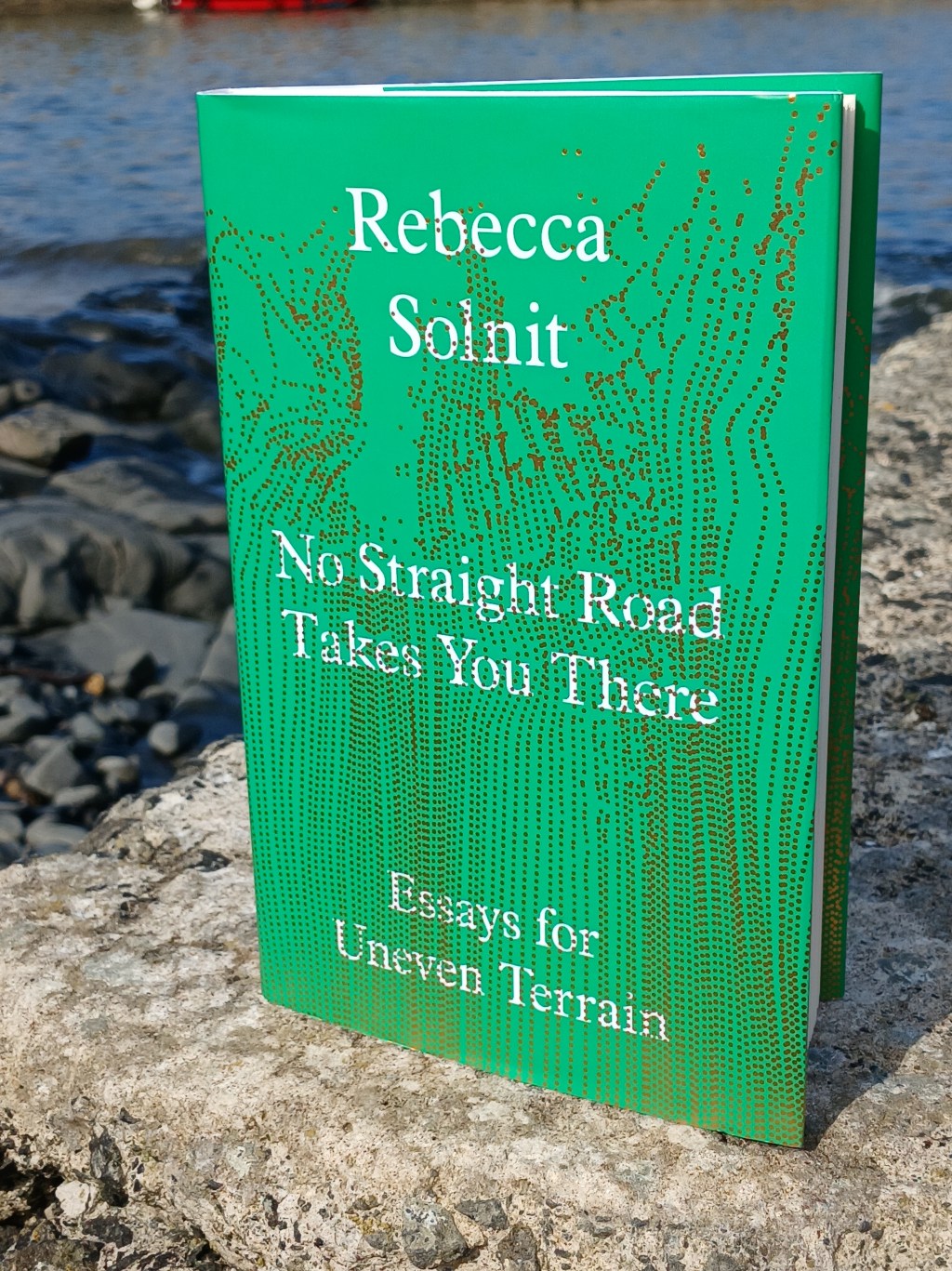
These words of Hillary matched the theme of Solnit’s ‘No Straight Road Takes You There’ so aptly that they seemed like the epigraph. In both cases, saving lives at sea and climate activism, the work of volunteers is vital. Those people who understand that something must be done and who don’t wait for Superman to turn up to alter lives positively. People who understand that the right thing to do is still the right thing to do, even in the face of difficulty and challenge. The metaphorical storms of fossil fuel deniers and delayers meet the physical storms of oceans and seas and remind us that we can still steer to safety. As Solnit states, “In embracing the truth that, although we may not know how and why something might matter when we do it, may nevertheless matter immensely.”
This structured ‘meander’ through past essays by Solnit reinforces that activism and community building makes a difference. A difference perhaps not realised until years have passed. After all, as Tolkien writes, ‘Not all those who wander are lost,’ and the unconventional path of bravery and long-termism outlined in this text might create new paths and futures that are, as yet, undreamed.
Travelling to the New World
There is no doubt that when Solnit wields words that they have power. She is a visionary storyteller, who understands that we are on a journey to a new time and a new place, one which will require the power and magic of stories to bind us in unity of purpose..
“We are leaving behind our old familiar world whose stability we can remember as a great kindness and entering into a rough new set of circumstances. Like refugees leaving a place, we are leaving a time. What should we carry with us?… We will need stories more than ever.”
Recognising and identifying this new world requires not forgetting the past, but accepting that it is us, now, who have been brought to this time and place to be the guides for those who will follow. “We must have landmarks and dreams ahead of us to orient ourselves, to remember that it has been different and could be different. We must have a vision of what our toil is for and how we will know when we get there.” As a species, we have been bound by stories, by great stories and tales, which have helped us understand our world and our place within it. “We were guided by stories, the old ones passed on, the new ones we made like rafts in a flood, the ones we told like water to pour on fire. Stories arose from this time, of this time, who did what was needed and those who stood in the way, and those who changed minds with their stories, of those new stories in which we saw a new heaven, a new Earth and a new humanity.”
Action is shaped by vision
Solnit argues convincingly that actions and words can bring about change, which can sometimes build under the surface until the moment comes and that nothing is as powerful as an idea whose time has come. “In embracing the truth that, although we may not know how and why something might matter when we do it, may nevertheless matter immensely.” She follows this concept of actions making a difference, by stating, “But even when the rock’s on the bottom of the pool, the ripples are still spreading.” Leaving the reader to wonder whether a new world can be brought into being simply by using the words to imagine that hopeful state. “Once you create a new idea of what is possible and acceptable, the seeds are planted.” Solnit quotes Joe Lamb, who reframed the ‘those who forget the past are doomed to repeat it’ aphorism and instead draws hope and courage from the many successes of the past and that the unforeseen happens more regularly than history notes. “We need to remember that we can learn from and repeat the successes of our past.” The tipping point of actions, words and community building may be closer than we think and all that is needed to activate this seed of an idea is to provide it with supportive water and care. What then blooms, could be transformative.
Solnit repeatedly reminds us that a new story of climate activism is possible and that a drip of water can eventually wear down a stone. In an up-to-date example, the International Court of Justice has recently ruled that countries must prevent harm to the climate system and that failing to do so could result in their having to pay compensation and make other forms of restitution. In a landmark case, brought about after years of campaigning from a group of Pacific Island law students, climate justice and a legal precedent for the future has now been created by an international court. The UN Secretary- General António Guterres said “This is a victory for our planet, for climate justice, and for the power of young people to make a difference.’
‘With courage nothing is impossible.’
A new evolution and a new story has been created by threatened islanders who understood that there would be no straight and easy path to their outcome, but that they had to make a path for others to follow. Solnit quotes Antonio Machado’s words:“Walker, there is no path; the path is made by walking.” For so many of our destinations, no straight road takes us there. The route is over mountains or through forests and beyond what we know.”
No Fate, but what we make
Solnit openly acknowledges that there are forces that try to obscure and obstruct the new possible stories of optimism. “Despairs’ cheerleaders offer the same message that institutions all around us do: that we are powerless, that power resides in the few, at the center, at the top. Part of resistance must consist of refusing to believe them, and that can be reinforced by better versions of history and theories of change.” She argues that despair’s message relies on trying to force the belief that the future is preordained and that we have no escape. Instead she argues, “If we can recognize that we don’t know what will happen, that the future does not yet exist but it is being made in the present, then we can be moved to participate in making that future.” Or in a more film-friendly manner- ‘No fate but what we make.’
What a powerful story- that we are the agents of the future. That we can decide ‘what to do with the time that is given us.’ That we can be the best of all ancestors. We are trying to be good ancestors, to make a world in which the land that, in the past, fed many species, including ours, will feed them in the future.
There is a risk to hope, in that it challenges those who wish for the story to be unchanged. Without speaking out and fighting for change, those with power will continue to silence those voices whom they deem as lesser. A democracy of voices is what can be brought into being.
“To hope is to risk. It’s to take a chance on losing. It’s also to take a chance on winning, and you can’t win if you don’t try.”
Changing the Climate Story
Perhaps new climate stories are being told if we have eyes to see. Walt Disney’s ‘Moana’ does not at first sight seem a strong contender as being a climate story, but when we have an island under attack, with crops failing and fish disappearing and our heroine being told repeatedly not to sail beyond the reef and change the story, but to accept what is happening- all at once the climate bells start to ring. By choosing to listen to her ancestors, in the guise of her grandmother and visions, Moana leaves this narrative of isolation behind and remembers the power of ‘We were voyagers’ and that seeking a new world and a new story is an option for us all.
Solnit also argues that “We are hemmed in by stories that prevent us from seeing, or believing in, or acting on the possibilities for change.” But that to become true agents of the future we need to inspire and create new traditions. “In order to do what the climate crisis demands of us, we have to find stories of a livable future, stories of popular power, stories that motivate people to do what it takes to make the world we need.”
Everything we can save is worth saving
Solnit concludes by reminding us that vested interests want us to be silent and to accept their story. “They want you to feel powerless and to surrender and to let them trample everything and you are not going to let them. You are not giving up, and neither am I. The fact that we cannot save everything does not mean that we cannot save anything and everything we can save is worth saving.”
I may be forgiven for returning to Tolkien once again by quoting this in full.
“It’s like in the great stories, Mr. Frodo. The ones that really mattered. Full of darkness and danger they were. And sometimes you didn’t want to know the end. Because how could the end be happy? How could the world go back to the way it was when so much bad had happened? But in the end, it’s only a passing thing, this shadow. Even darkness must pass. A new day will come. And when the sun shines it will shine out the clearer. Those were the stories that stayed with you. That meant something, even if you were too small to understand why. But I think, Mr. Frodo, I do understand. I know now. Folk in those stories had lots of chances of turning back, only they didn’t. They kept going, because they were holding on to something. That there is some good in this world, and it’s worth fighting for.”
 Climate Thoughts with Brian