
‘It’s now cheaper to save the world than destroy it.’
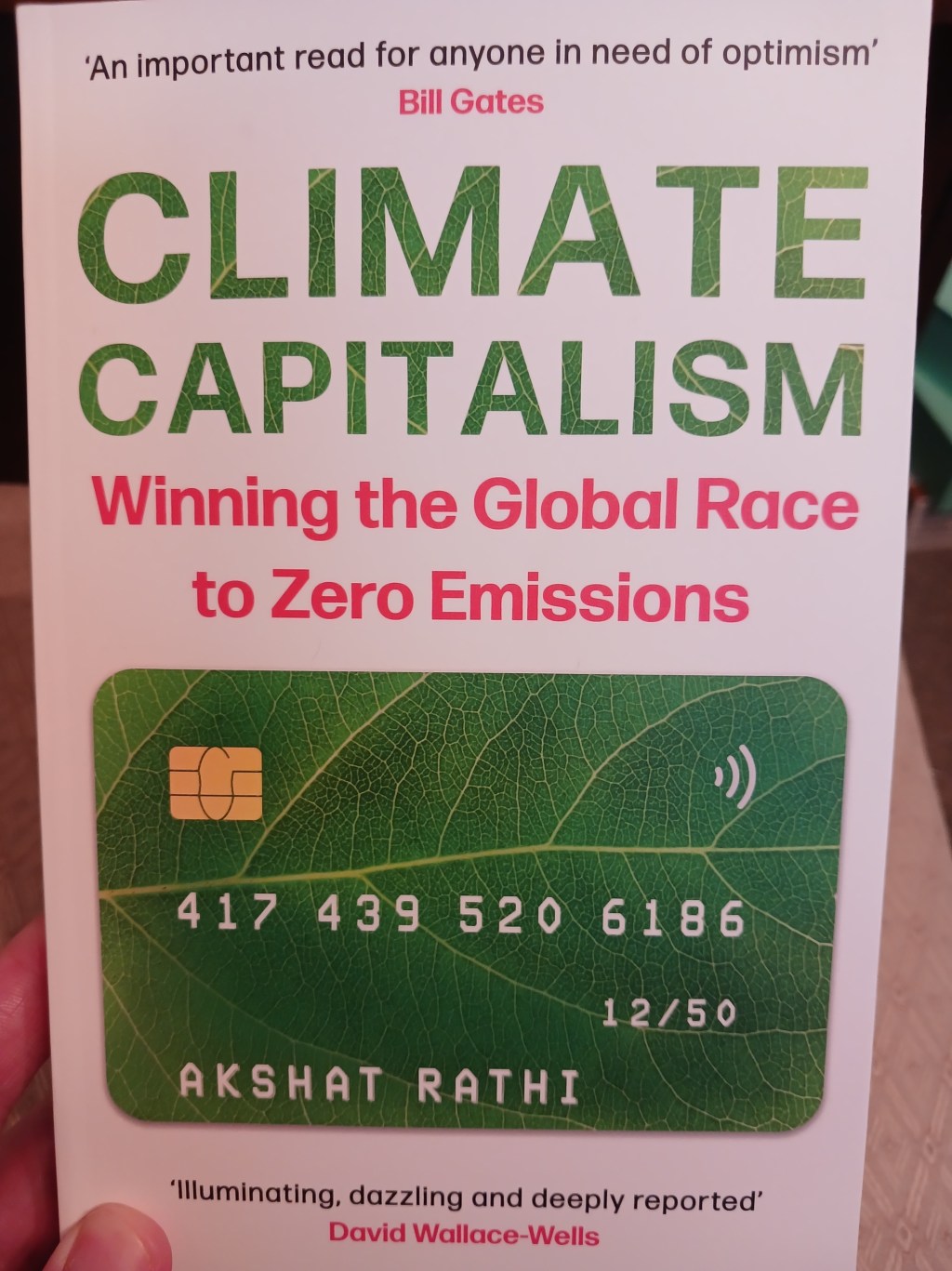
Rathi’s ‘Climate Capitalism’ starts with a stark economic argument, one which might resonate with economists, company directors and policy makers, but misses the mark somewhat with the public.
The book charts so-called ‘unlikely heroes’ who have had long-term visions and through timing, solutions and being the right person at the right time, have started shaping the solutions to help some companies on the path to net zero. It is difficult and challenging to read a book which urges us to break the narrative that capitalism and capitalists are ‘bad’, especially when Rathi himself is clear from the outset, ‘There is no denying that unfettered capitalism has contributed to warming the planet.’
However, he does not advocate an overthrowal of this capitalist system, instead arguing that transformation from within the system will lead in a timely fashion to emissions falling. ‘Climate Capitalism is about how we tackle climate change within the world’s dominant economic system and ensure that the wheels of progress don’t come to a halt, or, worse, go into reverse.’
He correctly praises individuals, sectors, countries and organisations who have ‘seen the writing on the wall’ and which have implemented systematic change, but then also notes and acknowledges that many companies still engage fully with ‘greenwashing’ practices, which eventually lead to their shareholders attempting to influence the direction of the company. ‘Greenwashing is rife in the corporate world, and companies rarely live up to those promises.’ But are we left with a satisfactory argument and resolution? Those named and praised in the book- those pushing innovation, still end up with their companies profiting- and their time scale is in decades. They have a long-term vision, but can they scale this up in the short term? Rathi argues that ‘Getting to zero emissions on a deadline will mean changing everything.’ At the same time, he appears to contradict himself by saying, ‘How far we push them is up to those in power. If they don’t act, then it’s unlikely the vast majority of people will sit still and suffer the consequences.’
He appears to leave change to those ‘in power’, arguing correctly that organisations are made up of people who can determine the direction of the future, but the stakes of a stable climate seem to be too high to be left to a few. Without serious and significant consequences for those countries and organisations who don’t follow the ‘nudge’ of good climate behaviour, there seems to be little incentive for them to act.
Simply exchanging the evil, old capitalists of the 20th century, for the transformed, new capitalists of the 21st century, hoping that they will be our economic saviours, is an argument that fails to be persuasive.
Overall, this book didn’t quite connect.
Yes, it identifies sectors, countries and organisations that have shown promise and holds them up to be praised. Yet, this seems an empty gesture while global emissions continue to rise and extreme weather events happen on a daily basis around the world. It seems empty and nowhere near the scale urgently needed to argue, ‘We can still be profitable and ‘green’’. It spends a chapter praising the ‘poster child of the energy transition’- Ørsted- but acknowledges that we don’t have the luxury of time anymore, leaving readers confused as to the overall point of this chapter. It is not enough to praise a company for a change over decades and then conclude by saying, ‘But we don’t have this time anymore!’ ‘And it happened, not over years, but decades. That’s not the kind of luxury available under tighter climate deadlines.’
‘Climate Capitalism’ has been touted as the book to transform the market place and with language like ‘entrepreneurs’, ‘venture capitalists’, ‘investors’, ‘financiers’, and ‘opportunities’ it seems to have a clear target demographic, for rational, logical, efficient investors who are looking to fund new technology to reduce emissions, within the capitalist system. New technologies such as direct air capture plants and carbon capture and storage technologies are floated as being within grasp, but then the book weakens its own argument by acknowledging that ‘CCS hasn’t been able to shake off its link to the fossil fuel industry and attempts by these powerful companies to sow doubt about climate science.’
The external levers suggested in the book such as rampant customer demand for greener products and carbon taxes also have not fully materialised as market changing. The book describes the ‘Unexpectedly fast decline in the cost of solar power, of about 90% between 2009 and 2019.’ It focuses on India and the Pavagada Solar Park, but does not fully make the links as to why solar panels have not changed the fossil fuel marketplace, despite their low price.
This book raised more questions than it answered unfortunately. Can we really trust economists to save our way of life and lives around the world? When capitalism has brought us to this point, why do they then deserve such trust, when they have exploited that trust for decades? It appears to also ignore populist political parties and individuals with large and proven links to the fossil fuel industry, which repeatedly delay climate action and pathways to reduce emissions. A clear example would be Reform UK, a newly formed right-wing party in the UK, who recently stated, ‘We at Reform serve notice to wind and solar developers and investors Invest at your own political peril’.
What is needed to win the global net zero race?
Perhaps ultimately, it’s the focus on people and their drive and determination to change the world in ‘Climate Capitalism’, where hope and optimism can be found.
Multiple levers all pulled at the same time will help the global race for zero emissions. Can capitalism help? Yes. But an energy transition suggests just that- a transition. Exclusively using the same models of the past and having economic growth as the sole goal, will not bring about the sustainable energy transition that the world needs.
‘It’s no longer climate against capitalism; it’s clear that increasingly the champions of capitalism want climate to be a problem that capitalism can solve rather than worsen.’
 Climate Thoughts with Brian