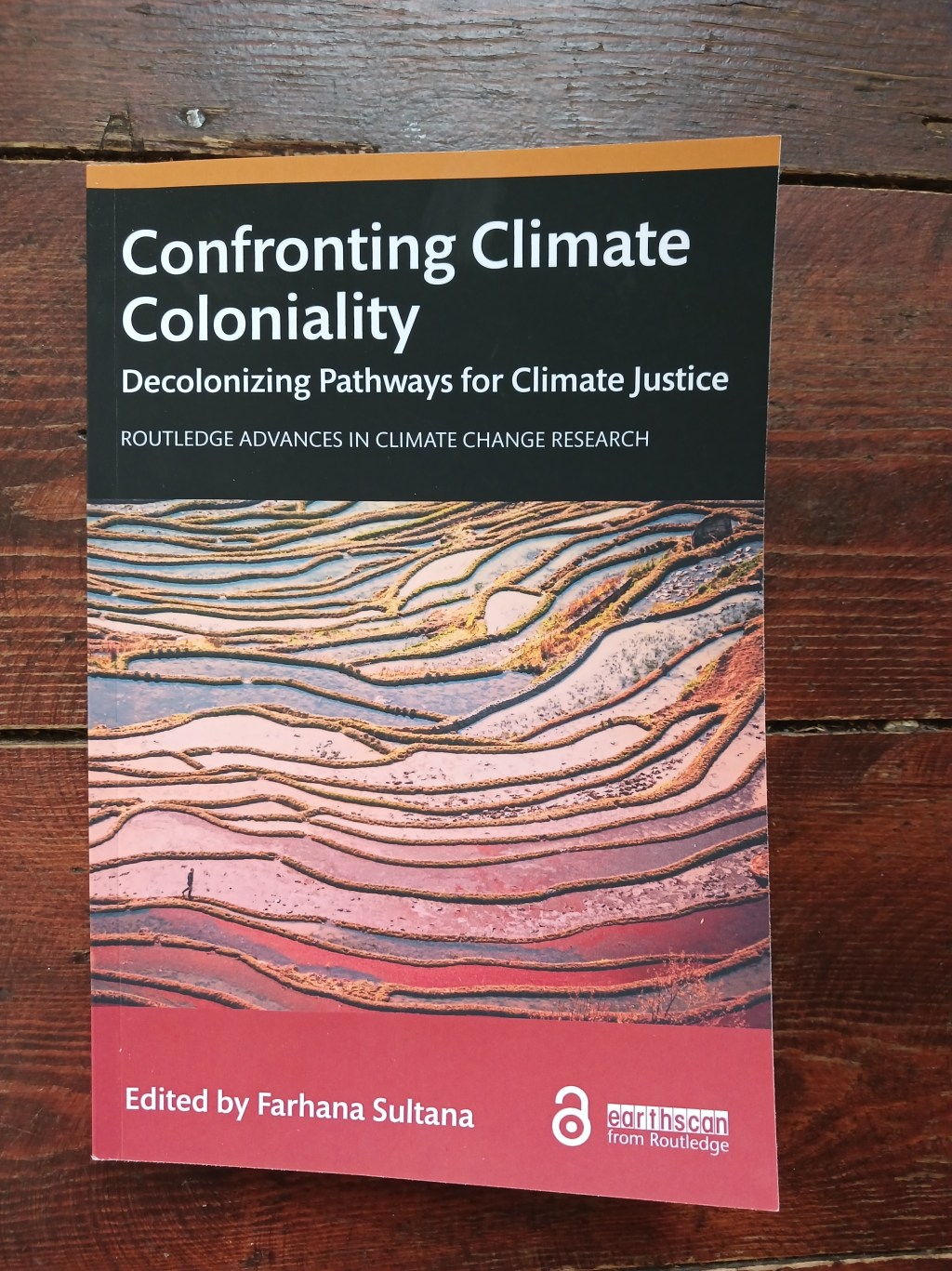

In the 2025 documentary “Ocean with David Attenborough”, industrialised modern fishing trawlers were described as ‘modern colonialism at sea’. A stark phrase which highlights the argument central to ‘Confronting Climate Coloniality’- that a colonial mindset is still at the heart of over-exploitation, resource stripping and profit building. The documentary stated, “Few wealthy nations are starving local communities of the food they have relied on for millennia. Modern colonialism at sea.” Confronting this colonialism by acknowledging, exposing, defying, challenging, transforming and replacing this narrative will help us grapple with the most critical issue of our time. Colonialism exists and attempts to deny its power and be wilfully blind to the imbalanced power dynamics thereof leads to climate injustice. Or as Farhana Sultana summarises, ‘…colonialism still haunts the past, present and future through climate coloniality in multiple ways.’
In the text, Sultana powerfully argues that, ‘Climate lays bare the colonialism and imperialism of not only the past, but an ongoing coloniality that governs and structures lives, institutions, laws and policies, which are so-constitutive of processes of capitalism, imperialism, international development, and geopolitics.’ She exposes a ‘culture’ of hyperconsumption and land control from dominant parties, whether countries or organisations have severe consequences for local peoples and biodiversity. ‘Extraction and exploitation leave behind place-specific pollution, devastation, and loss, much of which is irrevocably irretrievable or recoverable.’
The Fossil Fuel Empire
Different contributors to the chapters then develop this initial argument and frame climate coloniality as resistance to the fossil fuel empire and its impact. Joshua Long argues that, The coloniality of power runs through the history of the climate crisis. It is arguable, its most dominant throughline.’ He explores the term ‘climate apartheid’ within the context of this ‘coloniality of power’. Bernardo Jurema and Elias Kȍnig explore how states continue to exert and maintain ‘control’ by creating and fortifying their monopolies of fossil fuel infrastructures and profits, ‘Imperialism has made quite a comeback.’ They argue that blocking challengers to their markets has allowed states and organisations to prosper in this colonialism space. ‘Intervention can serve both to secure access to fossil fuels and supply routes, but also to destroy/ block challengers to existing monopolies.’ Jurema and Kȍnig do note however, that historically imperialist states are often successfully challenged and imagine a future where this legacy is left in ruins and a cooperative future is built. ‘This tradition carries the hope that the ruins of fossil empire will one day be inhabited by relationships of solidarity, care and repair- a future worth fighting for.’
The shapeshifter of ‘colonialism’
As noted by Andrew Curley, colonialism remains a shapeshifter and no more in the guise of cooperation and negotiation- at the expense of Indigenous communities.Jamie Haverkamp warns about the scarcely hidden colonialist ‘knowledge extraction’ from Indigenous peoples.
‘Recommendations to “share” Indigenous knowledge and technologies with high adaptation potential and mitigation co-benefits are put to Local Communities and Indigenous Peoples Platform (LCIPP) from various state-and expert-led bodies within the UNFCCC.’ This point is echoed by Andrew Kalani Carlson, when he argues that,
‘When climate change mitigation strategies replicate and perpetuate coloniality, they are ultimately counter-productive and ineffective.’ Decolonizing for climate justice then, does not just mean inviting Indigenous peoples and threatened communities ‘to the table’- a table already skewed and imbalanced with fossil fuel interests- but instead to systematically redefine the parameters of the injustices. As Sultana argues, ‘It is not just about having a seat at the table, but determining what the table is.’
Who controls the land?
Throughout the text, the implicit and core question of land ownership and control repeats strongly. How one party creates a narrative that an area of land or space is worthless or empty, so that they can exploit it for their own purposes. This form of capitalist imperialism is thoroughly discussed by Danielle Zoe Rivera and Eliza Breder when they explore the impact of Elon Musk’s SpaceX facility in the Rio Grande Valley, raising vital questions about land use, land control and who has the financial power to gain the stronghold. They argue that the false and misleading narratives of terra nullius– ‘nobody’s land’- as a means of appropriating land, ignore sites which are central to the sacred sites of Indigenous communities. ‘An empty space narrative both on earth and in outer space enables climate coloniality through extractivism.’ Rivera and Breder conclude, ‘Claims of empty-ness or no one-ness should be met with a default of skepticism. These narratives evoke the classic colonial mindset of terra nullius, which has been used for centuries as a tool of dispossession and environmental degradation.’ They continue, ‘No land is “empty”, it is embedded with histories, culture and stories creating places that cannot be found elsewhere. Protecting these spaces from pollution and land control simultaneously protects them from erasure.’
Therefore, the ‘Gulf of Mexico’ cannot simply be renamed the ‘Gulf of America’ because President Trump demands this to be the case. And yet, online maps were changed to this new nomenclature, erasing and eradicating the previous title. Is this how simple it is to erase an established claim, simply on the basis of a capitalist, exploitative narrative?
Resistance is not futile
How we break, resist, or confront this capitalist colonialism relies on decolonizing societal structures and our mindsets. Sultana argues, ‘Ultimately, there is no single blueprint for decolonizing climate, as decolonization is a process and not an event…This is because hyperconsumption and land control have severe consequences for local peoples, biodiversity and ecosystems.’ Manisha Anantharaman asks us, especially those of us in the Global North, to be ‘comfortable with the uncomfortable’, by bearing witness and to acknowledge the past. ‘Decolonizing means acknowledging history, bearing witness and from this place of unrelenting discomfort, attempting to configure pathways to remove colonial and imperial powers in all their forms.’
The climate crisis is here. Methods of mitigating the suffering and reducing harm will not ultimately be successful if they rely on the colonial methods that have led us to this point. A new, ethical, just and inclusive narrative is needed now to help build the future that allows for climate justice.
‘Climate change is no longer a distant threat; it’s a harsh reality inflicting untold suffering across the globe.’
 Climate Thoughts with Brian