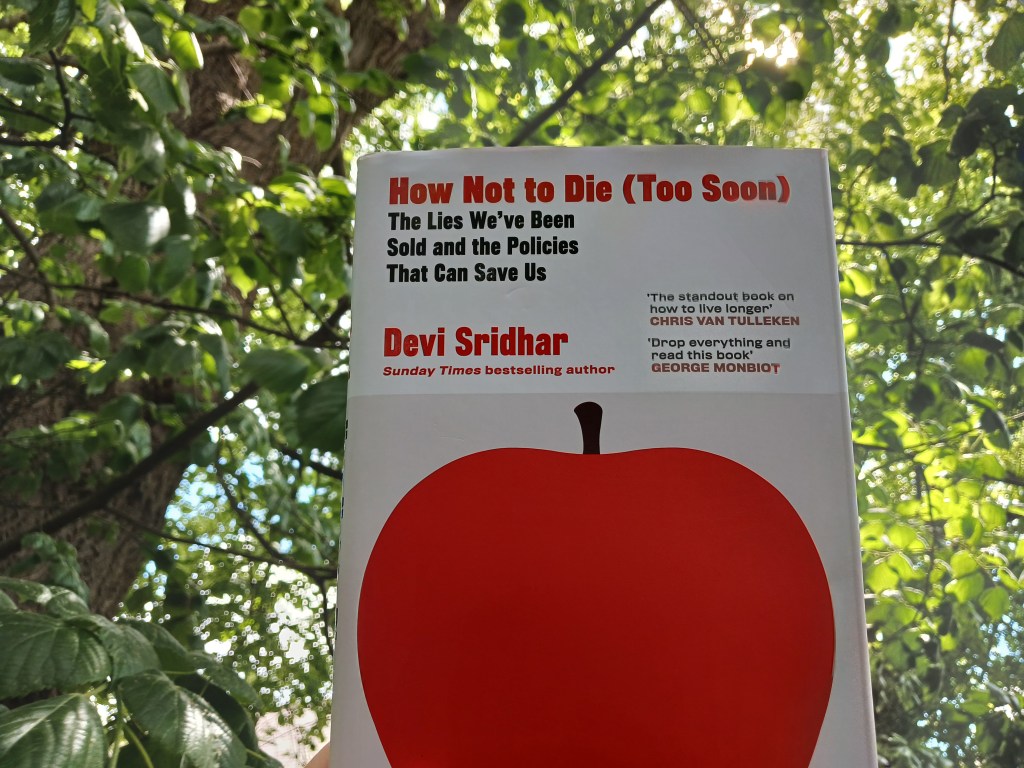
Professor Devi Sridhar comprehensively exposes the ‘lie’ of individualism within the global health crises and challenges us to switch to a narrative of more government accountability for the policy decisions which affect us all. She argues that where you live matters to your life expectancy and that the expected behaviours, driven by government action and inaction within that context, can shape not just your life, but the quality of that life. ‘We know from scientific studies and decades of public health research not only how to increase life expectancy but also how to maintain quality of life.’
Sridhar uses the age of 100 as the collective target for lifespan and explores reasons why this is both attainable and unattainable around the world. She comprehensively chronicles nine of the most important risk factors which impact our ability to live longer lives and challenges us to recognise the bad actors, companies and individuals, which stand in our way. ‘We have been focusing on the wrong thing: namely, we have been focusing on ourselves. This means looking at government policies that promote long lives…nine of the most important risk factors affecting healthy life expectancy in all countries: physical activity, diet, smoking, mental health, gun violence, safe roads and transport, clean water, clean air and access to quality health care.’
Why can’t we all live to be 100 years old?
Again and again Sridhar makes the point that the steps needed to enact these policies for longer living are well known and that it is societal accountability that lies at the crux of the problem. ‘We know how to prevent millions of unnecessary early deaths around the world, both in developing countries and closer to home.’ If we know how to prevent millions of early deaths around the world, the implicit question becomes why have those lives been targeted as being expendable and who has made that choice that some- in most cases, the wealthiest- lives are more valuable and need more protection than others. It would have been too easy for this book to turn into a polemical rant about obstructive capitalists intent on growth over human suffering, but Sridhar side-steps this effectively and instead presents examples where countries and communities have successfully changed, adapted and evolved, to better protect all its citizens. Her goal is clear, ‘My aim with this book is to show you that we know what works in solving the major health challenges.’
‘This is a book about how to live longer’
Sridhar also makes it emphatically clear that, ‘This is not a book about how to die. This is a book about how to live longer.’ There is a strong focus on family and the power of human relationships which echoes through the book, aspects of life which can enhance our human experience. She quotes her ‘Nani’, recently celebrating her ninetieth birthday, whose mindset was ‘it’s not about how to die. It’s about how to live.’ That treasuring the accidents of our lives is important, as ‘life is special because it is finite.’ Therefore, a longer life span is possible, is attainable and should be a birthright of all. Sridhar reminds us that in the mid 19th century, a life expectancy of 40 was not seen as being ‘mid-life’ or ‘middle-aged’. She celebrates how far we have come since then and questions why an extension of a healthy life should not be the new expectation. ‘In 1841, life expectancy at birth was roughly forty years old…Back then, forty wasn’t mid-life: it was life.’
Of course, the nine risk factors which Sridhar explores in the text, were not so prevalent in the mid-nineteenth century, although avoiding cholera outbreaks through drinking unsafe water, which the UK identified through the efforts of John Snow, is still a lived experience for millions around the world today.
Transforming the health expectations
Of the many global examples which are used by Sridhar, the Netherlands is highlighted as an example where ‘it wasn’t always like this’, but rather where the cities were designed and structured to ensure that health was a priority. Therefore, if examples exist, it becomes logical to understand that they can be replicated in other cities and countries. Paris, in France, also aimed to put the health of citizens as an integral part of daily life through its creation of ‘Fifteen- Minute Cities’- whereby ‘a city should be designed so that most of people’s daily errands, work, education and life can be carried out within fifteen minutes (by foot or bicycle) from their home.’ Nothing inherently unusual or controversial there, when building a healthier future was the goal. ‘The way to shift physical activity at a population level, as shown by Amsterdam and Paris, is to build it into daily life so that it becomes practical, invisible, free (or cheap) and social.’
Unfortunately, in recent years, populists have gained traction by referring to these cities as places where you only have ‘15 minutes of freedom’ and that these health measures are ‘Stalinist-style.’ In this, Sridhar identifies some of the obstacles and challenges faced by countries which try and build long term healthier communities for their citizens; that these are delayed by political interests and vested interests, which look to protect their profits and cause division.
Early deaths globally could be prevented through effective change and adaptation to more physically active lifestyles. ‘The World Health Organization (WHO) estimates that 4 to 5 million deaths per year could be averted if the global population were more physically active.’
Sridhar makes the convincing argument that, ‘Just telling people to move doesn’t work if they can’t implement this advice within their daily life and routine.’
Government inaction rather than individual lack of discipline
Changing daily routines such as diet, as well as exercise, should be led by government policy and action, argues the author, where she acknowledges the complexities of relationships with food and the financial implications of eating healthily, but summarises how governments should behave. ‘Make it easier to eat well and harder to eat badly.’ She follows this by emphasising that markers of ill-health indicate where governments have failed. ‘Similarly, a population being overweight is a sign of government inaction, rather than an individual lack of discipline.’
Several examples are highlighted where government regulation and action have led to increased health outcomes for citizens. Sridhar evaluates the positive impacts of the UK government’s measures regarding behaviours around smoking, and how quickly attitudes and the culture around smoking changed, when the government intervened to safeguard the public. ‘First, make it harder to smoke through taxation, minimum purchase age, bans on ‘kiddy packs’, and ensuring cigarettes aren’t visible in shops. Second, reduce the ability of people to be able to smoke in social or work settings. Third, counter the marketing and advertising of tobacco companies which are selling a dangerous product that literally kills.’ With increased health outcomes, this also lessens the strain on access to health services, which is also explored fully by Sridhar, who suggests that these health issues should all be seen as intertwined and connected, rather than discrete issues in their own right. However, she also makes the repeated point that, ‘Regulation only works if it’s enforced.’
Gun control and regulation
Shifting focus to America, Sridhar again highlights how the interests of a few can drive government policy, so that citizens there do not have the same chance of a healthier, longer- life span. She focuses on ‘freedom’ making the clear point that freedom of children to be safe appears to be of less national importance than the freedom of people to have firearms. ‘The gun lobby is a small minority who resist any change because it impinges on their profits.’ She compares school shootings in the USA, with the school shooting in Dunblane, Scotland and draws attention to a powerful group who can bring about change- the parents of dead children. For people to have the equal chance to enjoy longer life, gun control is a successful government measure and demonstrably works. ‘Gun control worked in Britain. As the Gun Control Network says, it ‘proved that good governments acting in the interests of the many, not the few, can overcome the rich and powerful gun lobby.’ She questions why the government does not intervene to protect its people-’If we know what works, why isn’t it being done?’ and notes bluntly that, ‘Getting shot at school is one of the most likely ways for a child to die in America.’ Cutting through the complex ideology and associated cultural identity that is linked with owning a firearm, Sridhar returns clearly to her underlying argument- ‘How Not To Die (Too Soon) in America, answered in part by strict gun control laws.
Access to equality
Sridhar then turns her focus on the inconsistency around the world where access to clean water, clean air and medical care is often problematic. She draws attention to the statistic that, ‘In 2023, the UN estimated that 2.2. billion people did not have access to safe drinking water.’ Over a quarter of the world’s population could not access safe drinking water in 2023- but this is only the beginning. ‘By 2025, the UN predicts two thirds of all people on the planet will live in water-stressed areas. There’s no ambiguity with water compared to other goods: humans, animals and plants cannot live without water. Find fresh water, or die.’
When there are concerns over the safety of drinking water, then this is when private companies swoop in with bottled water- making a profit out of the situation, rather than seeking to remedy a basic human need. When faced with statistics about access to safe drinking water, sometimes readers in Western Europe can feel that they are exempt from these concerns- but, as the recent ongoing sewage concerns and poor health of waterways in the UK demonstrates, having access to clean water affects developed countries as well. Schools have even closed in the US over water issues.
When we have a limited resource, which is necessary for life, then conflicts can begin over ownership of that resource. Sridhar again challenges us to imagine this scenario where a resource is privately owned and monopolised, as well as the extreme situation. ‘Can you imagine a world in which there is no fresh water?’
We are victims of circumstance in terms of geography and economic systems. Some of us can move to avoid the worst impacts and thus experience longer healthier life-spans, but this is not an option available to all. Although some risk factors are within our control, Sridhar turns to the most obvious one which is not in our control, whether we live in Switzerland, India, South Africa or the UK- the quality of our air and the impact of air pollution. ‘Dr Maria Neira of the WHO said, “The problem is that when you’re a citizen, you can’t choose the air you’re breathing. You breathe whatever is available.”’ The need to have clean air to help people enjoy healthier lives didn’t used to be a political football or a partisan issue. It has been viewed as a UK-wide public health issue, until recently, when populists used clean air as ‘anti-car’, once again prioritising the capitalist profits of industries over the health of the population. ‘The backlash against clean air measures is baffling: we all live longer with cleaner air, and the issues should have widespread appeal.’
Being happy with living
‘How Not To Die (Too Soon)’ outlines a blueprint then- a hopeful pathway to a healthier world. A pathway which identifies and challenges why the needs of the many don’t outweigh the needs of the few, or the one. As demonstrated time and time again in the book, countries around the world have identified the risk factors for their own people and have then enacted long-term solutions which change the attitudes and behaviours permanently for the good. Governments can be powerful instruments of good, which leave no one behind. ‘That’s the politics of hope: we must imagine a healthier world and take the public policy steps towards it.’All that remains is to change the political will and to make health a priority, in order to improve life for all within a society.
After all, ‘Life isn’t about not dying too soon. It’s about enjoying and being happy with living.’
 Climate Thoughts with Brian