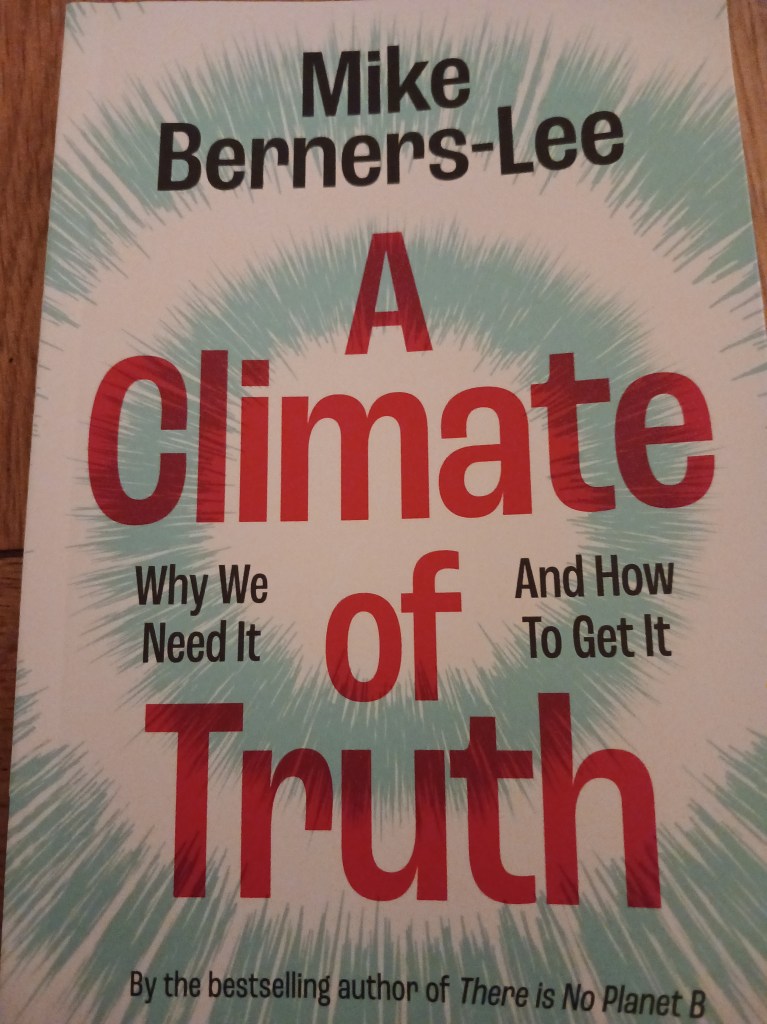
Mike Berners-Lee’s fresh new book challenges us all that we deserve more on climate communication, that we should expect more and finally, that we have the agency to demand more on climate communication. He calls for a new high standard of honesty and truth to reset the moral balance and reminds us that the standard we walk past is the standard we accept. When we choose to support media which lies and distorts. When we choose not to hold politicians to account for their self-serving behaviours and when we support businesses for our own convenience when we are aware of their links to fossil fuel companies.
This text A Climate of Truth follows Berners-Lee’s other famous books, There Is No Planet B and How Bad Are Bananas?, therefore we expect the same rigorous standards and evidence and in this, we are not disappointed. Berners-Lee cautions us that, ‘If humanity is to thrive in the decades ahead, the most critical step is to raise standards of honesty in our politics, our media and our businesses.’
He calls for an interruption to the failed system which has led us to this point and describes an emerging polycrisis of interconnected factors, which requires a new system of political cooperation and functionality to manage and adapt to these new threats. ‘This book is about the fact that humanity is accelerating into a deadly Polycrisis… yet in spite of this, our response continues to be hopelessly inadequate.’
He argues that the challenge facing us requires us to face the habit that has brought us here and then to break this habit, so that socio-economic trends do not continue to rise unabated. He argues, ‘The climate and ecological emergencies we face must transcend party politics and in the end will require a huge evolution of how political systems function and how all parties conduct themselves.’
Growth begets growth
Berners-Lee outlines the seven ‘outer layers’ of the polycrisis- ranging from components such as climate, energy, population, food, biodiversity, pollution and disease. He carefully unpacks each of these in turn and asks the question as to why we aren’t solving some of the technologically solvable problems. He does not present technology to be the silver bullet, but instead warns us about the dangers of ‘techno-optimism, that ‘tech-centricity assumes and hopes that our climate problems are only skin-deep and that our fundamental approach to business, technology, politics and society can remain in place.’
Instead he urges that there should be an interruption to the current systems. ‘You have to interrupt the carbon curve at the global system level.’ He notes that global emissions are still rising even after 28 COPS and that demand-reduction could be a critical pathway. He observes that even the strong pledges and commitments on plastic reduction have not made a dent in this rapacious business model. What we have been doing, has not worked.
‘The world now uses around 500 million tonnes of plastic per year, of which just 6% is from recycled materials and the rest is virgin, made almost entirely from fossil fuels.
Berners-Lee makes no excuse that multiple levers have to be pulled on simultaneously to achieve the necessary dramatic actions that we need, but that the most important lever is to create a culture of truth. ‘Demand reduction is the most critical and under-discussed component of the drive to leave fossil fuels in the ground. The fossil fuel companies hate the idea of using less energy, and they work hard to protect us from understanding the clear-cut need to do so.’
We must consume less and be more.
A Climate of Truth strongly advocates for a circular economy, rather than a consumer driven, capitalist based model. ‘We have developed societies based on consumerism rather than citizenship; we think more in terms of what we can have than in terms of what we can contribute.’ Berners-Lee stresses that we should remember that it is industry which have created these narratives in order to develop and preserve their own financial survival. ‘The fossil fuel industry makes more money the more coal, oil and gas we burn.’
In truth, there are few surprises in this book for an audience who are well versed in the duplicity of the fossil-fuel industry and its shills. Shill who constantly deter and delay the necessary climate action that will keep the level of suffering to a minimum by 2100.
‘In a survey of 380 climate scientist lead authors of IPCC reports since 2018, only 6% think the climate will stay below 1.5℃ compared with 42% who think we will go beyond 3℃.’ To note the countless extreme weather events which are observed in a 1.2℃ world, it is almost impossible to imagine what a possible 3℃ world might look like.
The choice is radical change or untold suffering and death.
The book then investigates the middle layers of the polycrisis before moving onto the core of the issue. Although a lot of ground is covered by Berners-Lee, the book is wrapped around the central pillar that we have to learn from what hasn’t worked and that a deference to the capitalist ideologies and acceptance of untruthful words and behaviours is a choice that we can choose to break. We choose to believe in and accept untruthful politicians. We choose to support dishonest, environmental harm causing companies. We choose to accept corporate dishonesty and media monopolies as the norm. But it doesn’t have to be this way, urges Berners-Lee.
We are urged as individuals, communities and countries to insist on a better narrative- a narrative of Truth. To demand this narrative of Truth.
And this is where our voice can be strong.
‘To start making headway on all these issues and more, a climate of truth across politics, media and business is what we most need. And the wonderful news is that we can get it if we really want it. We just have to not put up with anything less.’
Berners-Lee closes his text with a powerful call to realistic hope. He reminds us that sometimes we can be in the middle of a movement and not see it for what it is- a social tipping point, a collective moment of truth.
Social tipping points can happen fast. We might be on the cusp of one right now. We might not need an unimaginably traumatic event to shake us into action.
We can each be a meaningful part of the change, and that is enough.
 Climate Thoughts with Brian