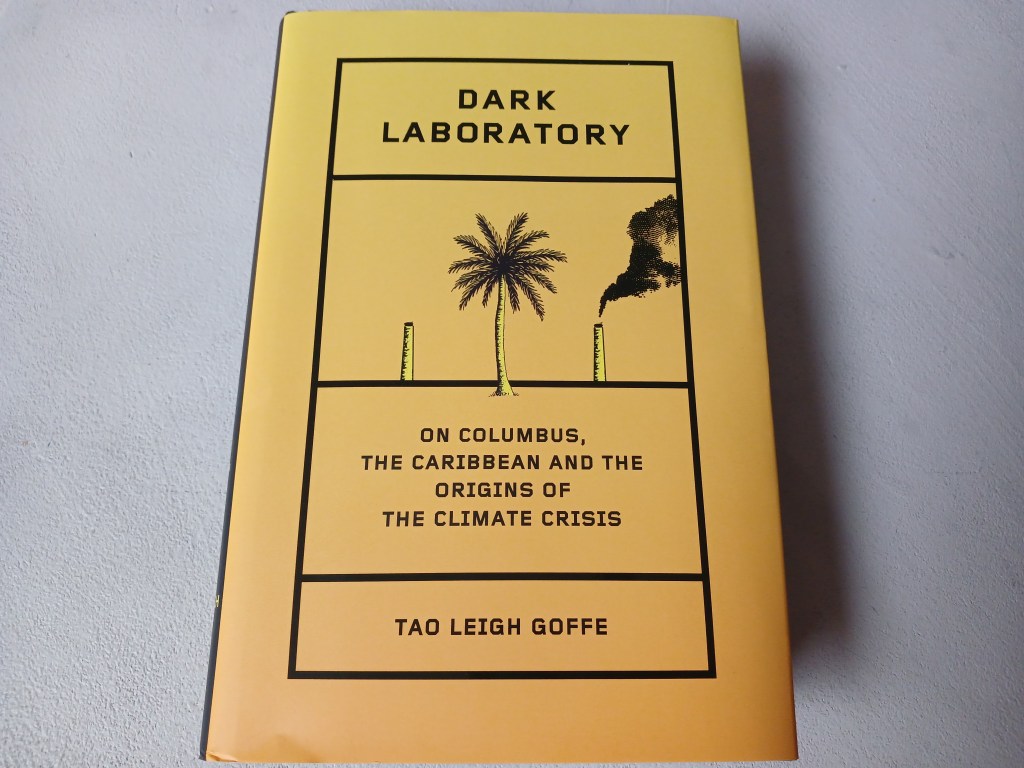
‘Dark Laboratory’ charts and chronicles the embedded and systemic colonial racism primarily from Western Europeans to those in the Caribbean, and argues that this ‘history’ should not have ‘a veil of ignorance’ pulled in front of it, but should be exposed, acknowledged, and a new narrative told. Goffe questions, ‘Yet, as a global community, we continuously fail to address the origin of the problem. Without economic and historical analyses of the origins of the climate crisis, how can we expect to understand its sedimented layers?’
She urges a new narrative that empowers communities long oppressed and which can be used as a powerful guide to help adapt to and mitigate the climate and ecological crisis. ‘We need new stories, new technologies, and new forms of nature writing.’
This book is a comprehensive, evidence-led study of the impact of colonialism and for Goffe this begins in the 1492 ‘discovery’ of the Americas and leads in an unbroken line to the 21st century. The players have changed, but the exploitative and extractive game is the same. ‘We are experiencing the consequences of a centuries-long cycle of exploitation of people of color, whom European colonial powers have forced to extract resources from the earth.’
Although this is a text which consciously looks towards the past, it also aims to break the cycle of the future- that future suffering need not be an inevitable future for millions. She states that not to break this cycle, could make us just as complicit as the arrogant and ignorant users of the past. ‘We must refuse to betray future generations, especially because we have been forsaken by so many before us.’
What’s past is prologue
Goffe calls on past strong, powerful leaders, to support us in our struggle and to have as examples. She reminds her readers of Queen Nanny of the Maroons and her refusal to betray those who would come after her. ‘Queen Nanny’s name echoes across the mountain ranges of the archipelago because she refused to sign the eighteenth-century British Treaty. She refused to betray the future.’ Interestingly, in the UK, Queen Nanny’s name should be well known to a generation of school students, who meet her in national exams, where the question of who gets to write history and who has the power to write history, and who gets to whitewash history, becomes the focus.
It is no accident also that Goffe uses arguably the most colonial Shakespeare play- ‘The Tempest’- to exemplify the historic struggles and conflicts between ‘native’ and ‘invader’. She continues to evaluate the colonial experimentation that played out in the Caribbean and asks, ‘What has the cost of imperialism been for the natural environment?’ She answers her own question by arguing that this European ideology led to the destruction of ‘Eden.’ ‘The mandate for discovery was a justification for ecological degradation.’ And continues that, ‘When Europeans arrived with the cross in the Caribbean, they could not help but see Eden.’
Goffe powerfully argues that racism lies at the foundation of the climate crisis and that the Caribbean has systematically been asset stripped for Western ‘trophy hunters’. ‘Racism structures the climate crisis because it was a part of its origins.’ She challenges modern day readers to accept this argument and to no longer be complicit in continued acts of racism- whether this be in the guise of modern day confrontations in Central Park (Cooper v Cooper), or in the mindset of policing and the justice system to black people, Rastafarians and Indigenous peoples around the globe. ‘To remain willfully blind to race is to enforce racist modes that lead to the premature death of racialized people.’
‘Too much evidence’
‘Dark Laboratory’ calls for a new kind of climate storytelling- one that no longer puts colonial and capitalist expansion as the priority and ‘norm’ of economic models. ‘Ultimately, hope rests on the caesura of capitalist expansion.’ With the book’s comprehensive and forensic analysis of the guano trade, coral coloniality, slavery, plant theft- which led to the rise of Big Pharma, animal theft and land theft, Goffe argues that there is simply too much evidence of the endemic racial ideology for it to be ignored, whitewashed or greenwashed.
She closes the text by imagining the next ‘New World’- ‘Time traveling from 1492 to the far future has been necessary for the scale of imagination of this book and will be necessary to face the climate crisis. Poets and policymakers will be critical to the scale of empathy we need.’
New stories will not however, be enough, by themselves, to stem the tide of rising sea levels, which pose a ‘death sentence’ for the Caribbean and other island states. If we cannot break the modern chains of never-ending capitalist growth, then climate disaster awaits, and the deaths of millions of Caribbean and Polynesian people will once again bloody our hands.
 Climate Thoughts with Brian