‘Breathe, said the wind
How can I breathe at a time like this,
when the air is full of the smoke
of burning tires, burning lives?’
-Lynn Ungar
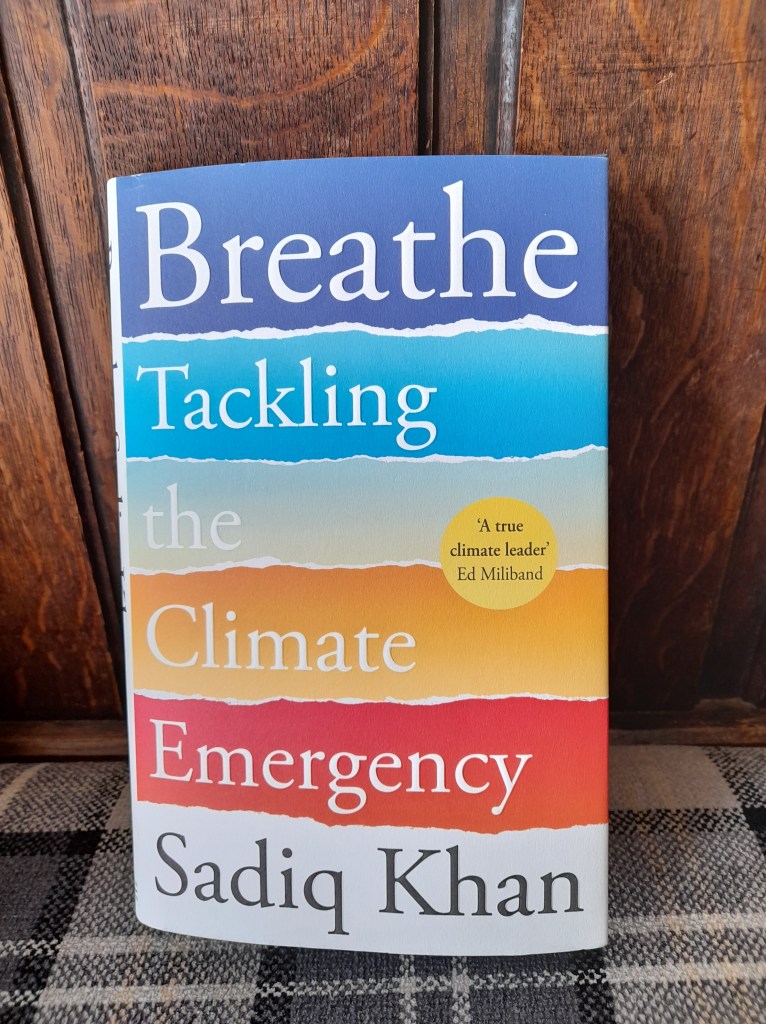
Despite the frankly ridiculous tearing up of Sadiq Khan’s book ‘Breathe’ by Talk TV presenters on live television a few days ago, no stunt by them can get away from the central point in the book.
Air pollution is killing people in London, and around the world, and it doesn’t have to be like this.
Khan cleverly organises the book into the attitudes-or obstacles- to issues like air pollution that are viewed and displayed- from Fatalism and Apathy, through Deprioritisation and Hostility and Cost and bookends the text with the story of Ella Kissi-Debrah, who is the first person in the UK to have air pollution listed as a cause of death. Khan’s book argues how we can avoid any more deaths like this.
Make air cleaner to save lives
Khan makes the early point that the impact of air pollution is linked to social disparities. ‘But while we breathe, we don’t all breathe the same air.’ Although this book is obviously London based, the same impact is felt in other cities. ‘If you’re living in a more deprived area, you’re much more likely to experience the negative effects of air pollution.’ Owing to an accident of geography then, your life span may not be equal to someone else in another area of the same city, simply owing to air pollution levels alone- and the impact of this is worse for the young with their developing lungs. ‘It revealed that hundreds of the capital’s primary schools were in areas where pollution breached the EU’s legal limits. Of these, 83 per cent were considered ‘deprived’ schools where more than 40 per cent of the pupils were entitled to free school meals.’
The World Health Organisation recently described air pollution as being ‘one of the greatest environmental risks to health.’ Khan picks up this point in his book and notes that, ‘The nine million early deaths it causes each year makes air pollution a bigger killer than tobacco smoking. These deaths are disproportionately concentrated among the most disadvantaged people in society.’
Making the invisible visible
Khan openly admits that at times he had viewed climate change, as not the priority issue that he now views it. ‘Climate change had always seemed very far way- both geographically and temporally. It was a ‘tomorrow’ issue rather than a ‘today’ issue.’ He states that through education, as well as personal asthma concerns, he realised the extent of the problem. In essence, this is the crux of the book- identify an issue and then work with interested parties to eradicate that problem in order to help as many people as possible. ‘The climate crisis was an issue right here in London.’ Khan outlines the measures and campaigns that were issued to grow the understanding of Londoners to this issue of air pollution- from graphic campaigns depicting soot, stating, ‘If you could see London’s air, you’d want to clean it too.’ Interactive air-quality maps showing the levels of air pollution in London were also used in attempts to alter the perception issue that climate change is only a problem for ‘them’, ‘over there’, but rather it is a problem for us, here.
The world today is not the world of ten years ago.
Khan takes the time to outline that the climate crisis is not the divisive issue that populist figures would have us believe. Nor is it a ‘political issue.’ Those who have the power to act, to mitigate and to plan, may be the mayors, politicians and councils, but that in itself does not ‘politicise’ the scientific evidence, despite attempts by the current US Republican nominee, Ron DeSantis to ‘politicise the weather.’ As a public, we have to be grown up to spot and ignore these attempts to delay action that can save lives and Khan suggests that the evidence suggest that we are growing up as a society. ‘Voters care about climate more than they ever have before.’ ‘In 2021, 82 per cent of Londoners were concerned about climate change, with more than two-thirds saying their level of concern had risen in the last year. Yet when you read the news or turned on the TV, you could be forgiven for thinking that climate change was a divisive issue.’
Learning the lessons
Khan details in his book the impact of the global pandemic and the impact of coronavirus especially for people in London. He also looks at what lessons could be learned from a global mobilisation to a problem and how to lead people during this time. He makes the point that when faced with a global emergency, working out the priority is key. ‘Rightly, the focus becomes saving lives first, and saving the economy second.’ This does not sound like the worst motto for action to mitigate the climate emergency. Khan notes the actions that have been put in place in London to reduce air pollution- such as ULEZ, building the infrastructure for 15-minute cities and focusing on sustainable transport. He always assesses the impact of his climate policies and records that, ‘The proportion of bicycle and walking journeys had increased from 29 per cent pre-pandemic to an estimated 46 per cent post lockdown.’
Changing the language?
Khan acknowledges that a change of language could be a useful approach- he notes that ‘the solutions to air pollution and climate change are often the same.’ The impression that this creates, is that he does not appear to be too invested in what we call the problem, as long as we enact solutions to the issue. This echoes the recent words of actor and ex-Governor, Arnold Schwarzenegger, who, in an interview said, ‘So my thing is, let’s go and rephrase this and communicate differently about is and really tell people we’re talking about pollution. Pollution creates climate change and pollution kills.’
Khan rightly concludes that ‘There is so much more that we have to do.’ It’s beyond time to question why what has been successful in London cannot be rolled out across other major cities, so that we can be the generation who ensures that no more children die from air pollution in our country, because we have been too apathetic to solve the problem.
 Climate Thoughts with Brian