
European State of the Climate report provides comprehensive overview of climate indicators
Findings released today from European Centre for Medium- Range Weather Forecasts (ECMWF) and the World Meteorological Organization (WMO) highlight key changes in climate indicators for the world’s fastest warming continent. A range of factors are addressed in the report ranging from cold environments, marine ecosystems, the threat to biodiversity, wildfire risks and glacier loss.
The European State of the Climate report, highlighted that, ‘At least 95% of Europe experienced above-average annual temperatures in 2025.’ It highlighted that the sea surface temperature is the highest on record and that the annual sea surface temperature for the European region was the highest on record, and 86% of the region experienced at least ‘strong’ marine heatwaves.
Unequivocal climate change signals
Dušan Chrenek, Principal Adviser for Digital Green Transition at DG Clima, said: “The climate change signal remains unequivocal across Europe, and the European State of the Climate 2025 report is a stark reminder that we must sustain and accelerate both adaptation and mitigation efforts. This edition provides compelling evidence of the profound impacts of climate change on intensity of extreme weather events, biodiversity and economy, while reinforcing Europe’s strategic ambition to further strengthen its Earth observation capabilities by harnessing cutting-edge technologies.”
Fears are already building about the coming summer temperature for Europe, with a possible ‘super El-Niño’ developing this year. Increased temperatures put lives at risk, whether this is through wildfires, droughts, heat stress and flooding. Wildfires are already blazing in Britain, with Saddleworth Moor being one of the areas around Greater Manchester seeing recent blazes. The European State of the Climate report states that, ‘Wildfires burnt around 1,034,550 hectares, the largest area on record.’ With a long summer still ahead of the UK, more areas may be at risk, causing significant levels of damage and loss.
‘Climate change is our present reality’
Samantha Burgess, Strategic Lead for Climate at ECMWF, said: “The ESOTC 2025 paints a stark picture: the pace of climate change demands more urgent action. With rising temperatures, and widespread wildfires and drought, the evidence is unequivocal; climate change is not a future threat, it is our present reality. In confronting the impact on biodiversity loss, we need to match the speed of adaptation happening in the clean energy transition and at the same time, ensure robust science continues to underpin our policies and decisions.”
Rising wildfire risk is a key priority for the European Commission, as the IPCC indicates that wildfire threats are likely to increase across all regions of Europe.
Record marine heat and ocean warming
The report also noted the global ocean has absorbed about 90% of the excess heat caused by human-induced greenhouse gas emissions. In 2025, the European ocean region experienced its highest annual sea surface temperature on record, marking the fourth consecutive year of record warmth.
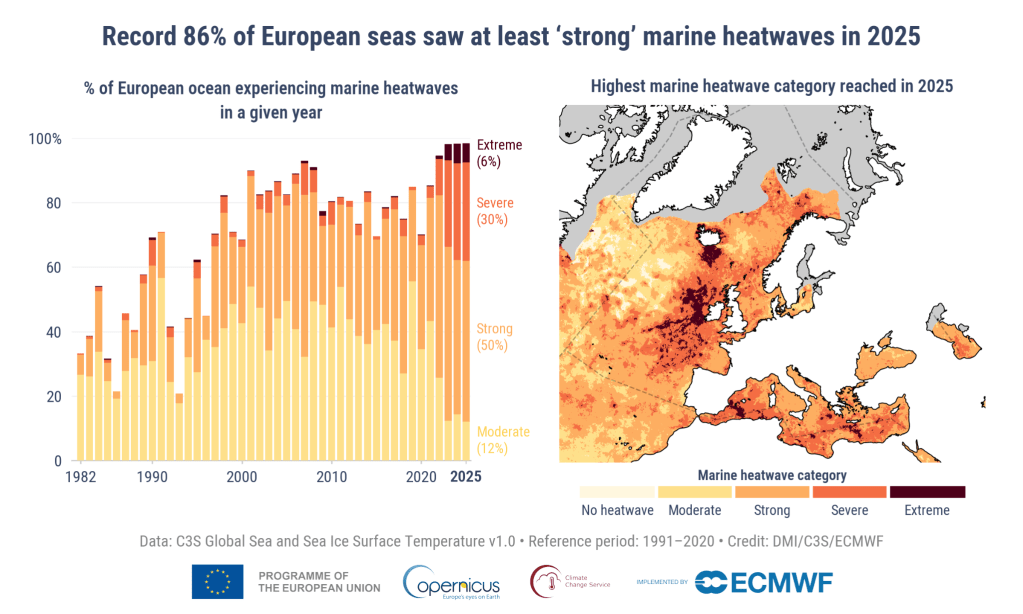
Percentage of the area of the WMO RA VI (Europe) ocean region experiencing marine heatwave conditions each year from 1982 to 2025
Celeste Saulo, Secretary-General of the World Meteorological Organization, said: “The WMO State of the Climate has revealed the imbalance of energy on our planet, and the European State of the Climate produced jointly by WMO and ECMWF reflects the impacts for Europe. Our joint effort to produce the ESOTC reflects how climate change is impacting biodiversity and the bold initiatives taken by European policy makers to protect and restore it.”
Climate indicators are flashing, but is anyone listening?
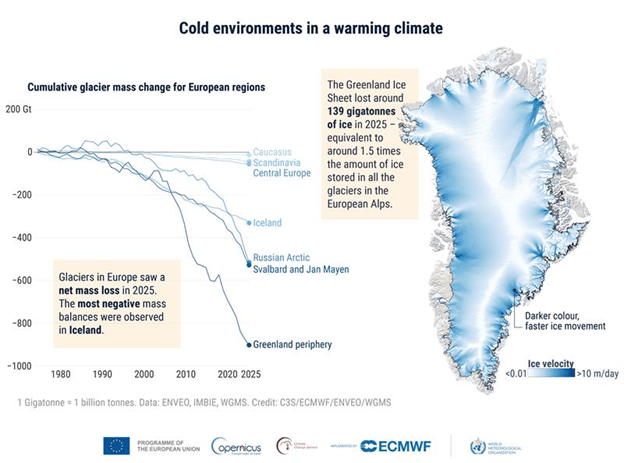
As well as wildfire risks and above-average temperatures, the impact on Europe’s glacier loss was also fully addressed in the report. Glaciers experienced a net mass loss, with Iceland recording its second-largest glacier mass loss on record. Additionally, the Greenland Ice Sheet lost 139 gigatonnes (139 billion tonnes) of ice – around 1.5 times the volume stored in all glaciers in the European Alps.’ With these ice losses, more people are exposed to water pressures, with every centimetre increasing exposure to an additional 6 million people to coastal flooding.
The impact on biodiversity
As well as the risks posed to humans, nature is also being placed under increased stress due to shrinking and shifting habitats, Sensitive ecosystems, such as seagrass meadows in the Mediterranean Sea and peatland wildfires are being impacted by the rising climate change indicators. Marine and terrestrial biodiversity is recognised as vital for a sustainable future, but is currently being degraded by climate change. European policies and frameworks strongly connect climate and biodiversity, with a clear focus on ecosystem resilience.
Informing policy decisions
Mauro Facchini, Head of Copernicus Unit at the European Commission, said: “The European State of the Climate 2025 report demonstrates once more the value of our joint efforts to have a world-class European Earth observation system. Maintaining our own state-of-the-art, reliable data records of our Earth system is vital for making informed policy decisions in our rapidly changing climate. Copernicus is pivotal to help us preserve our sovereignty, our environment, food systems, safety, and economy.”
 Climate Thoughts with Brian